More wheels today (and so on).

Continuing from yesterday's front wheel.
Tearing down and rebuilding the ITLAB45 rear wheel.

DT180 straight-pull spoke disc hub
24H, mandatory 2-cross lacing left and right
with the final crossings braided on both sides.

As usual, deep nipple pockets are filled in with
crispy thread-locking compound.
If this had any anti-loosening effect beyond initial creep,
the wheel should be difficult to disassemble,
but there's no sign of that.
Well, this wheel has the unusual condition of grease applied to the spoke threads,
so that might be affecting it.
Conversely, it means the thread-locking compound isn't doing enough work
to counteract the adverse condition of greasing the spoke threads.

This is a different area, but
the prep grease is applied excessively thick and sticky.

When I pull out a spoke with particularly heavy grease on the threads
from the hub flange, this happens.
There's another reason for this:
these custom titanium spokes actually have a
round section diameter of 2.3mm for both the spoke neck and threads,
equivalent to a #13 gauge spoke,
so the outer diameter nearly matches the inner diameter of the flange hole.

↑This is a spoke from the freewheel side,
but the threads have grease residue on them just like the non-freewheel side.

Yesterday's nipples were pre-cleaned with parts cleaner before ultrasonic washing,
but if you don't do that and put them straight in the ultrasonic cleaner,
here's what happens:

Within seconds of switching it on, the water turned like this.
Copper particles from the prep grease came rushing out
through the holes in the nipples.
In the end, I had to degrease the cleaner tank
and pre-clean the nipples with parts cleaner first.

The disassembled rear rim.
Like the front rim, this is also an "reverse rim" with reversed hole orientation,
and it was laced to a hub that can only accommodate standard rim hole orientation,
creating a mismatch.

Skipping ahead chronologically,
this is an image of the rear wheel after rebuilding.
With the right side of the image being the wheel's right side and the left side of the image being the wheel's left side,
zooming in on the rim gives us:

↑Freewheel side spokes

↑Non-freewheel side spokes
This is what it looks like.
The obvious first thing is, since that's how I laced it, the rim hole orientation and spoke direction
are visually aligned with each other.
Second, you can see that the non-freewheel side spokes are at a more acute angle.
Further, the nipples contact only one side of the rim hole profile—particularly pronounced on the non-freewheel side.
Additionally, since the nipple pocket is deep,
the relationship between the hole on the nipple's inner diameter and the spoke appears eccentric.

Going back to the rear rim alone image from before,
setting aside the rim holes themselves:

This rim hole's profile shows scuff marks
from being ground against by the nipple.
The spoke and nipple from the non-freewheel side passed through this hole.
In the image, the rim hole is oriented toward the upper side, but
the spoke was threaded in from the lower side.
Moreover, whereas with radial lacing the hole edge would curl straight downward,
with tangent lacing it curls toward the lower right in the image—
you can confirm this too.
Now, this is something I find very interesting:
was there some rational reason to deliberately order a reverse-rim and then lace it as a standard rim,
intentionally grinding the nipple against the rim hole edge?
Or was it just assembled by someone too incompetent to recognize at first glance
what I immediately identified as a reverse rim, and therefore laced it backwards?
I honestly want to know. I don't know how many wheels in the world were built with this rim,
but it can't be just this one pair.
Whether intentional or not, I genuinely want an explanation.

Changing the subject (though not really),
this is a Duke disc-road rim.
I've built Duke rims before—their ultra-lightweight MTB rims from the Lucky Jack series—
and those rims are offset rims with no clear hole orientation.
But this disc-road rim subtly yet clearly shows standard hole orientation.

↑Duke rim serial number format

↑This is from yesterday's front rim,
but the serial number format of this rim—
This rim is Duke-made, but its hole orientation is reversed from commercial products.
Also, just a side note,
the model name indicates a 45mm rim height, but
the rim marking shows 45.5,
which I thought might be the actual measured height,
but it actually measured slightly lower, at about 44.8mm.

As for the spokes, the rear wheel does have different lengths.
The image above shows 12 freewheel side spokes at 273mm.
Spoke specific gravity is 32.9 (g) ÷ 273 (mm) ÷ 12 (spokes) =
0.0100427... which divided by the 100% baseline of 0.0257 gives
0.0390767..., or about 39%.

The non-freewheel side is 275mm, same as both sides of the front wheel.

One side of the non-freewheel spokes shows
wear marks from the final crossing contact point.
This is more pronounced than the front wheel.

The freewheel side looks like this, meanwhile:

And the left-right difference looks like this.
This ITLAB45 rim, according to wind tunnel testing—
I won't include the specific numbers from the manual here—
performs aerodynamically +2W better than Roval's CLX50.
This is one of those truly pitiful points where the industry gets
the relative importance of wheel factors completely wrong.
I believe that the resistance to deformation when squeezing the spoke final crossing
and the small difference between left and right sides is a useful indicator
of how a wheel feels to ride. The forces aren't strictly identical to what happens
when you manually squeeze the final crossing while riding,
but similar forces do act on the spokes—
which is why wear marks appear at the final crossing, and why there are left-right differences.
If you incorporate something like different-diameter left-right lacing,
you can reduce the left-right difference in spoke wear marks like in the image above.
And with thread-lacing, the flutter at the final crossing nearly disappears.
This wheel doesn't show those kinds of structural refinements—
it's just a normal wheel with equal diameter, equal number lacing on both sides,
despite the spoke material being lightweight titanium
(though if they were carbon spokes, things would change).
I don't disbelieve the rim's wind tunnel results,
but I think the power-based aerodynamic advantage in watts from the rim
is much smaller as a factor compared to the power loss when the structural component
connecting the rim and hub is poorly designed.
I'm not saying aerodynamic rim characteristics are meaningless—
I'm saying there are bigger issues to consider first.
Also, non-internal nipples are angular objects that disturb air above half the wheel
at speeds over vehicle speed. Even if the ITLAB45 rim
has better aerodynamic characteristics than the Bora Ultra WTO45 rim alone,
when built into a complete wheel, a Bora Ultra WTO45 wheel with internal nipples
should actually have superior streamlining effects around the wheel perimeter.
If aerodynamics are such a priority, internal nipples should come before anything else—
rim width or rim-side shape whatever. I don't even know if #13 spoke internal nipples exist.


Built.
As usual, the valve hole phase
ends up within a pair of spokes from the final crossing.
Before work, I checked the spoke tension on the high-tension side (freewheel side)
at the point where the wheel would have "if nipple loosening hadn't occurred"
by only tightening the loosened nipples to near-zero radial runout.
It was slightly lower than the front wheel's high-tension side,
so I tensioned it to the same level.
So the rebuild has higher overall tension than before,
but not beyond the limit. Since the rear wheel has tighter radial runout, the non-freewheel spokes are
flexing as you'd expect from a normal wheel—
there's no better way within the given constraints.
Actually, the customer called today asking if I could rebuild just the rear wheel
how I see fit, but since it would be wasteful not to use the titanium spokes
and I want to monitor whether the nipples loosen again
(which is selfish of me, I apologize), I kept this to a simple rebuild only.
The wheel manual's wind tunnel test results show
the effects when wind at a specific speed (realistic racer range)
is applied from the front at yaw angles of 0° to 20° in steps,
the graph itself won't appear here, but
ITLAB45 rim and CLX50 rim produce similar graph shapes, with ITLAB45 superior—
which is where the +2W advantage comes from—
but there's also Alpinist CLX results included,
which clearly showed worse aerodynamic performance.
My subjective take is ITLAB45 = ◎, CLX50 = 〇, and Alpinist CLX = ×-leaning △ for aerodynamics.
So why am I bringing up Alpinist CLX here—
singling it out—

because combined front-rear weight is listed, and reading from "just" this information alone,
the ITLAB45 wheel combines CLX50-level aerodynamic performance (barely exceeding it) with
Alpinist CLX-level lightness!
...It seems designed to mislead readers into thinking that, though I doubt
many readers of this blog would fall for it,
but that's the angle they're pushing.
I don't know if the weight listed is the manual's stated value or actual measurement.
I also don't know if it includes rim tape weight.
This "combined wheel weight" metric is problematic because you can't read the rim weight alone,
which is the most important information, so it's not very meaningful.
It's unavoidable that some buyers only look at this and buy the wheel anyway.
I know the weight of most rims I've seen and handled.
For Nomulabo Wheel No. 5 rims, I can recite the upper limit, lower limit, average, and median weights,
but I cannot recite from memory the combined front-rear weight of those wheels built with Evolite hubs.
I'm occasionally asked, so I should keep that information ready.
Which is to say, that's how disinterested I am in the "combined front-rear weight" metric.
So what's the issue with the deceptive image above?
The spoke weights are completely different between ITLAB45 and Roval.

I've written out the rim and spoke weights.
ITLAB45's are measured values from this build,
while Roval's are calculated estimates from length and quantity,
but from experience these should be off by only about 2g for all left and right spokes.

I've also written out the combined weights of all left and right spokes front and rear.
Roval uses 2:1 lacing, so
there's significant left-right difference in spoke weight.
Alpinist has lower rim height too, so
the spoke weight itself is heavier.

I calculated the weight if spoke materials were reversed.
The titanium spoke specific gravity from all 48 spokes in this build
is 39.247...%, so I'm using 39.2% for calculation.


And I've calculated wheel weights with reversed spoke materials.
When your own deception comes back to haunt you,
this is what you get.

↑I really think comparisons should at least be made
within the same colored range,
with the same spoke material. But ITLAB probably doesn't even
know the specific gravity of their own titanium spokes
(if they were aware of spoke specific gravity as a concept,
they wouldn't use equal-diameter lacing),
so I calculated it for them.


After cleaning grease and dirt from around the nipple threads
and hub shell and rebuilding, the combined front-rear weight without rim tape was 1231g,
but don't worry about that.
The rim weight alone on this build is solid—
quite excellent in height-to-weight ratio.
But if the high-tension side allows
a reference spoke tension of 105 kgf
with an upper limit of only 110 kgf, then honestly,
rebuilding an Alpinist CLX myself would
create a wheel that, for most racers at most speeds,
yields more gain than loss compared to this one.
I'm bringing up Alpinist CLX because ITLAB brought it up—
even if this rim shows worse aerodynamics in wind tunnel tests than ITLAB45
(and frankly, even if the rim height is a bit lower and it loses on height-to-weight ratio),
if there were a rim that could handle up to about 130 kgf,
I'm confident I could build a wheel that would outperform this one
using unequal-diameter, unequal-quantity, different-tension left-right lacing with thread-lacing.
I'm not saying an infinitely stiff wheel is the fastest.
On that point, I can't beat something like a Racing Zero with steel spokes.
But a wheel that neglects the logic between hub and rim, excelling only in
rim aerodynamics and spoke weight, is something I could beat.
What? This rim's weight?
Claimed weight 1221g! Lighter than Alpinist CLX! Be satisfied with just that information for now.
↑jeez this guy's got a bad attitude

Terribly Sorry For The Wait! Please View The Following Image!

Front Rim Here!

Rear Rim Here!
Now, Hardly An Issue However
This Time During Rim Weighing
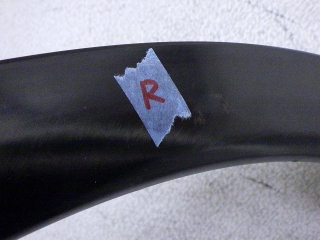

Tape Markers For Distinguishing The Original Left And Right Were Applied
So Please Keep That In Mind!
↑Don't Do This!

Continuing from yesterday's front wheel.
Tearing down and rebuilding the ITLAB45 rear wheel.

DT180 straight-pull spoke disc hub
24H, mandatory 2-cross lacing left and right
with the final crossings braided on both sides.

As usual, deep nipple pockets are filled in with
crispy thread-locking compound.
If this had any anti-loosening effect beyond initial creep,
the wheel should be difficult to disassemble,
but there's no sign of that.
Well, this wheel has the unusual condition of grease applied to the spoke threads,
so that might be affecting it.
Conversely, it means the thread-locking compound isn't doing enough work
to counteract the adverse condition of greasing the spoke threads.

This is a different area, but
the prep grease is applied excessively thick and sticky.

When I pull out a spoke with particularly heavy grease on the threads
from the hub flange, this happens.
There's another reason for this:
these custom titanium spokes actually have a
round section diameter of 2.3mm for both the spoke neck and threads,
equivalent to a #13 gauge spoke,
so the outer diameter nearly matches the inner diameter of the flange hole.

↑This is a spoke from the freewheel side,
but the threads have grease residue on them just like the non-freewheel side.

Yesterday's nipples were pre-cleaned with parts cleaner before ultrasonic washing,
but if you don't do that and put them straight in the ultrasonic cleaner,
here's what happens:

Within seconds of switching it on, the water turned like this.
Copper particles from the prep grease came rushing out
through the holes in the nipples.
In the end, I had to degrease the cleaner tank
and pre-clean the nipples with parts cleaner first.

The disassembled rear rim.
Like the front rim, this is also an "reverse rim" with reversed hole orientation,
and it was laced to a hub that can only accommodate standard rim hole orientation,
creating a mismatch.

Skipping ahead chronologically,
this is an image of the rear wheel after rebuilding.
With the right side of the image being the wheel's right side and the left side of the image being the wheel's left side,
zooming in on the rim gives us:

↑Freewheel side spokes

↑Non-freewheel side spokes
This is what it looks like.
The obvious first thing is, since that's how I laced it, the rim hole orientation and spoke direction
are visually aligned with each other.
Second, you can see that the non-freewheel side spokes are at a more acute angle.
Further, the nipples contact only one side of the rim hole profile—particularly pronounced on the non-freewheel side.
Additionally, since the nipple pocket is deep,
the relationship between the hole on the nipple's inner diameter and the spoke appears eccentric.

Going back to the rear rim alone image from before,
setting aside the rim holes themselves:

This rim hole's profile shows scuff marks
from being ground against by the nipple.
The spoke and nipple from the non-freewheel side passed through this hole.
In the image, the rim hole is oriented toward the upper side, but
the spoke was threaded in from the lower side.
Moreover, whereas with radial lacing the hole edge would curl straight downward,
with tangent lacing it curls toward the lower right in the image—
you can confirm this too.
Now, this is something I find very interesting:
was there some rational reason to deliberately order a reverse-rim and then lace it as a standard rim,
intentionally grinding the nipple against the rim hole edge?
Or was it just assembled by someone too incompetent to recognize at first glance
what I immediately identified as a reverse rim, and therefore laced it backwards?
I honestly want to know. I don't know how many wheels in the world were built with this rim,
but it can't be just this one pair.
Whether intentional or not, I genuinely want an explanation.

Changing the subject (though not really),
this is a Duke disc-road rim.
I've built Duke rims before—their ultra-lightweight MTB rims from the Lucky Jack series—
and those rims are offset rims with no clear hole orientation.
But this disc-road rim subtly yet clearly shows standard hole orientation.

↑Duke rim serial number format

↑This is from yesterday's front rim,
but the serial number format of this rim—
This rim is Duke-made, but its hole orientation is reversed from commercial products.
Also, just a side note,
the model name indicates a 45mm rim height, but
the rim marking shows 45.5,
which I thought might be the actual measured height,
but it actually measured slightly lower, at about 44.8mm.

As for the spokes, the rear wheel does have different lengths.
The image above shows 12 freewheel side spokes at 273mm.
Spoke specific gravity is 32.9 (g) ÷ 273 (mm) ÷ 12 (spokes) =
0.0100427... which divided by the 100% baseline of 0.0257 gives
0.0390767..., or about 39%.

The non-freewheel side is 275mm, same as both sides of the front wheel.

One side of the non-freewheel spokes shows
wear marks from the final crossing contact point.
This is more pronounced than the front wheel.

The freewheel side looks like this, meanwhile:

And the left-right difference looks like this.
This ITLAB45 rim, according to wind tunnel testing—
I won't include the specific numbers from the manual here—
performs aerodynamically +2W better than Roval's CLX50.
This is one of those truly pitiful points where the industry gets
the relative importance of wheel factors completely wrong.
I believe that the resistance to deformation when squeezing the spoke final crossing
and the small difference between left and right sides is a useful indicator
of how a wheel feels to ride. The forces aren't strictly identical to what happens
when you manually squeeze the final crossing while riding,
but similar forces do act on the spokes—
which is why wear marks appear at the final crossing, and why there are left-right differences.
If you incorporate something like different-diameter left-right lacing,
you can reduce the left-right difference in spoke wear marks like in the image above.
And with thread-lacing, the flutter at the final crossing nearly disappears.
This wheel doesn't show those kinds of structural refinements—
it's just a normal wheel with equal diameter, equal number lacing on both sides,
despite the spoke material being lightweight titanium
(though if they were carbon spokes, things would change).
I don't disbelieve the rim's wind tunnel results,
but I think the power-based aerodynamic advantage in watts from the rim
is much smaller as a factor compared to the power loss when the structural component
connecting the rim and hub is poorly designed.
I'm not saying aerodynamic rim characteristics are meaningless—
I'm saying there are bigger issues to consider first.
Also, non-internal nipples are angular objects that disturb air above half the wheel
at speeds over vehicle speed. Even if the ITLAB45 rim
has better aerodynamic characteristics than the Bora Ultra WTO45 rim alone,
when built into a complete wheel, a Bora Ultra WTO45 wheel with internal nipples
should actually have superior streamlining effects around the wheel perimeter.
If aerodynamics are such a priority, internal nipples should come before anything else—
rim width or rim-side shape whatever. I don't even know if #13 spoke internal nipples exist.


Built.
As usual, the valve hole phase
ends up within a pair of spokes from the final crossing.
Before work, I checked the spoke tension on the high-tension side (freewheel side)
at the point where the wheel would have "if nipple loosening hadn't occurred"
by only tightening the loosened nipples to near-zero radial runout.
It was slightly lower than the front wheel's high-tension side,
so I tensioned it to the same level.
So the rebuild has higher overall tension than before,
but not beyond the limit. Since the rear wheel has tighter radial runout, the non-freewheel spokes are
flexing as you'd expect from a normal wheel—
there's no better way within the given constraints.
Actually, the customer called today asking if I could rebuild just the rear wheel
how I see fit, but since it would be wasteful not to use the titanium spokes
and I want to monitor whether the nipples loosen again
(which is selfish of me, I apologize), I kept this to a simple rebuild only.
The wheel manual's wind tunnel test results show
the effects when wind at a specific speed (realistic racer range)
is applied from the front at yaw angles of 0° to 20° in steps,
the graph itself won't appear here, but
ITLAB45 rim and CLX50 rim produce similar graph shapes, with ITLAB45 superior—
which is where the +2W advantage comes from—
but there's also Alpinist CLX results included,
which clearly showed worse aerodynamic performance.
My subjective take is ITLAB45 = ◎, CLX50 = 〇, and Alpinist CLX = ×-leaning △ for aerodynamics.
So why am I bringing up Alpinist CLX here—

because combined front-rear weight is listed, and reading from "just" this information alone,
the ITLAB45 wheel combines CLX50-level aerodynamic performance (barely exceeding it) with
Alpinist CLX-level lightness!
...It seems designed to mislead readers into thinking that, though I doubt
many readers of this blog would fall for it,
but that's the angle they're pushing.
I don't know if the weight listed is the manual's stated value or actual measurement.
I also don't know if it includes rim tape weight.
This "combined wheel weight" metric is problematic because you can't read the rim weight alone,
which is the most important information, so it's not very meaningful.
It's unavoidable that some buyers only look at this and buy the wheel anyway.
I know the weight of most rims I've seen and handled.
For Nomulabo Wheel No. 5 rims, I can recite the upper limit, lower limit, average, and median weights,
but I cannot recite from memory the combined front-rear weight of those wheels built with Evolite hubs.
I'm occasionally asked, so I should keep that information ready.
Which is to say, that's how disinterested I am in the "combined front-rear weight" metric.
So what's the issue with the deceptive image above?
The spoke weights are completely different between ITLAB45 and Roval.

I've written out the rim and spoke weights.
ITLAB45's are measured values from this build,
while Roval's are calculated estimates from length and quantity,
but from experience these should be off by only about 2g for all left and right spokes.

I've also written out the combined weights of all left and right spokes front and rear.
Roval uses 2:1 lacing, so
there's significant left-right difference in spoke weight.
Alpinist has lower rim height too, so
the spoke weight itself is heavier.

I calculated the weight if spoke materials were reversed.
The titanium spoke specific gravity from all 48 spokes in this build
is 39.247...%, so I'm using 39.2% for calculation.


And I've calculated wheel weights with reversed spoke materials.
When your own deception comes back to haunt you,
this is what you get.

↑I really think comparisons should at least be made
within the same colored range,
with the same spoke material. But ITLAB probably doesn't even
know the specific gravity of their own titanium spokes
(if they were aware of spoke specific gravity as a concept,
they wouldn't use equal-diameter lacing),
so I calculated it for them.


After cleaning grease and dirt from around the nipple threads
and hub shell and rebuilding, the combined front-rear weight without rim tape was 1231g,
but don't worry about that.
The rim weight alone on this build is solid—
quite excellent in height-to-weight ratio.
But if the high-tension side allows
a reference spoke tension of 105 kgf
with an upper limit of only 110 kgf, then honestly,
rebuilding an Alpinist CLX myself would
create a wheel that, for most racers at most speeds,
yields more gain than loss compared to this one.
I'm bringing up Alpinist CLX because ITLAB brought it up—
even if this rim shows worse aerodynamics in wind tunnel tests than ITLAB45
(and frankly, even if the rim height is a bit lower and it loses on height-to-weight ratio),
if there were a rim that could handle up to about 130 kgf,
I'm confident I could build a wheel that would outperform this one
using unequal-diameter, unequal-quantity, different-tension left-right lacing with thread-lacing.
I'm not saying an infinitely stiff wheel is the fastest.
On that point, I can't beat something like a Racing Zero with steel spokes.
But a wheel that neglects the logic between hub and rim, excelling only in
rim aerodynamics and spoke weight, is something I could beat.
What? This rim's weight?
Claimed weight 1221g! Lighter than Alpinist CLX! Be satisfied with just that information for now.
↑jeez this guy's got a bad attitude

Terribly Sorry For The Wait! Please View The Following Image!

Front Rim Here!

Rear Rim Here!
Now, Hardly An Issue However
This Time During Rim Weighing


Tape Markers For Distinguishing The Original Left And Right Were Applied
So Please Keep That In Mind!
↑Don't Do This!