Another day, another wheel (and so on).

Built a rear wheel with an Araya RC540 WO aluminum rim and
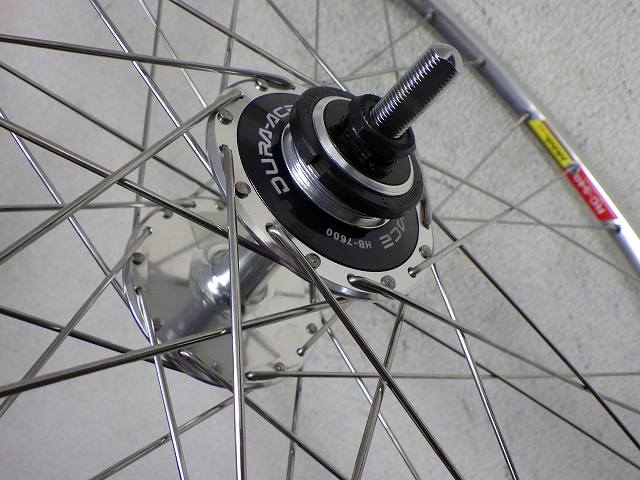
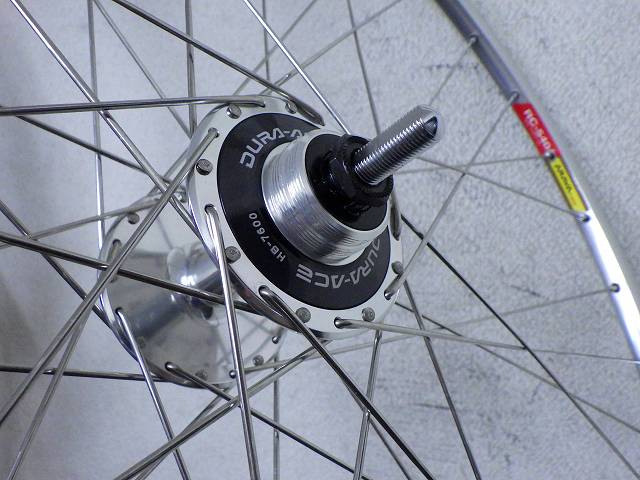
a Dura-Ace track hub HB-7600-R.


36H, all Campagnolo 88-spoke JIS lacing.
I'll do the nippling later. Full nippling on both sides, 18 locations each.

Backing up in time, here's this rim.
It's an aluminum WO rim that's been around since ancient times, weighing 420g.

Just to be clear, it's a standard-hole configuration.

Since this hub is 36H,
it has an NJS (Japan Keirin Association) stamp on the hub body.
But this is a rather special specification,
and while you can currently obtain it in production,
for some reason it doesn't appear in Shimano's official catalog.

The production year is either 1995 or 2021,
but of course it's the latter.
This HB-7600 hub
is designated as HB (hub) rather than FH (freewheel hub) even as a rear hub because it's not a freewheel type,
and after HB-7600 comes 100-9 for the front
or 120-10 for the rear. These part numbers refer to
the overlock-nut dimension and axle diameter respectively.
This particular rear hub is a special 8mm diameter axle version.
Though it's called an "8mm axle," it's not truly circular at 8mm outer diameter—

↑it's this kind


A 10mm axle cut flat on two parallel faces,
with the width between these flats being 8mm.
So the frame's straight-type dropout slot width is also
specified as 8mm nominal diameter.
After mounting the rear wheel, the hub axle maintains a fixed phase relative to the frame
and cannot rotate.
A customer contacted me the other day saying
"I got a frame from a keirin racer, but the rear wheel won't fit,"
and I thought, oh, it must be an 8mm-width dropout,
but as I listened to the details, something didn't add up,
so I asked them to bring the frame in.
The frame was from a certain builder, and it came with
a geometry sheet, but it listed 123mm
for the rear end width.
That's 120mm plus 3mm for the chain stays on both sides,
but the 8mm-axle hub is actually an even more specialized keirin specification
with an overlock-nut dimension of 110mm.
So the part number following HB-7600 is 110-8.
(This 110-8 designation doesn't appear in Shimano's catalog.)
When I looked at the frame itself, the dropout was indeed for an 8mm axle,
and when I measured it, the rear end width was about 113mm (112.8mm).
Right, there's no way an 8mm-axle dropout would be 123mm.
Apparently the geometry sheet is accurate for tube lengths and angles,
but for the rear end width, they just wrote 123mm out of habit.

↑the one at the top is
HB-7600-R S (Single/one-side threads) 120-10,
and the one at the bottom is
HB-7600-R W (Double/both-side threads) 110-8.
I forgot to mention that the 110-8 only exists in double-threaded version.
The little figurine on the upper right is there as an anti-slip measure
since the hub rolls during shooting, though I'm not sure
if it works as a good luck charm for exams.
The 120mm single-threaded version has wider flanges and a shoulder.
In the photo above, I've roughly aligned the center of the hub body,
so the 10mm difference in end width shows up almost entirely on the right side of the image,
making it visually clear.

The 110-8 has narrower flanges,
but that's because it's a double-threaded version—
the hub body dimensions are identical to the 120-10 double version.
So when building a wheel, if rim, spoke, and tension conditions are the same,
the structural rigidity of that part should be the same,
but the fact that a 110mm-width rear triangle and a 120mm-width rear triangle
have different lateral stiffness—well, a keirin racer
would definitely notice that difference,
so the overall result would change.

↑this is the 120-10 rear hub, and
the one notch on the axle
is for a star washer.
The washer sandwiched between the two end nuts has a lug on its inner side,
and when you tighten the nut, this washer—called a star washer—moves parallel to the axle
without rotating along with it.

This hub is not an HB-7600, but a Sun Tour Superbe Pro,

and this is a star washer.
It's not like British-made hubs have three lugs or anything like that.
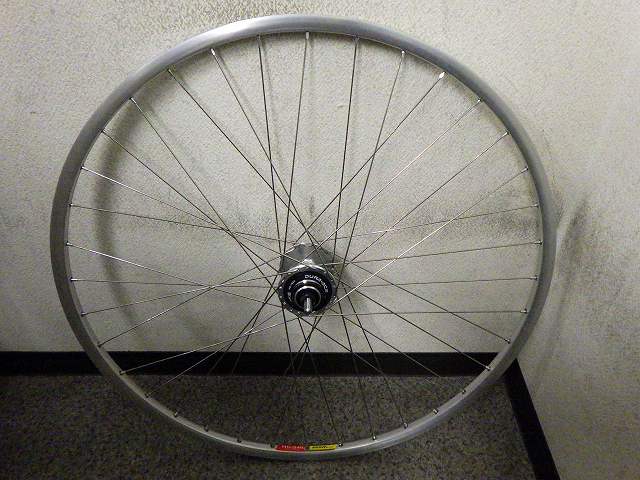
Built a rear wheel with an Araya RC540 WO aluminum rim and
a Dura-Ace track hub HB-7600-R.
36H, all Campagnolo 88-spoke JIS lacing.
I'll do the nippling later. Full nippling on both sides, 18 locations each.

Backing up in time, here's this rim.
It's an aluminum WO rim that's been around since ancient times, weighing 420g.

Just to be clear, it's a standard-hole configuration.

Since this hub is 36H,
it has an NJS (Japan Keirin Association) stamp on the hub body.
But this is a rather special specification,
and while you can currently obtain it in production,
for some reason it doesn't appear in Shimano's official catalog.

The production year is either 1995 or 2021,
but of course it's the latter.
This HB-7600 hub
is designated as HB (hub) rather than FH (freewheel hub) even as a rear hub because it's not a freewheel type,
and after HB-7600 comes 100-9 for the front
or 120-10 for the rear. These part numbers refer to
the overlock-nut dimension and axle diameter respectively.
This particular rear hub is a special 8mm diameter axle version.
Though it's called an "8mm axle," it's not truly circular at 8mm outer diameter—

↑it's this kind


A 10mm axle cut flat on two parallel faces,
with the width between these flats being 8mm.
So the frame's straight-type dropout slot width is also
specified as 8mm nominal diameter.
After mounting the rear wheel, the hub axle maintains a fixed phase relative to the frame
and cannot rotate.
A customer contacted me the other day saying
"I got a frame from a keirin racer, but the rear wheel won't fit,"
and I thought, oh, it must be an 8mm-width dropout,
but as I listened to the details, something didn't add up,
so I asked them to bring the frame in.
The frame was from a certain builder, and it came with
a geometry sheet, but it listed 123mm
for the rear end width.
That's 120mm plus 3mm for the chain stays on both sides,
but the 8mm-axle hub is actually an even more specialized keirin specification
with an overlock-nut dimension of 110mm.
So the part number following HB-7600 is 110-8.
(This 110-8 designation doesn't appear in Shimano's catalog.)
When I looked at the frame itself, the dropout was indeed for an 8mm axle,
and when I measured it, the rear end width was about 113mm (112.8mm).
Right, there's no way an 8mm-axle dropout would be 123mm.
Apparently the geometry sheet is accurate for tube lengths and angles,
but for the rear end width, they just wrote 123mm out of habit.

↑the one at the top is
HB-7600-R S (Single/one-side threads) 120-10,
and the one at the bottom is
HB-7600-R W (Double/both-side threads) 110-8.
I forgot to mention that the 110-8 only exists in double-threaded version.
The little figurine on the upper right is there as an anti-slip measure
since the hub rolls during shooting, though I'm not sure
if it works as a good luck charm for exams.
The 120mm single-threaded version has wider flanges and a shoulder.
In the photo above, I've roughly aligned the center of the hub body,
so the 10mm difference in end width shows up almost entirely on the right side of the image,
making it visually clear.

The 110-8 has narrower flanges,
but that's because it's a double-threaded version—
the hub body dimensions are identical to the 120-10 double version.
So when building a wheel, if rim, spoke, and tension conditions are the same,
the structural rigidity of that part should be the same,
but the fact that a 110mm-width rear triangle and a 120mm-width rear triangle
have different lateral stiffness—well, a keirin racer
would definitely notice that difference,
so the overall result would change.

↑this is the 120-10 rear hub, and
the one notch on the axle
is for a star washer.
The washer sandwiched between the two end nuts has a lug on its inner side,
and when you tighten the nut, this washer—called a star washer—moves parallel to the axle
without rotating along with it.

This hub is not an HB-7600, but a Sun Tour Superbe Pro,

and this is a star washer.