I received a Cosmic Pro Carbon UST (Mavic carbon wheelset with UST tubeless-ready rim) from a customer.
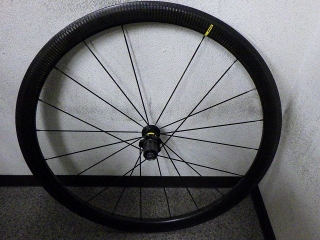
He picked it up at an auction,
but the condition is terrible and he wants me to fix it.
About the condition—if I post details here,
the previous owner might see them and realize.
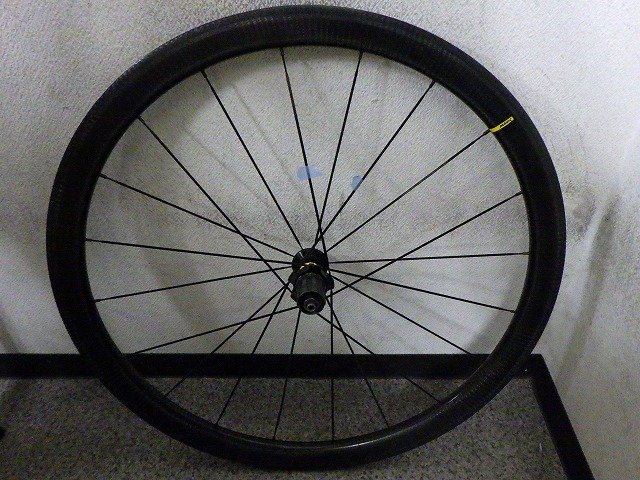
Let me start with the rear wheel.
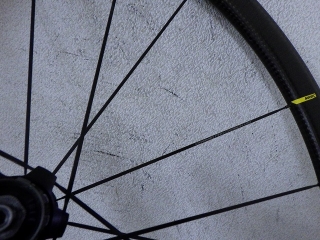
One spoke is missing.
This customer isn't a one-time visitor—I've worked with him many times—but this is pushing it even for him.
My shop doesn't carry Mavic, so I don't know much, but
their spare parts supply is notoriously poor.
Even parts they say are "available, not discontinued"
can take six months or longer to arrive. That's what I've heard anyway.
If there's anyone in the industry out there who, like we do with Campagnolo and Fulcrum wheels,
keeps full stock of spare spokes for all major Mavic wheel models,
please get in touch. I'd like to feature you here.
Oh, but in this case, spare spokes
happened to be available.
If spares become impossible to find, Mavic spokes often have non-standard butted dimensions
that won't work with generic replacements. You might think you could just do a full spoke swap on one side
with straight generic spokes to keep the spoke weight balanced,
but Mavic spokes often have special bases—many are #13 base.
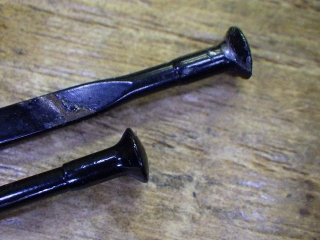
For this particular wheel,
just below the head, #13 equivalent (2.3mm diameter)
spokes are used.
The hub flange slot is also sized for 2.3mm diameter,
so generic spokes won't fit this hub.
The spoke in the photo was temporarily removed from the original wheel
just to measure its length.
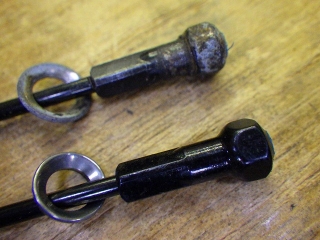
The nipple holes in the rim are sized to accept generic nipples.
So theoretically, I could rebuild this wheel using this rim
with a generic hub and spokes.
But since spare spokes were available, we didn't need to resort to that.
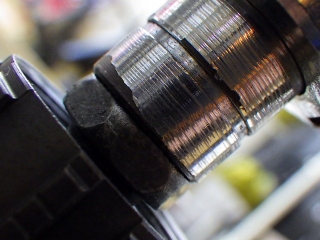
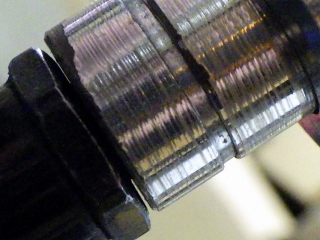
I temporarily removed the partner spoke at the final crossing point
of the missing spoke, so the original and new spoke form a pair that crosses at the final intersection.
First, I trued the lateral runout as much as I could using just the nipples on those two spokes,
then once the worst runout point was eliminated, I fine-tuned at about five spots to get the lateral runout roughly corrected.
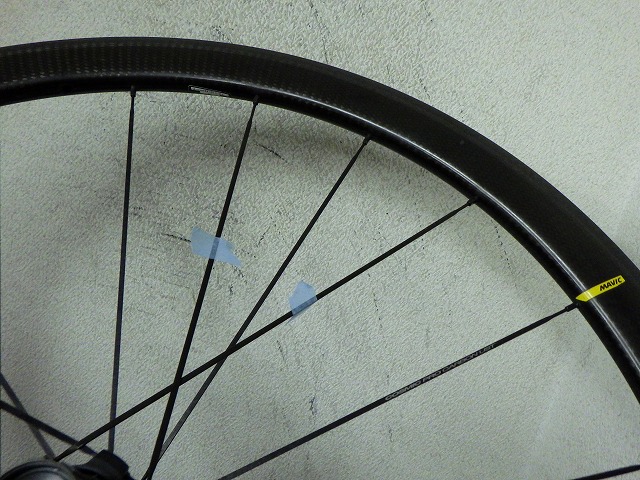
Since one spoke was missing initially, I didn't establish a provisional center,
but since this is a Mavic rear wheel, I expected the rim to be biased toward the non-drive side,
so I was mindful to bias my truing work slightly toward tightening the drive side
as shown in the image above.
The rim is now very slightly offset toward the non-drive side.
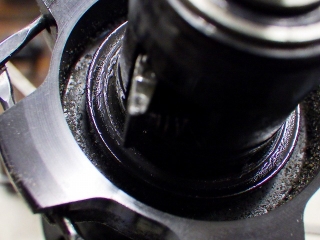
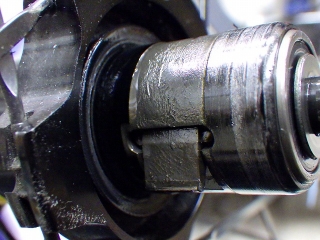
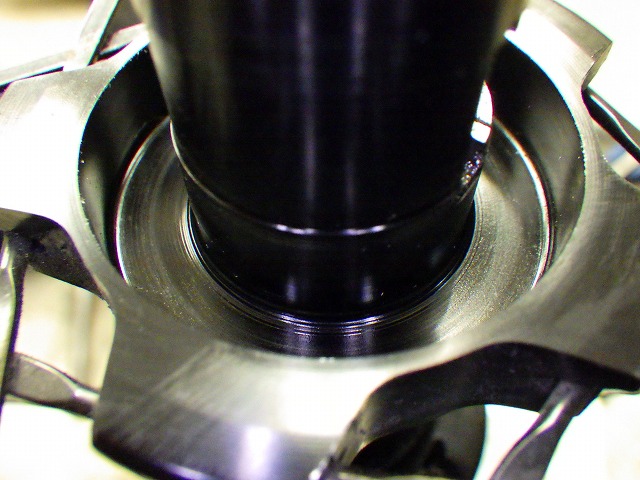
I set the centering issue aside for a moment—the freewheel body rotation felt gritty and gritty,
like sand was caught in it, so
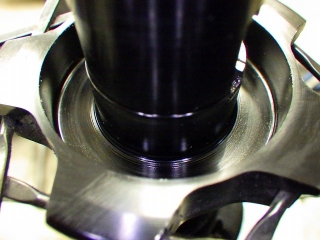
I disassembled it, cleaned it, filled it with dedicated oil, and reassembled the freewheel body.
This wheel uses an FTS-L freewheel body.
The bearings inside the FTS-L freewheel body have inner diameters of either 8mm or 9mm.
If you want to adapt a hub to through-axle standards,
since the through-axle outer diameter is 12mm,
the hub axle inner diameter also needs to be 12mm.
With a 12mm inner diameter axle, the outer diameter would be
15mm or 17mm to match the hub bearing inner diameter.
Mavic's current Instant Drive 360 came about for exactly this reason,
and was originally adopted on MTB wheels,
but now, not just on disc-road wheels
but also on rim brake wheels—probably because they want to share hub bodies and manufacturing processes—
there are still a few examples of its use.
As for Instant Drive 360,
whether it uses the same surface ratchet as DT's star ratchet or whatever,
frankly I don't care. What bothers me is that
the seal between the hub body and freewheel body is weak,
water easily enters the ratchet section, and the parts inside the surface ratchet on the hub body side—
specifically the C-ring retained part that looks like a toy gun's powder cartridge (percussion cap)—
rusts quickly and starts dripping brown rust juice.
Up until now, I've been telling customers orally that
"The ideal initial state of Instant Drive 360, after cleaning the internals and applying dedicated paste to the surface ratchet,
lasts about 1500km maximum,
but get caught in the rain once and it's done."
This is hearsay too, but apparently from something I heard recently,
in Mavic's official Instant Drive 360 explanation video,
where they state the dedicated grease (paste) reapplication interval is
4000–5000km in the video itself,
the subtitle correction shows it as 1000km.
I checked it just now. (→here) around 3:40 in the video.
Yeah, I knew it. 5000km is way too optimistic.
What I'm getting at is that if you don't have a through-axle hub,
the FTS-L freewheel body is the better choice.
Very recently, though I didn't shoot images for an article,
I inspected current rim brake Ksyrium SL wheels.
Since Mavic discontinued aluminum spoke models,
even Ksyrium SL is now a steel spoke wheel.
It does have isopulse lacing, so
even without aluminum spokes, it qualifies as Ksyrium, I have no objection there,
but the rim is an Open Pro UST rim with holes modified for Zicral spokes—meaning it's not an offset rim.
In terms of spoke material, it's similar to the old Ksyrium Elite,
but the original Ksyrium Elite used offset rim specifications.
When Ksyrium SSC first came out in 1999,
I thought "now that's a wheel ten years ahead of its time," and it really was,
but the current so-called Ksyrium SL is theoretically inferior to the 2012 Ksyrium Elite.
Plus the rear hub is Instant Drive 360 spec.
If I say here "Don't buy the current Ksyrium SL!", I'll probably catch heat,
so let me stick to a factual framing:
"The current Ksyrium SL requires hub ratchet section regreasing every 1000km (that's the manufacturer's spec!),
and I haven't mentioned this yet,
but the freewheel body bearing also lets water in and rusts easily,
causing water staining to migrate down to the bearing seats below the hub axle,
often making the freewheel body impossible to remove by hand.
Each time that happens, you need to remove the left cone locknut, take off the snap ring on the hub axle flange,
and pull out the hub axle with the freewheel body—
unless you don't mind that hassle, or you can overlook the poor maintainability in favor of pure wheel performance,
I can't recommend it!"
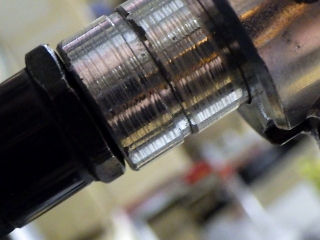
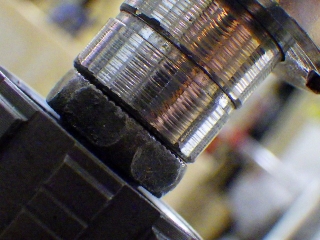
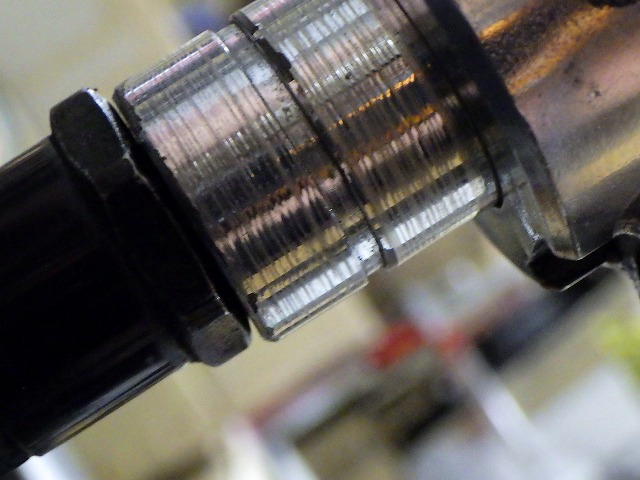
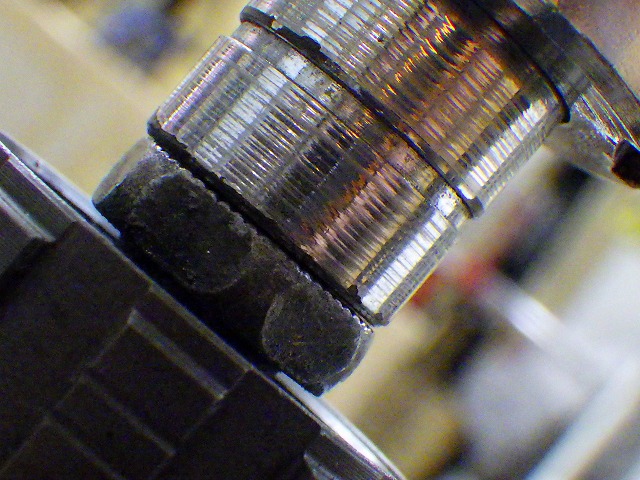
I did the freewheel body overhaul even though there was still a centering offset,
because I thought the rim's position relative to the hub might change depending on how tight the right locknut was.
In fact, the right end being tightened more than before
shifted the rim position relative to the hub toward the right side.
The images above don't show it clearly, but
actually the rim shifted past center by about the thickness of a sheet of paper to the right.
I then centered it,
but the resulting image was nearly identical, so I didn't photograph it.
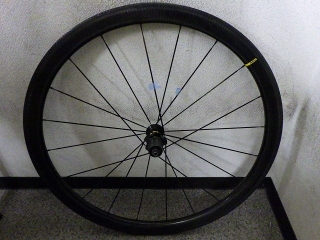

Done.
Now for the front wheel.
I forgot to take an overall photo of the wheel.
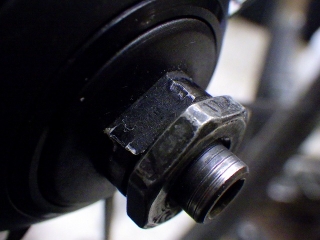
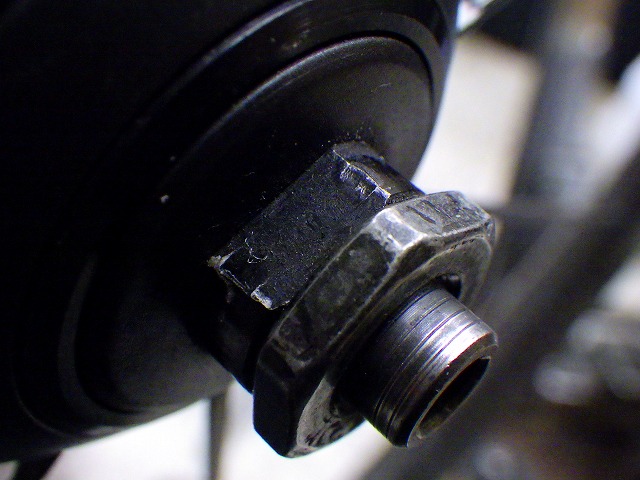
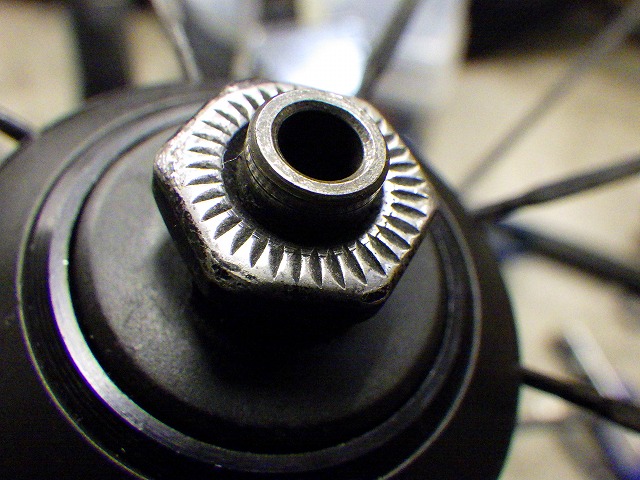
The hub has lateral play, and there are signs the locknuts have been tampered with.
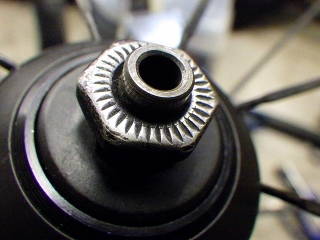
I loosened this side and adjusted the bearing adjustment,

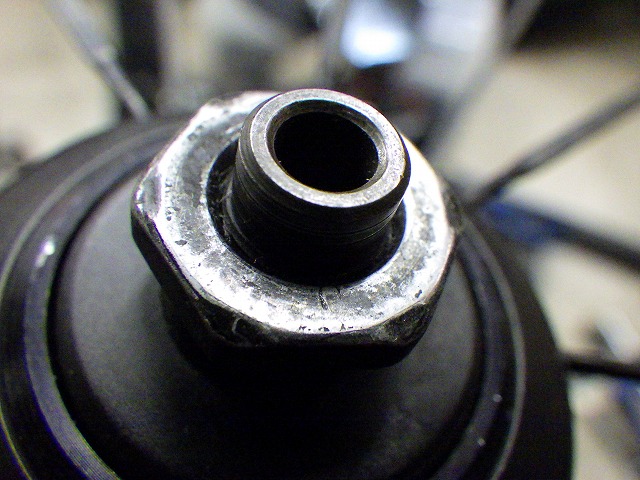
but the opposite locknut had been tightened in the wrong direction,

so I fixed it.
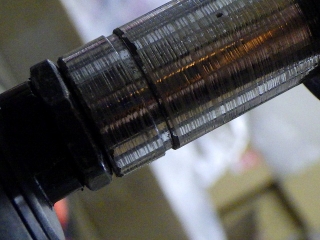
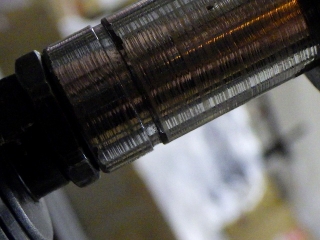
No centering issues and barely any runout.
The previous owner probably bent or broke a rear wheel spoke,
couldn't get it fixed at a local shop,
and decided to part with both wheels.
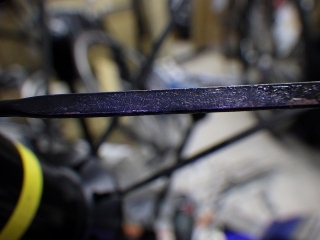
About these kinds of Mavic spokes—
if you call Sapim and DT spokes "stainless spokes" in the broad sense,
these are essentially steel, and while they might have superior tensile strength,
rust wells up from under the paint and spreads.
Some of the Colima "S" series wheels from a while back
have hubs with mercury-colored chrome plating,
and those also develop rusty pockmarks as they age.
Do the French just not care about that kind of thing?
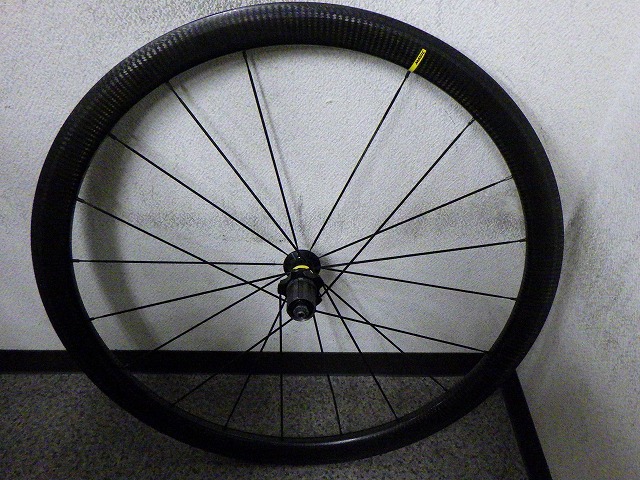
He picked it up at an auction,
but the condition is terrible and he wants me to fix it.
About the condition—if I post details here,
the previous owner might see them and realize.
Let me start with the rear wheel.
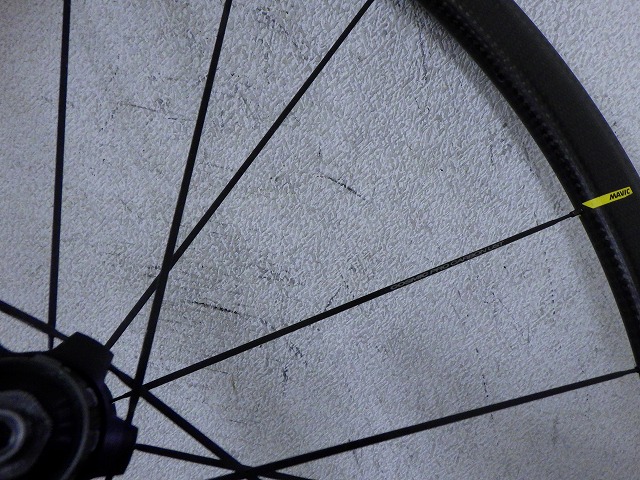
One spoke is missing.
This customer isn't a one-time visitor—I've worked with him many times—but this is pushing it even for him.
My shop doesn't carry Mavic, so I don't know much, but
their spare parts supply is notoriously poor.
Even parts they say are "available, not discontinued"
can take six months or longer to arrive. That's what I've heard anyway.
If there's anyone in the industry out there who, like we do with Campagnolo and Fulcrum wheels,
keeps full stock of spare spokes for all major Mavic wheel models,
please get in touch. I'd like to feature you here.
Oh, but in this case, spare spokes
happened to be available.
If spares become impossible to find, Mavic spokes often have non-standard butted dimensions
that won't work with generic replacements. You might think you could just do a full spoke swap on one side
with straight generic spokes to keep the spoke weight balanced,
but Mavic spokes often have special bases—many are #13 base.
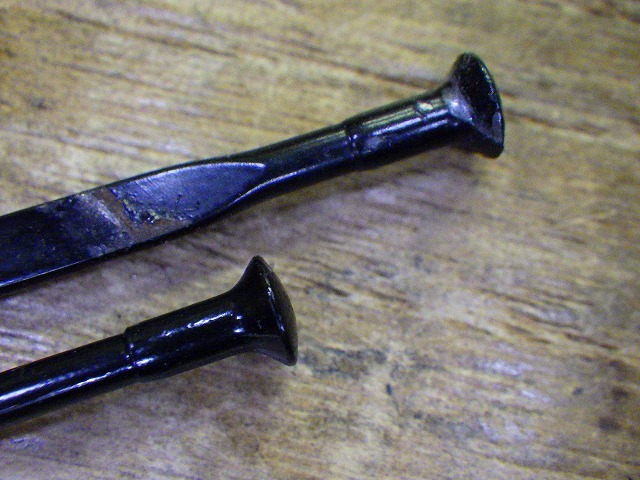
For this particular wheel,
just below the head, #13 equivalent (2.3mm diameter)
spokes are used.
The hub flange slot is also sized for 2.3mm diameter,
so generic spokes won't fit this hub.
The spoke in the photo was temporarily removed from the original wheel
just to measure its length.
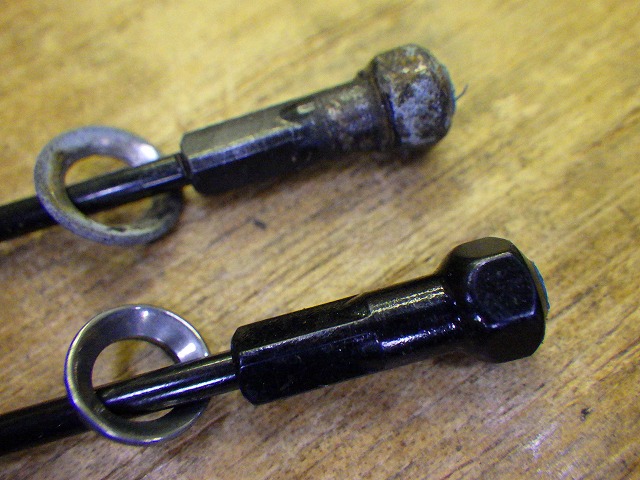
The nipple holes in the rim are sized to accept generic nipples.
So theoretically, I could rebuild this wheel using this rim
with a generic hub and spokes.
But since spare spokes were available, we didn't need to resort to that.
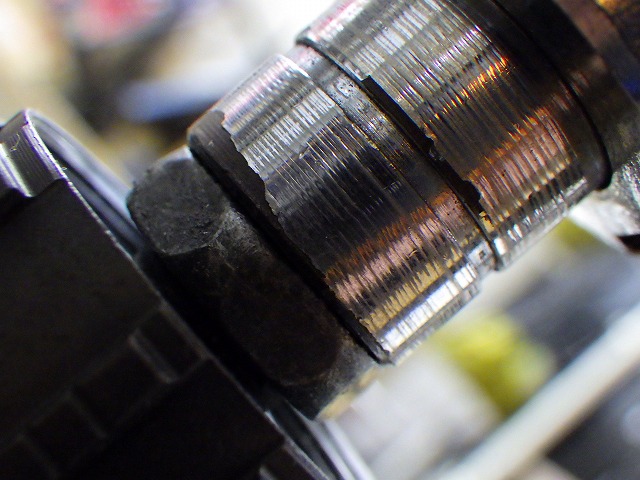
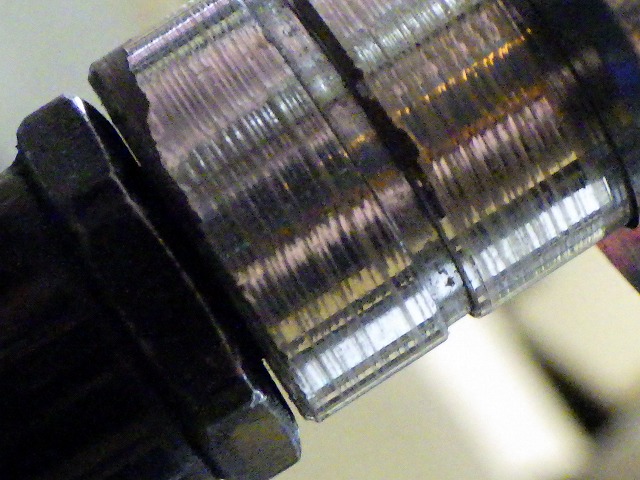
I temporarily removed the partner spoke at the final crossing point
of the missing spoke, so the original and new spoke form a pair that crosses at the final intersection.
First, I trued the lateral runout as much as I could using just the nipples on those two spokes,
then once the worst runout point was eliminated, I fine-tuned at about five spots to get the lateral runout roughly corrected.
Since one spoke was missing initially, I didn't establish a provisional center,
but since this is a Mavic rear wheel, I expected the rim to be biased toward the non-drive side,
so I was mindful to bias my truing work slightly toward tightening the drive side
as shown in the image above.
The rim is now very slightly offset toward the non-drive side.
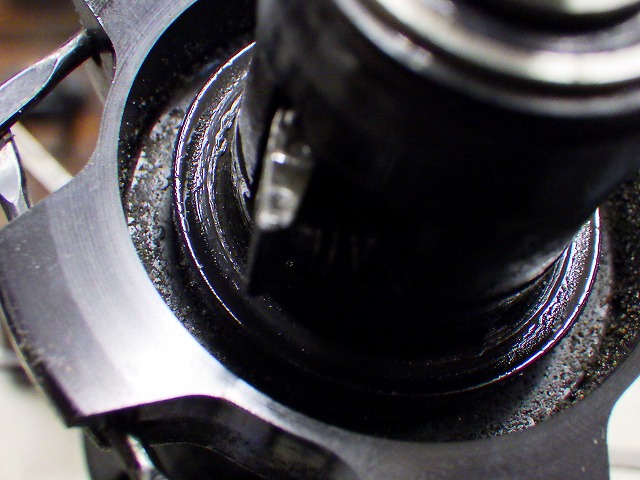

I set the centering issue aside for a moment—the freewheel body rotation felt gritty and gritty,
like sand was caught in it, so
I disassembled it, cleaned it, filled it with dedicated oil, and reassembled the freewheel body.
This wheel uses an FTS-L freewheel body.
The bearings inside the FTS-L freewheel body have inner diameters of either 8mm or 9mm.
If you want to adapt a hub to through-axle standards,
since the through-axle outer diameter is 12mm,
the hub axle inner diameter also needs to be 12mm.
With a 12mm inner diameter axle, the outer diameter would be
15mm or 17mm to match the hub bearing inner diameter.
Mavic's current Instant Drive 360 came about for exactly this reason,
and was originally adopted on MTB wheels,
but now, not just on disc-road wheels
but also on rim brake wheels—probably because they want to share hub bodies and manufacturing processes—
there are still a few examples of its use.
As for Instant Drive 360,
whether it uses the same surface ratchet as DT's star ratchet or whatever,
frankly I don't care. What bothers me is that
the seal between the hub body and freewheel body is weak,
water easily enters the ratchet section, and the parts inside the surface ratchet on the hub body side—
specifically the C-ring retained part that looks like a toy gun's powder cartridge (percussion cap)—
rusts quickly and starts dripping brown rust juice.
Up until now, I've been telling customers orally that
"The ideal initial state of Instant Drive 360, after cleaning the internals and applying dedicated paste to the surface ratchet,
lasts about 1500km maximum,
but get caught in the rain once and it's done."
This is hearsay too, but apparently from something I heard recently,
in Mavic's official Instant Drive 360 explanation video,
where they state the dedicated grease (paste) reapplication interval is
4000–5000km in the video itself,
the subtitle correction shows it as 1000km.
I checked it just now. (→here) around 3:40 in the video.
Yeah, I knew it. 5000km is way too optimistic.
What I'm getting at is that if you don't have a through-axle hub,
the FTS-L freewheel body is the better choice.
Very recently, though I didn't shoot images for an article,
I inspected current rim brake Ksyrium SL wheels.
Since Mavic discontinued aluminum spoke models,
even Ksyrium SL is now a steel spoke wheel.
It does have isopulse lacing, so
even without aluminum spokes, it qualifies as Ksyrium, I have no objection there,
but the rim is an Open Pro UST rim with holes modified for Zicral spokes—meaning it's not an offset rim.
In terms of spoke material, it's similar to the old Ksyrium Elite,
but the original Ksyrium Elite used offset rim specifications.
When Ksyrium SSC first came out in 1999,
I thought "now that's a wheel ten years ahead of its time," and it really was,
but the current so-called Ksyrium SL is theoretically inferior to the 2012 Ksyrium Elite.
Plus the rear hub is Instant Drive 360 spec.
If I say here "Don't buy the current Ksyrium SL!", I'll probably catch heat,
so let me stick to a factual framing:
"The current Ksyrium SL requires hub ratchet section regreasing every 1000km (that's the manufacturer's spec!),
and I haven't mentioned this yet,
but the freewheel body bearing also lets water in and rusts easily,
causing water staining to migrate down to the bearing seats below the hub axle,
often making the freewheel body impossible to remove by hand.
Each time that happens, you need to remove the left cone locknut, take off the snap ring on the hub axle flange,
and pull out the hub axle with the freewheel body—
unless you don't mind that hassle, or you can overlook the poor maintainability in favor of pure wheel performance,
I can't recommend it!"
I did the freewheel body overhaul even though there was still a centering offset,
because I thought the rim's position relative to the hub might change depending on how tight the right locknut was.
In fact, the right end being tightened more than before
shifted the rim position relative to the hub toward the right side.
The images above don't show it clearly, but
actually the rim shifted past center by about the thickness of a sheet of paper to the right.
I then centered it,
but the resulting image was nearly identical, so I didn't photograph it.
Done.
Now for the front wheel.
I forgot to take an overall photo of the wheel.
The hub has lateral play, and there are signs the locknuts have been tampered with.
I loosened this side and adjusted the bearing adjustment,
but the opposite locknut had been tightened in the wrong direction,

so I fixed it.
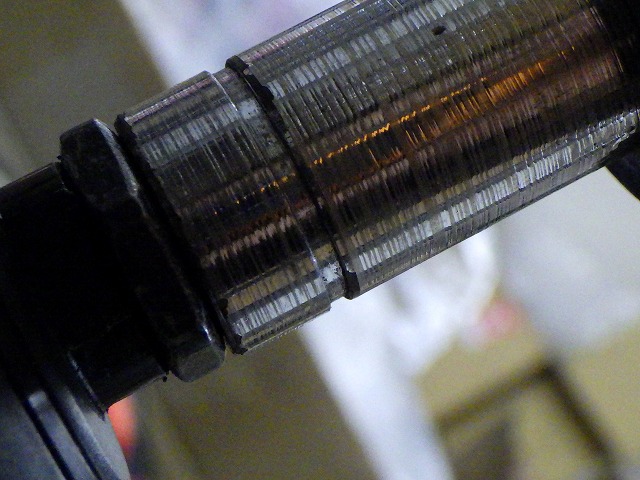

No centering issues and barely any runout.
The previous owner probably bent or broke a rear wheel spoke,
couldn't get it fixed at a local shop,
and decided to part with both wheels.

About these kinds of Mavic spokes—
if you call Sapim and DT spokes "stainless spokes" in the broad sense,
these are essentially steel, and while they might have superior tensile strength,
rust wells up from under the paint and spreads.
Some of the Colima "S" series wheels from a while back
have hubs with mercury-colored chrome plating,
and those also develop rusty pockmarks as they age.
Do the French just not care about that kind of thing?