Today it's wheels again (and so on).
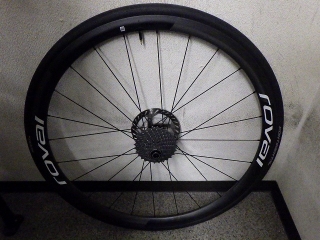

Continuing from yesterday.
I'm rebuilding the rear wheel of the Alpinist CLX.
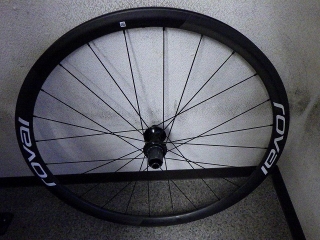
Got it built.
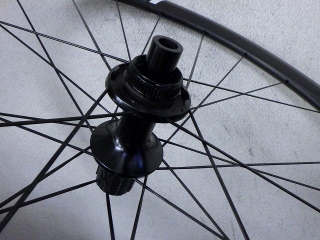
You probably can't tell from the photo,
but I've switched the non-freewheel side to black CX Sprint straight spokes.
I'll handle the lacing later.
With this Roqual disc brake rear wheel,
I'm doing something taboo beyond taboo—
a 2:1 build with tangent lacing on the non-freewheel side.
So the freewheel-side spokes actually have
greater deformation than the non-freewheel side,
which is a weird rear wheel
(the fact that the freewheel side uses a cross-3 lacing also plays into this),
but replacing the non-freewheel side's Aero Light spokes
(spokes with 65% weight ratio) with
CX Sprint spokes (78% weight ratio)
doesn't change the second spoke tension
because the non-freewheel side is already incredibly tight.
Or rather, I can't change it.
The deformation of the non-freewheel side spokes does decrease.
With the same second spoke tension, the weight ratio is higher.
However, the freewheel-side spoke deformation can barely be changed.
Assuming both wheels stay centered
before and after the rebuild, if you squeeze the left and right spokes,
you can clearly feel that the non-freewheel side has less deformation,
but the freewheel side barely changes.
So to eliminate the freewheel-side spoke deformation,
you have to compensate with lacing.
The front wheel can be shaped even without lacing,
but the rear wheel absolutely requires freewheel-side lacing.
So you might think: wouldn't a Roqual disc brake rear wheel
get nearly the same results from just inspection and lacing
without a full rebuild?
And actually, that's true.
Well, the non-freewheel side does change, so it's not pointless.
We happen to have a stock Alpinist rear wheel hanging here right now,
and when I squeeze-compare them, you can see that
the freewheel-side spoke deformation is almost unchanged.
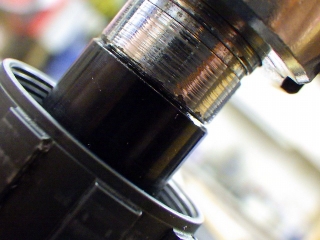
This is the condition after the rebuild,
and with Roqual disc brake rear wheels,
doing a reverse different-diameter build makes centering extremely difficult.
On normal wheels, the non-freewheel side has lower tension,
and with a 2:1 build using non-freewheel radial lacing,
the left and right are about equal.
Up to that point, tightening the non-freewheel side
feels smooth and easy,
but on this wheel, the non-freewheel side has higher tension,
so you have to tighten carefully,
like treading on thin ice, creeping toward the answer.
I wrote earlier that 2:1 builds with non-freewheel tangent lacing
are taboo beyond taboo,
and I've mentioned this before, but for disc brake rear wheels:
the sensible approach is
・standard equal-spoke-count lacing on both sides with different diameters and spoke counts for balance,
or if you can't think of that, use an offset rim,
whereas
・2:1 builds with non-freewheel radial lacing
don't rate poorly as a wheel structure,
but considering the intense braking forces on the hub during disc braking,
radial lacing is a bit...problematic, making this taboo,
yet with straight spokes, it seems experience has shown
the strength issue is cleared.
Beyond that,
・getting nervous about the twisting power from hub-side braking
and doing tangent lacing on the non-freewheel side despite it being a 2:1 build,
ignoring or underestimating the left-right spoke tension difference—
not just being even, but actually reversing left-right—
is taboo beyond taboo.
It's a build method you'd never do on a rim brake rear wheel,
so it's clear the reason for doing it here is bias from getting nervous about disc brakes.
Being a wheel manufacturer that makes 2:1 builds their selling point
might mean they can't back out either.
That Fulcrum Speed 25, which deliberately doesn't do 2:1 on the rear wheel,
aligns almost perfectly with my wheel philosophy,
and this reasoning is why.

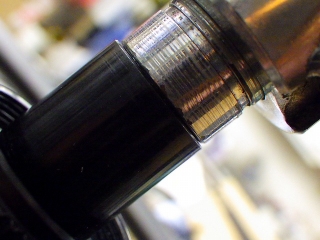
The left-side dropout end of this rear wheel.
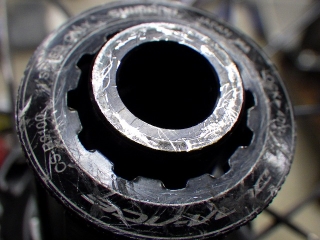
And this is the right-side dropout end, with the sprocket lockring
lightly hand-tightened for the photo.
There are a lot of marks on it,
indicating the through-axle was ridden with loose tension.
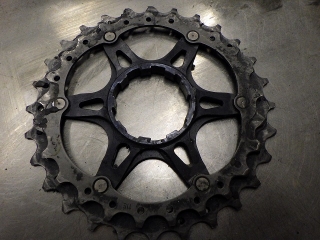
This is the spider arm that holds the lowest two cogs of the sprocket
that came on this rear wheel,
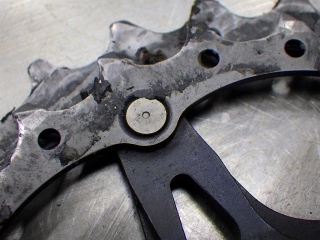
and the riveted connection between the spider arm and sprocket has loosened,
creating play.
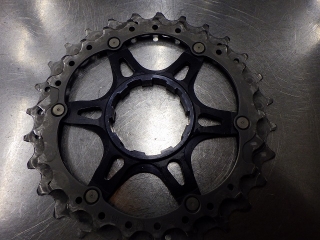
Cleaned it.
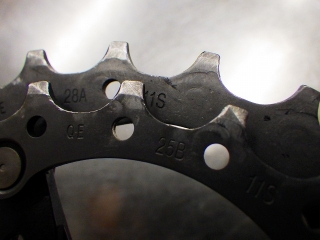
The low two cogs on the 11-28T cassette are the 25T and 28T,
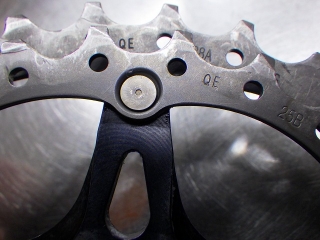
and there's no play between the spider arm and the 25T.
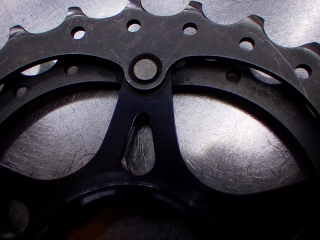
Flipped over and photographing from the inside contact side,
there's reproducible play between the spider arm and the 28T—
you can make a clicking sound with it.
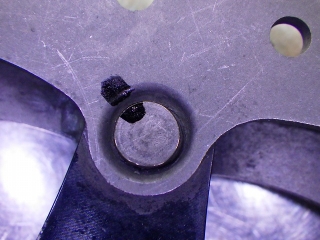
I marked the 28T at the full clockwise extent of the play
relative to the spider arm using an oil pen.
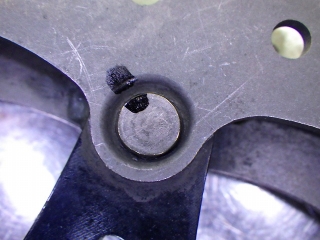
Then I rotated the 28T fully counterclockwise.
It might be easier to see it this way: the gap width on the opposite side of the mark has become narrower.


Continuing from yesterday.
I'm rebuilding the rear wheel of the Alpinist CLX.

Got it built.

You probably can't tell from the photo,
but I've switched the non-freewheel side to black CX Sprint straight spokes.
I'll handle the lacing later.
With this Roqual disc brake rear wheel,
I'm doing something taboo beyond taboo—
a 2:1 build with tangent lacing on the non-freewheel side.
So the freewheel-side spokes actually have
greater deformation than the non-freewheel side,
which is a weird rear wheel
(the fact that the freewheel side uses a cross-3 lacing also plays into this),
but replacing the non-freewheel side's Aero Light spokes
(spokes with 65% weight ratio) with
CX Sprint spokes (78% weight ratio)
doesn't change the second spoke tension
because the non-freewheel side is already incredibly tight.
Or rather, I can't change it.
The deformation of the non-freewheel side spokes does decrease.
With the same second spoke tension, the weight ratio is higher.
However, the freewheel-side spoke deformation can barely be changed.
Assuming both wheels stay centered
before and after the rebuild, if you squeeze the left and right spokes,
you can clearly feel that the non-freewheel side has less deformation,
but the freewheel side barely changes.
So to eliminate the freewheel-side spoke deformation,
you have to compensate with lacing.
The front wheel can be shaped even without lacing,
but the rear wheel absolutely requires freewheel-side lacing.
So you might think: wouldn't a Roqual disc brake rear wheel
get nearly the same results from just inspection and lacing
without a full rebuild?
And actually, that's true.
Well, the non-freewheel side does change, so it's not pointless.
We happen to have a stock Alpinist rear wheel hanging here right now,
and when I squeeze-compare them, you can see that
the freewheel-side spoke deformation is almost unchanged.


This is the condition after the rebuild,
and with Roqual disc brake rear wheels,
doing a reverse different-diameter build makes centering extremely difficult.
On normal wheels, the non-freewheel side has lower tension,
and with a 2:1 build using non-freewheel radial lacing,
the left and right are about equal.
Up to that point, tightening the non-freewheel side
feels smooth and easy,
but on this wheel, the non-freewheel side has higher tension,
so you have to tighten carefully,
like treading on thin ice, creeping toward the answer.
I wrote earlier that 2:1 builds with non-freewheel tangent lacing
are taboo beyond taboo,
and I've mentioned this before, but for disc brake rear wheels:
the sensible approach is
・standard equal-spoke-count lacing on both sides with different diameters and spoke counts for balance,
or if you can't think of that, use an offset rim,
whereas
・2:1 builds with non-freewheel radial lacing
don't rate poorly as a wheel structure,
but considering the intense braking forces on the hub during disc braking,
radial lacing is a bit...problematic, making this taboo,
yet with straight spokes, it seems experience has shown
the strength issue is cleared.
Beyond that,
・getting nervous about the twisting power from hub-side braking
and doing tangent lacing on the non-freewheel side despite it being a 2:1 build,
ignoring or underestimating the left-right spoke tension difference—
not just being even, but actually reversing left-right—
is taboo beyond taboo.
It's a build method you'd never do on a rim brake rear wheel,
so it's clear the reason for doing it here is bias from getting nervous about disc brakes.
Being a wheel manufacturer that makes 2:1 builds their selling point
might mean they can't back out either.
That Fulcrum Speed 25, which deliberately doesn't do 2:1 on the rear wheel,
aligns almost perfectly with my wheel philosophy,
and this reasoning is why.

The left-side dropout end of this rear wheel.

And this is the right-side dropout end, with the sprocket lockring
lightly hand-tightened for the photo.
There are a lot of marks on it,
indicating the through-axle was ridden with loose tension.

This is the spider arm that holds the lowest two cogs of the sprocket
that came on this rear wheel,

and the riveted connection between the spider arm and sprocket has loosened,
creating play.

Cleaned it.

The low two cogs on the 11-28T cassette are the 25T and 28T,

and there's no play between the spider arm and the 25T.

Flipped over and photographing from the inside contact side,
there's reproducible play between the spider arm and the 28T—
you can make a clicking sound with it.

I marked the 28T at the full clockwise extent of the play
relative to the spider arm using an oil pen.

Then I rotated the 28T fully counterclockwise.
It might be easier to see it this way: the gap width on the opposite side of the mark has become narrower.