I hadn't planned to write an article about this, but
the condition was so extreme
I determined it had value as a post
so I took some photos.
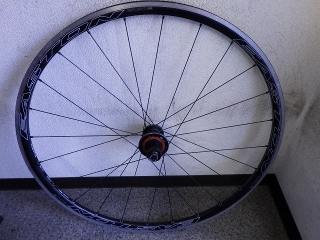
A customer brought in the front and rear wheels of an Easton EA90SL.
We inspected them here a few years ago.
Both wheels had almost no runout
and the front hub bearings are fine,
but the rear hub has odd rotation and the bearings are shot.
Since the main use is a trainer (roller),
it's likely the rear wheel just got hammered.
The customer also mentioned the rear hub bearings seem bad themselves.
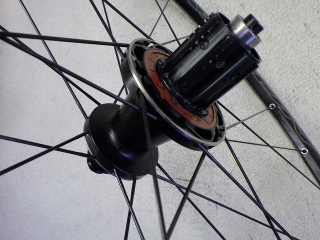
The hub is an Easton ECHO model,
which has a somewhat unusual internal design.
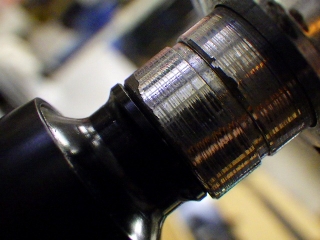
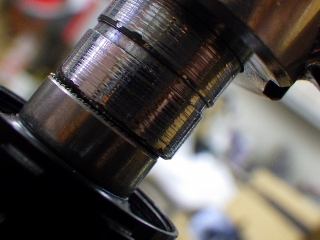
The first image and this one show the state after disassembly.

I pulled out the freebody with the right snap ring end cap intact.
Based on its inner diameter, there's a spacer-like component
that doesn't appear to be related to the hub structure itself.
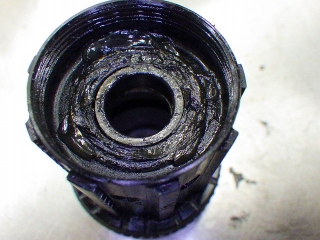
↑The extracted freebody
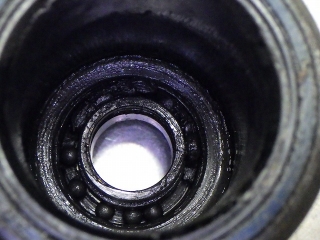
Looking from inside, the bearing retainer was broken
and the ball bearings had scattered positions.
The spacer-like component from before
is this bearing seal.
I wondered where all the broken retainer fragments went—
they shouldn't have all turned to dust—
so I gently tapped the freebody with the inside facing down
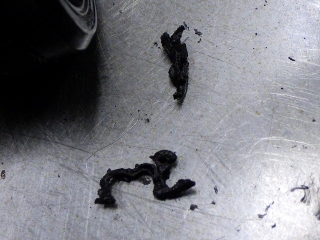
and out came retainer fragments.
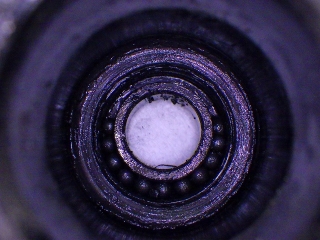
I gathered the ball bearings in one spot...
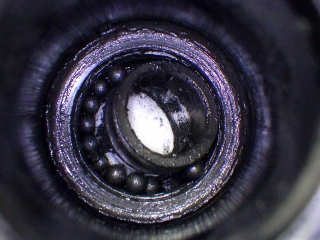
and by pressing up from below with a finger covered in paper towel,
the inner race came free.
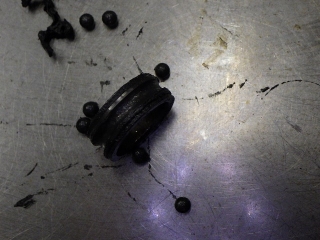
↑The inner race and ball bearings
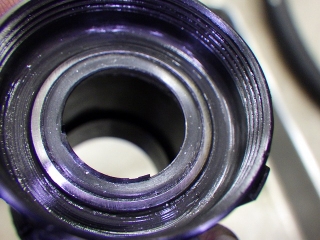
What's pressed into the freebody
is just the outer race and the seal fitted to its edge.
The seal has no markings indicating the bearing maker or size.
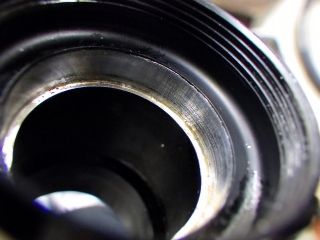
I removed the outer race.
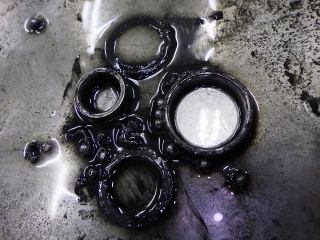
↑The complete bearing set
What was once a bearing now spread across the tray
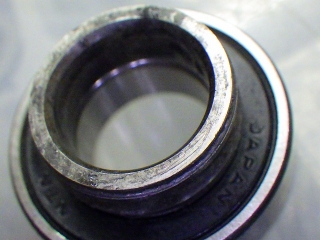
The bearing seal has no markings, but by measuring the inner diameter

and outer diameter and thickness
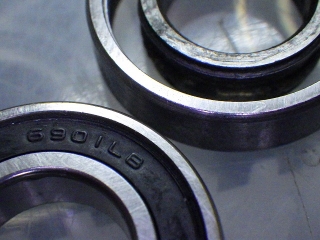
I could identify it as a 6901.
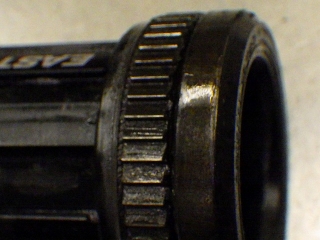
Deep inside the freebody
is a 1-1/8" headset cartridge bearing.
Normally this shouldn't be a press-fit situation—
when you pull the freebody out of the hub shell after assembly,
the bearing should stay in the hub shell
since the dimensional fit with the inner race is so loose.
But rust had seized it in place.
The rotation was also gritty.
The ratchet teeth are on the freebody side
and the pawls are on the hub shell side—opposite to most hubs.
This design means when you replace the freebody,
the ratchet teeth get refreshed, which is nice.

I carefully positioned the puller and pulled it out.
Like a fork's lower cone race,
it has a tapered shape that contacts the bearing's inner angle.
As I mentioned before, this bearing makes contact only at the edges
of the inner and outer angles, not a press fit.
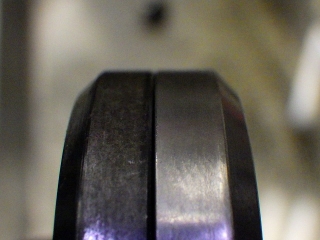
We had the same bearing in stock.
It's a 36°/45° bearing.
The other 1-1/8" standard bearings (where "standard" refers to bicycle industry specs, not international bearing standards)
come in 36°/36° and 45°/45° (the Campagnolo spec).
Most of the time it's one of these three.
Adding the outer diameter: 36°/45° is 41.0mm,
45°/45° is 41.8mm, and 36°/36° is 41.5mm.
So by comparing them as shown above,
if they line up without discrepancy, you can confirm they're the same bearing.
There's an exception: 36°/45° with 41.7mm outer diameter,
but that's identifiable too.
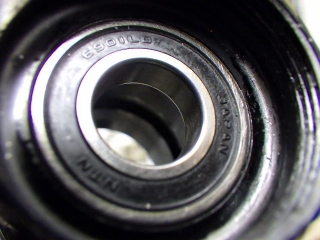
I pressed the freebody bearing in.
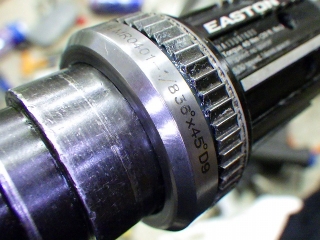
I carelessly installed the headset bearing on the freebody first,
but there was a tool that could install it without pressing,
so no problem.
If it did interfere, I could just remove it.

The bearing inside the freebody,
like a Mavic FTS-L freebody,
is pressed into the hub shell's protruding section on the right side.
You can see a hole in the hub shell,
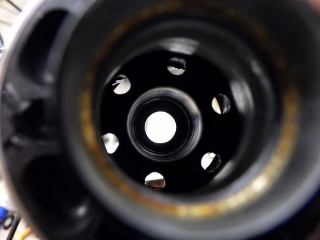
and peeking from the left side, it looks like this.
Weight reduction, maybe?
But this connects to the ratchet teeth section that moves around,
so grease from the ratchet area could migrate into the hub shell.
Also, the hub shell bearing rotation felt gritty too,
so I removed the left side bearing at this point.
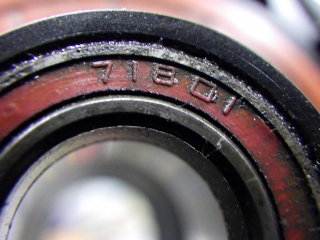
The seal marking shows the maker as Enduro
and the size as 71801.
With 5-digit numbers like this, the second digit is always 1,
and removing it leaves a standard bearing size.
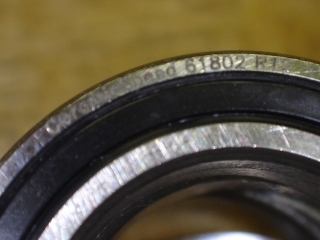
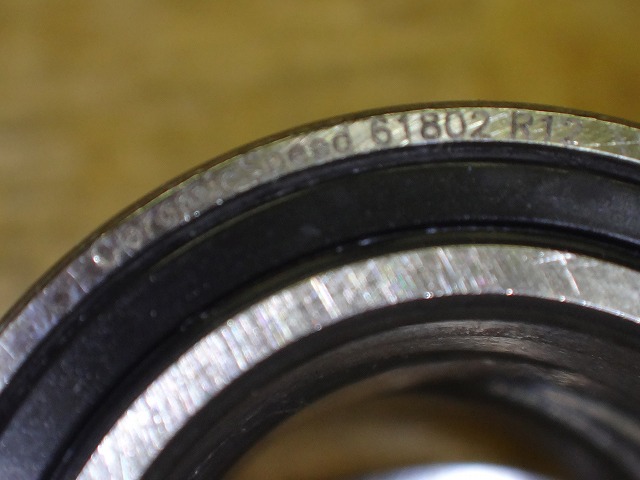
This is from a past article,
but the image above shows a CeramicSpeed bearing
with laser etching on the outer race reading 61802.
Removing the 1 leaves 6802,
and this bearing is indeed the same size as a 6802.
This is a black seal facing inside the hub,
while the outside-facing side has a blue seal.
By the same logic, today's Enduro bearing should be
7801, but no such standard bearing exists.
※A correction appears below, but it does exist.
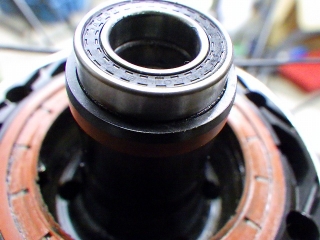
The size itself is the same as a 6801.
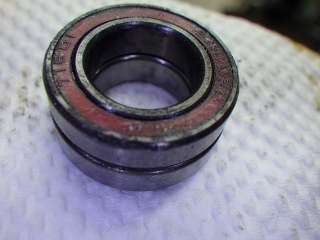
This was also gritty, so I removed the 71801.
So in the end, I completely replaced all the bearings.
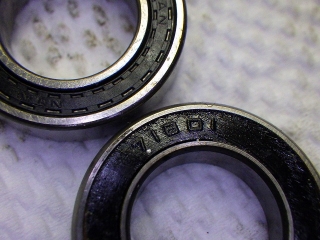
It had a black seal inside.
Some Campagnolo/Fulcrum non-cup-and-cone budget hub bearings
and DT hub bearings use contact seals only on the outside-facing side,
and use different seal colors to tell them apart.
Strictly speaking, it's not that they're changing colors intentionally,
but rather there's a convention that says
"non-contact seals are black, contact seals are orange or brown,"
so following that naturally results in different colors.
But this bearing appears to have non-contact seals on both sides.
The outside seal could be worn through if the gap was too large,
but it doesn't look that way.
Standard bearing designations follow the format
"6××" or "6×××" or "16×××" and such,
so the bicycle industry takes liberties by sandwiching 1s in the middle
or making other modifications.
The fact that they changed from 6××× to 7××× makes me think
they wanted to indicate something—
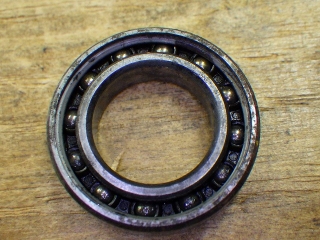
So I peeled back the seal.
Actually, I didn't need to peel it to figure it out.
The image above shows the outside-facing surface,
and comparing the thickness of the inner race section
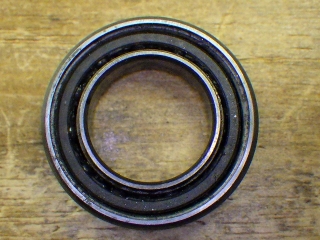
to the inside-facing side,
the inside is visibly thinner.
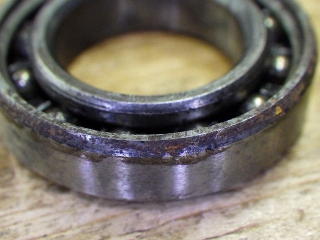
Here's the outside face again.
It's hard to see, but the contact between the inner race and bearing ball
is shaped like a Campagnolo cup-and-cone cone race,
except it actually is a cone.
This is an angular contact bearing.
Note:
There's an international standard rule that when a 6××× size radial bearing
becomes an angular contact bearing,
it gets designated as 7×××!
I had thought this didn't exist, but both NTN and NSK
use the same convention for their bearings,
so while 71801 is debatable, 7801 follows the standard naming.
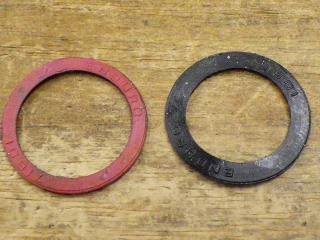
About the inner and outer seals:

The outer diameter is the same, but the inner diameter
has a large gap even accounting for the angular contact inner race.
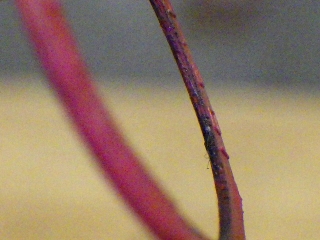
Looking at the seal's inner edge, orange color remains,
so it's not worn—this is the original size.
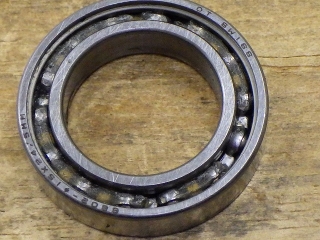
This is a separate case,
but a bearing from a recently rebuilt Alpinist CLX front wheel
had gritty rotation, so I replaced it
after letting the customer confirm the before and after condition.
The seal is peeled back.
The image shows the outside-facing side
with laser etching on the outer race.
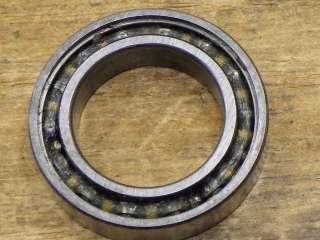
The inside-facing side has no marking
but otherwise looks identical to the outside.
This is a radial bearing.
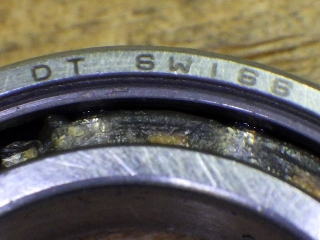
The marking shows the maker name and
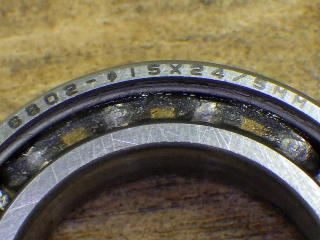
the size designation.
Standard bearing sizes in id/od/thickness (mm):
6902 is 15/28/7 and 6903 is 17/30/7.
If only 6902's outer diameter were 26mm,
it'd be perfect for press-fitting into freeibodies and hub shells!
So they made a non-standard bearing with just the inner diameter at 26mm,
called 15267. This uses three millimeter numbers,
which is more intuitive.
If 6903's inner diameter were 18mm,
that'd be ideal for through-axle hub bearings.
So they made one with just that changed to 18mm,
following the same format: 18307.
DT, following the millimeter notation of non-standard bearings,
applies this method to standard bearings too,
so when ordering their bearings,
you don't say "6802 please!"
but rather "15245 please!"
If the bearing came from a DT hub,
both numbers are marked on it,
so confusion isn't an issue.
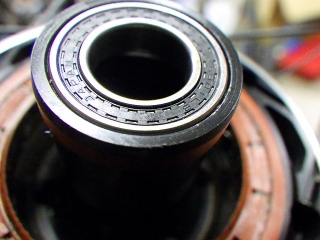
Anyway,
I pressed in a standard radial 6801.
This hub isn't angular contact anyway,
and the Enduro bearing had solid proof of severe damage,
so a normal radial bearing should be fine.
In fact, it might maintain performance longer this way.
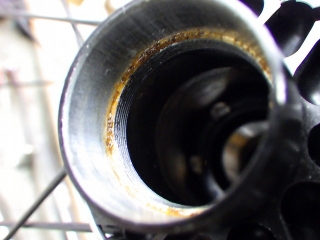
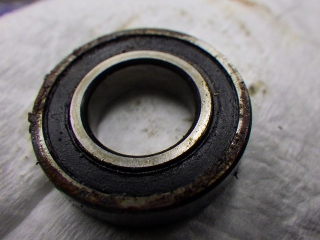
The hub shell's left side and its bearing both show
what looks like rust from galvanic corrosion on the contact surfaces.
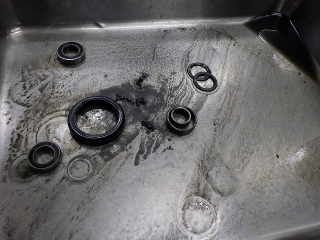
In the end, I replaced all the bearings.
I didn't go in with the assumption I'd replace everything, just for the record.
Not visible in the image above,

an overlock stop spacer was lurking in the bearing debris.
That was close!
Without this, the rear wheel would lock up when tightening the quick release.
When that happens, pressure is applied not between this spacer and the 6901 and 71801,
but against the headset bearing,
so removing it doesn't change the overlock distance much.
When I first pulled out the freebody with the snap ring,
it was stuck with oil residue inside,
then fell onto the tray later—almost missed it.
I checked the Echo hub diagram to confirm
it goes here without question.
By the way, that diagram lists
the headset bearing as 3645, the 71801 as 7801,
and the unnamed seal bearings on both wheel ends (freebody outside and hub shell left)
as 6901.
The fact that it lists 71801 as 7801 in 4 digits is odd.
I didn't shoot any front wheel images,
but I confirmed both wheels have minimal runout after truing
and no centering error.
I determined it had value as a post
so I took some photos.

A customer brought in the front and rear wheels of an Easton EA90SL.
We inspected them here a few years ago.
Both wheels had almost no runout
and the front hub bearings are fine,
but the rear hub has odd rotation and the bearings are shot.
Since the main use is a trainer (roller),
it's likely the rear wheel just got hammered.
The customer also mentioned the rear hub bearings seem bad themselves.

The hub is an Easton ECHO model,
which has a somewhat unusual internal design.
The first image and this one show the state after disassembly.

I pulled out the freebody with the right snap ring end cap intact.
Based on its inner diameter, there's a spacer-like component
that doesn't appear to be related to the hub structure itself.

↑The extracted freebody

Looking from inside, the bearing retainer was broken
and the ball bearings had scattered positions.
The spacer-like component from before
is this bearing seal.
I wondered where all the broken retainer fragments went—
they shouldn't have all turned to dust—
so I gently tapped the freebody with the inside facing down

and out came retainer fragments.

I gathered the ball bearings in one spot...

and by pressing up from below with a finger covered in paper towel,
the inner race came free.

↑The inner race and ball bearings

What's pressed into the freebody
is just the outer race and the seal fitted to its edge.
The seal has no markings indicating the bearing maker or size.

I removed the outer race.

↑The complete bearing set
What was once a bearing now spread across the tray

The bearing seal has no markings, but by measuring the inner diameter

and outer diameter and thickness

I could identify it as a 6901.

Deep inside the freebody
is a 1-1/8" headset cartridge bearing.
Normally this shouldn't be a press-fit situation—
when you pull the freebody out of the hub shell after assembly,
the bearing should stay in the hub shell
since the dimensional fit with the inner race is so loose.
But rust had seized it in place.
The rotation was also gritty.
The ratchet teeth are on the freebody side
and the pawls are on the hub shell side—opposite to most hubs.
This design means when you replace the freebody,
the ratchet teeth get refreshed, which is nice.

I carefully positioned the puller and pulled it out.
Like a fork's lower cone race,
it has a tapered shape that contacts the bearing's inner angle.
As I mentioned before, this bearing makes contact only at the edges
of the inner and outer angles, not a press fit.

We had the same bearing in stock.
It's a 36°/45° bearing.
The other 1-1/8" standard bearings (where "standard" refers to bicycle industry specs, not international bearing standards)
come in 36°/36° and 45°/45° (the Campagnolo spec).
Most of the time it's one of these three.
Adding the outer diameter: 36°/45° is 41.0mm,
45°/45° is 41.8mm, and 36°/36° is 41.5mm.
So by comparing them as shown above,
if they line up without discrepancy, you can confirm they're the same bearing.
There's an exception: 36°/45° with 41.7mm outer diameter,
but that's identifiable too.

I pressed the freebody bearing in.

I carelessly installed the headset bearing on the freebody first,
but there was a tool that could install it without pressing,
so no problem.
If it did interfere, I could just remove it.

The bearing inside the freebody,
like a Mavic FTS-L freebody,
is pressed into the hub shell's protruding section on the right side.
You can see a hole in the hub shell,

and peeking from the left side, it looks like this.
Weight reduction, maybe?
But this connects to the ratchet teeth section that moves around,
so grease from the ratchet area could migrate into the hub shell.
Also, the hub shell bearing rotation felt gritty too,
so I removed the left side bearing at this point.

The seal marking shows the maker as Enduro
and the size as 71801.
With 5-digit numbers like this, the second digit is always 1,
and removing it leaves a standard bearing size.
This is from a past article,
but the image above shows a CeramicSpeed bearing
with laser etching on the outer race reading 61802.
Removing the 1 leaves 6802,
and this bearing is indeed the same size as a 6802.
This is a black seal facing inside the hub,
while the outside-facing side has a blue seal.
By the same logic, today's Enduro bearing should be
7801, but no such standard bearing exists.
※A correction appears below, but it does exist.

The size itself is the same as a 6801.

This was also gritty, so I removed the 71801.
So in the end, I completely replaced all the bearings.

It had a black seal inside.
Some Campagnolo/Fulcrum non-cup-and-cone budget hub bearings
and DT hub bearings use contact seals only on the outside-facing side,
and use different seal colors to tell them apart.
Strictly speaking, it's not that they're changing colors intentionally,
but rather there's a convention that says
"non-contact seals are black, contact seals are orange or brown,"
so following that naturally results in different colors.
But this bearing appears to have non-contact seals on both sides.
The outside seal could be worn through if the gap was too large,
but it doesn't look that way.
Standard bearing designations follow the format
"6××" or "6×××" or "16×××" and such,
so the bicycle industry takes liberties by sandwiching 1s in the middle
or making other modifications.
The fact that they changed from 6××× to 7××× makes me think
they wanted to indicate something—

So I peeled back the seal.
Actually, I didn't need to peel it to figure it out.
The image above shows the outside-facing surface,
and comparing the thickness of the inner race section

to the inside-facing side,
the inside is visibly thinner.

Here's the outside face again.
It's hard to see, but the contact between the inner race and bearing ball
is shaped like a Campagnolo cup-and-cone cone race,
except it actually is a cone.
This is an angular contact bearing.
Note:
There's an international standard rule that when a 6××× size radial bearing
becomes an angular contact bearing,
it gets designated as 7×××!
I had thought this didn't exist, but both NTN and NSK
use the same convention for their bearings,
so while 71801 is debatable, 7801 follows the standard naming.

About the inner and outer seals:

The outer diameter is the same, but the inner diameter
has a large gap even accounting for the angular contact inner race.

Looking at the seal's inner edge, orange color remains,
so it's not worn—this is the original size.

This is a separate case,
but a bearing from a recently rebuilt Alpinist CLX front wheel
had gritty rotation, so I replaced it
after letting the customer confirm the before and after condition.
The seal is peeled back.
The image shows the outside-facing side
with laser etching on the outer race.

The inside-facing side has no marking
but otherwise looks identical to the outside.
This is a radial bearing.

The marking shows the maker name and

the size designation.
Standard bearing sizes in id/od/thickness (mm):
6902 is 15/28/7 and 6903 is 17/30/7.
If only 6902's outer diameter were 26mm,
it'd be perfect for press-fitting into freeibodies and hub shells!
So they made a non-standard bearing with just the inner diameter at 26mm,
called 15267. This uses three millimeter numbers,
which is more intuitive.
If 6903's inner diameter were 18mm,
that'd be ideal for through-axle hub bearings.
So they made one with just that changed to 18mm,
following the same format: 18307.
DT, following the millimeter notation of non-standard bearings,
applies this method to standard bearings too,
so when ordering their bearings,
you don't say "6802 please!"
but rather "15245 please!"
If the bearing came from a DT hub,
both numbers are marked on it,
so confusion isn't an issue.

Anyway,
I pressed in a standard radial 6801.
This hub isn't angular contact anyway,
and the Enduro bearing had solid proof of severe damage,
so a normal radial bearing should be fine.
In fact, it might maintain performance longer this way.


The hub shell's left side and its bearing both show
what looks like rust from galvanic corrosion on the contact surfaces.

In the end, I replaced all the bearings.
I didn't go in with the assumption I'd replace everything, just for the record.
Not visible in the image above,

an overlock stop spacer was lurking in the bearing debris.
That was close!
Without this, the rear wheel would lock up when tightening the quick release.
When that happens, pressure is applied not between this spacer and the 6901 and 71801,
but against the headset bearing,
so removing it doesn't change the overlock distance much.
When I first pulled out the freebody with the snap ring,
it was stuck with oil residue inside,
then fell onto the tray later—almost missed it.
I checked the Echo hub diagram to confirm
it goes here without question.
By the way, that diagram lists
the headset bearing as 3645, the 71801 as 7801,
and the unnamed seal bearings on both wheel ends (freebody outside and hub shell left)
as 6901.
The fact that it lists 71801 as 7801 in 4 digits is odd.


I didn't shoot any front wheel images,
but I confirmed both wheels have minimal runout after truing
and no centering error.