Another wheel day (and so on...).

A customer brought in a budget-grade rear wheel
that came stock with an MTB complete bike.
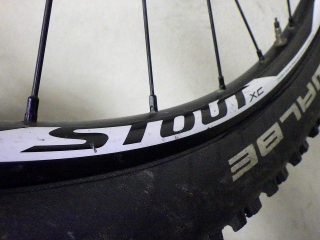
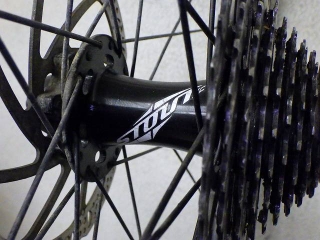
Both the hub and rim say STOUT on them.
This isn't really related, but there are cases where
companies get nervous about new products and over-design for durability,
only to realize later it wasn't that serious—or conversely,
as technology progresses, things that used to be impossible become possible.
When the upper outer cage plate of Campagnolo's top-tier front derailleur
first went carbon, it had a plastic plate that contacted the chain
when shifting to the inner ring. But the current Campagnolo Super Record
front derailleur pushes the chain directly with a carbon plate.
With Campagnolo disc brake rear wheels,
the G3-laced radial spokes on the anti-freewheel side—
on early models like the Zonda DB, the flange shape was massive,
surrounding each spoke heavily, clearly showing nervousness
about stress when braking. But on wheels like the Bora WTO DB,
the flange shape is now basically the same as rim-brake radial lacing.
Campagnolo's ongoing cautiousness appears in chain connectors.
The way early 10-speed Campy Powerlinks and 11S/12S chains
are pinned so the connection point becomes the strongest in the entire chain
shows serious anxiety about chain breakage.
Old Suntur MTB hubs had something called a "suspension-specific hub"—
it looked like a 100mm quick-release hub, but the difference was
the axle and hub body were thicker, designed so that even with hard landings
on a suspension-fork MTB that relies on suspension geometry,
it wouldn't break. This is another example of being nervous
because suspension forks were a "new technology" at the time.
Shimano's hydraulic disc brakes first appeared on the XT 750-series, not XTR,
but only the first model used stainless steel braided hose.
They were worried hydraulic pressure would expand or worst-case rupture the hose.
If the braid contacted the frame, it would abnormally grind it down,
so it was quickly discontinued. Hydraulic pressure does actually expand the hose ID—
you'll notice this when reusing a rear brake hose for the front by cutting it short:
when you try to press-fit the insert, it slides in easier than a new hose would.
Anyway, the rim and hub here say STOUT,
which was originally a model name used on Specialized's
front hubs designed for sturdy, robust strength.
The logo had changed, so I didn't notice at first.
It was initially used only on front hubs and came in an impressive wooden box.
Searching "specialized stout hub wooden case" will bring it up.
Later it became a slightly budget model name for disc brake front hubs
assembled on complete bikes like the Stumpjumper
(still a front-hub-only designation at that point),
but nowadays it seems to be slapped on any wheel-related parts at all.
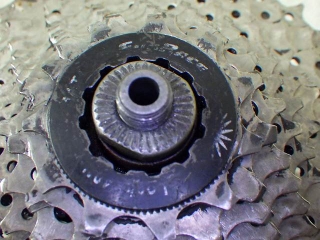
The reason the customer brought in this wheel:
it has a cassette sprocket from Sunrace, a manufacturer
that makes budget freewheel sprockets frequently.
Nothing wrong with Sunrace itself, but
parts inside the freewheel body were cracked,
so the entire sprocket assembly has become completely loose.

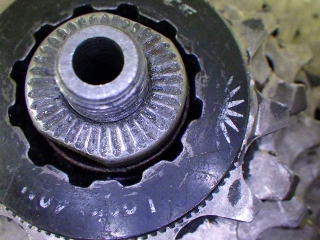
↑When you grab the sprocket and shake it, it's like this
The hub is probably Formula-made (doesn't look like Joytech),
and when I checked the freewheel body, it turned out to be incompatible
with a Shimano OEM HG freewheel body swap, so either
the rear hub itself needs replacing or the customer needs to buy
a cheaper rear wheel. I suggested the latter, but they wanted
a proper wheel even if it cost a bit more, so we ended up
reusing the rim and rebuilding the wheel.
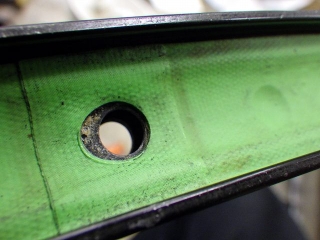
Oh! The cheap rim tape typical of complete-bike wheels—
you'd be hard-pressed to find a replacement as spare parts.
Some are even cheaper and look like packaging PP strapping material.
At least this one matches the rim's internal width;
that's one step better than the lefty from the previous post.
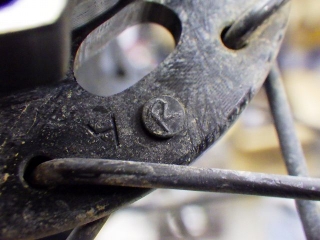
The stamping on the spoke head says "R," which is Richman's, a spoke maker.
At least it's branded rather than unmarked, but oddly
the company address is the same as Pillar's.
For a similar situation to this one, see here
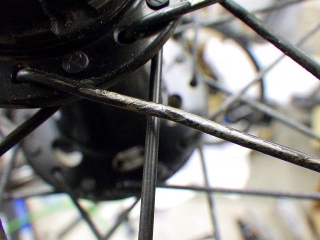
This rear wheel is 32H. Of the 16 spokes on one side (freewheel side),
all eight inpokes had damage from chain drops and were deformed.
If they'd all been fine, I would have reused the spokes,
but when I checked the lengths, this hub has reverse high-low flanges,
so the anti-freewheel side spokes were too short to reuse.
Even if I used the original freewheel-side spokes as freewheel-side spokes
in the rebuild, there was about a 3mm difference—impossible.
Though my calculated length is to the nipple face, and
the original spoke length only barely reaches the slot,
so if we interpret nipple-related length the same way,
it's about a 2mm difference. Same lacing wouldn't work either way,
but when using 4-cross lacing with four spokes on the freewheel side,
reusing the 16 anti-freewheel spokes wasn't technically impossible.
But with anything other than DT or Sapim spokes, that has a high probability
of heading to spoke breakage repairs in the not-too-distant future,
so I skipped it.
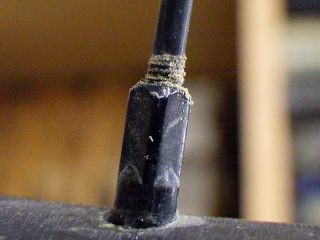
For a wheel at this price point, it's being ridden competitively
as a "bike for running mountains," and sand had packed
into the grooves of the nipples.

Built.
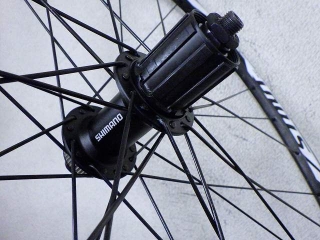
The hub is an M4000-series Alivio quick-release disc hub,
FH-M4050: 32H, black Campagnolo/Comp four-cross lacing, unwired.
The original was plain 14g, six-cross on both sides,
symmetric diameter and spoke count on left and right—
I changed it to asymmetric diameter and count, and

This rim is offset, so even without wiring,
the left-right difference in spoke deformation is quite small.
And looking at this setup not in isolation but compared to the original wheel,
the fact that it's no longer reverse high-low flange is huge.
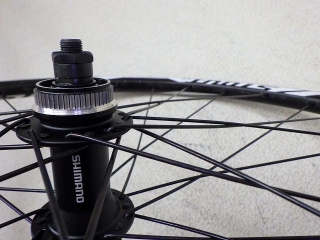
The original hub had a 6-hole rotor mount,
and the new hub is center-lock, but that can be handled with an adapter.
As for the internal freewheel body damage that caused the rebuild in the first place—
with Shimano hubs this is extremely unlikely to happen,
and even if it did, spare parts are available, so
there's a major difference in confidence going forward.

A customer brought in a budget-grade rear wheel
that came stock with an MTB complete bike.


Both the hub and rim say STOUT on them.
This isn't really related, but there are cases where
companies get nervous about new products and over-design for durability,
only to realize later it wasn't that serious—or conversely,
as technology progresses, things that used to be impossible become possible.
When the upper outer cage plate of Campagnolo's top-tier front derailleur
first went carbon, it had a plastic plate that contacted the chain
when shifting to the inner ring. But the current Campagnolo Super Record
front derailleur pushes the chain directly with a carbon plate.
With Campagnolo disc brake rear wheels,
the G3-laced radial spokes on the anti-freewheel side—
on early models like the Zonda DB, the flange shape was massive,
surrounding each spoke heavily, clearly showing nervousness
about stress when braking. But on wheels like the Bora WTO DB,
the flange shape is now basically the same as rim-brake radial lacing.
Campagnolo's ongoing cautiousness appears in chain connectors.
The way early 10-speed Campy Powerlinks and 11S/12S chains
are pinned so the connection point becomes the strongest in the entire chain
shows serious anxiety about chain breakage.
Old Suntur MTB hubs had something called a "suspension-specific hub"—
it looked like a 100mm quick-release hub, but the difference was
the axle and hub body were thicker, designed so that even with hard landings
on a suspension-fork MTB that relies on suspension geometry,
it wouldn't break. This is another example of being nervous
because suspension forks were a "new technology" at the time.
Shimano's hydraulic disc brakes first appeared on the XT 750-series, not XTR,
but only the first model used stainless steel braided hose.
They were worried hydraulic pressure would expand or worst-case rupture the hose.
If the braid contacted the frame, it would abnormally grind it down,
so it was quickly discontinued. Hydraulic pressure does actually expand the hose ID—
you'll notice this when reusing a rear brake hose for the front by cutting it short:
when you try to press-fit the insert, it slides in easier than a new hose would.
Anyway, the rim and hub here say STOUT,
which was originally a model name used on Specialized's
front hubs designed for sturdy, robust strength.
The logo had changed, so I didn't notice at first.
It was initially used only on front hubs and came in an impressive wooden box.
Searching "specialized stout hub wooden case" will bring it up.
Later it became a slightly budget model name for disc brake front hubs
assembled on complete bikes like the Stumpjumper
(still a front-hub-only designation at that point),
but nowadays it seems to be slapped on any wheel-related parts at all.

The reason the customer brought in this wheel:
it has a cassette sprocket from Sunrace, a manufacturer
that makes budget freewheel sprockets frequently.
Nothing wrong with Sunrace itself, but
parts inside the freewheel body were cracked,
so the entire sprocket assembly has become completely loose.


↑When you grab the sprocket and shake it, it's like this
The hub is probably Formula-made (doesn't look like Joytech),
and when I checked the freewheel body, it turned out to be incompatible
with a Shimano OEM HG freewheel body swap, so either
the rear hub itself needs replacing or the customer needs to buy
a cheaper rear wheel. I suggested the latter, but they wanted
a proper wheel even if it cost a bit more, so we ended up
reusing the rim and rebuilding the wheel.

Oh! The cheap rim tape typical of complete-bike wheels—
you'd be hard-pressed to find a replacement as spare parts.
Some are even cheaper and look like packaging PP strapping material.
At least this one matches the rim's internal width;
that's one step better than the lefty from the previous post.

The stamping on the spoke head says "R," which is Richman's, a spoke maker.
At least it's branded rather than unmarked, but oddly
the company address is the same as Pillar's.
For a similar situation to this one, see here

This rear wheel is 32H. Of the 16 spokes on one side (freewheel side),
all eight inpokes had damage from chain drops and were deformed.
If they'd all been fine, I would have reused the spokes,
but when I checked the lengths, this hub has reverse high-low flanges,
so the anti-freewheel side spokes were too short to reuse.
Even if I used the original freewheel-side spokes as freewheel-side spokes
in the rebuild, there was about a 3mm difference—impossible.
Though my calculated length is to the nipple face, and
the original spoke length only barely reaches the slot,
so if we interpret nipple-related length the same way,
it's about a 2mm difference. Same lacing wouldn't work either way,
but when using 4-cross lacing with four spokes on the freewheel side,
reusing the 16 anti-freewheel spokes wasn't technically impossible.
But with anything other than DT or Sapim spokes, that has a high probability
of heading to spoke breakage repairs in the not-too-distant future,
so I skipped it.

For a wheel at this price point, it's being ridden competitively
as a "bike for running mountains," and sand had packed
into the grooves of the nipples.

Built.

The hub is an M4000-series Alivio quick-release disc hub,
FH-M4050: 32H, black Campagnolo/Comp four-cross lacing, unwired.
The original was plain 14g, six-cross on both sides,
symmetric diameter and spoke count on left and right—
I changed it to asymmetric diameter and count, and

This rim is offset, so even without wiring,
the left-right difference in spoke deformation is quite small.
And looking at this setup not in isolation but compared to the original wheel,
the fact that it's no longer reverse high-low flange is huge.

The original hub had a 6-hole rotor mount,
and the new hub is center-lock, but that can be handled with an adapter.
As for the internal freewheel body damage that caused the rebuild in the first place—
with Shimano hubs this is extremely unlikely to happen,
and even if it did, spare parts are available, so
there's a major difference in confidence going forward.