Another day with wheels (and so on).
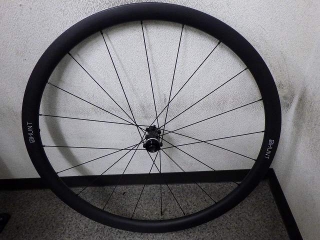
A customer brought in a HUNT disc brake wheel for me to work on.
I swear I didn't prompt this comment myself, but they said
"it doesn't roll as well as the Nomu Lab Wheel No. 5."
Oh dear, my apologies for causing that.
If they'd never heard of the Nomu Lab wheel,
they probably wouldn't have questioned this one's performance.
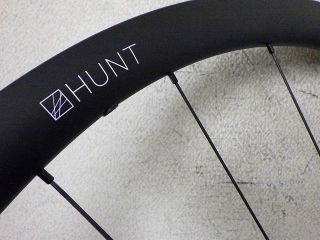
The rim and
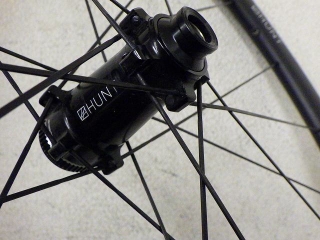
hub both bear the HUNT mark.
Today I only worked on the front wheel, but
the front is 20H and the rear is 24H with Pillar's square aero spokes,
laced with equal numbers and diameters on both sides,
with a full cross lacing pattern all around front and rear.
It's a steel spoke version rather than carbon spokes
like their higher-end models.
These Pillar aero spokes have roughly the same spoke weight ratio as Sapim's CX-RAY,
but they're softer in the twist direction.
Having the same spoke weight ratio means
the cross-sectional area is the same when cut perpendicular to the spoke's lengthwise direction,
but whether the softer bending within the elastic deformation range in twisting comes from
the difference in shape between a rectangle and a tapered ellipse,
or from work hardening and so on, I can't say for certain.
The front wheel is 20H, but 20H for a disc brake front wheel
is rather a modest spoke count.
Adding one more spoke and splitting it 14 and 7 left and right
might look good in terms of the apparent total spoke tension sum,
but unless you make the multi-spoke side flange a large flange
and really lay back the final cross angle as much as possible,
12H on each side for a total of 24H is the safer bet
(in short, don't mess with 2:1 lacing unless you know what you're doing).
Come to think of it, the other day I wrote that the Roval C38 with equal-spoke-count lacing
would be good as rim material for rebuilding,
but today I saw another wheel that had an Alpinist CL (not CLX).
That one's also not 2:1 laced, so it would be excellent if you're planning to rebuild it.
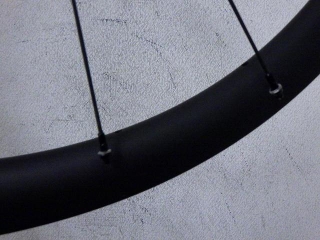
At the time of photographing the wheel, I removed one spoke from each side
for investigation purposes.
Now, about this rim...
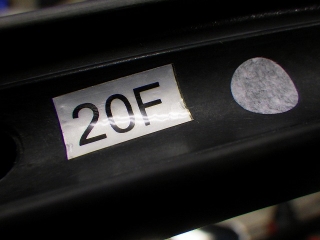
20H and
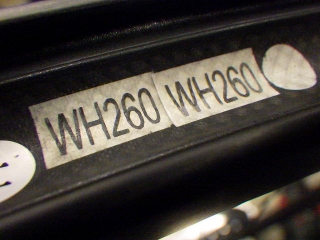
marked as WH260 rim... this marking...
Isn't this an Exinox rim!
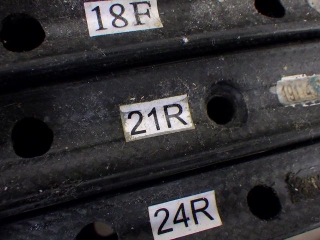
↑Top and bottom are the old Nomu Lab Wheel No. 2 rim,
middle is the Vittoria 2:1 laced 21H rear wheel rim.
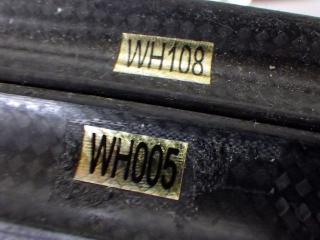
↑Top is the old Nomu Lab Wheel No. 2 rim,
bottom is the Nomu Lab Wheel No. 2.5 rim.
As for the Exinox rims,
(→check this out)(→and this)(→and this).
On both wheels, I use CX Sprint on the side where the spokes angle steeper
and lace the flatter side,
and while it's possible even from a semi-disassembly,
I ended up doing a complete disassembly. As I worked through it systematically,
the last spoke with no nipple rotation whatsoever
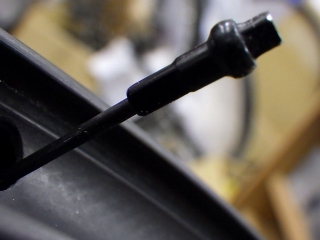
came out of the rim easily, and I checked it. With no spoke tension applied,
in the state shown in the image above, I could loosen the nipple by hand.
No threadlocker was used, and it wasn't even one of those nipples with it pre-applied.
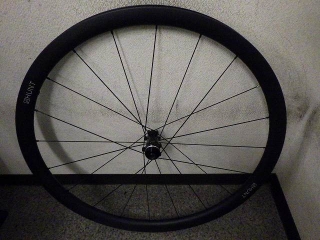
Built.
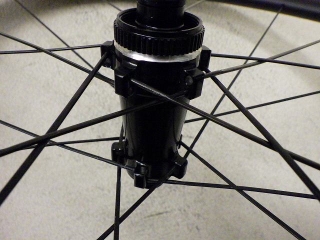
I've used black CX Sprint straight spokes on the rotor mounting side.
I'll do the lacing later.

A customer brought in a HUNT disc brake wheel for me to work on.
I swear I didn't prompt this comment myself, but they said
"it doesn't roll as well as the Nomu Lab Wheel No. 5."
Oh dear, my apologies for causing that.
If they'd never heard of the Nomu Lab wheel,
they probably wouldn't have questioned this one's performance.

The rim and

hub both bear the HUNT mark.
Today I only worked on the front wheel, but
the front is 20H and the rear is 24H with Pillar's square aero spokes,
laced with equal numbers and diameters on both sides,
with a full cross lacing pattern all around front and rear.
It's a steel spoke version rather than carbon spokes
like their higher-end models.
These Pillar aero spokes have roughly the same spoke weight ratio as Sapim's CX-RAY,
but they're softer in the twist direction.
Having the same spoke weight ratio means
the cross-sectional area is the same when cut perpendicular to the spoke's lengthwise direction,
but whether the softer bending within the elastic deformation range in twisting comes from
the difference in shape between a rectangle and a tapered ellipse,
or from work hardening and so on, I can't say for certain.
The front wheel is 20H, but 20H for a disc brake front wheel
is rather a modest spoke count.
Adding one more spoke and splitting it 14 and 7 left and right
might look good in terms of the apparent total spoke tension sum,
but unless you make the multi-spoke side flange a large flange
and really lay back the final cross angle as much as possible,
12H on each side for a total of 24H is the safer bet
Come to think of it, the other day I wrote that the Roval C38 with equal-spoke-count lacing
would be good as rim material for rebuilding,
but today I saw another wheel that had an Alpinist CL (not CLX).
That one's also not 2:1 laced, so it would be excellent if you're planning to rebuild it.

At the time of photographing the wheel, I removed one spoke from each side
for investigation purposes.
Now, about this rim...

20H and

marked as WH260 rim... this marking...
Isn't this an Exinox rim!

↑Top and bottom are the old Nomu Lab Wheel No. 2 rim,
middle is the Vittoria 2:1 laced 21H rear wheel rim.

↑Top is the old Nomu Lab Wheel No. 2 rim,
bottom is the Nomu Lab Wheel No. 2.5 rim.
As for the Exinox rims,
(→check this out)(→and this)(→and this).

On both wheels, I use CX Sprint on the side where the spokes angle steeper
and lace the flatter side,
and while it's possible even from a semi-disassembly,
I ended up doing a complete disassembly. As I worked through it systematically,
the last spoke with no nipple rotation whatsoever
came out of the rim easily, and I checked it. With no spoke tension applied,
in the state shown in the image above, I could loosen the nipple by hand.
No threadlocker was used, and it wasn't even one of those nipples with it pre-applied.

Built.

I've used black CX Sprint straight spokes on the rotor mounting side.
I'll do the lacing later.