Alright, let's keep this moving!
Today I'm covering the limits on how many crosses you can build with tangent lacing.

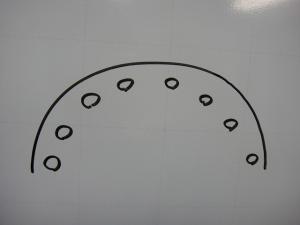
↑That's exactly what this diagram shows. Case closed.
But I can't leave it at that, so...
First, the part about "when the hub and rim have the same number of holes and they're evenly spaced"—that's basically just saying normal rims and spokes. One thing I left out: the spoke count has to be the same on both sides too.
Working from that assumption.
When you want to build a rim with y crosses on a normal rim, and you have x spokes total, the formula is:
y≦x/4. That's the range where you can actually build the wheel.
Speaking of which, I've never actually explained what "x-cross" means in wheel building, so let me cover that.
The diagram above is a hub flange.

When you count which holes on the hub flange the last pair of crossing spokes emerge from (viewing from the side), if the first and second spokes are crossing, that's 2-cross lacing.
Normally, crossing spokes are one inpoke and one outpoke, but in the diagram above they're both inpokes.
The part where they cross when viewed from the side—I'll call that part being "woven" from now on.
You can't actually weave a 2-cross intersection because of hub flange thickness.
But if you make both spokes of a 2-cross pair the same type—either both inpoke or both outpoke—then you can weave them even at 2-cross.
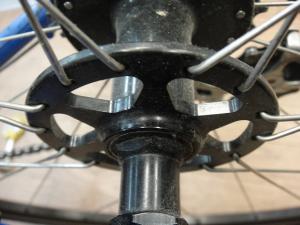
↑This is 2-cross inpoke lacing
Quick tangent—let me explain "weaving" while I'm at it.
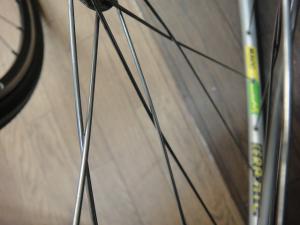
This is a Mavic Ksyrium CD Ceramic, but never mind the rim bragging (laughs).
See how the spoke intersections are in contact? That's "weaving."
Weaving spokes makes the wheel more resistant to lateral twist and less prone to runout.
The downside is that if spoke tension is low, you get annoying creaking noises.
I absolutely hate the black spokes used on so many complete wheels, and one reason is "black spokes creak more easily."
The other reason is "you basically can't solder them at the crossings."
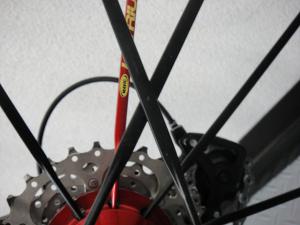
↑With aluminum spokes like Ksyrium,
even when spokes appear to cross from the side view,
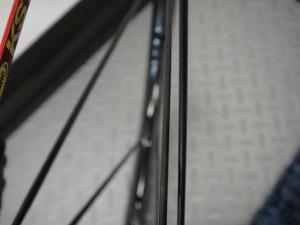
from the front-to-back view, they're not woven.
Aluminum spokes wear so much more easily than steel—incomparably so—that this is a necessary precaution. Yet complete wheels often don't weave even with steel spokes.
The current Ksyrium Elite uses aero steel spokes tensioned abnormally high, and they ARE woven.
Seeing that, I think "yeah, I just can't compete with that kind of quality in complete wheels."
Back to tangent lacing.
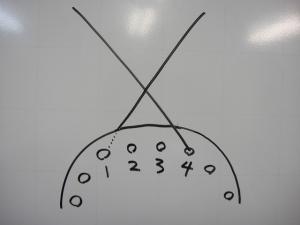
↑This is 4-cross. The 1st and 4th spokes cross.
At 4-cross and above, you use one inpoke and one outpoke to create the crossing.

↑Next, 6-cross.
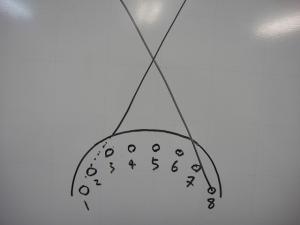
↑And finally, 8-cross.
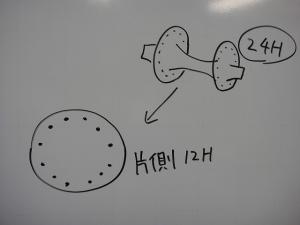
Let's say you want to build tangent lacing on a 24H hub.
24H means each flange has 12 holes.
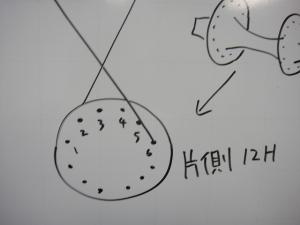
↑I tried 6-cross. No problem here.
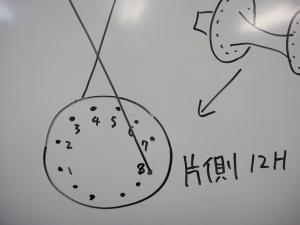
I tried 8-cross. Something's wrong here.
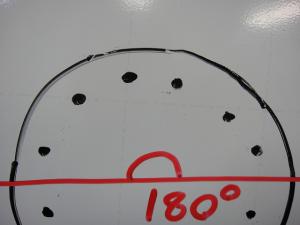
In tangent lacing, the phase angle between the holes where the last crossing spokes emerge cannot exceed 180 degrees.
(Technically it's not impossible if the spokes don't touch the hub shell, but there's no mechanical benefit.)
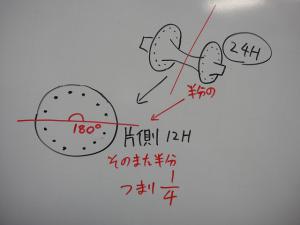
In normal tangent lacing, the maximum number of holes you can thread spokes through is half of half the total hub holes.
Half of half is one-quarter.
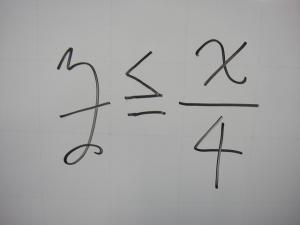
And there's the formula from the beginning.
Plug in x for your spoke count and y for the number of crosses, and you can instantly calculate the maximum crosses possible with x spokes or the minimum spokes needed for y-cross lacing.
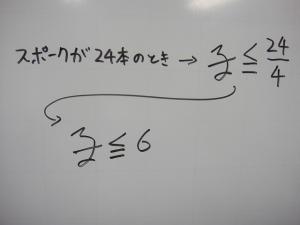
For example, with 24H, the maximum is 6-cross.
Since the inequality uses "≦," this means 4-cross, 2-cross, and even 0-cross (radial lacing) all work too.
8-cross doesn't work because the left side would be larger than the right.
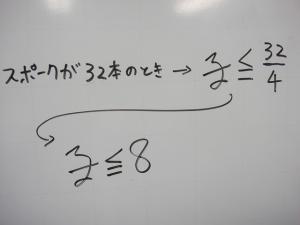
You can do 8-cross starting with 32H and up.
That's basically extinct as a spec now (no materials available), so I've never actually built one, but 40H would allow 10-cross.

This formula is pretty handy. For instance, if you imagine a hypothetical 200H hub, you can instantly calculate "the limit is 50-cross."
I often do thought experiments imagining a wheel around 120H where I systematically or randomly remove spokes to see what kind of stress changes occur (I know, I'm a bit odd), and this formula comes in really useful there.
In real wheels, this leads to "you can't do 6-cross on a 20H rim, but you can barely do it on 24H".
That's a story for another day.
Today I'm covering the limits on how many crosses you can build with tangent lacing.
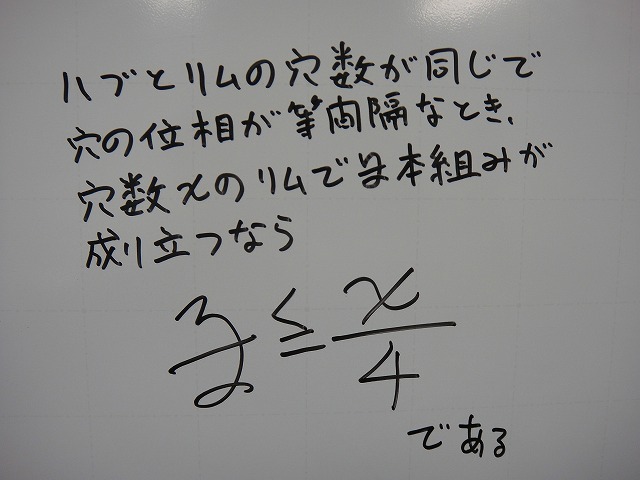
↑That's exactly what this diagram shows. Case closed.
But I can't leave it at that, so...
First, the part about "when the hub and rim have the same number of holes and they're evenly spaced"—that's basically just saying normal rims and spokes. One thing I left out: the spoke count has to be the same on both sides too.
Working from that assumption.
When you want to build a rim with y crosses on a normal rim, and you have x spokes total, the formula is:
y≦x/4. That's the range where you can actually build the wheel.
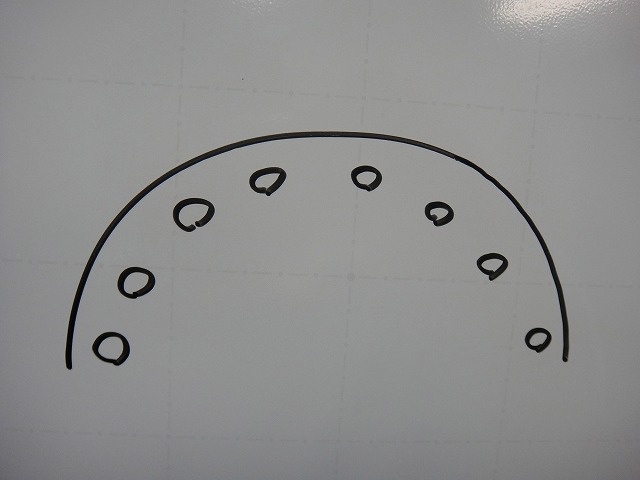
Speaking of which, I've never actually explained what "x-cross" means in wheel building, so let me cover that.
The diagram above is a hub flange.
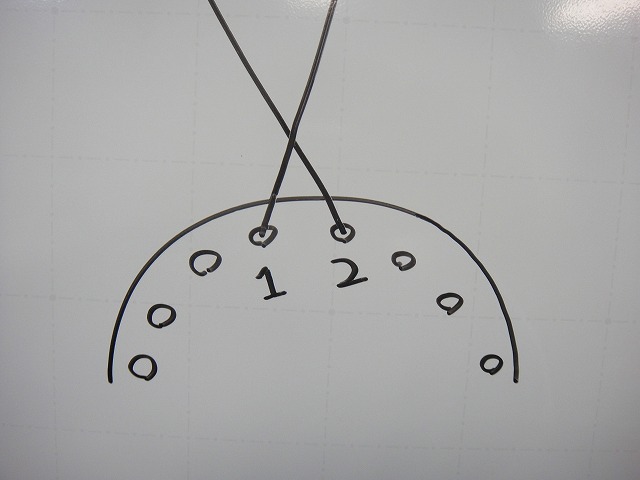
When you count which holes on the hub flange the last pair of crossing spokes emerge from (viewing from the side), if the first and second spokes are crossing, that's 2-cross lacing.
Normally, crossing spokes are one inpoke and one outpoke, but in the diagram above they're both inpokes.
The part where they cross when viewed from the side—I'll call that part being "woven" from now on.
You can't actually weave a 2-cross intersection because of hub flange thickness.
But if you make both spokes of a 2-cross pair the same type—either both inpoke or both outpoke—then you can weave them even at 2-cross.
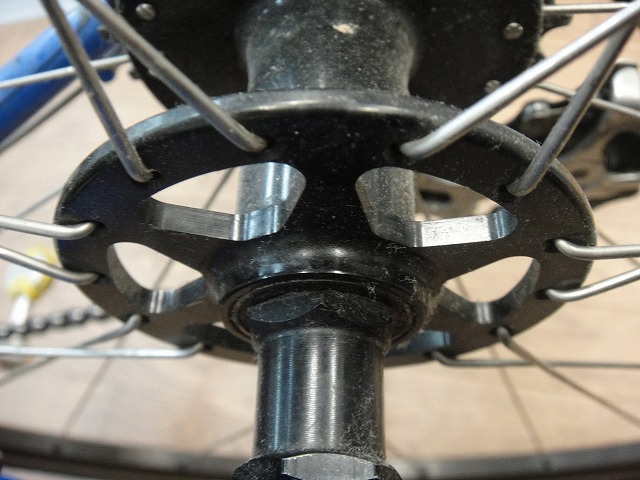
↑This is 2-cross inpoke lacing
Quick tangent—let me explain "weaving" while I'm at it.
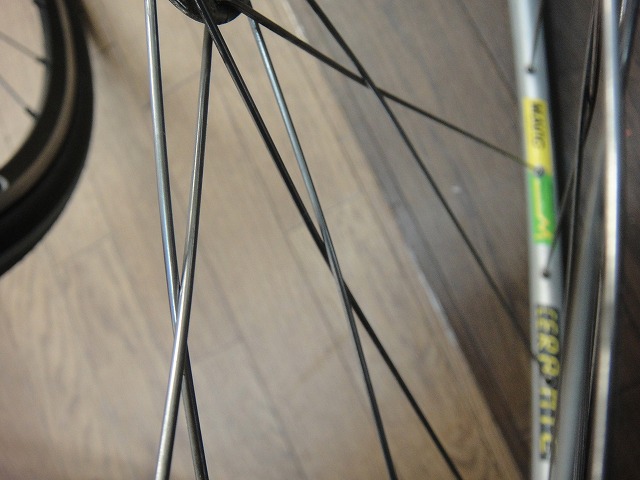
This is a Mavic Ksyrium CD Ceramic, but never mind the rim bragging (laughs).
See how the spoke intersections are in contact? That's "weaving."
Weaving spokes makes the wheel more resistant to lateral twist and less prone to runout.
The downside is that if spoke tension is low, you get annoying creaking noises.
I absolutely hate the black spokes used on so many complete wheels, and one reason is "black spokes creak more easily."
The other reason is "you basically can't solder them at the crossings."
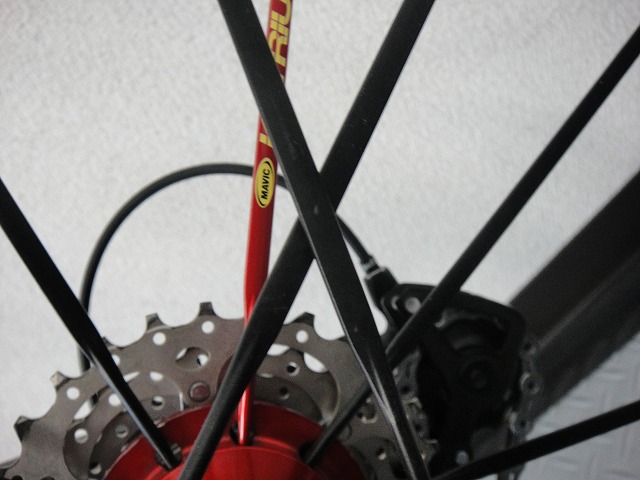
↑With aluminum spokes like Ksyrium,
even when spokes appear to cross from the side view,
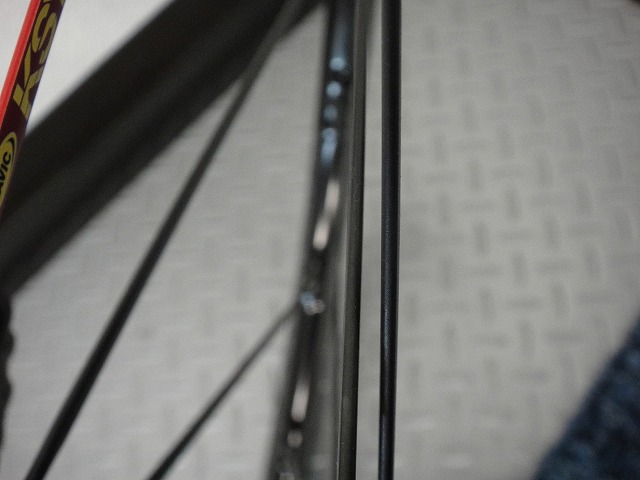
from the front-to-back view, they're not woven.
Aluminum spokes wear so much more easily than steel—incomparably so—that this is a necessary precaution. Yet complete wheels often don't weave even with steel spokes.
The current Ksyrium Elite uses aero steel spokes tensioned abnormally high, and they ARE woven.
Seeing that, I think "yeah, I just can't compete with that kind of quality in complete wheels."
Back to tangent lacing.

↑This is 4-cross. The 1st and 4th spokes cross.
At 4-cross and above, you use one inpoke and one outpoke to create the crossing.

↑Next, 6-cross.
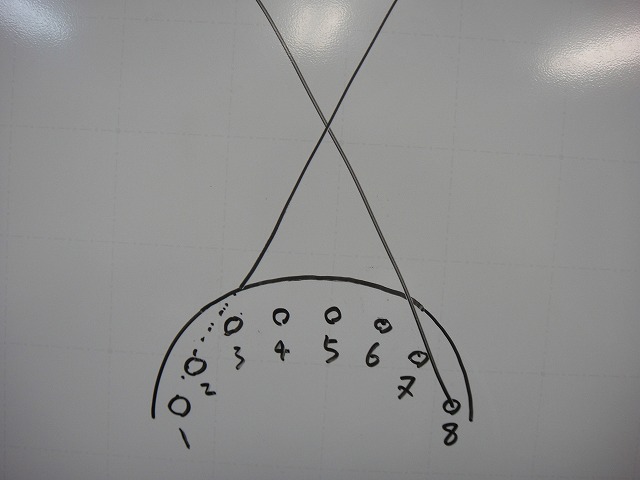
↑And finally, 8-cross.
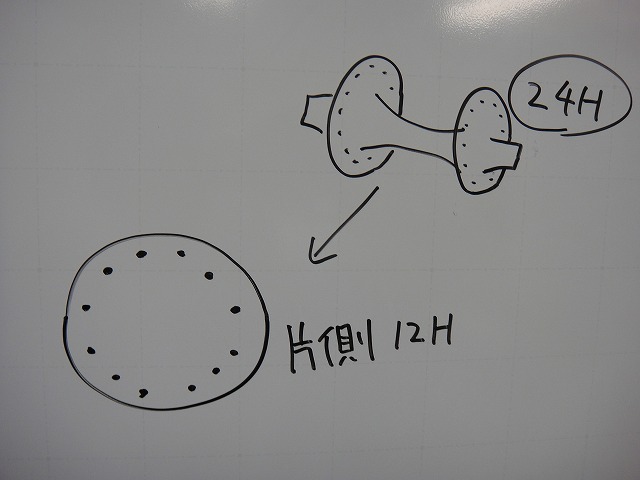
Let's say you want to build tangent lacing on a 24H hub.
24H means each flange has 12 holes.
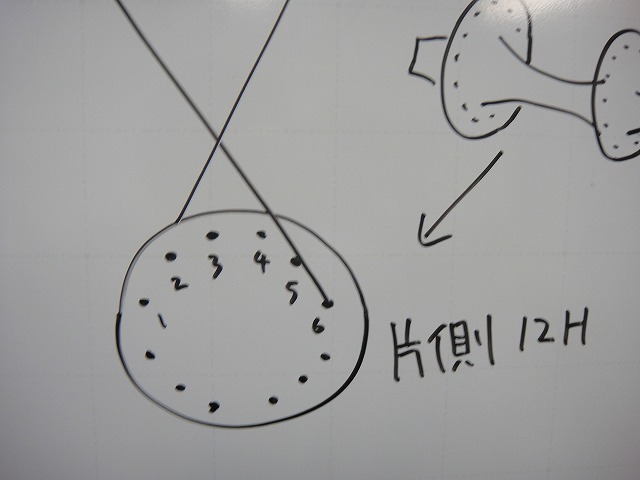
↑I tried 6-cross. No problem here.
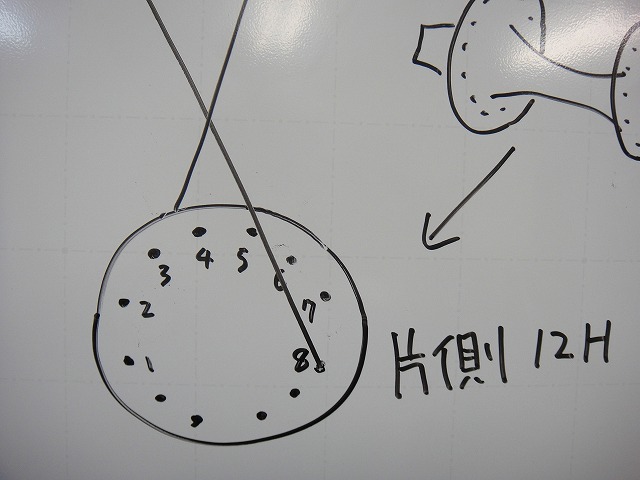
I tried 8-cross. Something's wrong here.
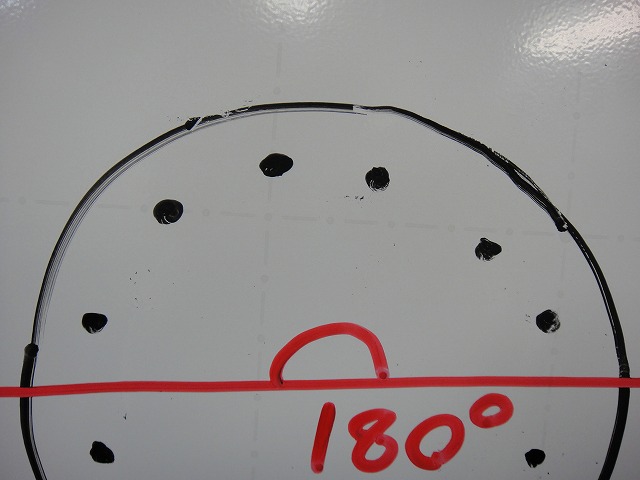
In tangent lacing, the phase angle between the holes where the last crossing spokes emerge cannot exceed 180 degrees.
(Technically it's not impossible if the spokes don't touch the hub shell, but there's no mechanical benefit.)

In normal tangent lacing, the maximum number of holes you can thread spokes through is half of half the total hub holes.
Half of half is one-quarter.

And there's the formula from the beginning.
Plug in x for your spoke count and y for the number of crosses, and you can instantly calculate the maximum crosses possible with x spokes or the minimum spokes needed for y-cross lacing.
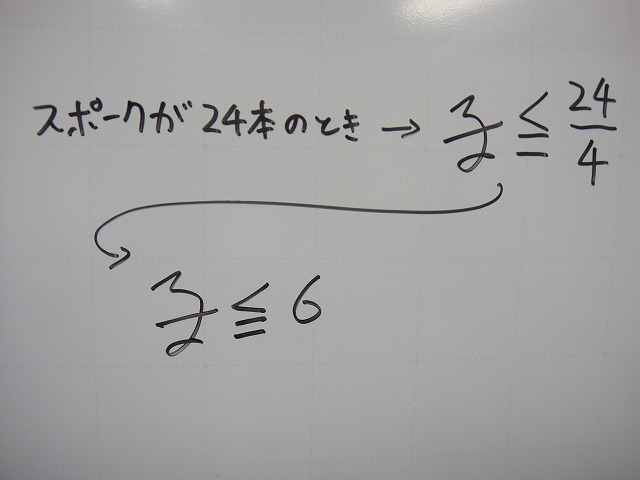
For example, with 24H, the maximum is 6-cross.
Since the inequality uses "≦," this means 4-cross, 2-cross, and even 0-cross (radial lacing) all work too.
8-cross doesn't work because the left side would be larger than the right.
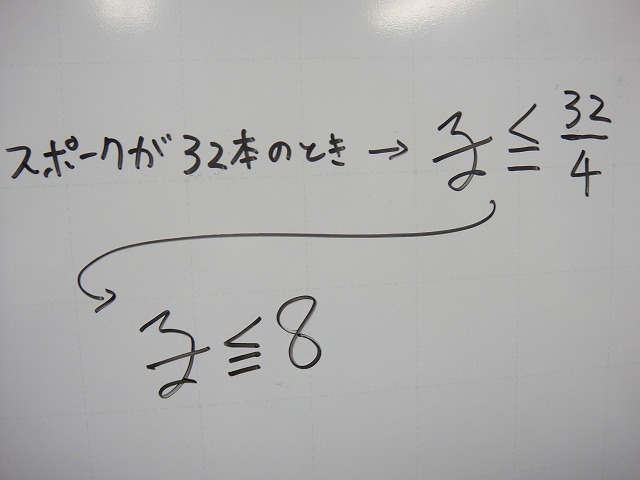
You can do 8-cross starting with 32H and up.
That's basically extinct as a spec now (no materials available), so I've never actually built one, but 40H would allow 10-cross.
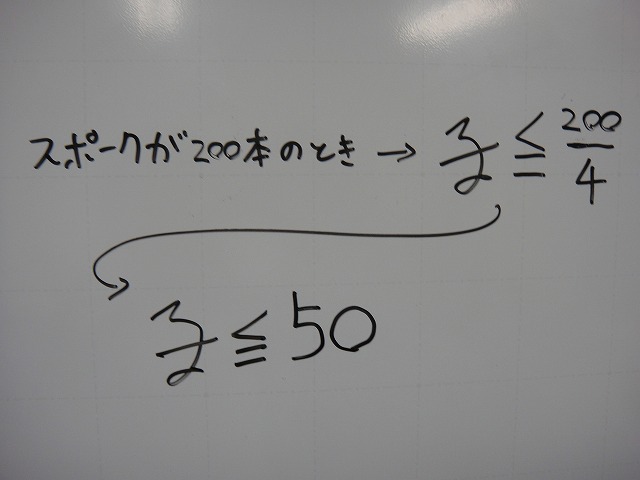
This formula is pretty handy. For instance, if you imagine a hypothetical 200H hub, you can instantly calculate "the limit is 50-cross."
I often do thought experiments imagining a wheel around 120H where I systematically or randomly remove spokes to see what kind of stress changes occur (I know, I'm a bit odd), and this formula comes in really useful there.
In real wheels, this leads to "you can't do 6-cross on a 20H rim, but you can barely do it on 24H".
That's a story for another day.