In my previous discussion about wheels, I wrote that changing the spoke thickness (=cross-sectional area) between the drive and non-drive sides might help correct spoke tension differences.

↑This is 2.0mm plain on the freewheel side and CX-RAY on the non-freewheel side.
As I mentioned before, even in Park Tool's tension gauge conversion chart, there's a noticeable difference in the measured deflection and estimated spoke tension between 2.0mm and 1.8mm plain spokes. So using different spoke sizes left and right does seem to have some merit. However, I do have concerns about whether using heavier spokes would be generally accepted in the current situation where "everyone and their cousin is using CX-RAY".
Even if I say "this makes for a better-performing wheel!" or "the added weight isn't on the outer edge!", the fact that the wheel becomes slightly heavier just doesn't sell well.
But then yesterday, a customer gave me some very welcome information: "Reynolds wheels use different-diameter spokes on left and right sides." Indeed, some of their models do have this design. I felt a bit more confident.
While Reynolds wheels and my wheels may not have identical reasons for using different-diameter spokes, the fact that two unrelated parties with no connection reached the same conclusion is almost like convergent evolution.
Currently, Nomu Lab wheels don't use different-diameter spokes as standard, but if we do make that a standard specification in the future, being able to say "Reynolds does the same thing" will be one piece of supporting evidence. That's what's so helpful about this.
That said, my insistence on building the rear wheel with straight spokes even at fairly tall rim heights is my own bias.
But without doing this, I can't differentiate from off-the-shelf wheels.
I display built wheels because I want people to actually handle and feel a rigid, performance-focused wheel that benefits from a slight weight increase.
Campagnolo's Hyperion also uses different-diameter spokes, but they exploit the privileges of complete assembly with ultra-high/low flange hubs and straight spokes. Reynolds, on the other hand, uses butted spokes with more modest hub flanges.
What's nice is that they're achieving different-diameter spoke design with ordinary hubs.
That's Reynolds sensei for you.
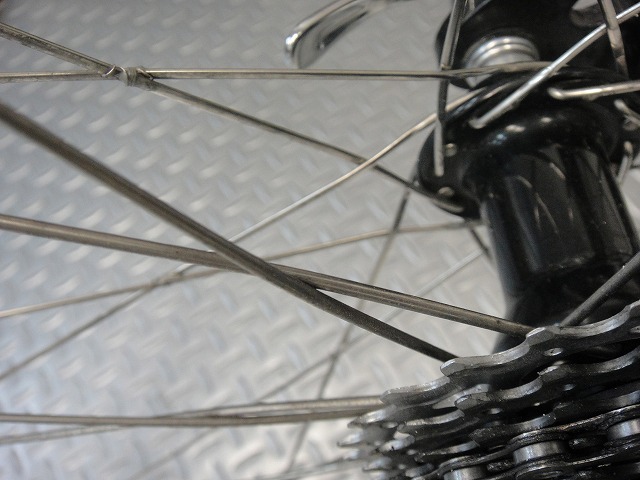
↑This is 2.0mm plain on the freewheel side and CX-RAY on the non-freewheel side.
As I mentioned before, even in Park Tool's tension gauge conversion chart, there's a noticeable difference in the measured deflection and estimated spoke tension between 2.0mm and 1.8mm plain spokes. So using different spoke sizes left and right does seem to have some merit. However, I do have concerns about whether using heavier spokes would be generally accepted in the current situation where "everyone and their cousin is using CX-RAY".
Even if I say "this makes for a better-performing wheel!" or "the added weight isn't on the outer edge!", the fact that the wheel becomes slightly heavier just doesn't sell well.
But then yesterday, a customer gave me some very welcome information: "Reynolds wheels use different-diameter spokes on left and right sides." Indeed, some of their models do have this design. I felt a bit more confident.
While Reynolds wheels and my wheels may not have identical reasons for using different-diameter spokes, the fact that two unrelated parties with no connection reached the same conclusion is almost like convergent evolution.
Currently, Nomu Lab wheels don't use different-diameter spokes as standard, but if we do make that a standard specification in the future, being able to say "Reynolds does the same thing" will be one piece of supporting evidence. That's what's so helpful about this.
That said, my insistence on building the rear wheel with straight spokes even at fairly tall rim heights is my own bias.
But without doing this, I can't differentiate from off-the-shelf wheels.
I display built wheels because I want people to actually handle and feel a rigid, performance-focused wheel that benefits from a slight weight increase.
Campagnolo's Hyperion also uses different-diameter spokes, but they exploit the privileges of complete assembly with ultra-high/low flange hubs and straight spokes. Reynolds, on the other hand, uses butted spokes with more modest hub flanges.
What's nice is that they're achieving different-diameter spoke design with ordinary hubs.
That's Reynolds sensei for you.