A while back, I built a wheel using a Novatec (Japanese wheel hub brand) 2:1 spoke hub at our shop.
I've done center truing on Bora wheels too, and I've built the original Racing 1 from scratch.
I've received about five comments asking something like "What do you think about 2:1 spoke wheels?"
so I'll write down my own thoughts on the matter.
Before that though. When truing a wheel, consider
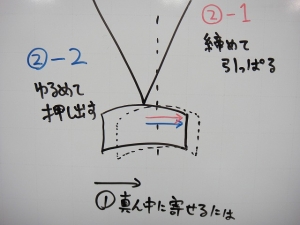
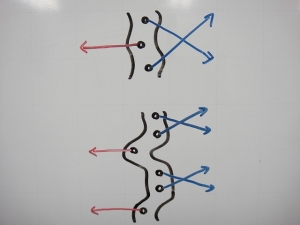
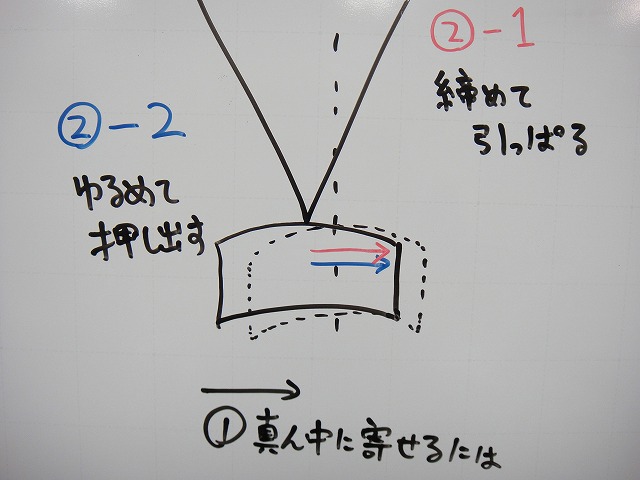
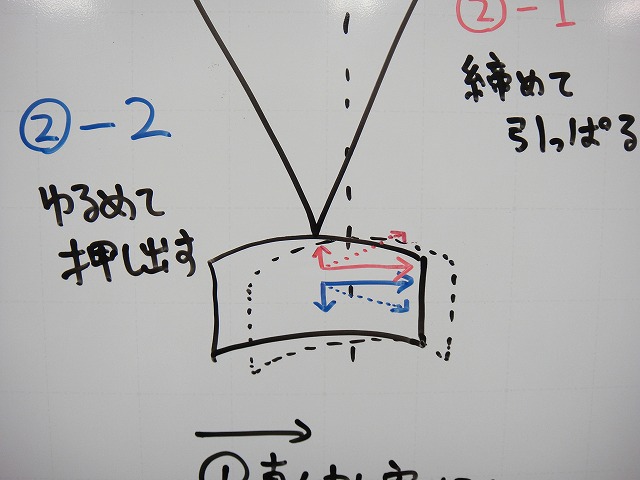
a situation like in the diagram above where you want to bring the rim back to center.
To move it to the middle, you either tighten the nipples to pull the rim
or loosen the nipples on the opposite side to push it out.
When it comes to lateral runout, tightening and loosening look the same.
The red and blue arrows in the diagram above actually overlap,
but I've shifted them slightly to make it easier to see.
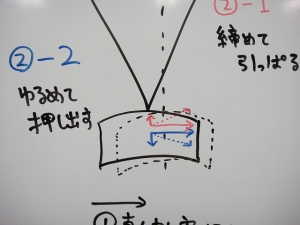
Even though tightening and loosening nipples have the same effect on lateral runout,
they differ when it comes to radial runout.
Tightening moves the rim inward, while loosening moves it outward.
So the rim's movement becomes a combination of lateral and radial,
creating something like the broken line in the diagram above.
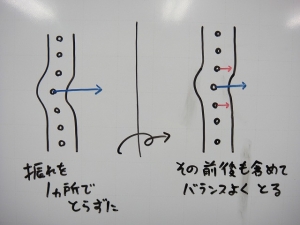
When correcting lateral runout, if you only adjust the nipples at the point of maximum deflection,
you'll introduce radial runout. That's why it's common to simultaneously adjust
the nipples before and after that point to counteract the radial distortion.
In my opinion, this nuance is something only people who've actually built wheels would understand,
so I don't think someone who says "I can true wheels but can't build them" really qualifies as being able to true.
Bringing a partially-built wheel to that person's own "I've finished it!" compromise point
and wheel truing are probably the same operation.
To achieve the highest possible precision in radial truing,
it's best if the rim holes are evenly spaced and the spokes pull in alternating directions.
In other words, a normal wheel is the best.
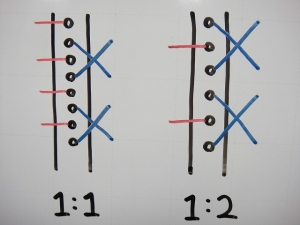
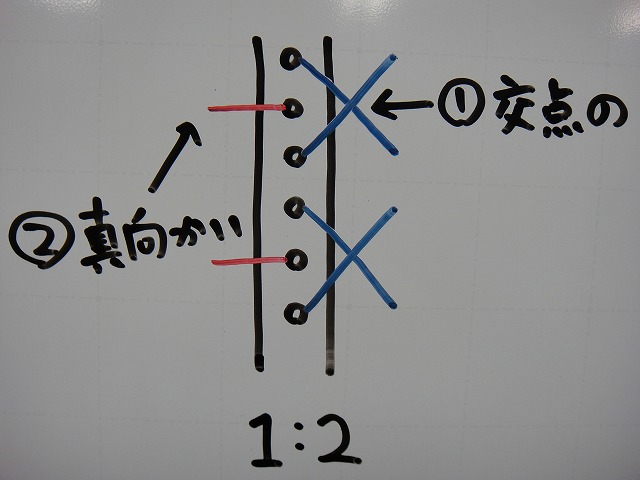
In a 2:1 wheel like in the diagram above, where two consecutive freewheel-side spokes (blue) continue,
if you want to move the rim toward the non-freewheel side in that area,
you have no choice but to loosen the freewheel-side nipples.
The rim moves outward in that section,
but there's no way to bring it back inward (without introducing lateral runout).
With complete wheels, spoke tension is usually high, so
rims for 2:1 spoke wheels ideally need to be ones where spoke tension doesn't easily translate to radial runout
= stiffer ≈ heavier rims.
Since there's no rim with perfect rigidity when it comes to radial runout,
2:1 spoke wheels essentially have to abandon precise radial truing.
The compromise seems to be "as long as radial runout is less than the tire's contact patch deformation, you won't notice it while riding,"
but that's a point I find hard to accept.
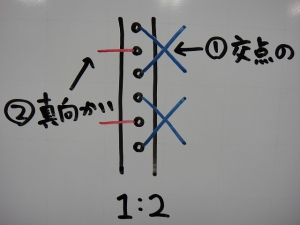
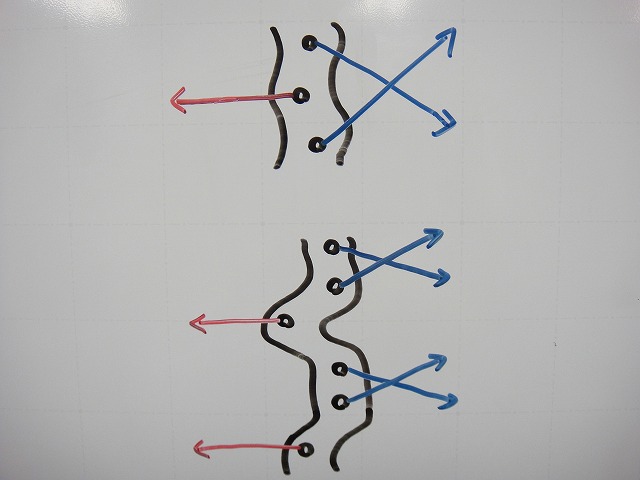
Since the rim isn't perfectly rigid laterally either, it's desirable for the non-freewheel-side radial lacing
to be directly opposite the crossing point of the freewheel-side tangential lacing.
This way the rim deformation is more balanced left and right,
which results in less lateral runout.
The non-freewheel side is fixed to radial lacing because
if you do tangential lacing on the non-freewheel side with 2:1 spokes,
spoke tension could reverse between left and right sides depending on conditions.
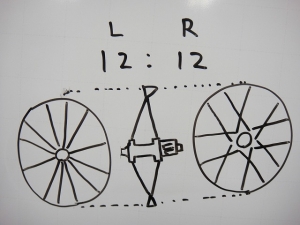
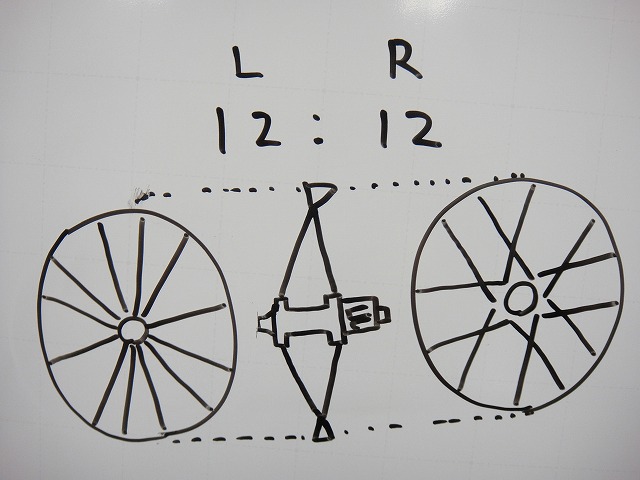
From here on I'll compare spoke counts to the diagrams,
so I'll express them as "left:right".
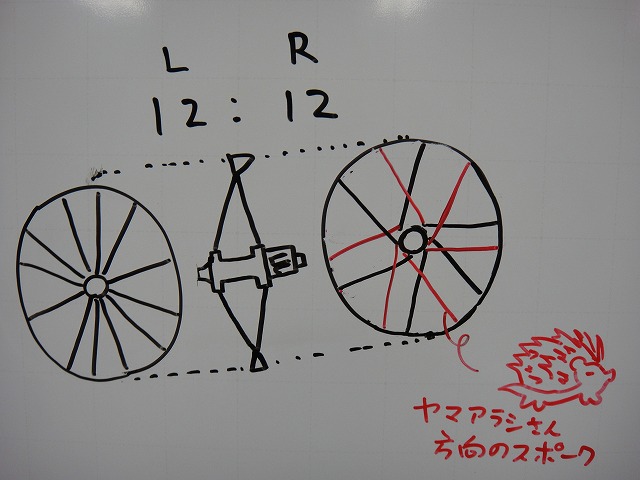
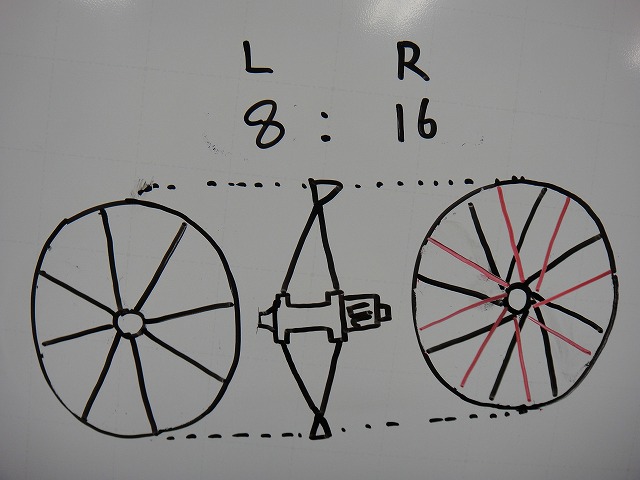
For 1:2 spokes on a 24H wheel, that's 8:16 spokes.
Comparing this when the freewheel side has 16 spokes, it's the same as a 32H wheel with 16:16,
but to match the total spoke count on both sides,
I'll compare it to a 12:12 24H wheel.
I'll continue assuming non-freewheel-side radial lacing and freewheel-side tangential lacing.
The merit of 1:2 spokes (gained even at the cost of abandoning radial truing)
is that the spoke tension between left and right becomes very close,
but it also has an advantage in having more freewheel-side spokes.
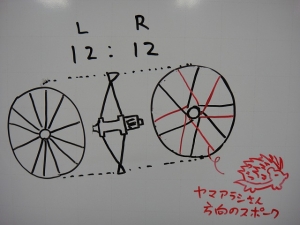
Pedaling power is transmitted to the rim and tire mainly through the freewheel-side spokes,
and more specifically, through the spokes in the "porcupine" direction (the red spokes in the diagram above).
To put it extremely, I even think that in the instant you stomp hard on the pedals,
only the spokes in the porcupine direction really exist in terms of driving efficiency.
If you take this logic to its extreme, the more spokes you have in the porcupine direction,
the better the driving efficiency becomes.
For a 12:12 24H wheel, that's 6 spokes, but
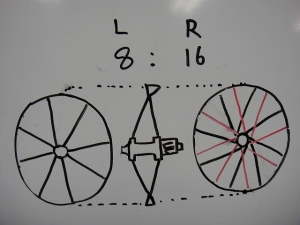
for an 8:16 24H wheel, that's 8 spokes.
Shouldn't this be considered another merit of asymmetric spoke wheels?
However, I also have the idea that "the total spoke tension on one side of the wheel should be divided and supported by the number of spokes on that side,"
and based on that, 8 non-freewheel spokes seems like a lot of load per spoke,
which makes me worry whether spoke breakage would become more likely.
(Especially with bent-elbow spokes.) The rim-side load would also increase.
That's the RK (the force with which the nipple tries to tear through the rim) mentioned in this blog.
Regarding this,
I received a comment saying:
"Regarding RK, if we ignore rim hole drilling variance,
and consider that left and right tension become nearly equal,
wouldn't there be no rim-side issue as long as we don't exceed the tension that the freewheel-side can handle?"
The idea being, for example, with 1:2 spokes at 120 kgf tension on both sides,
if the rim's stated limit is 130 kgf, it should be fine, right?
Strictly speaking, a rim breaks when spoke tension exceeds the rim's RK tolerance.
However, even if manufacturers showed the RK limit,
there's no practical way for wheel builders to actually measure RK,
so they only show it as an approximation using spoke tension.
Let me think about the case of maximum difference when building a 24H wheel with asymmetric spokes where left < right.
The minimum number of spokes for a functional spoked wheel on one side is 3.
So for 24H that would be 3:21, but
since 21 is odd, you can't do tangential lacing.
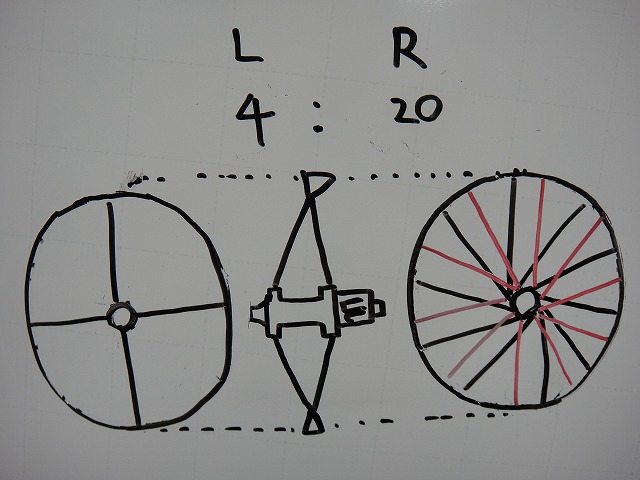
So 4:20 becomes the maximum spoke count difference for a 24H wheel.
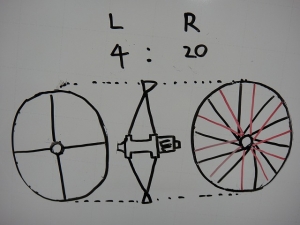
The freewheel-side porcupine spokes have become 10.
That's theoretically the maximum for a 24H wheel.
If you keep spoke diameter the same on both sides (same-diameter build)
and precisely adjust only the hub flange diameters,
you should be able to equalize left and right spoke tension even under these spoke count conditions.
But even if that tension stays below the rim's "stated spoke tension threshold,"
I really don't think spoke durability and RK would be the same as a 12:12 24H wheel.
With the logic of "dividing one side's load by the spoke count,"
the non-freewheel side is doing it with just 4 spokes.
If reducing the non-freewheel spoke count is OK as long as "spoke tension" is the same,
then a 4:20 24H wheel should be acceptable too.
It might seem extreme, but
12:12 → 8:16 → 4:20 is just increasing the number of porcupine spokes by 2 each
while keeping the 24H count the same.
Among these three,
I don't have a solid logical basis to say
"8:16 is the best compromise for 24H when weighing merits and demerits."
I can only see it as "8:16 has one foot in the door of 4:20 compared to 12:12."
So then if I do some creative variations on 12:12 with different diameters and different spoke counts...
that's the kind of wheel I usually build.
Though if I had the position of someone designing complete wheels from the hub up,
it would probably be different.
"We've found the optimal hub dimensions and rim hole spacing for 8:16!"
That kind of thing becomes possible.
But as for the merits of doing 1:2 lacing with off-the-shelf even-spaced-hole hubs and rims,
I don't think the merits outweigh the drawbacks.
To wrap up this long post:
asymmetric spoke wheels might be viable for specially-designed complete wheels,
but for hand-built wheels, I'd say you're probably better off not going that route.
That's my conclusion.
Bonus
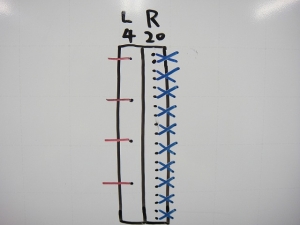
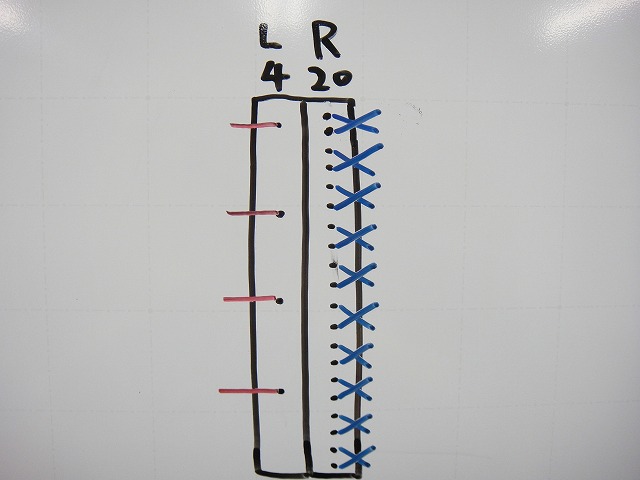
With a 4:20, you can't evenly space the spoke pull intervals no matter what you do.
Speaking of non-1:2 asymmetric spokes,
Colima (Japanese wheel brand) has a 20H rear wheel. It's 8:12.
Looking at the hole pattern on the rim as you go around one full revolution,
it goes RRLRLRRRLRLRRLRLRLR (R = regular side, L = left side or varying positions),
and the holes aren't even spaced.
The runout on this—both radial and lateral—is just really hard to true.
I've actually fixed center problems with it before,
but the radial runout compromise has to be pretty loose.
(I got it to equal or better than the radial runout before I touched it, though.)
I've done center truing on Bora wheels too, and I've built the original Racing 1 from scratch.
I've received about five comments asking something like "What do you think about 2:1 spoke wheels?"
so I'll write down my own thoughts on the matter.
Before that though. When truing a wheel, consider
a situation like in the diagram above where you want to bring the rim back to center.
To move it to the middle, you either tighten the nipples to pull the rim
or loosen the nipples on the opposite side to push it out.
When it comes to lateral runout, tightening and loosening look the same.
The red and blue arrows in the diagram above actually overlap,
but I've shifted them slightly to make it easier to see.
Even though tightening and loosening nipples have the same effect on lateral runout,
they differ when it comes to radial runout.
Tightening moves the rim inward, while loosening moves it outward.
So the rim's movement becomes a combination of lateral and radial,
creating something like the broken line in the diagram above.

When correcting lateral runout, if you only adjust the nipples at the point of maximum deflection,
you'll introduce radial runout. That's why it's common to simultaneously adjust
the nipples before and after that point to counteract the radial distortion.
In my opinion, this nuance is something only people who've actually built wheels would understand,
so I don't think someone who says "I can true wheels but can't build them" really qualifies as being able to true.
Bringing a partially-built wheel to that person's own "I've finished it!" compromise point
and wheel truing are probably the same operation.

To achieve the highest possible precision in radial truing,
it's best if the rim holes are evenly spaced and the spokes pull in alternating directions.
In other words, a normal wheel is the best.
In a 2:1 wheel like in the diagram above, where two consecutive freewheel-side spokes (blue) continue,
if you want to move the rim toward the non-freewheel side in that area,
you have no choice but to loosen the freewheel-side nipples.
The rim moves outward in that section,
but there's no way to bring it back inward (without introducing lateral runout).
With complete wheels, spoke tension is usually high, so
rims for 2:1 spoke wheels ideally need to be ones where spoke tension doesn't easily translate to radial runout
= stiffer ≈ heavier rims.
Since there's no rim with perfect rigidity when it comes to radial runout,
2:1 spoke wheels essentially have to abandon precise radial truing.
The compromise seems to be "as long as radial runout is less than the tire's contact patch deformation, you won't notice it while riding,"
but that's a point I find hard to accept.
Since the rim isn't perfectly rigid laterally either, it's desirable for the non-freewheel-side radial lacing
to be directly opposite the crossing point of the freewheel-side tangential lacing.
This way the rim deformation is more balanced left and right,
which results in less lateral runout.
The non-freewheel side is fixed to radial lacing because
if you do tangential lacing on the non-freewheel side with 2:1 spokes,
spoke tension could reverse between left and right sides depending on conditions.
From here on I'll compare spoke counts to the diagrams,
so I'll express them as "left:right".
For 1:2 spokes on a 24H wheel, that's 8:16 spokes.
Comparing this when the freewheel side has 16 spokes, it's the same as a 32H wheel with 16:16,
but to match the total spoke count on both sides,
I'll compare it to a 12:12 24H wheel.
I'll continue assuming non-freewheel-side radial lacing and freewheel-side tangential lacing.
The merit of 1:2 spokes (gained even at the cost of abandoning radial truing)
is that the spoke tension between left and right becomes very close,
but it also has an advantage in having more freewheel-side spokes.
Pedaling power is transmitted to the rim and tire mainly through the freewheel-side spokes,
and more specifically, through the spokes in the "porcupine" direction (the red spokes in the diagram above).
To put it extremely, I even think that in the instant you stomp hard on the pedals,
only the spokes in the porcupine direction really exist in terms of driving efficiency.
If you take this logic to its extreme, the more spokes you have in the porcupine direction,
the better the driving efficiency becomes.
For a 12:12 24H wheel, that's 6 spokes, but
for an 8:16 24H wheel, that's 8 spokes.
Shouldn't this be considered another merit of asymmetric spoke wheels?
However, I also have the idea that "the total spoke tension on one side of the wheel should be divided and supported by the number of spokes on that side,"
and based on that, 8 non-freewheel spokes seems like a lot of load per spoke,
which makes me worry whether spoke breakage would become more likely.
(Especially with bent-elbow spokes.) The rim-side load would also increase.
That's the RK (the force with which the nipple tries to tear through the rim) mentioned in this blog.
Regarding this,
I received a comment saying:
"Regarding RK, if we ignore rim hole drilling variance,
and consider that left and right tension become nearly equal,
wouldn't there be no rim-side issue as long as we don't exceed the tension that the freewheel-side can handle?"
The idea being, for example, with 1:2 spokes at 120 kgf tension on both sides,
if the rim's stated limit is 130 kgf, it should be fine, right?
Strictly speaking, a rim breaks when spoke tension exceeds the rim's RK tolerance.
However, even if manufacturers showed the RK limit,
there's no practical way for wheel builders to actually measure RK,
so they only show it as an approximation using spoke tension.
Let me think about the case of maximum difference when building a 24H wheel with asymmetric spokes where left < right.
The minimum number of spokes for a functional spoked wheel on one side is 3.
So for 24H that would be 3:21, but
since 21 is odd, you can't do tangential lacing.
So 4:20 becomes the maximum spoke count difference for a 24H wheel.
The freewheel-side porcupine spokes have become 10.
That's theoretically the maximum for a 24H wheel.
If you keep spoke diameter the same on both sides (same-diameter build)
and precisely adjust only the hub flange diameters,
you should be able to equalize left and right spoke tension even under these spoke count conditions.
But even if that tension stays below the rim's "stated spoke tension threshold,"
I really don't think spoke durability and RK would be the same as a 12:12 24H wheel.
With the logic of "dividing one side's load by the spoke count,"
the non-freewheel side is doing it with just 4 spokes.
If reducing the non-freewheel spoke count is OK as long as "spoke tension" is the same,
then a 4:20 24H wheel should be acceptable too.
It might seem extreme, but
12:12 → 8:16 → 4:20 is just increasing the number of porcupine spokes by 2 each
while keeping the 24H count the same.
Among these three,
I don't have a solid logical basis to say
"8:16 is the best compromise for 24H when weighing merits and demerits."
I can only see it as "8:16 has one foot in the door of 4:20 compared to 12:12."
So then if I do some creative variations on 12:12 with different diameters and different spoke counts...
that's the kind of wheel I usually build.
Though if I had the position of someone designing complete wheels from the hub up,
it would probably be different.
"We've found the optimal hub dimensions and rim hole spacing for 8:16!"
That kind of thing becomes possible.
But as for the merits of doing 1:2 lacing with off-the-shelf even-spaced-hole hubs and rims,
I don't think the merits outweigh the drawbacks.
To wrap up this long post:
asymmetric spoke wheels might be viable for specially-designed complete wheels,
but for hand-built wheels, I'd say you're probably better off not going that route.
That's my conclusion.
Bonus
With a 4:20, you can't evenly space the spoke pull intervals no matter what you do.
Speaking of non-1:2 asymmetric spokes,
Colima (Japanese wheel brand) has a 20H rear wheel. It's 8:12.
Looking at the hole pattern on the rim as you go around one full revolution,
it goes RRLRLRRRLRLRRLRLRLR (R = regular side, L = left side or varying positions),
and the holes aren't even spaced.
The runout on this—both radial and lateral—is just really hard to true.
I've actually fixed center problems with it before,
but the radial runout compromise has to be pretty loose.
(I got it to equal or better than the radial runout before I touched it, though.)