An apology and correction! (→see here)
I could edit the post, but I want to keep things like this as-is
so I'm leaving it unchanged.
Regarding the American Classic hub with slitted holes from the other day (→see here)
I received a comment along the lines of:
"If you're willing to accept the valve hole ending up in the final crossing bundle,
you can do both JIS lacing and Italian lacing, but..."
And then: "Isn't the real issue with this hub actually that 'if you lace avoiding the slit,
there's a possibility the spokes will cross over the valve hole'?"
What they were questioning was my statement that
"this hub is limited to either JIS or Italian lacing"—
they were saying "isn't that a bit off base?"
They're right, but the rule that "the valve hole must not be in the crossing bundle,
it must be in the gap between them" is absolutely critical to my wheel-building approach.
(That's why I poke a screwdriver into the valve hole during mock-up to verify this.)
I'd rather build an ugly wheel with the valve hole in the crossing bundle as JIS lacing
than build it as Italian lacing. No way. If I'm going to build a wheel,
the valve hole has to sit properly in the gap between spoke crossings—that's non-negotiable for me.
Whether it's same-count or mixed-count lacing on left and right flanges,
switching between JIS and Italian reverses the right-drop/left-drop relationship,
but the whole reason I worry about right-drop versus left-drop in the first place
is precisely so the valve hole doesn't end up in the crossing bundle.
Even if a wheel turned out fine performance-wise after I laced it Italian while avoiding the slit
and the valve hole ended up in the crossing bundle, I wouldn't want to sell it.
So the idea of "the valve hole can be in the crossing bundle"
never even occurred to me.
That's why I wrote that the hub is limited to either JIS or Italian lacing—
because if we're working under the condition that the valve hole must be in the gap,
that constraint really does hold.
To someone who thinks "it's okay if the valve hole is in the crossing,
that's acceptable," my phrasing probably sounds off-base.
But since I've never (at least on any wheel I've sold) built a wheel that way,
that hub with its slit really is limited to JIS or Italian lacing in my book,
so that's how I expressed it.
ADDENDUM: Now that I'm back in an environment
with a whiteboard and camera, I'm adding more.
Some of the wording overlaps with what came before, but please bear with me.
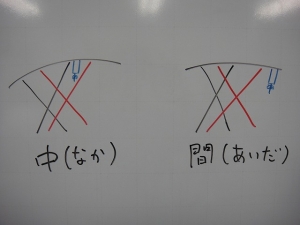
I'm going to call it "in" (中) when the valve hole is inside the crossing bundle,
and "between" (間) when it's in the gap between crossings.
That American Classic hub with the slit, if we stick to "between" positioning,
really is limited to either JIS or Italian lacing.
But regarding that word "limited,"
I got a comment saying "if you do 'in' lacing, you can do both JIS and Italian,
so isn't that a bit off?"
I exclude hideously ugly "in"-positioned wheels from my concept of what a wheel should be,
which is why I said it's limited to JIS or Italian.
If "in" positioning were acceptable, you could lace a 4-6 Italian rear wheel
with left-drop just fine.
You'd just tell the customer:
"I'm building your 24-spoke rear wheel, and I think 4-6 lacing gives better balance
than 4-4, so I'm doing 4-6. It'll be 'in' positioned though—sorry about the looks."
I can't do that, so I build my 24-spoke 4-6 Italian wheels with right-drop (laughs).
The whole concept of right-drop and left-drop exists in the first place
as a way to always achieve "between" positioning.
Bringing up examples where you abandon that seems wrong to me.
The absolute prerequisite is "between" positioning,
and then (in my case) ideally Italian lacing on top of that.
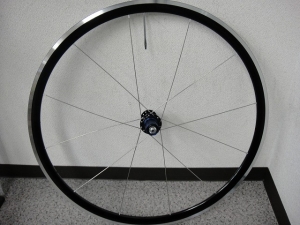
Doing a mock-up of a 24-spoke rear wheel.
I've laced only the freewheel side, 4-spoke through.

When the valve hole is straight up, the spoke exiting the hole to the left
comes out from the near flange (from my perspective)—that rim hole orientation
I call "standard rim" on this blog.
It's the most common arrangement.
Exceptions exist on Campagnolo, Fulcrum, Colima, and similar,
which I call "reverse rim."
I laced this as standard rim.

With the inpokes heading porcupine-style,
depending on how I lace the non-freewheel side, the possible methods are Italian or JIS,
and impossible are reverse-Italian and reverse-JIS.

I laced the spokes with right-drop, and
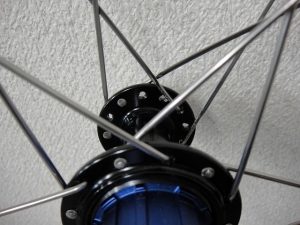
laced just two sets of 4 spokes—6-spoke total—as JIS.
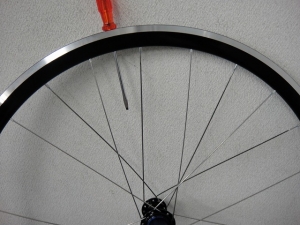
It's "in" positioned.
Wow, that's ugly!
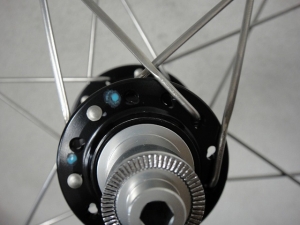
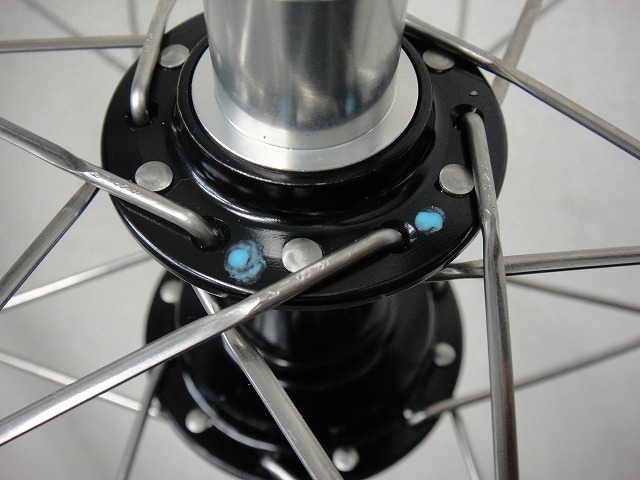
↑ In that state, I marked it blue.
This blue mark means: "Don't pull spokes in the direction of the slit."

↑ Here's what that means.

I re-laced the non-freewheel side's 4 spokes through the same rim holes
so they'd become Italian lacing instead.
Naturally, the spoke orientation changes too.
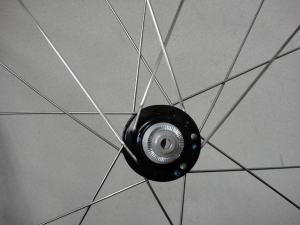
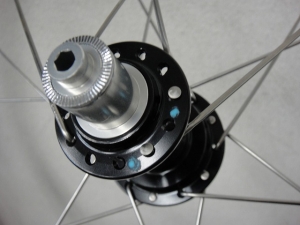
↑ No spokes pulled in the blue-marked direction.
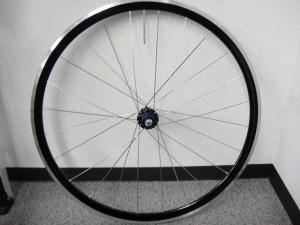
Then I laced the rest of the non-freewheel side spokes too.
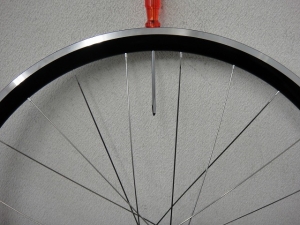
Now it's properly "between" positioned.
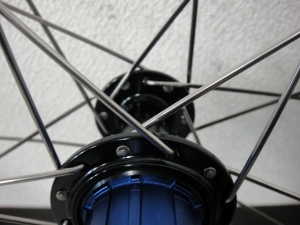
Italian lacing.
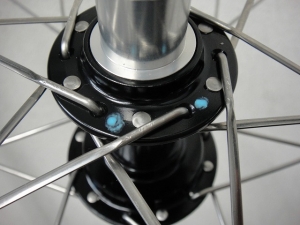
Once more for good measure.
The conversion between right-drop/left-drop with JIS/Italian lacing switching,
and how the slit direction also reverses—I think you can see that now.
In this example, right-drop 4-6 Italian lacing made the slit direction work out.
But what if it hadn't? Let me cover that too.
Solution #1: "Switch to 4-4 lacing"—well, that's obvious.
You can maintain "between" positioning while doing Italian lacing.
Now, thinking about the conditions where "between" and "in" swap:
First is: change between right-drop and left-drop.
Second is: make the left and right flange counts
a combination of (odd × 2) and (even × 2).
2-spoke lacing involves crossing outpokes and inpokes themselves,
which creates problems, so I'll exclude that.
For 4-spoke and above, there's 4-4, 6-8, 8-8, and so on,
but the practical case is basically just 4-6.
Third, if the rim allows it: treat it as a "reverse rim."
In that mock-up example, the XR300 rim can be laced as reverse too.
If "standard rim, right-drop 4-6 Italian gives 'between' positioning
but you're pulling the slit," you could solve it by
treating it as reverse rim—you'd stay "between" and not pull the slit.
So Solution #2 is: treat as reverse rim and lace (rim-dependent).
The point is: as long as there are ways to solve this without building
that aesthetically offensive "in"-positioned wheel,
the "in"-positioning option doesn't deserve a moment's consideration.
If that doesn't sit right, why not try lacing that 24-spoke 4-6 Italian
deliberately with left-drop to get "in" positioning?
Some might argue "for that American Classic hub with the slit,
building 'in' is unavoidable if you avoid the slit,"
but as long as there are ways to avoid it without the "in" position,
"unavoidable" it is not.
That hub with left-right same-count or with mixed (odd × 2) and (even × 2) counts,
when laced "between" as Italian, pulls the slit,
so I said it's limited to JIS.
The key point is solving that with 4-6 lacing and avoiding the slit
without going "in."
If 4-6 Italian pulled the slit, I'd have gone with 4-8.
With a 28-spoke rear hub and rim, that barely works.
For 28-spoke 4-8, if the rim is 700c low-profile,
it becomes what this blog calls true tangent lacing,
and spoke length might become unobtainable.
So every wheel makes me think hard about the lacing approach,
but while each individual wheel is just one of thousands I've built,
for that customer it might be their one and only—100% of what they have.
"I avoided the slit but ended up 'in,' I couldn't think of another way,
so here you go"—not every customer would accept that,
and more importantly, I wouldn't either.
The thought of that single wheel someone owns turning out
as a hideously ugly "in"-positioned wheel gives me chills.
So I'd never casually settle for "in" positioning—
it's unthinkable. "Between" positioning is the non-negotiable baseline,
and if that constraint holds, that hub really is normally laced
as JIS only.
Finally, let me give an example where "in" positioning really is unavoidable:
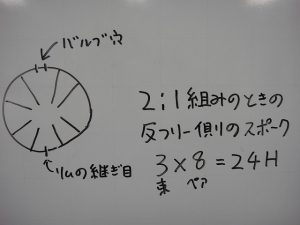
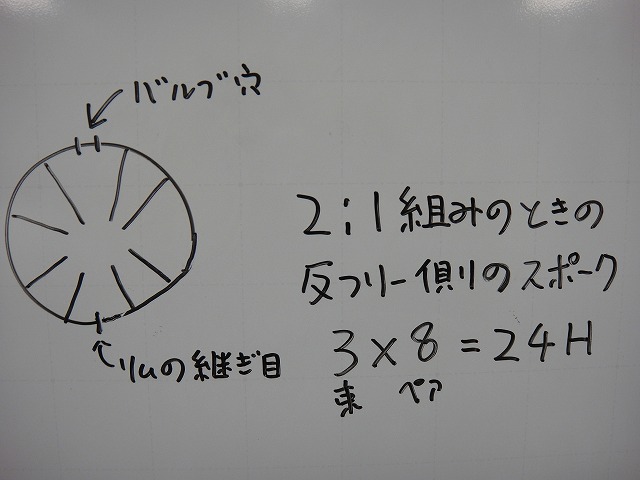
With Fulcrum-style 2:1 spoke lacing where
3 spokes from freewheel and non-freewheel sides form one bundle,
if the number of bundles is even, you can achieve "between" positioning.
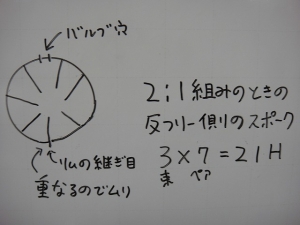
But with odd-spoke counts like 21-spoke,
you get an odd number of bundles, and the valve hole or rim joint
ends up coinciding with a rim hole,
so you have to shift the phase slightly.
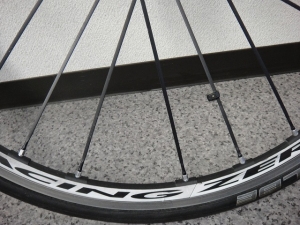
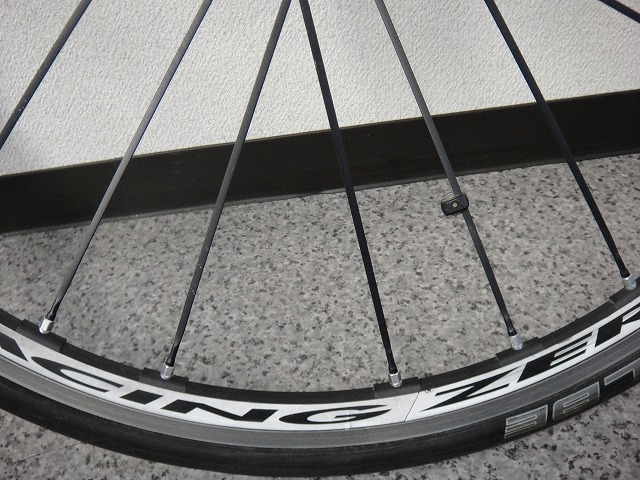
↑ The rim joint is around the middle of that "G."

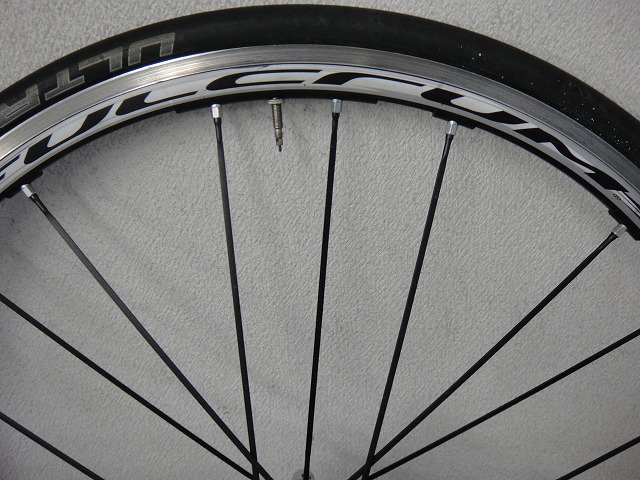
↑ And there, the valve hole ends up appearing to be in the spoke bundle "in."
That's truly unavoidable.
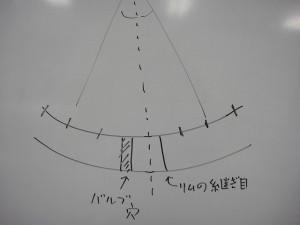
If you position the valve hole and rim joint equally far apart,
in the middle of the spoke bundles,
the looks improve somewhat, but
this rim has a thick seam wall and is heavy (→see here),
(maybe intentionally for balance),
so the valve hole has to be opposite the joint.
Addendum:
I received a comment (skipping the before/after) like:
"If the wheel arrived with valve hole 'in' positioning, I'd be very disappointed..."
Exactly right. When building an unfamiliar wheel, you really do think through tons of options.
Ideally the best lacing method, and if that's truly impossible,
at least a good alternative.
I think including "in" positioning as an option is actually an abdication of thought.
Thanks for the comment.
I could edit the post, but I want to keep things like this as-is
so I'm leaving it unchanged.
Regarding the American Classic hub with slitted holes from the other day (→see here)
I received a comment along the lines of:
"If you're willing to accept the valve hole ending up in the final crossing bundle,
you can do both JIS lacing and Italian lacing, but..."
And then: "Isn't the real issue with this hub actually that 'if you lace avoiding the slit,
there's a possibility the spokes will cross over the valve hole'?"
What they were questioning was my statement that
"this hub is limited to either JIS or Italian lacing"—
they were saying "isn't that a bit off base?"
They're right, but the rule that "the valve hole must not be in the crossing bundle,
it must be in the gap between them" is absolutely critical to my wheel-building approach.
(That's why I poke a screwdriver into the valve hole during mock-up to verify this.)
I'd rather build an ugly wheel with the valve hole in the crossing bundle as JIS lacing
than build it as Italian lacing. No way. If I'm going to build a wheel,
the valve hole has to sit properly in the gap between spoke crossings—that's non-negotiable for me.
Whether it's same-count or mixed-count lacing on left and right flanges,
switching between JIS and Italian reverses the right-drop/left-drop relationship,
but the whole reason I worry about right-drop versus left-drop in the first place
is precisely so the valve hole doesn't end up in the crossing bundle.
Even if a wheel turned out fine performance-wise after I laced it Italian while avoiding the slit
and the valve hole ended up in the crossing bundle, I wouldn't want to sell it.
So the idea of "the valve hole can be in the crossing bundle"
never even occurred to me.
That's why I wrote that the hub is limited to either JIS or Italian lacing—
because if we're working under the condition that the valve hole must be in the gap,
that constraint really does hold.
To someone who thinks "it's okay if the valve hole is in the crossing,
that's acceptable," my phrasing probably sounds off-base.
But since I've never (at least on any wheel I've sold) built a wheel that way,
that hub with its slit really is limited to JIS or Italian lacing in my book,
so that's how I expressed it.
ADDENDUM: Now that I'm back in an environment
with a whiteboard and camera, I'm adding more.
Some of the wording overlaps with what came before, but please bear with me.
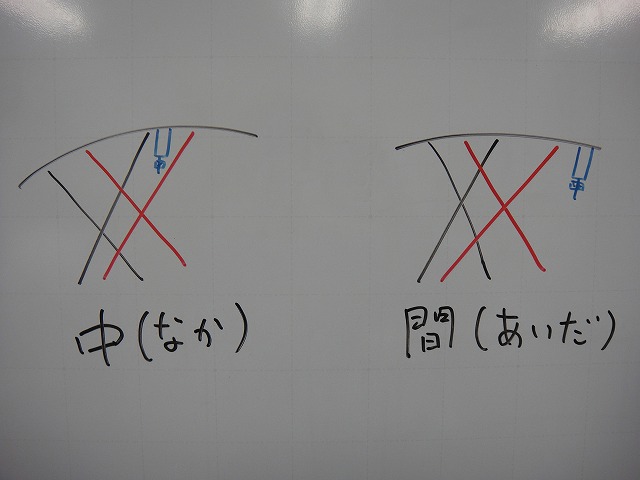
I'm going to call it "in" (中) when the valve hole is inside the crossing bundle,
and "between" (間) when it's in the gap between crossings.
That American Classic hub with the slit, if we stick to "between" positioning,
really is limited to either JIS or Italian lacing.
But regarding that word "limited,"
I got a comment saying "if you do 'in' lacing, you can do both JIS and Italian,
so isn't that a bit off?"
I exclude hideously ugly "in"-positioned wheels from my concept of what a wheel should be,
which is why I said it's limited to JIS or Italian.
If "in" positioning were acceptable, you could lace a 4-6 Italian rear wheel
with left-drop just fine.
You'd just tell the customer:
"I'm building your 24-spoke rear wheel, and I think 4-6 lacing gives better balance
than 4-4, so I'm doing 4-6. It'll be 'in' positioned though—sorry about the looks."
I can't do that, so I build my 24-spoke 4-6 Italian wheels with right-drop (laughs).
The whole concept of right-drop and left-drop exists in the first place
as a way to always achieve "between" positioning.
Bringing up examples where you abandon that seems wrong to me.
The absolute prerequisite is "between" positioning,
and then (in my case) ideally Italian lacing on top of that.
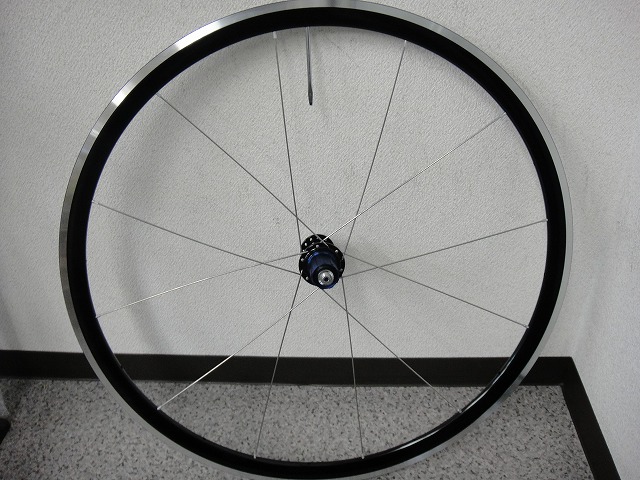
Doing a mock-up of a 24-spoke rear wheel.
I've laced only the freewheel side, 4-spoke through.
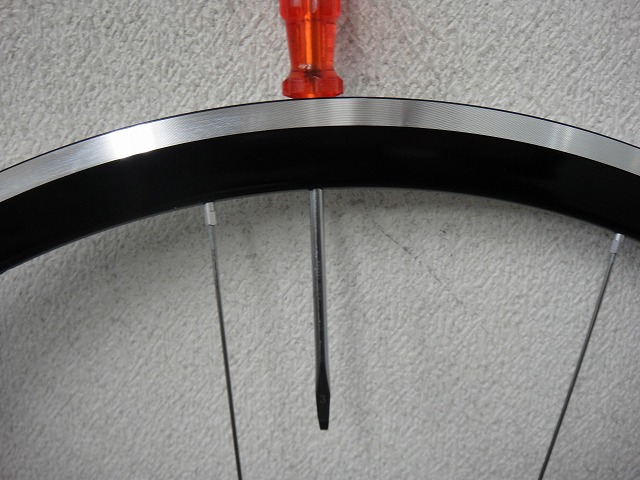
When the valve hole is straight up, the spoke exiting the hole to the left
comes out from the near flange (from my perspective)—that rim hole orientation
I call "standard rim" on this blog.
It's the most common arrangement.
Exceptions exist on Campagnolo, Fulcrum, Colima, and similar,
which I call "reverse rim."
I laced this as standard rim.
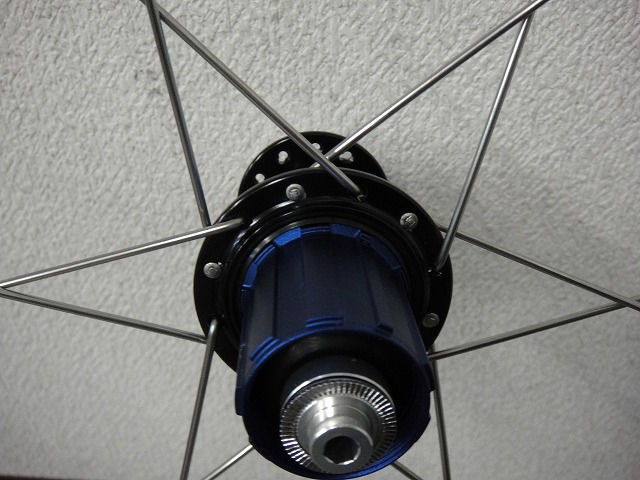
With the inpokes heading porcupine-style,
depending on how I lace the non-freewheel side, the possible methods are Italian or JIS,
and impossible are reverse-Italian and reverse-JIS.
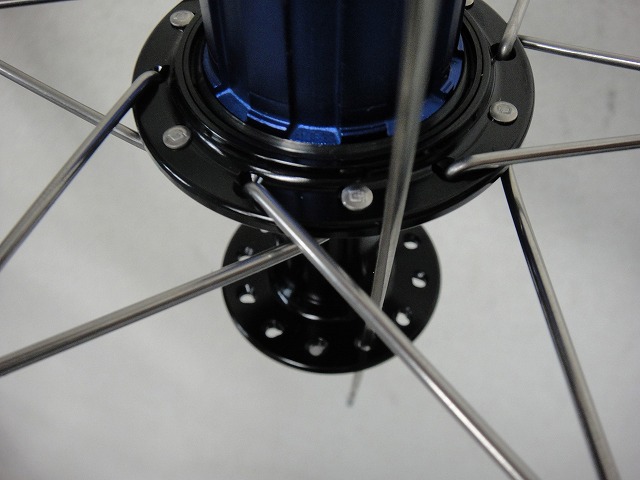
I laced the spokes with right-drop, and

laced just two sets of 4 spokes—6-spoke total—as JIS.
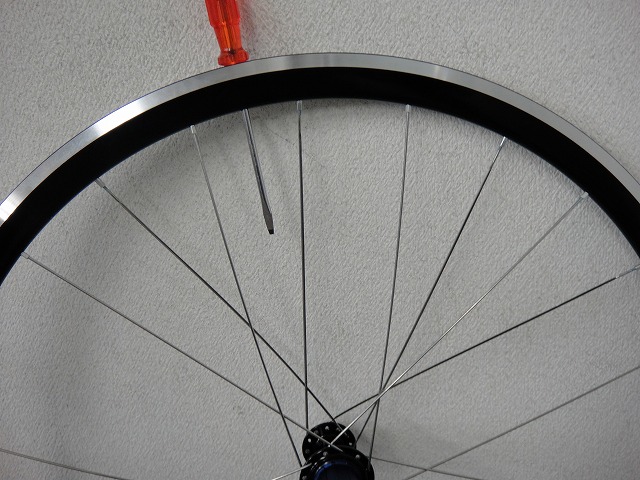
It's "in" positioned.
Wow, that's ugly!
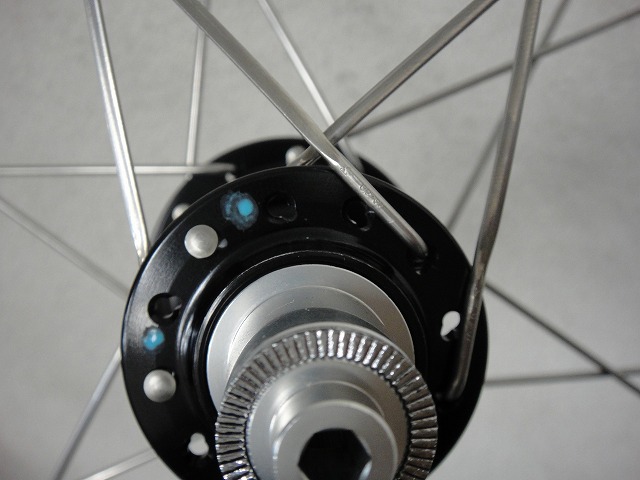
↑ In that state, I marked it blue.
This blue mark means: "Don't pull spokes in the direction of the slit."
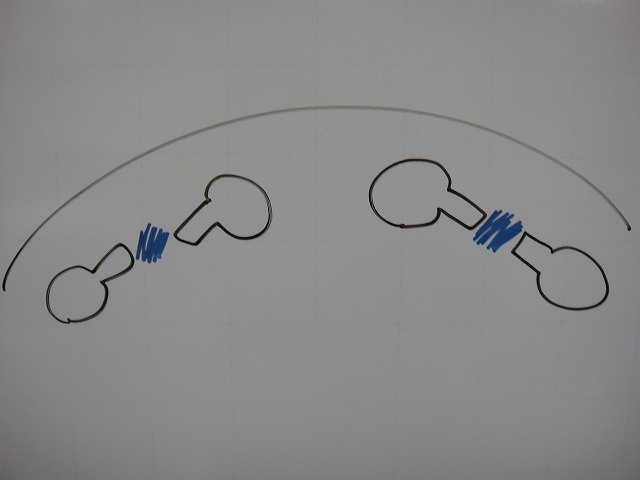
↑ Here's what that means.
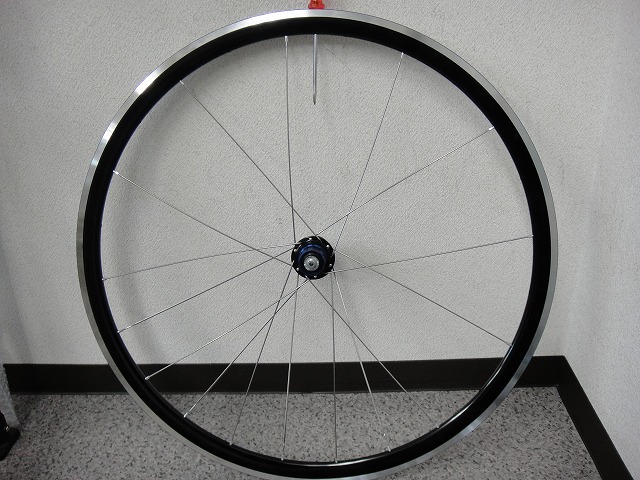
I re-laced the non-freewheel side's 4 spokes through the same rim holes
so they'd become Italian lacing instead.
Naturally, the spoke orientation changes too.
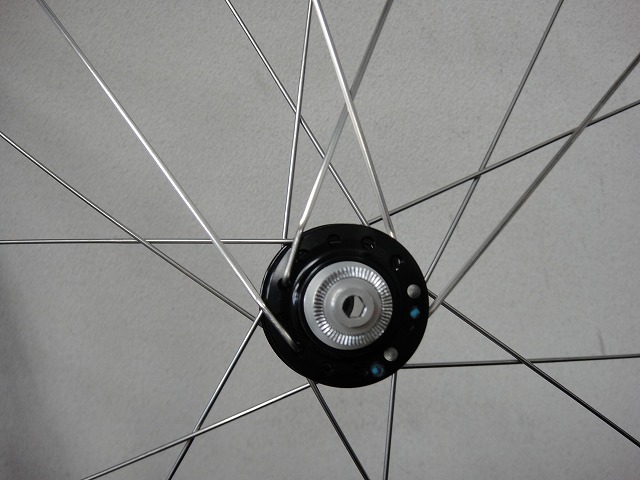
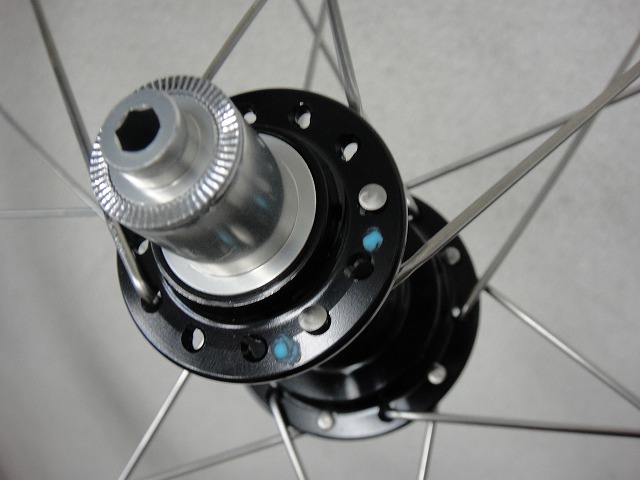
↑ No spokes pulled in the blue-marked direction.
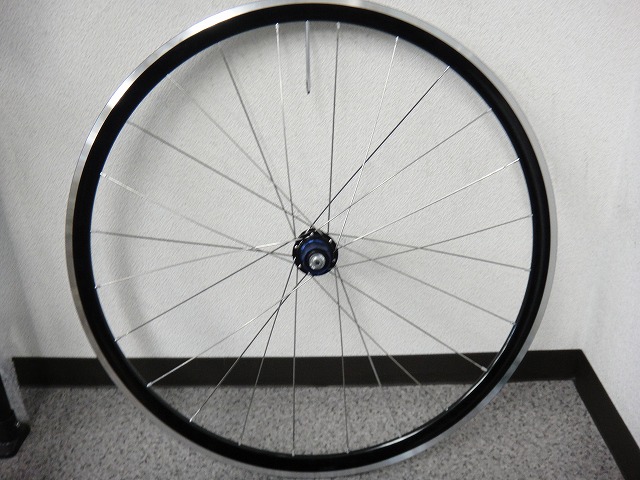
Then I laced the rest of the non-freewheel side spokes too.
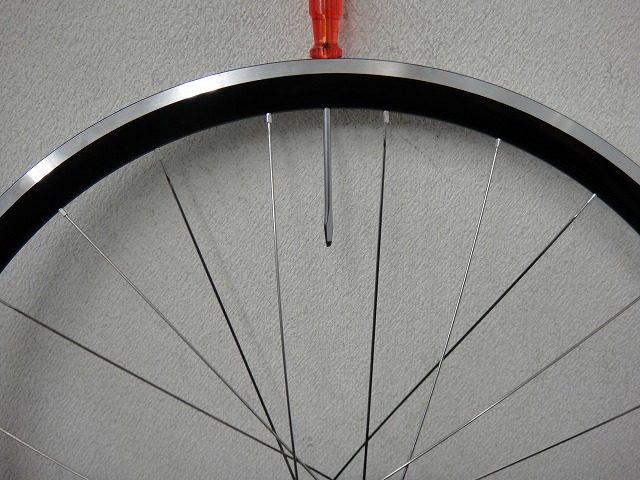
Now it's properly "between" positioned.

Italian lacing.
Once more for good measure.
The conversion between right-drop/left-drop with JIS/Italian lacing switching,
and how the slit direction also reverses—I think you can see that now.
In this example, right-drop 4-6 Italian lacing made the slit direction work out.
But what if it hadn't? Let me cover that too.
Solution #1: "Switch to 4-4 lacing"—well, that's obvious.
You can maintain "between" positioning while doing Italian lacing.
Now, thinking about the conditions where "between" and "in" swap:
First is: change between right-drop and left-drop.
Second is: make the left and right flange counts
a combination of (odd × 2) and (even × 2).
2-spoke lacing involves crossing outpokes and inpokes themselves,
which creates problems, so I'll exclude that.
For 4-spoke and above, there's 4-4, 6-8, 8-8, and so on,
but the practical case is basically just 4-6.
Third, if the rim allows it: treat it as a "reverse rim."
In that mock-up example, the XR300 rim can be laced as reverse too.
If "standard rim, right-drop 4-6 Italian gives 'between' positioning
but you're pulling the slit," you could solve it by
treating it as reverse rim—you'd stay "between" and not pull the slit.
So Solution #2 is: treat as reverse rim and lace (rim-dependent).
The point is: as long as there are ways to solve this without building
that aesthetically offensive "in"-positioned wheel,
the "in"-positioning option doesn't deserve a moment's consideration.
If that doesn't sit right, why not try lacing that 24-spoke 4-6 Italian
deliberately with left-drop to get "in" positioning?
Some might argue "for that American Classic hub with the slit,
building 'in' is unavoidable if you avoid the slit,"
but as long as there are ways to avoid it without the "in" position,
"unavoidable" it is not.
That hub with left-right same-count or with mixed (odd × 2) and (even × 2) counts,
when laced "between" as Italian, pulls the slit,
so I said it's limited to JIS.
The key point is solving that with 4-6 lacing and avoiding the slit
without going "in."
If 4-6 Italian pulled the slit, I'd have gone with 4-8.
With a 28-spoke rear hub and rim, that barely works.
For 28-spoke 4-8, if the rim is 700c low-profile,
it becomes what this blog calls true tangent lacing,
and spoke length might become unobtainable.
So every wheel makes me think hard about the lacing approach,
but while each individual wheel is just one of thousands I've built,
for that customer it might be their one and only—100% of what they have.
"I avoided the slit but ended up 'in,' I couldn't think of another way,
so here you go"—not every customer would accept that,
and more importantly, I wouldn't either.
The thought of that single wheel someone owns turning out
as a hideously ugly "in"-positioned wheel gives me chills.
So I'd never casually settle for "in" positioning—
it's unthinkable. "Between" positioning is the non-negotiable baseline,
and if that constraint holds, that hub really is normally laced
as JIS only.
Finally, let me give an example where "in" positioning really is unavoidable:
With Fulcrum-style 2:1 spoke lacing where
3 spokes from freewheel and non-freewheel sides form one bundle,
if the number of bundles is even, you can achieve "between" positioning.

But with odd-spoke counts like 21-spoke,
you get an odd number of bundles, and the valve hole or rim joint
ends up coinciding with a rim hole,
so you have to shift the phase slightly.
↑ The rim joint is around the middle of that "G."
↑ And there, the valve hole ends up appearing to be in the spoke bundle "in."
That's truly unavoidable.
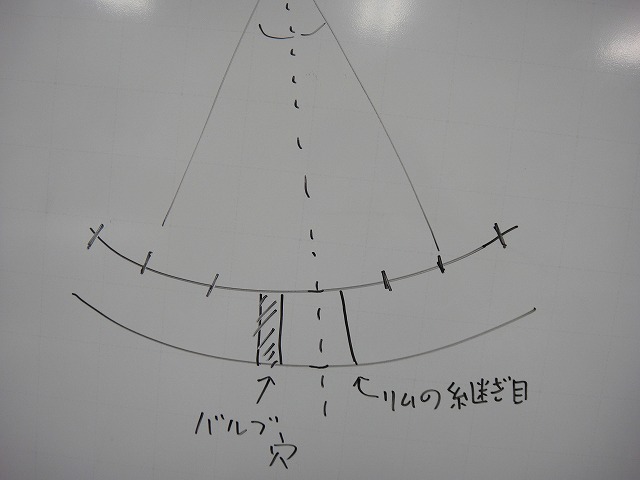
If you position the valve hole and rim joint equally far apart,
in the middle of the spoke bundles,
the looks improve somewhat, but
this rim has a thick seam wall and is heavy (→see here),
(maybe intentionally for balance),
so the valve hole has to be opposite the joint.
Addendum:
I received a comment (skipping the before/after) like:
"If the wheel arrived with valve hole 'in' positioning, I'd be very disappointed..."
Exactly right. When building an unfamiliar wheel, you really do think through tons of options.
Ideally the best lacing method, and if that's truly impossible,
at least a good alternative.
I think including "in" positioning as an option is actually an abdication of thought.
Thanks for the comment.