The other day, I built a front wheel using a Tune (チューン) front hub
and at that time, as one of the precautions,
I used the phrase "exotic wheel building prohibited."
In response to that,
I received a comment saying:
"Nobody pointed this out...
I think it should be eccentric, not exotic."
I used the word "exotic" for a certain reason,
but apart from that, I think the word "eccentric"
is not so much wrong as it is inappropriate.
I'm at a loss to understand why such a petty and unfounded nitpick
came in, but certainly "eccentric" does have the meaning of "odd or abnormal."
In the title of this article,
"A Response to an Eccentric Comment," I tried using it in that sense (laugh).
I haven't written about that "certain reason" yet, but
the reason why "eccentric" is inappropriate is
that "eccentric" doesn't just mean "odd"—
it also means "off-center" or "decentered."
And in the bicycle world, we normally use the word "eccentric"
to mean "off-center."
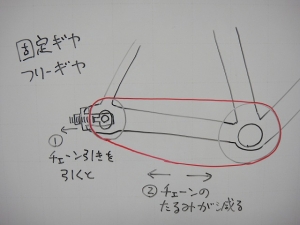
About the method of adjusting chain tension on single-speed bikes.
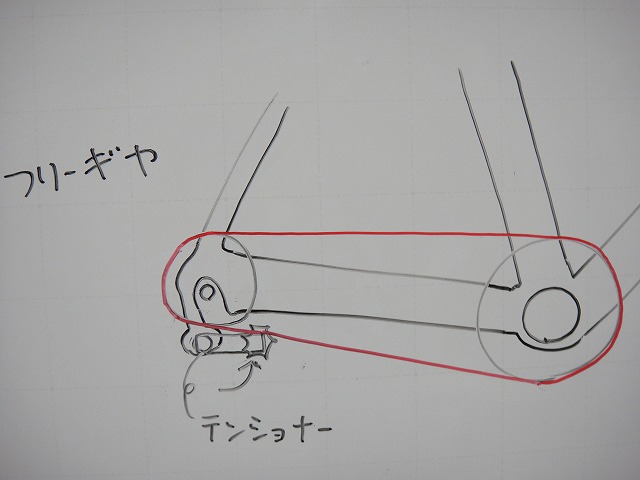
For frames with horizontal dropouts (dropouts where you remove the rear wheel by pulling the rear hub axle straight back),
we use a part called a chain tensioner to take up slack in the chain.
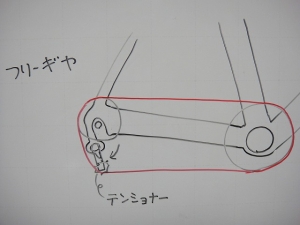
Also, if it's a freewheel hub, using a tensioner is fine.
If you use a tensioner with a fixed gear,
the chain will bounce wildly and drop off when you backpedal.
You can use a dedicated single-pulley tensioner,
but if the mounting bracket is available, you can also substitute a rear derailleur.
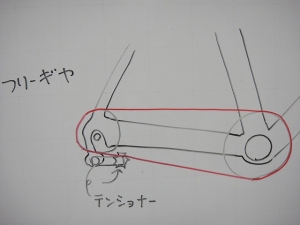
In the case of a single-pulley tensioner,
besides the type that pulls the chain outward like a rear derailleur,
there's also a type that pushes the chain inward.
This is determined by the direction of the spring coil around the pivot bolt,
so some tensioners come with two springs wound in different directions
and you can swap them to change the direction the chain is tensioned.
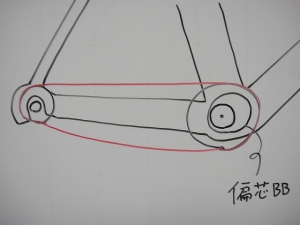
Anyway, to the main topic.
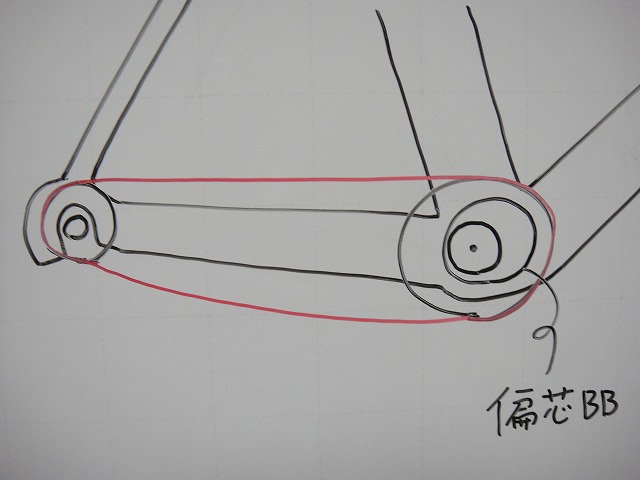
There are single-gear frames where the bottom bracket shell
sits eccentrically within an even larger shell.
Usually these are non-racing single-speed bikes.
With these frames, the position of the smaller shell (the BB shell)
relative to the larger shell can be changed arbitrarily
by rotating it.
As for how it's fixed, usually there's a mechanism
at the bottom of the frame similar to
the fixing bolts around the stem column on road bikes,
and it's secured by tightening a bolt.
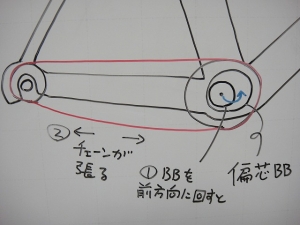
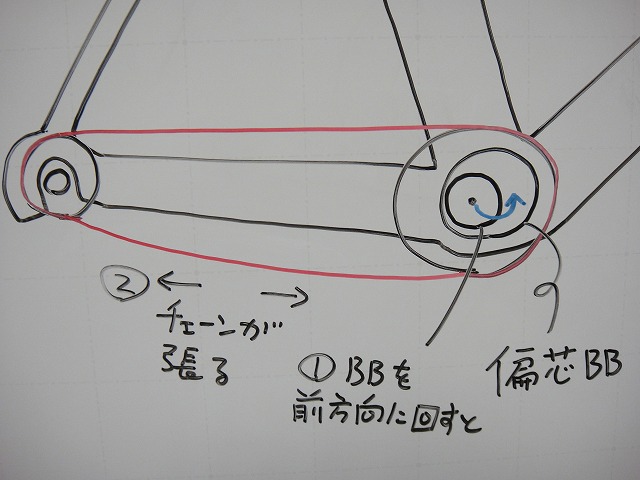
With the BB shell positioned as far toward the rear hub axle (that is, the rear) as possible,
you adjust the chain length.
Then, moving the BB shell forward
allows you to tension the chain.
Chain length can be adjusted in two-link increments (one outer plate and one inner plate set),
so as long as the eccentric mechanism has an adjustment range
greater than or equal to the distance that changes with two chain links or more,
you should always be able to take up all the slack in the chain.
In practice, there's more adjustment range than that.
Also, if you're using a chain for thick-tooth cogs, you can use "half-links"
to adjust the chain length in single-link increments.
On Italian Scapin frames, rear derailleurs are installed and
the frames have multiple gears front and rear,
but sometimes this mechanism is also incorporated.
In that case, it simply means
"you can change the amount of hanger drop and rear center
within the range that the eccentricity allows."
In any case, this type of BB shell is called
an "eccentric BB" or "off-center BB."
The advantage of an eccentric BB is that you don't need a chain tensioner,
so the frame can have vertical dropouts (the kind where you drop the rear wheel down and forward diagonally
like on road bikes) and still work fine, giving a cleaner appearance.
Tandem bikes have two BB shells, but
as a method of taking up slack in the chain on the frame's left side
(which connects front and rear BBs and synchronizes rotation),
the front BB is made eccentric.
White Industries makes a hub called the "ENO"
that has an eccentric mechanism built into the rear hub axle.
(ENO is styled like a mirror-image "ヨиO" of ONE, which is apparently
because it's designed for single-speed, so they use a mirror-image font for the ONE name)
This hub has a chain tension adjustment mechanism in the rear hub.
Standard track bike rear dropout width is 120mm,
but the ENO hub only comes in 130mm and 135mm.
So its intended use is as a rear hub for fixed-gear road or MTB builds.
As I mentioned earlier, with tensioner-type solutions like using a derailleur,
you can't use a fixed gear.
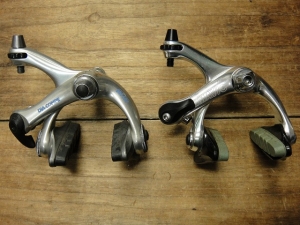
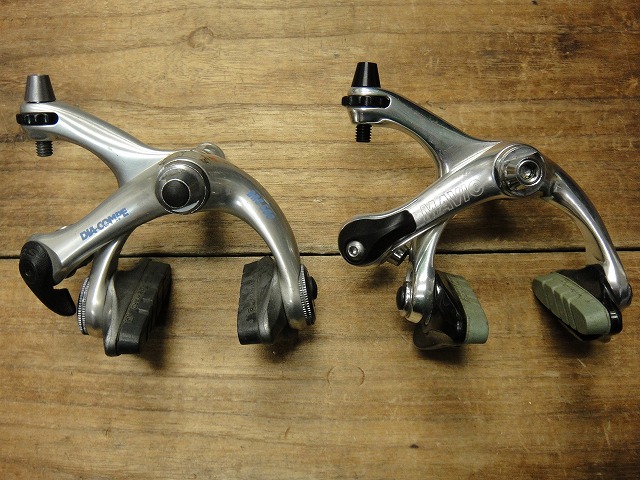
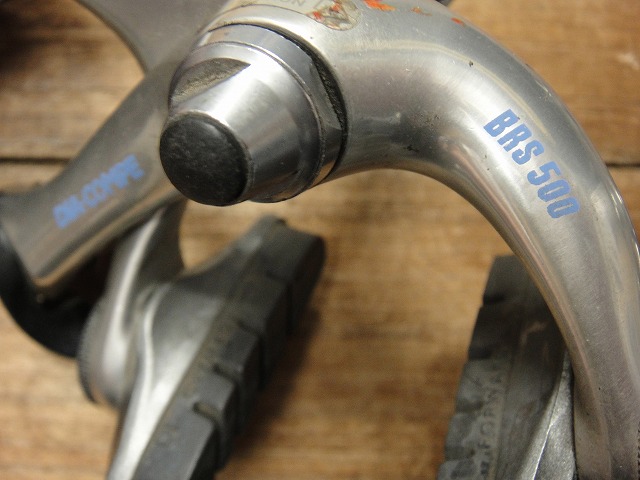
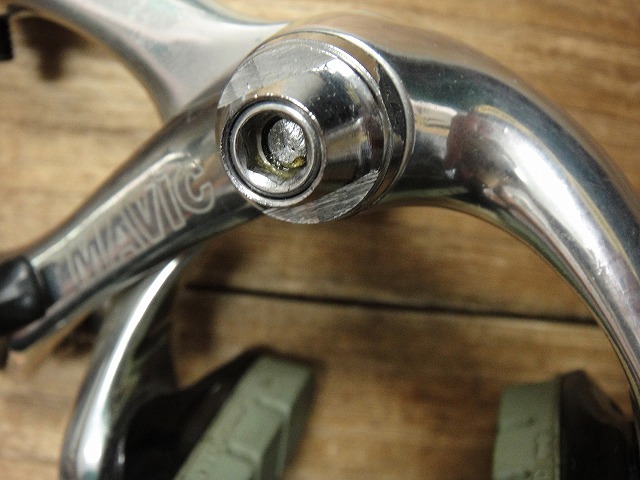
↑On the left is the Diacompe BRS500,
and on the right is the Mavic brake from that era, which was based on it as an OEM source.
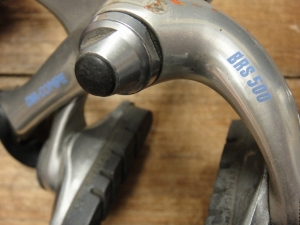
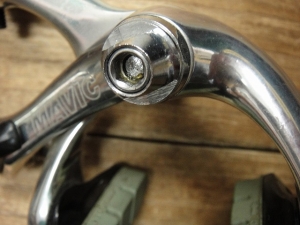
↑They're basically the same thing.
The differences are the shape of the quick-release lever, the direction it opens,
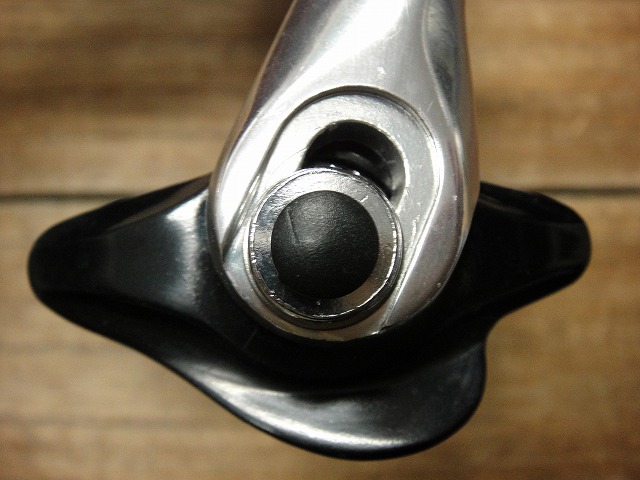
and the brake pad height adjustment mechanism.
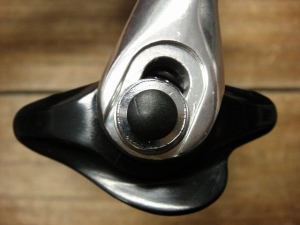
↑Mavic has the usual elongated slot, but
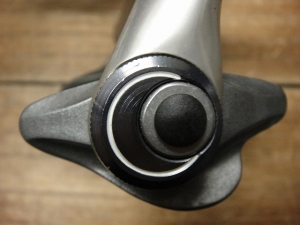
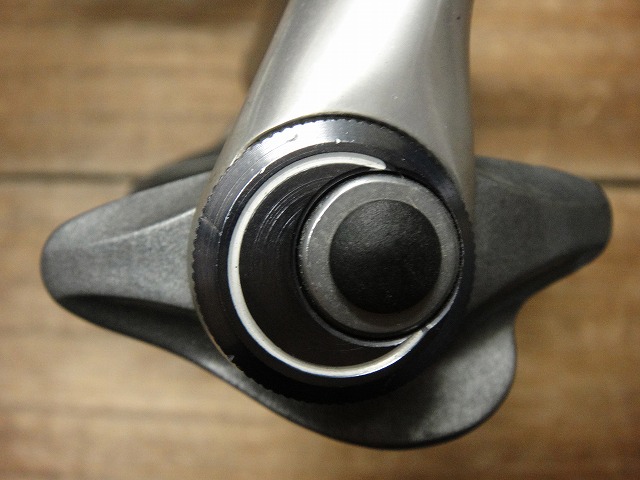
↑the BRS500 uses an "eccentric ring" mechanism
to adjust pad height.
It's off-center and rotates around, you see.
So, to sum up what I imagine when I hear "eccentric"
and what I would imagine from the phrase "eccentric wheel building method"...
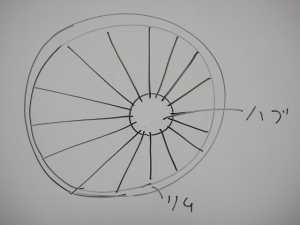
↑...it would be a wheel like this. Needless to say,
due to the severe lateral runout, it's completely unusable.
To avoid the meaning "off-center,"
the word "eccentric" probably shouldn't be used in the bicycle world,
so "exotic" might be better.
But from the phrasing "Nobody pointed this out...",
I sense the nuance that
"including myself, most people probably think
the word exotic is wrong."
I can't understand what basis that confidence is founded on, so
I've written this long-winded article about how the word "eccentric"
is handled in the bicycle world.
If the person who left that comment
would like to send me any objections or counter-arguments,
I'm planning to add a followup about that "certain reason" I mentioned at the start.
Addendum: I haven't heard back from the original commenter,
but the correct answer appeared in another comment I received, so
I'll explain the "certain reason."
The reason I used the word "exotic" is quite simple:
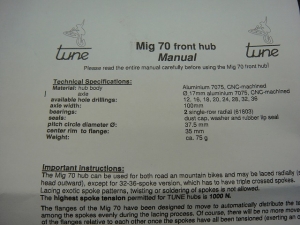
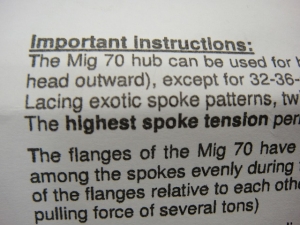
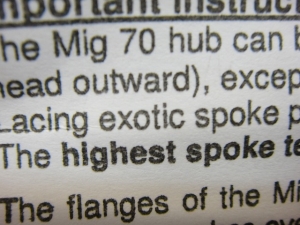
because the original instruction manual said "exotic"
That's all there was to it.
The reason I held this back was
that if I led with it, the discussion would end with me having "proven my point,"
and I thought no rebuttals would come after that.
Turned out no rebuttals came anyway!
So, if you're so confident in your English skills that
it's surprising nobody pointed it out, and you believe
"eccentric" would be a better expression than "exotic,"
then by all means, go ahead with that,
but take it up with Tune, not with me.
I'm not the kind of person who enjoys
publicly calling out amateurs—that's something I'd do with fellow pros at most.
I'll admit I'm not cool-headed enough not to get irritated
at repeatedly receiving off-base nitpicking comments.
I think you can sense that from the atmosphere (ふいんき) that drifts through
the beginning of this article...
Addendum to the addendum:
Someone pointed out my use of "ふいんき" (fumbling the reading of the word for "atmosphere"),
but of course I was joking around.
I do know the correct word is 雰囲気 (ふんいき), so just to be clear.
From other comments I received:
"When I hear exotic, I think of Hiromi Go (Exotic Japan)"
"When I hear eccentric, I think of Downtown (Eccentric Shōnen Bowei)"
Each of these really gives away your generation.
Someone also commented that it's my personality that's eccentric.
I have no words in response to that.
and at that time, as one of the precautions,
I used the phrase "exotic wheel building prohibited."
In response to that,
I received a comment saying:
"Nobody pointed this out...
I think it should be eccentric, not exotic."
I used the word "exotic" for a certain reason,
but apart from that, I think the word "eccentric"
is not so much wrong as it is inappropriate.
I'm at a loss to understand why such a petty and unfounded nitpick
came in, but certainly "eccentric" does have the meaning of "odd or abnormal."
In the title of this article,
"A Response to an Eccentric Comment," I tried using it in that sense (laugh).
I haven't written about that "certain reason" yet, but
the reason why "eccentric" is inappropriate is
that "eccentric" doesn't just mean "odd"—
it also means "off-center" or "decentered."
And in the bicycle world, we normally use the word "eccentric"
to mean "off-center."
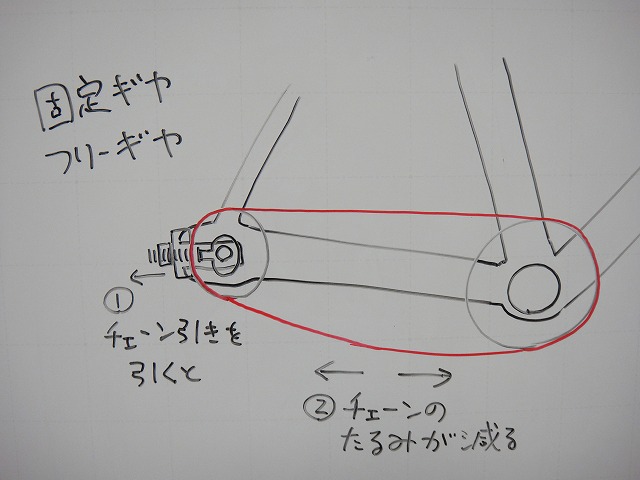
About the method of adjusting chain tension on single-speed bikes.
For frames with horizontal dropouts (dropouts where you remove the rear wheel by pulling the rear hub axle straight back),
we use a part called a chain tensioner to take up slack in the chain.
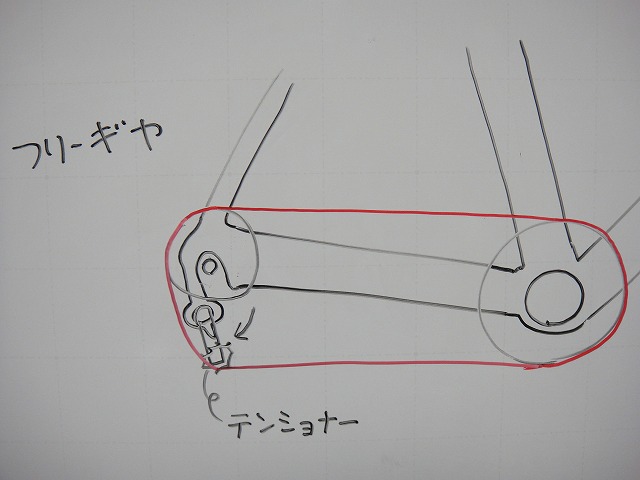
Also, if it's a freewheel hub, using a tensioner is fine.
If you use a tensioner with a fixed gear,
the chain will bounce wildly and drop off when you backpedal.
You can use a dedicated single-pulley tensioner,
but if the mounting bracket is available, you can also substitute a rear derailleur.
In the case of a single-pulley tensioner,
besides the type that pulls the chain outward like a rear derailleur,
there's also a type that pushes the chain inward.
This is determined by the direction of the spring coil around the pivot bolt,
so some tensioners come with two springs wound in different directions
and you can swap them to change the direction the chain is tensioned.
Anyway, to the main topic.
There are single-gear frames where the bottom bracket shell
sits eccentrically within an even larger shell.
Usually these are non-racing single-speed bikes.
With these frames, the position of the smaller shell (the BB shell)
relative to the larger shell can be changed arbitrarily
by rotating it.
As for how it's fixed, usually there's a mechanism
at the bottom of the frame similar to
the fixing bolts around the stem column on road bikes,
and it's secured by tightening a bolt.
With the BB shell positioned as far toward the rear hub axle (that is, the rear) as possible,
you adjust the chain length.
Then, moving the BB shell forward
allows you to tension the chain.
Chain length can be adjusted in two-link increments (one outer plate and one inner plate set),
so as long as the eccentric mechanism has an adjustment range
greater than or equal to the distance that changes with two chain links or more,
you should always be able to take up all the slack in the chain.
In practice, there's more adjustment range than that.
Also, if you're using a chain for thick-tooth cogs, you can use "half-links"
to adjust the chain length in single-link increments.
On Italian Scapin frames, rear derailleurs are installed and
the frames have multiple gears front and rear,
but sometimes this mechanism is also incorporated.
In that case, it simply means
"you can change the amount of hanger drop and rear center
within the range that the eccentricity allows."
In any case, this type of BB shell is called
an "eccentric BB" or "off-center BB."
The advantage of an eccentric BB is that you don't need a chain tensioner,
so the frame can have vertical dropouts (the kind where you drop the rear wheel down and forward diagonally
like on road bikes) and still work fine, giving a cleaner appearance.
Tandem bikes have two BB shells, but
as a method of taking up slack in the chain on the frame's left side
(which connects front and rear BBs and synchronizes rotation),
the front BB is made eccentric.
White Industries makes a hub called the "ENO"
that has an eccentric mechanism built into the rear hub axle.
(ENO is styled like a mirror-image "ヨиO" of ONE, which is apparently
because it's designed for single-speed, so they use a mirror-image font for the ONE name)
This hub has a chain tension adjustment mechanism in the rear hub.
Standard track bike rear dropout width is 120mm,
but the ENO hub only comes in 130mm and 135mm.
So its intended use is as a rear hub for fixed-gear road or MTB builds.
As I mentioned earlier, with tensioner-type solutions like using a derailleur,
you can't use a fixed gear.
↑On the left is the Diacompe BRS500,
and on the right is the Mavic brake from that era, which was based on it as an OEM source.
↑They're basically the same thing.
The differences are the shape of the quick-release lever, the direction it opens,
and the brake pad height adjustment mechanism.
↑Mavic has the usual elongated slot, but
↑the BRS500 uses an "eccentric ring" mechanism
to adjust pad height.
It's off-center and rotates around, you see.
So, to sum up what I imagine when I hear "eccentric"
and what I would imagine from the phrase "eccentric wheel building method"...
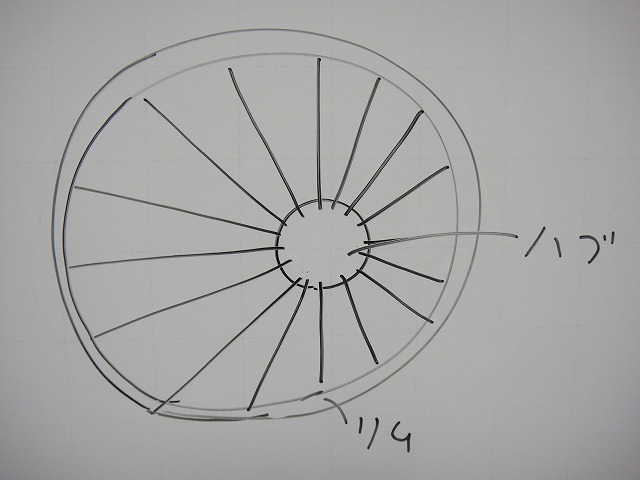
↑...it would be a wheel like this. Needless to say,
due to the severe lateral runout, it's completely unusable.
To avoid the meaning "off-center,"
the word "eccentric" probably shouldn't be used in the bicycle world,
so "exotic" might be better.
But from the phrasing "Nobody pointed this out...",
I sense the nuance that
"including myself, most people probably think
the word exotic is wrong."
I can't understand what basis that confidence is founded on, so
I've written this long-winded article about how the word "eccentric"
is handled in the bicycle world.
If the person who left that comment
would like to send me any objections or counter-arguments,
I'm planning to add a followup about that "certain reason" I mentioned at the start.
Addendum: I haven't heard back from the original commenter,
but the correct answer appeared in another comment I received, so
I'll explain the "certain reason."
The reason I used the word "exotic" is quite simple:
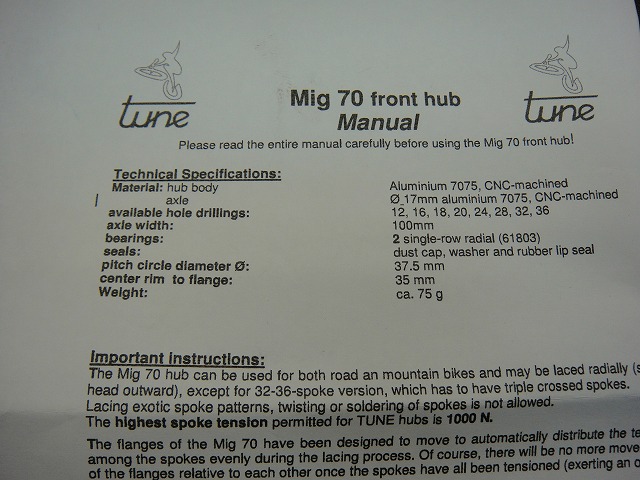
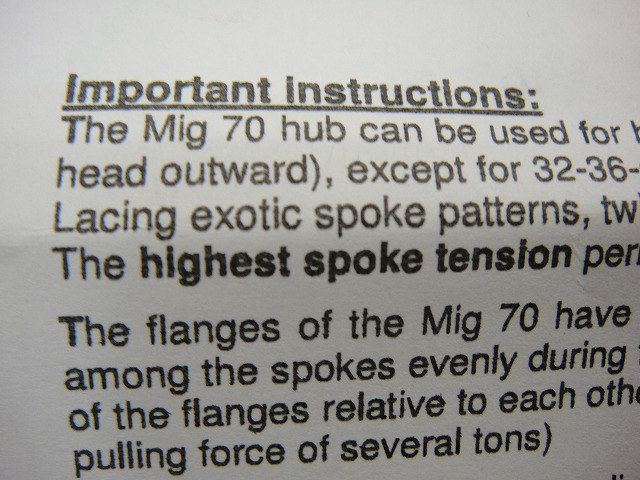
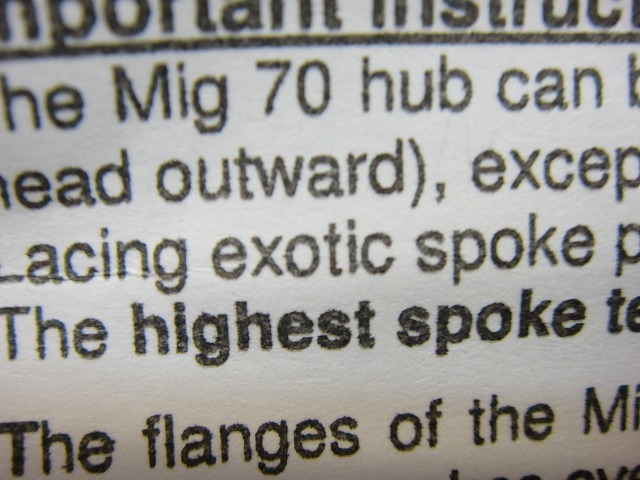
because the original instruction manual said "exotic"
That's all there was to it.
The reason I held this back was
that if I led with it, the discussion would end with me having "proven my point,"
and I thought no rebuttals would come after that.
Turned out no rebuttals came anyway!
So, if you're so confident in your English skills that
it's surprising nobody pointed it out, and you believe
"eccentric" would be a better expression than "exotic,"
then by all means, go ahead with that,
but take it up with Tune, not with me.
I'm not the kind of person who enjoys
publicly calling out amateurs—that's something I'd do with fellow pros at most.
I'll admit I'm not cool-headed enough not to get irritated
at repeatedly receiving off-base nitpicking comments.
I think you can sense that from the atmosphere (ふいんき) that drifts through
the beginning of this article...
Addendum to the addendum:
Someone pointed out my use of "ふいんき" (fumbling the reading of the word for "atmosphere"),
but of course I was joking around.
I do know the correct word is 雰囲気 (ふんいき), so just to be clear.
From other comments I received:
"When I hear exotic, I think of Hiromi Go (Exotic Japan)"
"When I hear eccentric, I think of Downtown (Eccentric Shōnen Bowei)"
Each of these really gives away your generation.
Someone also commented that it's my personality that's eccentric.
I have no words in response to that.