Customers sometimes ask me, "How much do the Nomu Lab wheels model ○ weigh front and rear combined?"
but this is a difficult question to answer.
I can't remember off the top of my head, so I can't give a quick answer.
If we're talking about rim weight alone, I think there are fewer rims—even outside of Nomu Lab wheels—that I couldn't answer from memory.
As I've mentioned several times here before, the combined front and rear wheel weight doesn't contain rim or wheel stiffness data in a form that can be extracted.
For example, compared to the Evo Lite hub, Chris King's R45 hub is about 44g heavier in the front and 6g heavier in the rear,
but considering hub rotation smoothness and the probability of bearings being dead after a year of maintenance-free use,
Chris King is definitely a higher-grade hub,
so you can't simply compare quality by weight alone.
However, when the front and rear differ by 50g, it crosses the 100g boundary,
and with catalog specs of 1320g vs. 1270g front and rear,
the latter tends to be judged as the "faster" wheel.
My belief is that if rim weight and stiffness are the same, there's not much difference.


↑These are yesterday's carbon WO wheel weights, front and rear.
The combined total comes to 1673g.
Suppose this wheel's spokes and lacing configuration were
Front: Aero SBII radial lacing → CX-RAY radial lacing
Rear: half-strong 4x4 lacing → full CX-RAY 4x4 lacing
—a common setup—
then the estimated weight would be front wheel 720g, rear wheel 877g, 1597g total.
At least on flat ground to gentle climbs, there's no doubt that the 1673g spec wheels are the faster wheels,
so you shouldn't be fixated on weight alone.
Considering the comprehensive gains and losses across all situations—climbs, descents, cornering—
it's definitely true from experience that racers will rate the 1673g wheels higher.
By the way, the Shimano RS81-C35-CL, a WO wheel with nearly the same rim depth, weighs 733g front and 910g rear, totaling 1643g.
Compared to that, yesterday's wheel doesn't seem particularly heavy—strange...
Actually, not strange at all; it's just deceptive rim-weight wrapping in the total wheel weight.
With Shimano wheels,
the hub is heavy because of high dust/water sealing, the freewheel body material and structure,
and because cup-and-cone bearings don't allow for extremely small bearing balls,
but most other complete wheelsets tend to lighten the hub and spokes while disguising the rim weight with deceptive wrapping—so watch out.
Even without intending to do deceptive wrapping,
stating only the total wheel weight and not the rim weight
(which is standard practice for complete wheelsets)
amounts to deceptive wrapping.
For this reason, because I place such emphasis on rim weight,
I'm not well-versed in overall wheel weight—please forgive me.
If I also stated rim weight alongside total weight, it would be useful information,
so you might think I should at least remember that much for Nomu Lab wheels,
but the weight differs quite a bit even between Evo Lite hubs and Leaf hubs.
If I were trying to do deceptive wrapping,
I could just lace 24-hole rear wheels with full CX-RAY 4x4 lacing,
and the fact that I don't build wheels like that shows—I think—
that I'm not prioritizing "what it feels like to hold" as the most important factor.
ADDENDUM: Reply to Comments
I received a comment asking: "Considering the rolling-resistance performance differences of tires and tubes as well, don't you think WO wheels (with tires) are at a disadvantage?"
I'm not sure if this question assumes "WO tires have lighter rolling resistance,"
but even if WO tires possessed some magic structure unique to them giving rolling lightness that tubulars lack,
the performance difference from rim weight can't possibly be bridged,
so absolute performance is superior with tubulars,
and WO is ultimately just a convenient training substitute...
that's what I've thought,
but since Michelin's Axial Pro came out, I've come to think somewhat differently—
that WO tires have become capable of race use.
Long ago, you could say "even the finest WO tires were below the level of a 1000-yen tire."
By "1000-yen tire," I mean there was an era when you could buy the cheapest tubular tires for 1000 yen.
Vittoria and Veloflex are manufacturers that sell WO and tubular in nearly identical constructions.
These two companies' WO tires (Vittoria only with Open Corsa) are called "open tubulars" rather than WO,
with a construction that is "a tubular tire unsewn, with a bead attached only at the edges."
As a counterexample,
Continental's Grand Prix 4000S II tubular has the same tread pattern and name as the WO model,
but from the tire sidewall shape and tire height differences, they're completely different tires.
So, taking a wheel that sells both WO and tubular—for example, Bora One—
mounting Open Corsa CX and Corsa CX tubular respectively and comparing rides,
I don't think the WO would be faster.
As I wrote earlier, recent WO tires are vastly better than before,
but tubular tires still have superior performance—that's my view.
Next.
Actually from the same person, but they asked: "For Bora One or RS81, there are 'same-rim higher-end models' like Ultra Two or 9000—do you think these don't have performance differences matching their price?"
I received this comment as well.
My answer is: it depends on the "contents" and the "price."
First, the "contents."
For Bora, the difference is between USB bearings and CULT bearings,
and these two do have performance differences you can actually feel.
There's a clear difference when freewheeling on descents or riding on smooth pavement.
With Shimano wheels, it's the difference between hub equivalent to Ultegra or Dura-Ace,
but there's almost no difference in rotation smoothness.
The Ultegra-equivalent is slightly murkier,
but I doubt you could distinguish the difference by riding.
The reduction in rear hub weight from freewheel body material differences isn't something you can feel.
However, after tens of thousands of kilometers or years of maintenance-free use,
it's definitely true that Dura-Ace wheels have a higher probability of bearings not being dead.
Next, about "price."
Considering these performance differences and price gaps,
which to buy is up to each person,
but if it were me, I'd buy the Bora One.
With Shimano wheels, since I can build a completely superior wheel myself except for the dust/water sealing of the hub, I wouldn't buy either.
That's my answer.
I usually build wheels with Evo Lite hubs,
but I almost never use the Wing hub, which is supposed to be the higher-end model.
I don't feel the attraction matching the price difference for ceramic bearings,
and the rear hub dimensions are superior on the Evo Lite—that's why.
Also, it's rather unimportant,
but certain models of the Evo hub, before Evo Lite, had slot holes,
but when switching to Evo Lite, they became only round holes.
Wing hub remained with slot holes,
so it was handy when using spokes like CX,
but recently Wing hub is also transitioning to round holes,
so I no longer have reason to use it.
Thank you for the comments.
but this is a difficult question to answer.
I can't remember off the top of my head, so I can't give a quick answer.
If we're talking about rim weight alone, I think there are fewer rims—even outside of Nomu Lab wheels—that I couldn't answer from memory.
As I've mentioned several times here before, the combined front and rear wheel weight doesn't contain rim or wheel stiffness data in a form that can be extracted.
For example, compared to the Evo Lite hub, Chris King's R45 hub is about 44g heavier in the front and 6g heavier in the rear,
but considering hub rotation smoothness and the probability of bearings being dead after a year of maintenance-free use,
Chris King is definitely a higher-grade hub,
so you can't simply compare quality by weight alone.
However, when the front and rear differ by 50g, it crosses the 100g boundary,
and with catalog specs of 1320g vs. 1270g front and rear,
the latter tends to be judged as the "faster" wheel.
My belief is that if rim weight and stiffness are the same, there's not much difference.
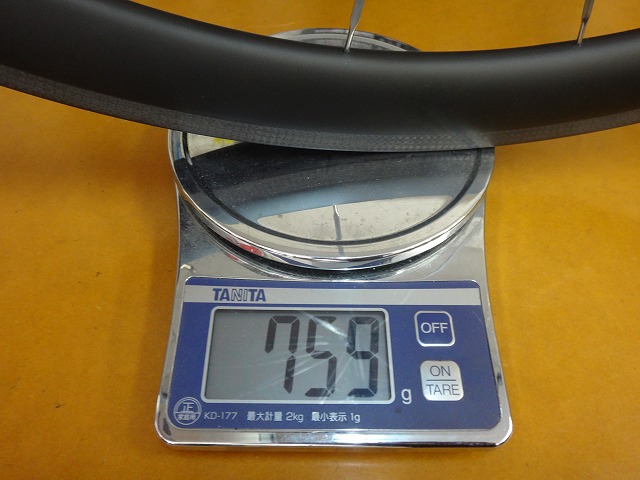
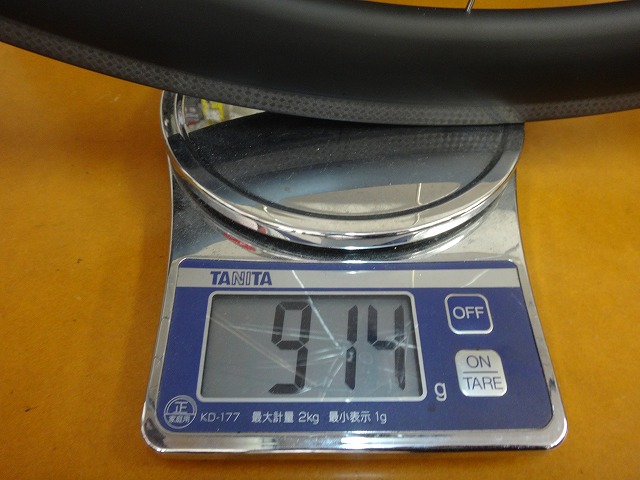
↑These are yesterday's carbon WO wheel weights, front and rear.
The combined total comes to 1673g.
Suppose this wheel's spokes and lacing configuration were
Front: Aero SBII radial lacing → CX-RAY radial lacing
Rear: half-strong 4x4 lacing → full CX-RAY 4x4 lacing
—a common setup—
then the estimated weight would be front wheel 720g, rear wheel 877g, 1597g total.
At least on flat ground to gentle climbs, there's no doubt that the 1673g spec wheels are the faster wheels,
so you shouldn't be fixated on weight alone.
Considering the comprehensive gains and losses across all situations—climbs, descents, cornering—
it's definitely true from experience that racers will rate the 1673g wheels higher.
By the way, the Shimano RS81-C35-CL, a WO wheel with nearly the same rim depth, weighs 733g front and 910g rear, totaling 1643g.
Compared to that, yesterday's wheel doesn't seem particularly heavy—strange...
Actually, not strange at all; it's just deceptive rim-weight wrapping in the total wheel weight.
With Shimano wheels,
the hub is heavy because of high dust/water sealing, the freewheel body material and structure,
and because cup-and-cone bearings don't allow for extremely small bearing balls,
but most other complete wheelsets tend to lighten the hub and spokes while disguising the rim weight with deceptive wrapping—so watch out.
Even without intending to do deceptive wrapping,
stating only the total wheel weight and not the rim weight
(which is standard practice for complete wheelsets)
amounts to deceptive wrapping.
For this reason, because I place such emphasis on rim weight,
I'm not well-versed in overall wheel weight—please forgive me.
If I also stated rim weight alongside total weight, it would be useful information,
so you might think I should at least remember that much for Nomu Lab wheels,
but the weight differs quite a bit even between Evo Lite hubs and Leaf hubs.
If I were trying to do deceptive wrapping,
I could just lace 24-hole rear wheels with full CX-RAY 4x4 lacing,
and the fact that I don't build wheels like that shows—I think—
that I'm not prioritizing "what it feels like to hold" as the most important factor.
ADDENDUM: Reply to Comments
I received a comment asking: "Considering the rolling-resistance performance differences of tires and tubes as well, don't you think WO wheels (with tires) are at a disadvantage?"
I'm not sure if this question assumes "WO tires have lighter rolling resistance,"
but even if WO tires possessed some magic structure unique to them giving rolling lightness that tubulars lack,
the performance difference from rim weight can't possibly be bridged,
so absolute performance is superior with tubulars,
and WO is ultimately just a convenient training substitute...
that's what I've thought,
but since Michelin's Axial Pro came out, I've come to think somewhat differently—
that WO tires have become capable of race use.
Long ago, you could say "even the finest WO tires were below the level of a 1000-yen tire."
By "1000-yen tire," I mean there was an era when you could buy the cheapest tubular tires for 1000 yen.
Vittoria and Veloflex are manufacturers that sell WO and tubular in nearly identical constructions.
These two companies' WO tires (Vittoria only with Open Corsa) are called "open tubulars" rather than WO,
with a construction that is "a tubular tire unsewn, with a bead attached only at the edges."
As a counterexample,
Continental's Grand Prix 4000S II tubular has the same tread pattern and name as the WO model,
but from the tire sidewall shape and tire height differences, they're completely different tires.
So, taking a wheel that sells both WO and tubular—for example, Bora One—
mounting Open Corsa CX and Corsa CX tubular respectively and comparing rides,
I don't think the WO would be faster.
As I wrote earlier, recent WO tires are vastly better than before,
but tubular tires still have superior performance—that's my view.
Next.
Actually from the same person, but they asked: "For Bora One or RS81, there are 'same-rim higher-end models' like Ultra Two or 9000—do you think these don't have performance differences matching their price?"
I received this comment as well.
My answer is: it depends on the "contents" and the "price."
First, the "contents."
For Bora, the difference is between USB bearings and CULT bearings,
and these two do have performance differences you can actually feel.
There's a clear difference when freewheeling on descents or riding on smooth pavement.
With Shimano wheels, it's the difference between hub equivalent to Ultegra or Dura-Ace,
but there's almost no difference in rotation smoothness.
The Ultegra-equivalent is slightly murkier,
but I doubt you could distinguish the difference by riding.
The reduction in rear hub weight from freewheel body material differences isn't something you can feel.
However, after tens of thousands of kilometers or years of maintenance-free use,
it's definitely true that Dura-Ace wheels have a higher probability of bearings not being dead.
Next, about "price."
Considering these performance differences and price gaps,
which to buy is up to each person,
but if it were me, I'd buy the Bora One.
With Shimano wheels, since I can build a completely superior wheel myself except for the dust/water sealing of the hub, I wouldn't buy either.
That's my answer.
I usually build wheels with Evo Lite hubs,
but I almost never use the Wing hub, which is supposed to be the higher-end model.
I don't feel the attraction matching the price difference for ceramic bearings,
and the rear hub dimensions are superior on the Evo Lite—that's why.
Also, it's rather unimportant,
but certain models of the Evo hub, before Evo Lite, had slot holes,
but when switching to Evo Lite, they became only round holes.
Wing hub remained with slot holes,
so it was handy when using spokes like CX,
but recently Wing hub is also transitioning to round holes,
so I no longer have reason to use it.
Thank you for the comments.