This is a clickbait title. Sorry about that.
Using this as the headline, I figured a decent number of people searching for information would end up here.
I get asked very frequently these days: "What do you think about Open Pro Exalith?"
The surface-level answer is: we don't carry Mavic products, so we wouldn't know.
If there were 24H versions available, they'd be pretty usable, but.
Personally, I'm not against the performance of Exalith itself,
but the brake shoe consumables aren't cheap, and they wear out faster than normal,
so when you factor that in, I don't think the benefits justify the cost and hassle.
That said, if I had to race in a downpour
and could choose between a carbon rim, a regular aluminum rim, or an Exalith aluminum rim wheel,
I'd probably reach for the Exalith.

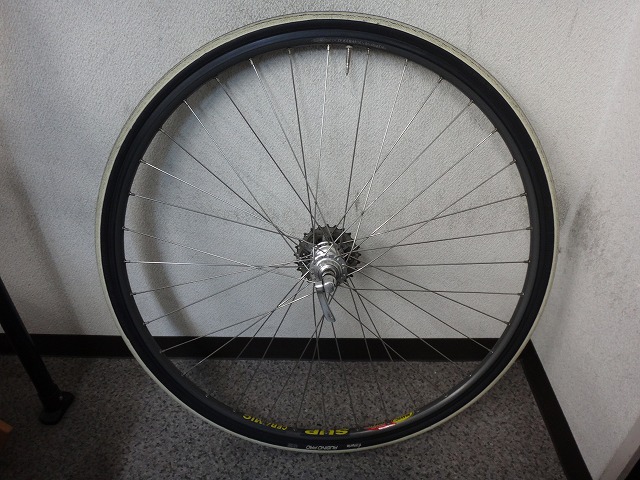
Anyway, I needed photos of wheels for reference material,
so I asked a friend to bring over "that rear wheel" and ride it over.

It's a 36H rim with the original generation Open Pro label, but

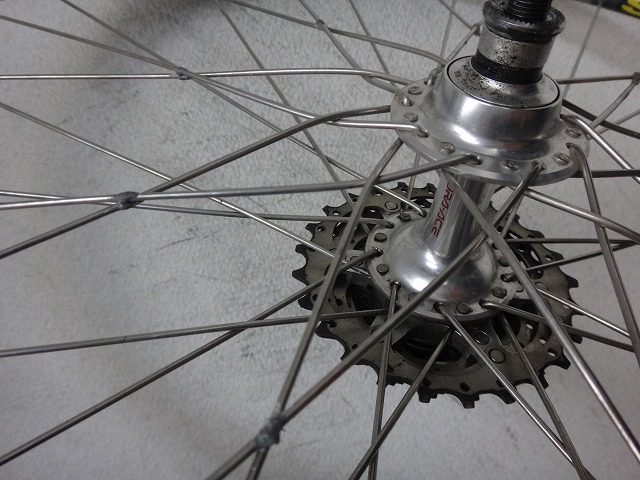
on the non-freewheel side, it's laced double-cross all the way, including the crossing just before the final cross,
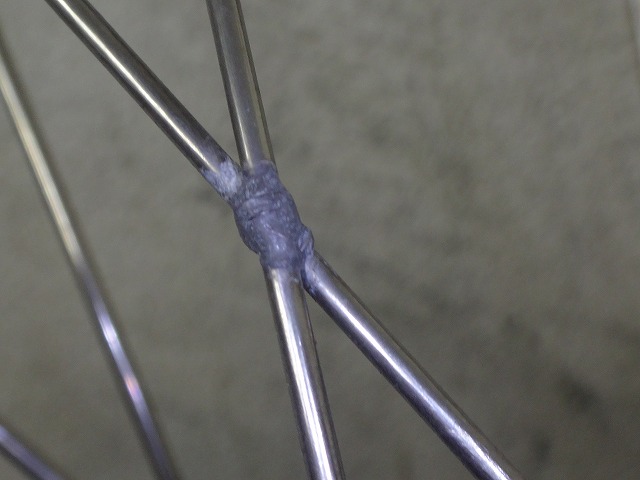
with tied-and-soldered joints.
This is a lacing method that's taken logic too far—if even one spoke breaks,
you'd need to undo the adjacent crossing to thread in a new spoke,
and to undo that, you'd have to undo the next one over... and so on,
until you've disassembled all the spokes on one side.
With round spokes, the spoke waviness also gets pretty severe, so
if you're going to do this, flat spokes would be better.
It would only work if spokes absolutely never broke—an impossible condition—
and even then, I might use it for Nomu Lab wheels.

Tied-and-soldered version 2.
I'm embarrassed by my own work, frankly.
This wheel was built before Nomu Lab; at the time Nomu Lab opened we were on version 3, and now we're at version 4.
Version 4's improvements are a subtle change in how the ties are wrapped
(but it makes an enormous difference on the non-freewheel side of JIS-laced rear wheels)
and the ability to use black spokes for the ties.

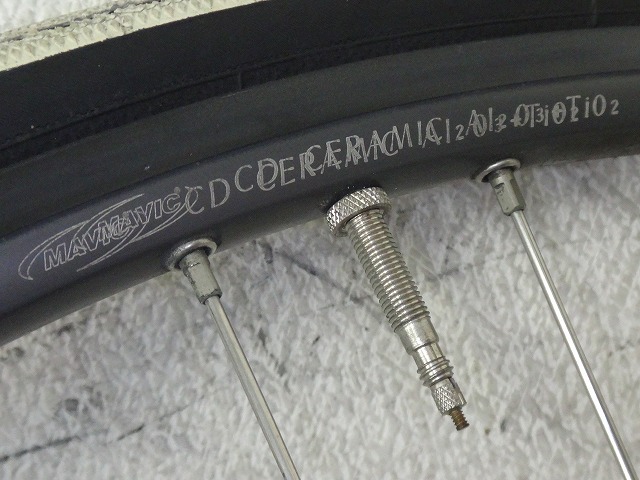
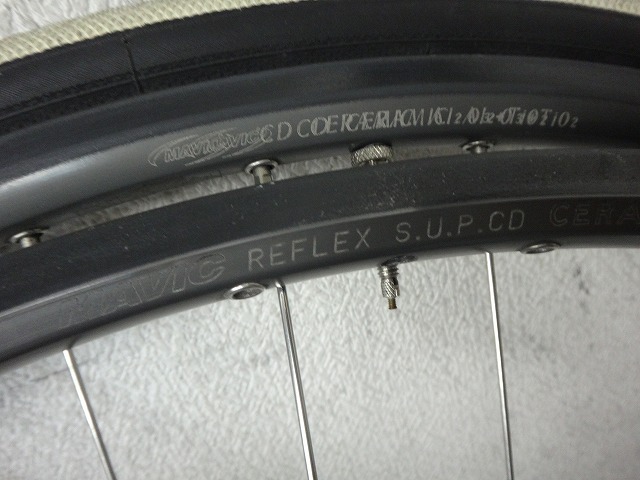
So this Open Pro isn't just in what Mavic calls hard-anodized "CD" finish,
but rather CD Ceramic—with ceramic layered over the braking zone.
The laser engraving got messed up, so there are two different markings,
but the chemical formula is written on there.
With MACH 2, there was a silver rim model with ceramic brake zone, I think,
but other than that, CD + Ceramic combo is the only combination that should exist.

I also own a Reflex WO in the same spec.

At 1997 pricing, road rims in CD/CD Ceramic were
Open SUP at ¥6,800/¥12,000, Reflex WO at ¥6,800/¥11,800,
and for MTB rims, the 217 was ¥7,000/¥11,800.
Corresponding brake shoes came out for the 7700-series Dura-Ace and
9500-series XT (V-brake) of the time,
and paired with those, wet-weather braking performance is phenomenal,
but the nice thing about CD Ceramic is it works with regular brake shoes too.
Not quite as powerful as dedicated shoes, but better braking than a normal brake zone,
and while shoe wear is slightly accelerated, it's nowhere near as dramatic as with Exalith.
If Exalith is a single-cut metal file,
then Ceramic is like a diamond file.
Rather than releasing hand-laced Exalith rims, I'd like them to bring back these instead.
Using this as the headline, I figured a decent number of people searching for information would end up here.
I get asked very frequently these days: "What do you think about Open Pro Exalith?"
The surface-level answer is: we don't carry Mavic products, so we wouldn't know.
If there were 24H versions available, they'd be pretty usable, but.
Personally, I'm not against the performance of Exalith itself,
but the brake shoe consumables aren't cheap, and they wear out faster than normal,
so when you factor that in, I don't think the benefits justify the cost and hassle.
That said, if I had to race in a downpour
and could choose between a carbon rim, a regular aluminum rim, or an Exalith aluminum rim wheel,
I'd probably reach for the Exalith.
Anyway, I needed photos of wheels for reference material,
so I asked a friend to bring over "that rear wheel" and ride it over.

It's a 36H rim with the original generation Open Pro label, but
on the non-freewheel side, it's laced double-cross all the way, including the crossing just before the final cross,
with tied-and-soldered joints.
This is a lacing method that's taken logic too far—if even one spoke breaks,
you'd need to undo the adjacent crossing to thread in a new spoke,
and to undo that, you'd have to undo the next one over... and so on,
until you've disassembled all the spokes on one side.
With round spokes, the spoke waviness also gets pretty severe, so
if you're going to do this, flat spokes would be better.
It would only work if spokes absolutely never broke—an impossible condition—
and even then, I might use it for Nomu Lab wheels.
Tied-and-soldered version 2.
I'm embarrassed by my own work, frankly.
This wheel was built before Nomu Lab; at the time Nomu Lab opened we were on version 3, and now we're at version 4.
Version 4's improvements are a subtle change in how the ties are wrapped
(but it makes an enormous difference on the non-freewheel side of JIS-laced rear wheels)
and the ability to use black spokes for the ties.
So this Open Pro isn't just in what Mavic calls hard-anodized "CD" finish,
but rather CD Ceramic—with ceramic layered over the braking zone.
The laser engraving got messed up, so there are two different markings,
but the chemical formula is written on there.
With MACH 2, there was a silver rim model with ceramic brake zone, I think,
but other than that, CD + Ceramic combo is the only combination that should exist.
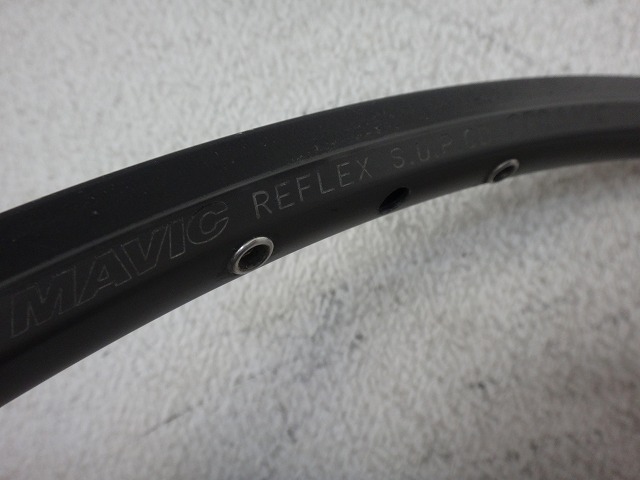
I also own a Reflex WO in the same spec.
At 1997 pricing, road rims in CD/CD Ceramic were
Open SUP at ¥6,800/¥12,000, Reflex WO at ¥6,800/¥11,800,
and for MTB rims, the 217 was ¥7,000/¥11,800.
Corresponding brake shoes came out for the 7700-series Dura-Ace and
9500-series XT (V-brake) of the time,
and paired with those, wet-weather braking performance is phenomenal,
but the nice thing about CD Ceramic is it works with regular brake shoes too.
Not quite as powerful as dedicated shoes, but better braking than a normal brake zone,
and while shoe wear is slightly accelerated, it's nowhere near as dramatic as with Exalith.
If Exalith is a single-cut metal file,
then Ceramic is like a diamond file.
Rather than releasing hand-laced Exalith rims, I'd like them to bring back these instead.