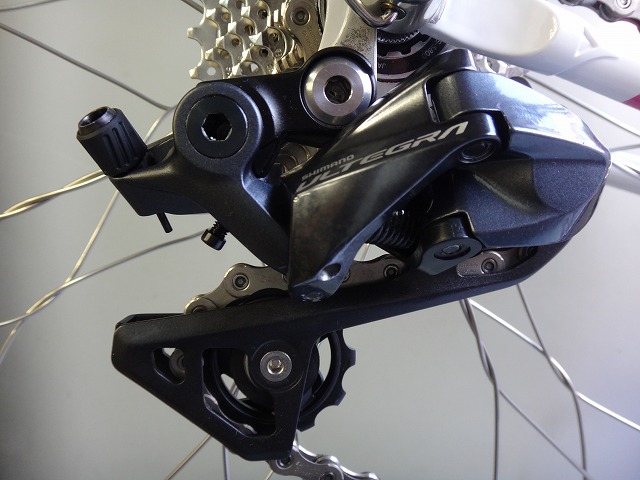
Shimano's R9100 and R8000 rear mechs use the same

"shadow" type design as current MTB models—
with minimal lateral protrusion.

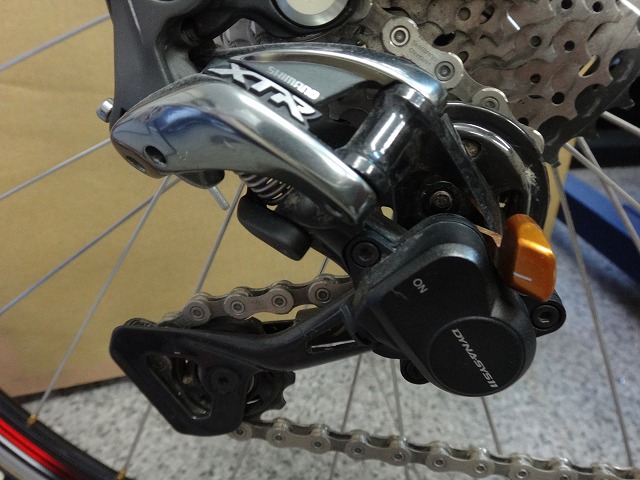
↑This is an XT rear mech, and the differences from road versions include

the addition of a stabilizer function that restricts P-tension movement to reduce chain slap,
the pulley cage length, and the fact that MTB has the cable adjuster on the lever side
rather than on the rear mech side—basically the fundamental design is the same.

When I switched to an R8000 rear mech
and set the chain length according to Shimano's manual,
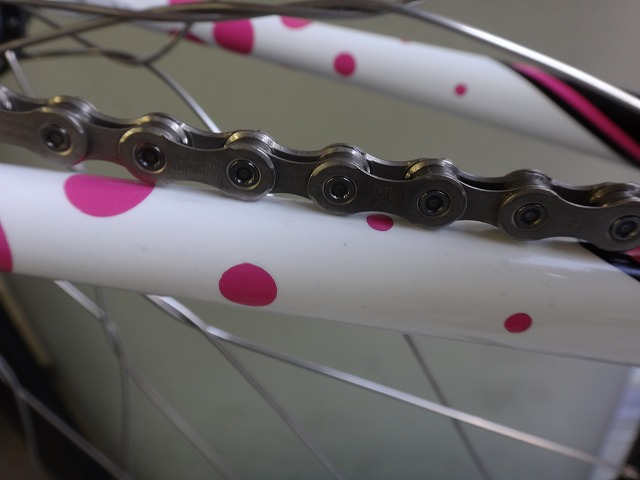
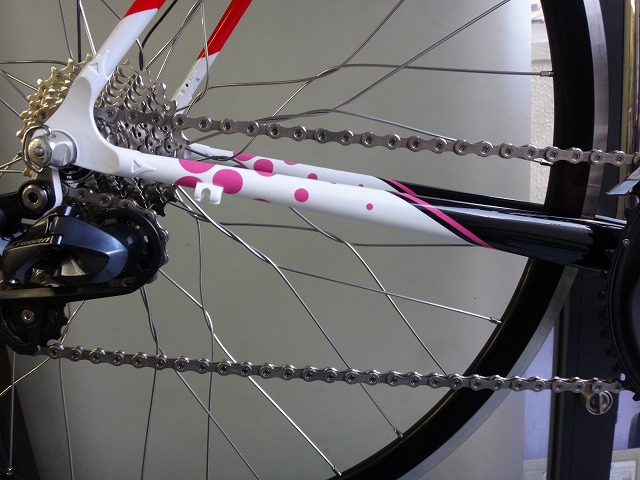
on inner × top sprocket, the chain hung slack like this.
For chain length, to avoid the draggy pedal feel that happens in outer × low,
I chose to go 3 links longer rather than just 1 link longer,
so it's on the longer end of the manual spec.

↑The top side of the chain is nearly touching the chainstay.

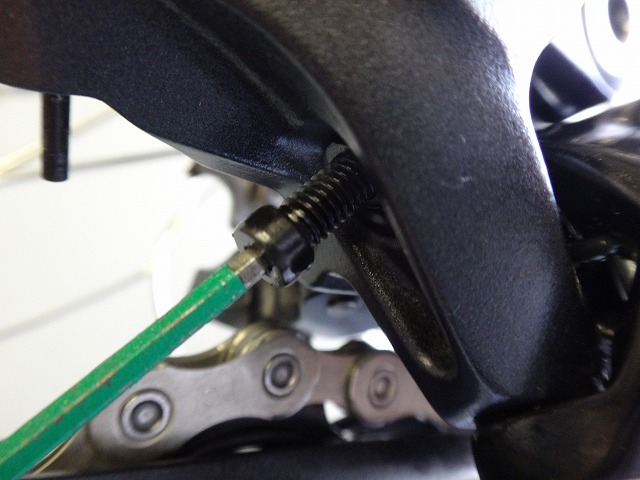
Shadow rear mechs are single-tension, so there's no B-tension,
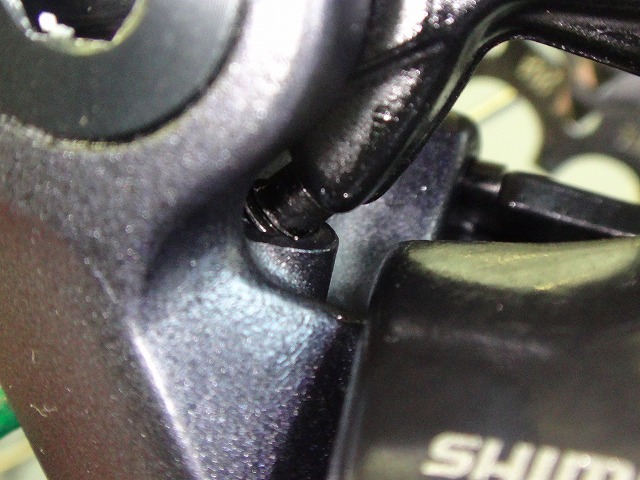
but by tightening this screw—
which corresponds to what would traditionally be called the
B-tension adjust bolt on older road rear mechs—

relative to the derailleur hanger,

the parallelogram and pulley position changes, so

tension gets applied to the chain.
Whether or not you use it or apply tension,
bikes built with R9100-series components that end up with slack chain
on inner × top have become extremely common lately—many shops probably aren't aware of it—
so I always check this point even when bikes come in for other issues.

I deliberately loosened the hanger adjust bolt again.
And there's the slack chain again.

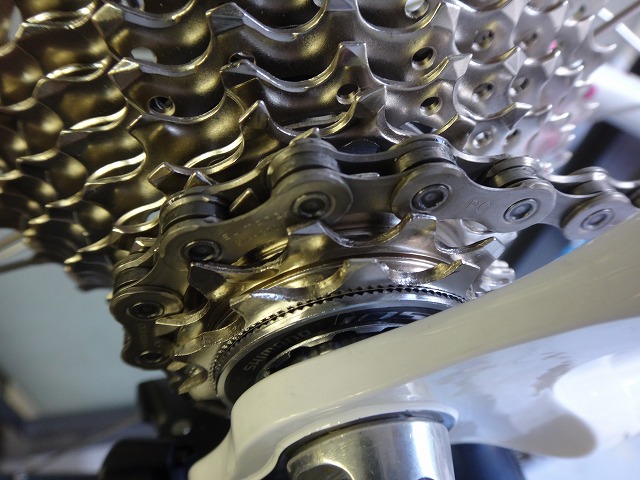
From that state, I shifted the chain to the 3rd sprocket from the top.
Shimano counts the low gear as sprocket number 1, so
on an 11-speed, the top is the "11 sprocket,"
and the 3rd sprocket from top is the "9 sprocket."

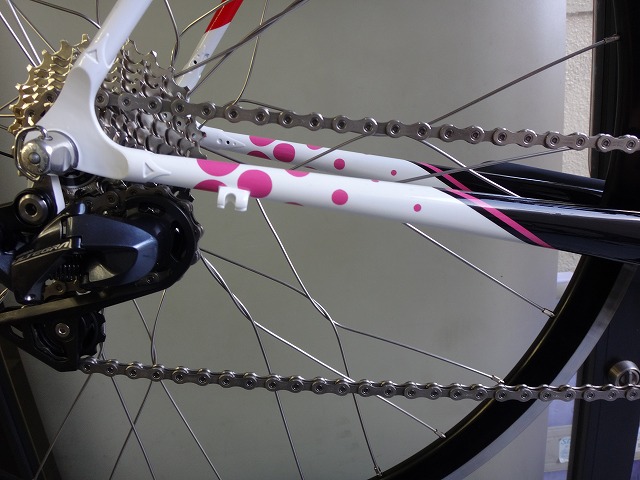
No slack. This is mechanical groupset, but
actually with R9100-series electronic groupsets,
the system prevents shifting to the top 2 sprockets when the front is on the inner ring.
Even if you try to shift the rear toward the top sprockets from inner × 9,
it won't respond—like the battery's dead.
The system is programmed so that when you shift the front from either of the top 2 rear combinations,
on the first button press (even though you're pressing the front shift button)
it first shifts the rear to the 9 sprocket, and only after pressing front shift again
does it shift to the inner ring.
So with electronic groupsets, the hanger adjust bolt setting could be
a "latent slack chain configuration" where inner × top would theoretically slack,
but since you can't actually shift to the top 2 sprockets, you never see it.
With mechanical groupsets, you can shift to inner × top,
so if you're using an R9100-series rear mech,
I'd recommend checking whether the chain actually goes slack
on inner × top.
"shadow" type design as current MTB models—
with minimal lateral protrusion.
↑This is an XT rear mech, and the differences from road versions include

the addition of a stabilizer function that restricts P-tension movement to reduce chain slap,
the pulley cage length, and the fact that MTB has the cable adjuster on the lever side
rather than on the rear mech side—basically the fundamental design is the same.

When I switched to an R8000 rear mech
and set the chain length according to Shimano's manual,
on inner × top sprocket, the chain hung slack like this.
For chain length, to avoid the draggy pedal feel that happens in outer × low,
I chose to go 3 links longer rather than just 1 link longer,
so it's on the longer end of the manual spec.
↑The top side of the chain is nearly touching the chainstay.
Shadow rear mechs are single-tension, so there's no B-tension,
but by tightening this screw—
which corresponds to what would traditionally be called the
B-tension adjust bolt on older road rear mechs—

relative to the derailleur hanger,
the parallelogram and pulley position changes, so
tension gets applied to the chain.
Whether or not you use it or apply tension,
bikes built with R9100-series components that end up with slack chain
on inner × top have become extremely common lately—many shops probably aren't aware of it—
so I always check this point even when bikes come in for other issues.

I deliberately loosened the hanger adjust bolt again.
And there's the slack chain again.
From that state, I shifted the chain to the 3rd sprocket from the top.
Shimano counts the low gear as sprocket number 1, so
on an 11-speed, the top is the "11 sprocket,"
and the 3rd sprocket from top is the "9 sprocket."
No slack. This is mechanical groupset, but
actually with R9100-series electronic groupsets,
the system prevents shifting to the top 2 sprockets when the front is on the inner ring.
Even if you try to shift the rear toward the top sprockets from inner × 9,
it won't respond—like the battery's dead.
The system is programmed so that when you shift the front from either of the top 2 rear combinations,
on the first button press (even though you're pressing the front shift button)
it first shifts the rear to the 9 sprocket, and only after pressing front shift again
does it shift to the inner ring.
So with electronic groupsets, the hanger adjust bolt setting could be
a "latent slack chain configuration" where inner × top would theoretically slack,
but since you can't actually shift to the top 2 sprockets, you never see it.
With mechanical groupsets, you can shift to inner × top,
so if you're using an R9100-series rear mech,
I'd recommend checking whether the chain actually goes slack
on inner × top.