This is completely unrelated to a certain beer yeast(EBIOS), but
long ago, Cinelli had a drop bar called Eubios (EUBIOS).
As a lightweight derivative model of that,
there was a model called Diet Eubios, but it was nothing special—
other than shortening the straight section of the drop end, it was identical to the Eubios,
and they didn't bother with tricks like changing the thickness of the butting.
When Eubios debuted,
Cinelli's bar clamp diameter was their proprietary 26.4mm standard,
so the stem diameter needed to match.
Later, a 26.0mm Eubios came out,
and that one has 26.0 marked on the clamp section.
Anyway,
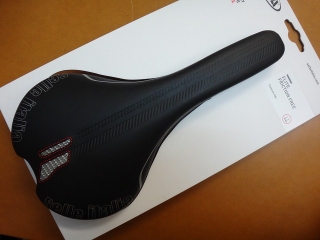
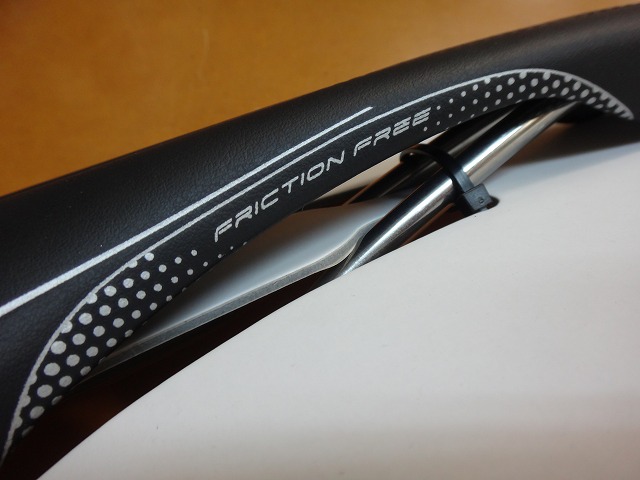
I bought a saddle called Friction Free, a derivative model of Selle Italia's Flight.
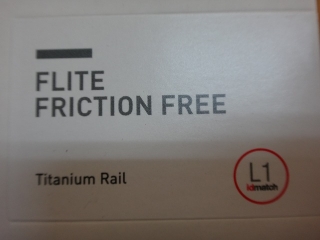
"Friction Free" doesn't mean that the saddle surface has less friction
or anything like that.
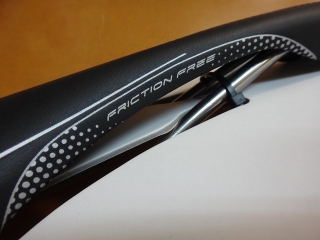
It means that the nose section is narrow, so there's less interference with your thighs.
For that kind of saddle, I'd also recommend Selle San Marco's Zoncolan.
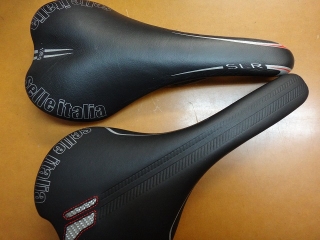
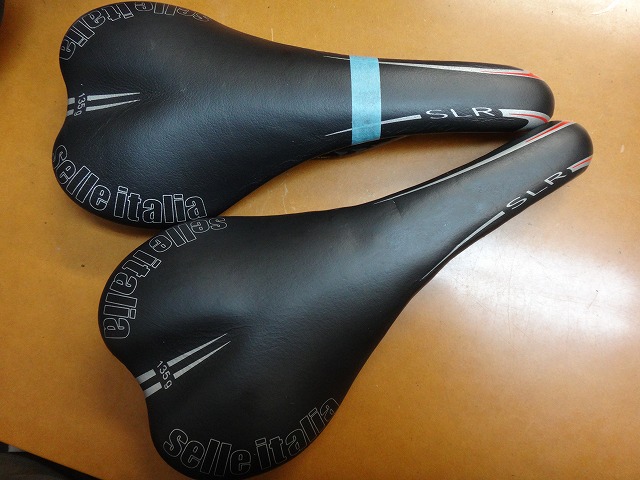
I'll compare it with the SLR, which is the first generation in shape and the second generation in design chronology.
I also have the original SLR, but I need this one for the purpose of this article.
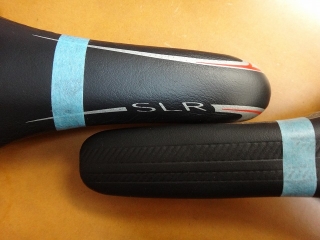
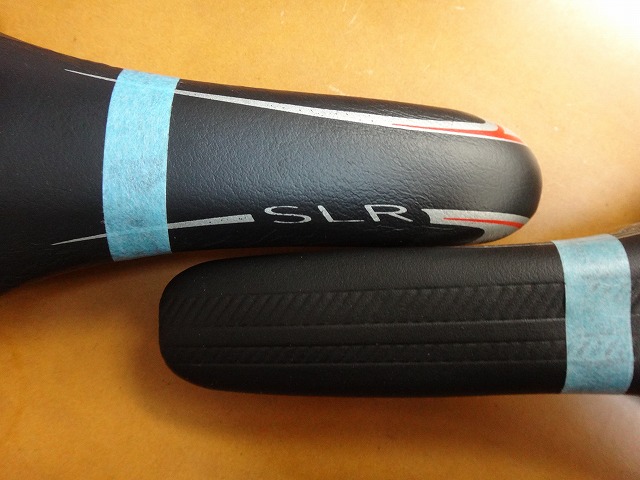
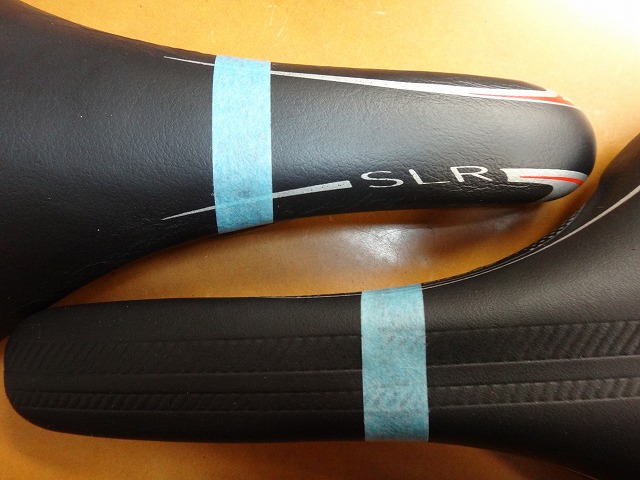
I put a reference tape at 10cm from the tip of the saddle.
The 10cm is just arbitrary. Rather than intentional,
it was "because I thought the difference would be obvious around that point."
If you call that intentional, then I suppose it is.
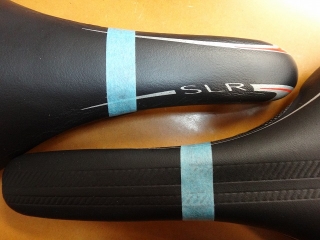
The Friction Free is narrower in width.
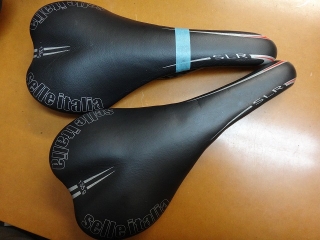
Now, the second-generation SLR had a derivative model called "SLR Narrow" with a narrow nose—
that's a lie; I actually modified and made it myself.
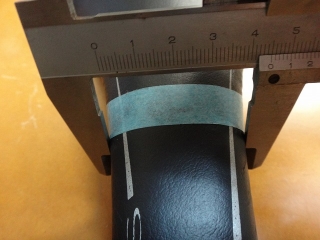
The lateral width of the SLR at 10cm from the tip.
About 45mm.
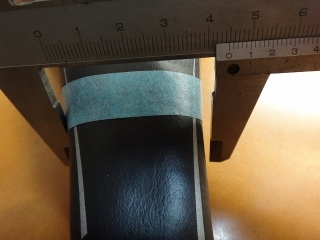
With calipers pressed against one side at the rail grip point of the SLR Narrow, there was this much space on the opposite side.
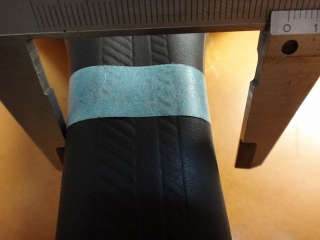
Same with the Friction Free. It's quite narrow.
When a saddle has a narrow nose, you can more easily
exceed 200 RPM cadence on a three-roller trainer and maintain it.
Though in real riding, it's not really a consciously noticed point.
Now, with this Friction Free,
I wondered if it was a lazy derivative model like Diet Eubios,
just a modified regular model—but it's not.
It's a purpose-designed nose to make it narrow,
but because of that, a different problem arises.
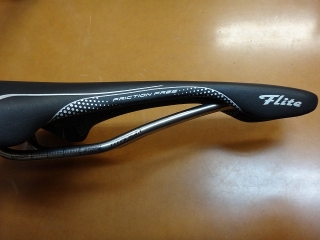
If you just shaved down the nose, the legs would interfere with the rails,
so they've made the section where the rail width narrows at the tip quite long.
In other words, it becomes difficult to take a large saddle setback.
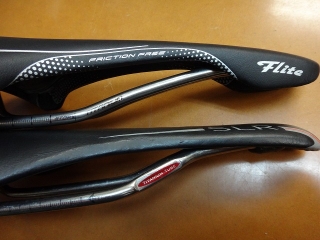
I put it side by side with the SLR. Furthermore,
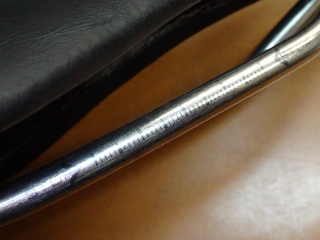
↑SLR rails
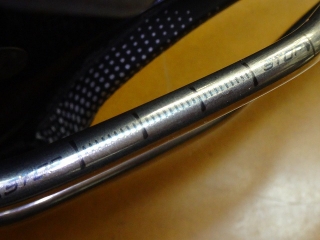
↑Friction Free rails
The clamp width of the seatpost clamp is also narrow,
so the freedom of position adjustment is low, and
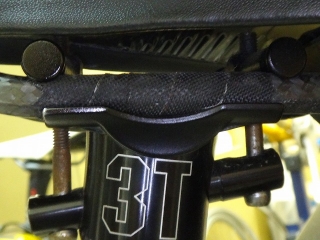
↑When the clamp width is wide,
it practically becomes "install and you're done."
(The image above shows a 3T front-and-back balance-type clamp and Fizik carbon rails)
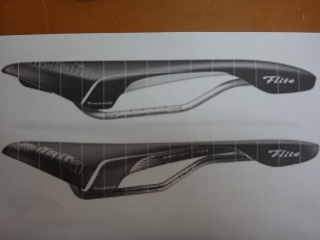
I compared it with an image of the regular Flight model.
You can see it doesn't pull back and has limited adjustment range.
If you wanted to use this saddle to combine friction-free pedaling with rearward riding,
you'd need a seatpost with considerable setback.
When I made the SLR Narrow myself, I thought I shaved down the nose considerably,
but considering rail interference, that was the limit.
In that regard, purpose design can't be beaten.
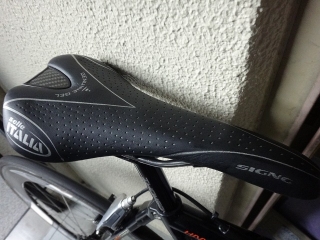
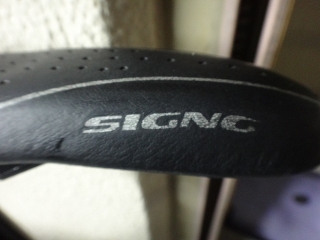
By the way, I'm currently using a Selle Italia Signo model.
It's long been discontinued, but I wonder why these classic models like Signo and Filante from that era
were discontinued.
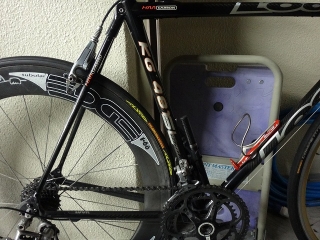
My LOOK is a horizontal tube frame, and
I took this photo with the top edge parallel to the top tube.
You can see the seat tube angle is unusually slack.
The manufacturer's skeleton chart shows 72°.
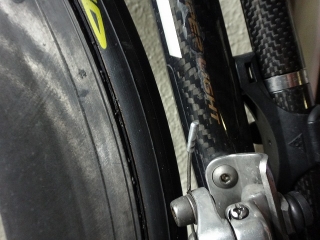
With a TUFO tubular tire with a low vertical profile,
the clearance with the seat tube is pretty tight
(the clear coat gets scraped by mud flicking, so I've applied protective tape).
With a 25C clincher, some models won't fit.
The narrowest front-back diameter was 28.3mm.
This seat tube has a shape like a 28.6mm true circular tube
flattened into a pentagon.
If this seat angle stayed the same but the seat tube diameter became 34.9mm,
it would definitely interfere regardless of tire size.
The reason modern frames have steeper seat angles
is largely to avoid this interference.
If you mount a front derailleur designed for a 73° frame
on a 75° frame, you get "tooth drop," but
recent components seem to be premised on around 75°.

Against a Thomson seatpost with no setback
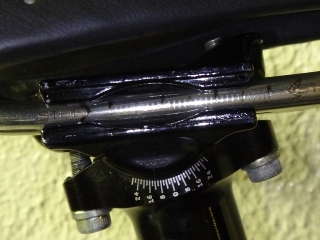
I'm mounting it quite far forward,
but even so I get decent rearward travel.
I also have a LOOK ergo seatpost,
but even when you mount the clamp at the very front of its very wide adjustment range,
it ends up like a standard setback seatpost.
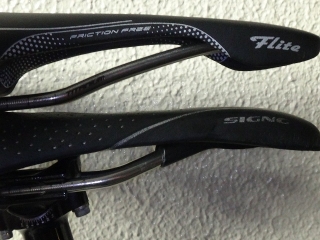
I aligned the noses of the Friction Free and Signo and roughly checked
if the Thomson clamp could grab them at the same position.
It looks like I can just barely clamp them.
If it comes out a bit further forward than now, I can just change the seatpost.
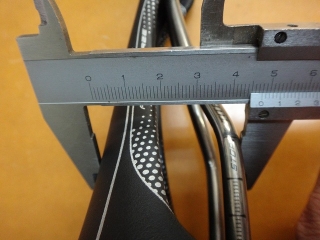
I measured the saddle from top and bottom with calipers at the front end of the rail clamp grip.
With the Friction Free, it's a bit under 48mm.
I get the feeling that saddles with thin bases can extend the seatpost further,
but saddles with a "raised rail" type of shape have greater vertical width here,
which results in the seatpost extending less overall.
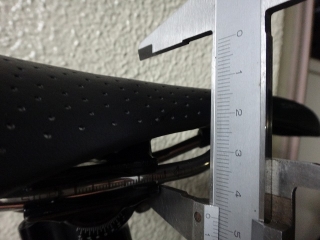
I put it on the Signo.
The seatpost drops by the amount of gap between the saddle top and the calipers.
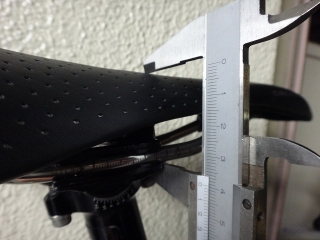
I measured the Signo's thickness. Just under 40mm.
The thinnest of these—varies by era—but the SLR is 35-37mm,
and the original Specialized Toupe (a saddle too thin for most people)
is around 35mm.
In the end, I decided not to put it on the LOOK.
I'll use it on my three-roller trainer bike instead.
Just to be clear,
the point of this article isn't to badmouth the Friction Free.
It's just that the design is different from the regular model,
so you can't use it the same way—that's the warning.

Since the LOOK's seatpost diameter is 25.0mm, the selection isn't large.
What I have on hand is a Selcof 66X, a Suntour Superbe Pro,
a Campagnolo Euclid single-bolt, the Sugino 75 in the image above,
and about a Campagnolo two-bolt.

The Sugino 75 seatpost is nominally carbon but essentially aluminum.

Rather than measuring everything on the sizing stand each time,
I make seatpost and saddle sets and swap them as units.
If you're lazy and try to get height and setback without using the stand, you'll regret it.
Using a plumb bob (string with a weight) to measure setback
is also lazy in my opinion.
It has very poor reproducibility—if you measured immediately, your memory was erased,
and then you measured again, you probably couldn't
state the same value (to 1mm) three times in a row.
Or if you had several people hold a plumb bob and measure setback,
you'd get considerable variation.
Of course, if you're careful to level the measuring point
and swap where your front and rear wheels contact while measuring,
you can get pretty close to accuracy.
Saddles are designed to be used with the height of the bend on the front and the highest point on the back
set level (the line connecting those two points made horizontal).
The exceptions are old Selle San Marco Concor and
Strada models (including Bontrager KA and Carboneo 650, etc.),
where you level it about two-thirds from the front
and let the rear angle upward.
The image above is a Selle Italia Turbo, so I set it level.
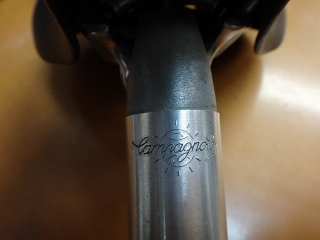
With a Campagnolo two-bolt with the earth mark, matte-finish clamp
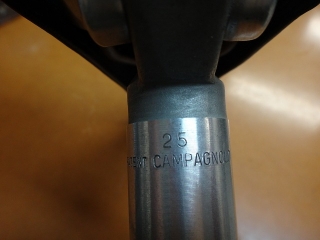
25.0mm diameter exists.
Is this for TVT?
Back then (late 1980s), Bianchi had frames with 23.8mm diameter seatposts,
which is the narrowest seatpost diameter I know of.
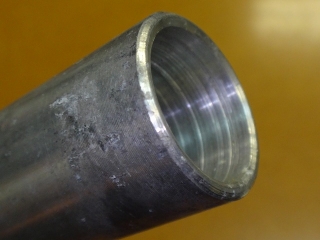
From the end surface shape, it appears to be stock and not cut,
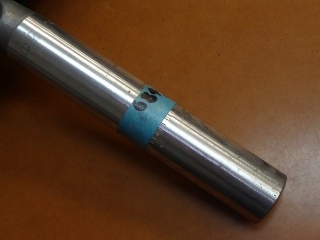
but the overall length of the seatpost is quite short.
Fujita Saddle made a seatpost called Hyper Rider,
but the regular model is even shorter (the box itself is short).
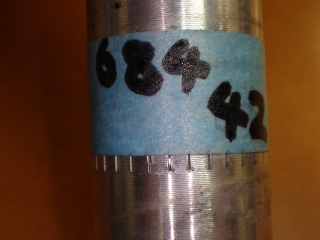
It's right at the limit, so it can't be used on sloping frames.
I doubt there's even such a thing as a sloping frame with a 25.0mm seatpost.
long ago, Cinelli had a drop bar called Eubios (EUBIOS).
As a lightweight derivative model of that,
there was a model called Diet Eubios, but it was nothing special—
other than shortening the straight section of the drop end, it was identical to the Eubios,
and they didn't bother with tricks like changing the thickness of the butting.
When Eubios debuted,
Cinelli's bar clamp diameter was their proprietary 26.4mm standard,
so the stem diameter needed to match.
Later, a 26.0mm Eubios came out,
and that one has 26.0 marked on the clamp section.
Anyway,
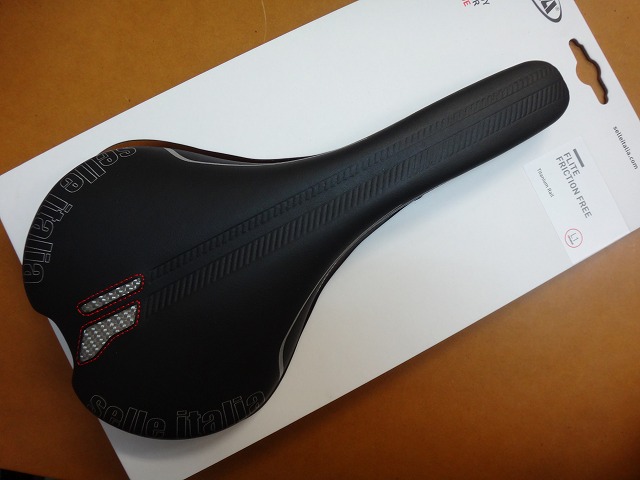
I bought a saddle called Friction Free, a derivative model of Selle Italia's Flight.
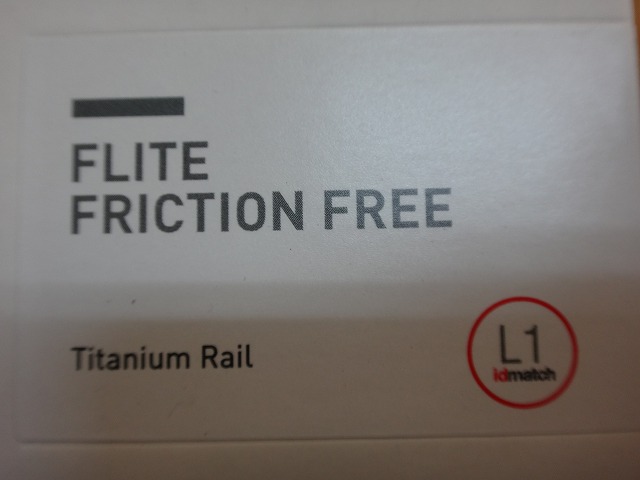
"Friction Free" doesn't mean that the saddle surface has less friction
or anything like that.
It means that the nose section is narrow, so there's less interference with your thighs.
For that kind of saddle, I'd also recommend Selle San Marco's Zoncolan.

I'll compare it with the SLR, which is the first generation in shape and the second generation in design chronology.
I also have the original SLR, but I need this one for the purpose of this article.
I put a reference tape at 10cm from the tip of the saddle.
The 10cm is just arbitrary. Rather than intentional,
it was "because I thought the difference would be obvious around that point."
If you call that intentional, then I suppose it is.
The Friction Free is narrower in width.
Now, the second-generation SLR had a derivative model called "SLR Narrow" with a narrow nose—
that's a lie; I actually modified and made it myself.
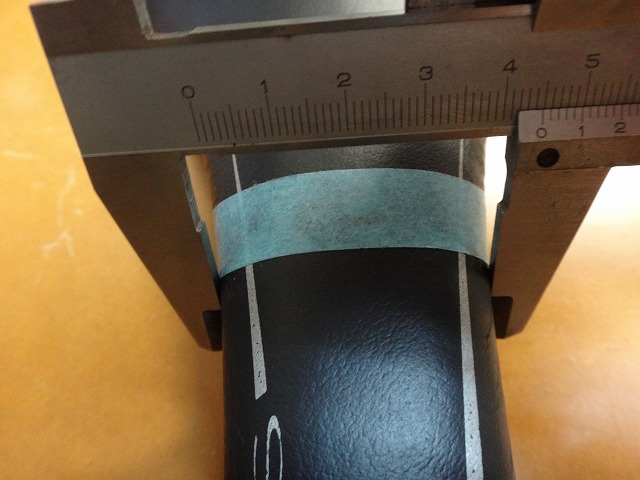
The lateral width of the SLR at 10cm from the tip.
About 45mm.
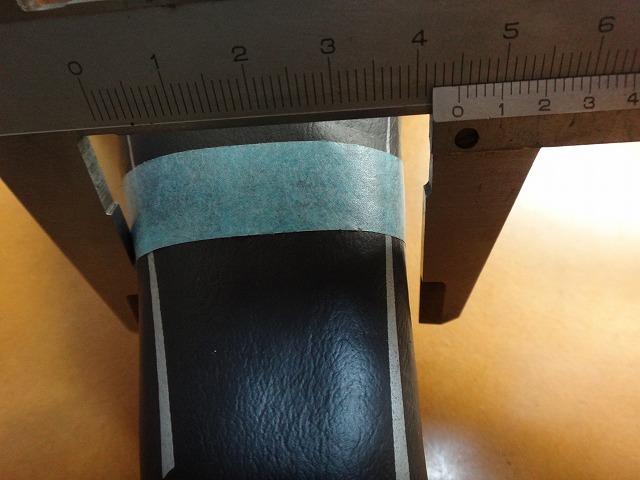
With calipers pressed against one side at the rail grip point of the SLR Narrow, there was this much space on the opposite side.
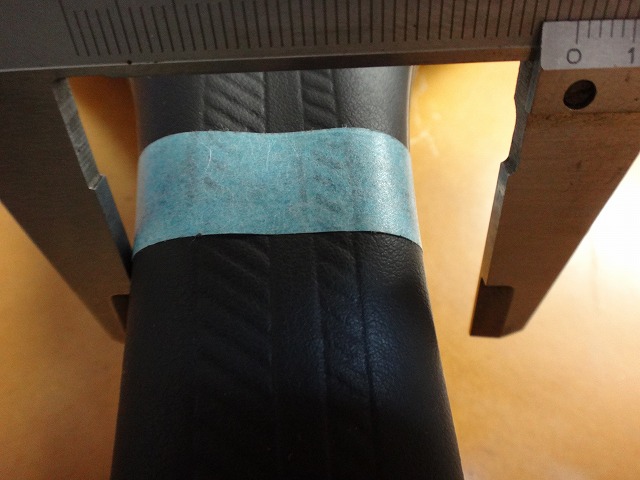
Same with the Friction Free. It's quite narrow.
When a saddle has a narrow nose, you can more easily
exceed 200 RPM cadence on a three-roller trainer and maintain it.
Though in real riding, it's not really a consciously noticed point.
Now, with this Friction Free,
I wondered if it was a lazy derivative model like Diet Eubios,
just a modified regular model—but it's not.
It's a purpose-designed nose to make it narrow,
but because of that, a different problem arises.
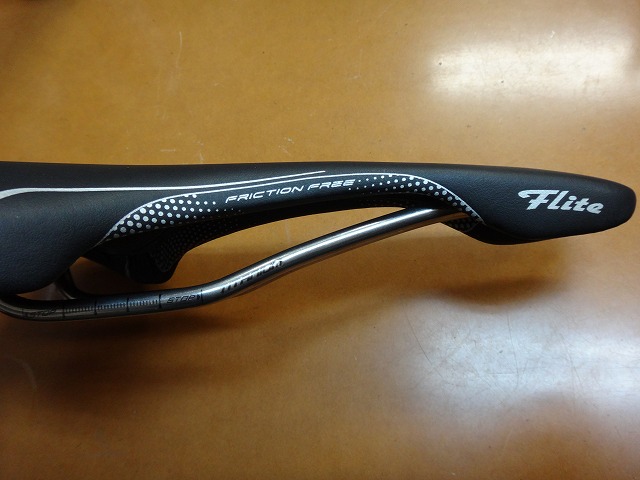
If you just shaved down the nose, the legs would interfere with the rails,
so they've made the section where the rail width narrows at the tip quite long.
In other words, it becomes difficult to take a large saddle setback.
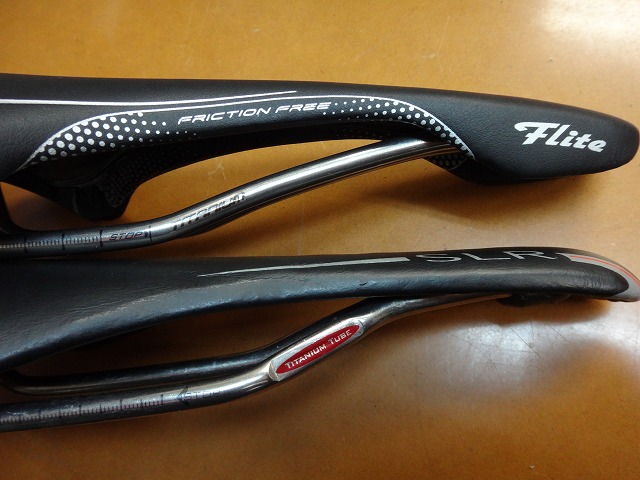
I put it side by side with the SLR. Furthermore,

↑SLR rails
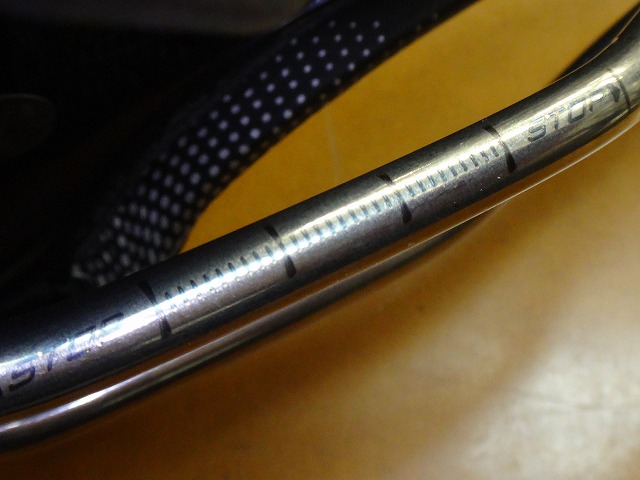
↑Friction Free rails
The clamp width of the seatpost clamp is also narrow,
so the freedom of position adjustment is low, and
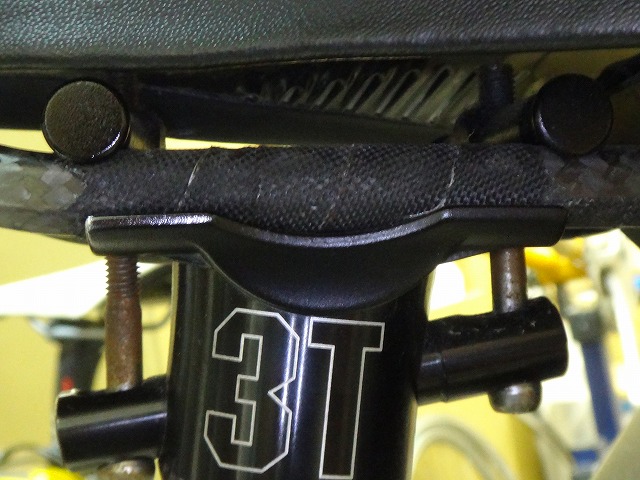
↑When the clamp width is wide,
it practically becomes "install and you're done."
(The image above shows a 3T front-and-back balance-type clamp and Fizik carbon rails)
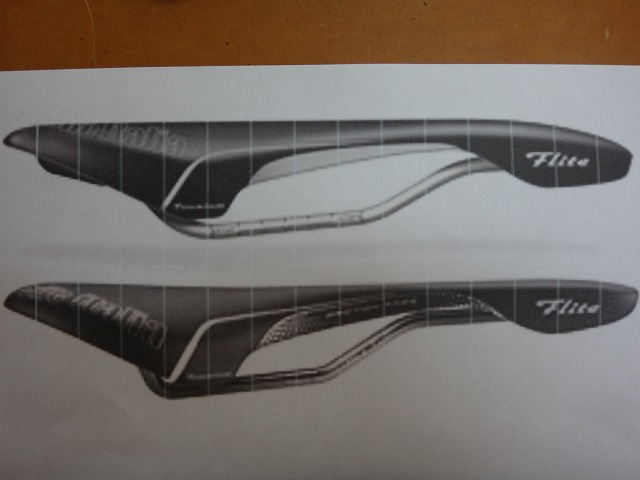
I compared it with an image of the regular Flight model.
You can see it doesn't pull back and has limited adjustment range.
If you wanted to use this saddle to combine friction-free pedaling with rearward riding,
you'd need a seatpost with considerable setback.
When I made the SLR Narrow myself, I thought I shaved down the nose considerably,
but considering rail interference, that was the limit.
In that regard, purpose design can't be beaten.

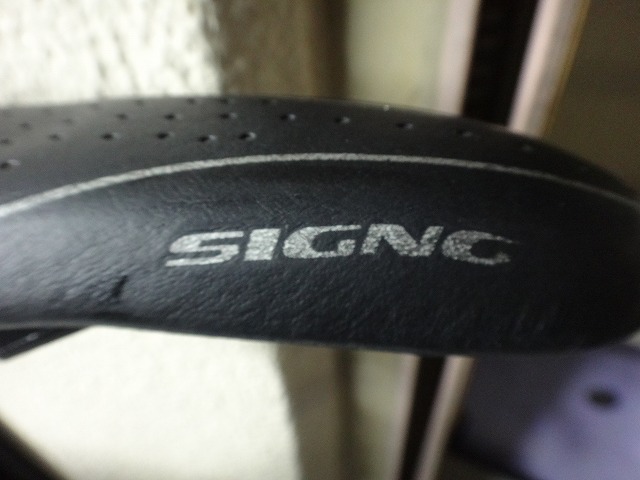
By the way, I'm currently using a Selle Italia Signo model.
It's long been discontinued, but I wonder why these classic models like Signo and Filante from that era
were discontinued.
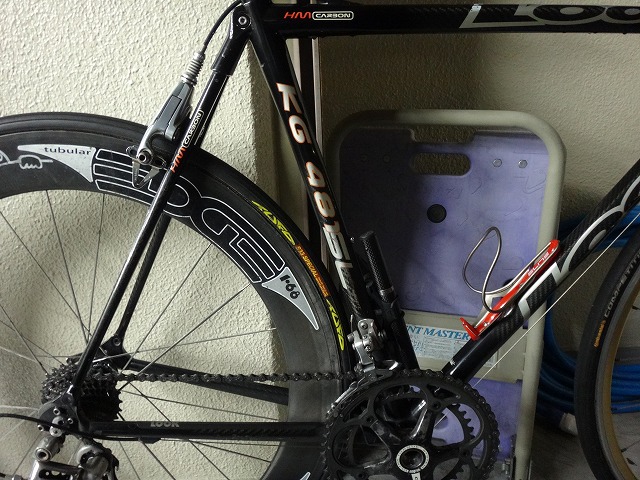
My LOOK is a horizontal tube frame, and
I took this photo with the top edge parallel to the top tube.
You can see the seat tube angle is unusually slack.
The manufacturer's skeleton chart shows 72°.
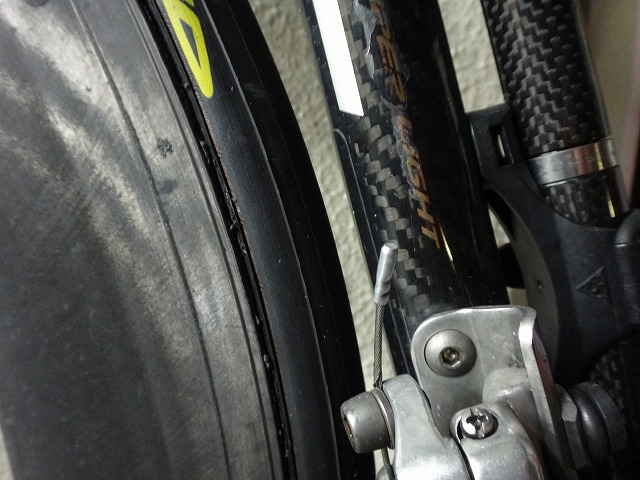
With a TUFO tubular tire with a low vertical profile,
the clearance with the seat tube is pretty tight
(the clear coat gets scraped by mud flicking, so I've applied protective tape).
With a 25C clincher, some models won't fit.
The narrowest front-back diameter was 28.3mm.
This seat tube has a shape like a 28.6mm true circular tube
flattened into a pentagon.
If this seat angle stayed the same but the seat tube diameter became 34.9mm,
it would definitely interfere regardless of tire size.
The reason modern frames have steeper seat angles
is largely to avoid this interference.
If you mount a front derailleur designed for a 73° frame
on a 75° frame, you get "tooth drop," but
recent components seem to be premised on around 75°.
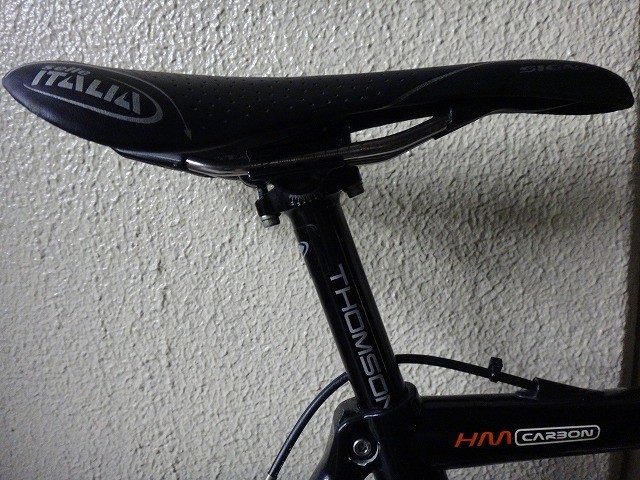
Against a Thomson seatpost with no setback
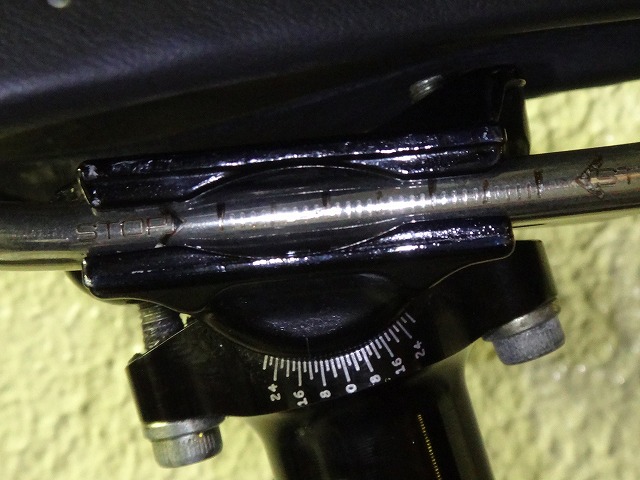
I'm mounting it quite far forward,
but even so I get decent rearward travel.
I also have a LOOK ergo seatpost,
but even when you mount the clamp at the very front of its very wide adjustment range,
it ends up like a standard setback seatpost.

I aligned the noses of the Friction Free and Signo and roughly checked
if the Thomson clamp could grab them at the same position.
It looks like I can just barely clamp them.
If it comes out a bit further forward than now, I can just change the seatpost.
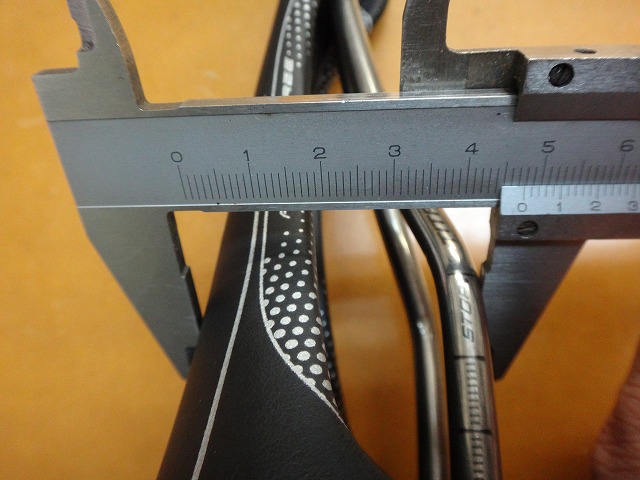
I measured the saddle from top and bottom with calipers at the front end of the rail clamp grip.
With the Friction Free, it's a bit under 48mm.
I get the feeling that saddles with thin bases can extend the seatpost further,
but saddles with a "raised rail" type of shape have greater vertical width here,
which results in the seatpost extending less overall.
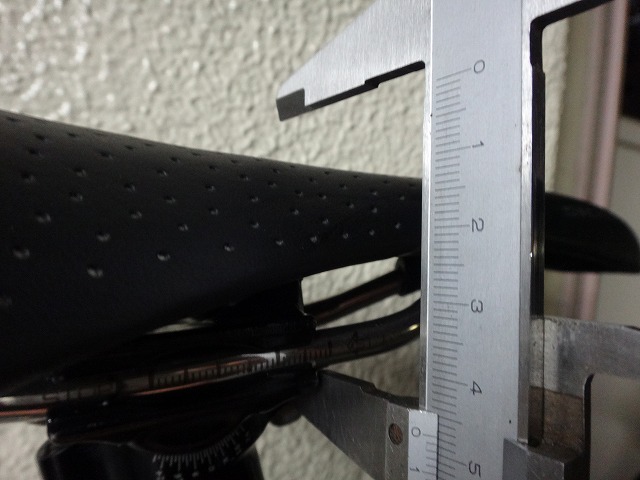
I put it on the Signo.
The seatpost drops by the amount of gap between the saddle top and the calipers.
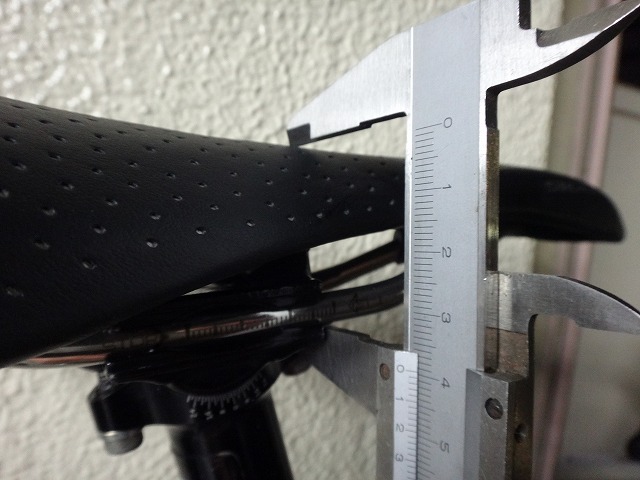
I measured the Signo's thickness. Just under 40mm.
The thinnest of these—varies by era—but the SLR is 35-37mm,
and the original Specialized Toupe (a saddle too thin for most people)
is around 35mm.
In the end, I decided not to put it on the LOOK.
I'll use it on my three-roller trainer bike instead.
Just to be clear,
the point of this article isn't to badmouth the Friction Free.
It's just that the design is different from the regular model,
so you can't use it the same way—that's the warning.
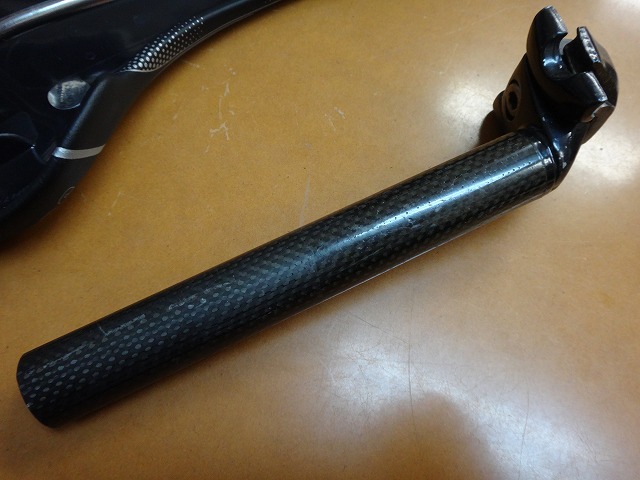
Since the LOOK's seatpost diameter is 25.0mm, the selection isn't large.
What I have on hand is a Selcof 66X, a Suntour Superbe Pro,
a Campagnolo Euclid single-bolt, the Sugino 75 in the image above,
and about a Campagnolo two-bolt.
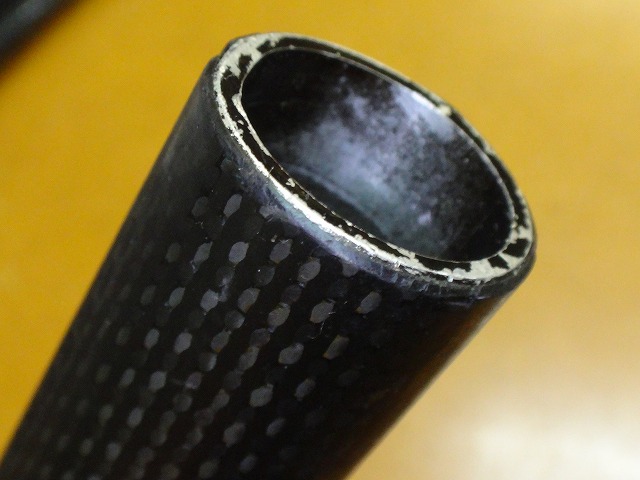
The Sugino 75 seatpost is nominally carbon but essentially aluminum.

Rather than measuring everything on the sizing stand each time,
I make seatpost and saddle sets and swap them as units.
If you're lazy and try to get height and setback without using the stand, you'll regret it.
Using a plumb bob (string with a weight) to measure setback
is also lazy in my opinion.
It has very poor reproducibility—if you measured immediately, your memory was erased,
and then you measured again, you probably couldn't
state the same value (to 1mm) three times in a row.
Or if you had several people hold a plumb bob and measure setback,
you'd get considerable variation.
Of course, if you're careful to level the measuring point
and swap where your front and rear wheels contact while measuring,
you can get pretty close to accuracy.
Saddles are designed to be used with the height of the bend on the front and the highest point on the back
set level (the line connecting those two points made horizontal).
The exceptions are old Selle San Marco Concor and
Strada models (including Bontrager KA and Carboneo 650, etc.),
where you level it about two-thirds from the front
and let the rear angle upward.
The image above is a Selle Italia Turbo, so I set it level.
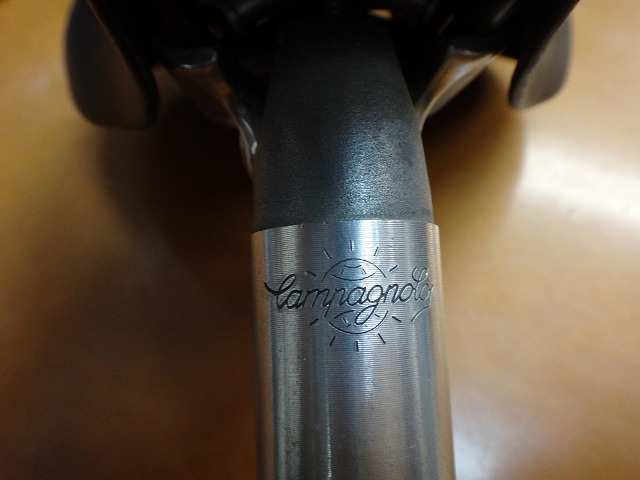
With a Campagnolo two-bolt with the earth mark, matte-finish clamp
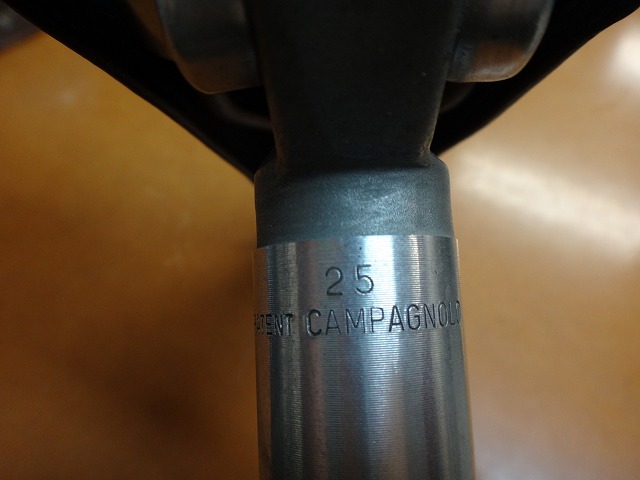
25.0mm diameter exists.
Is this for TVT?
Back then (late 1980s), Bianchi had frames with 23.8mm diameter seatposts,
which is the narrowest seatpost diameter I know of.
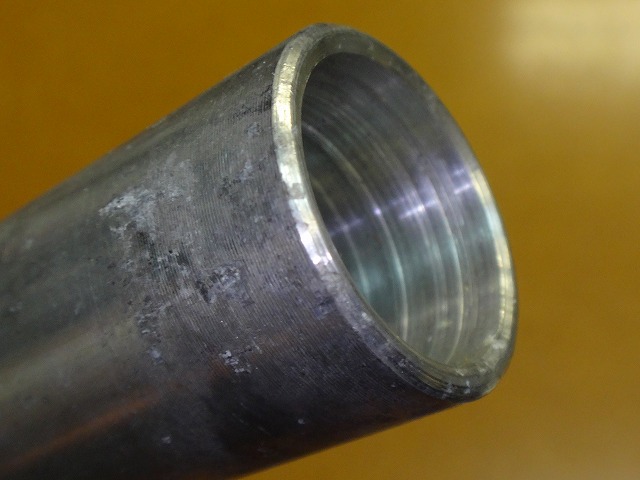
From the end surface shape, it appears to be stock and not cut,
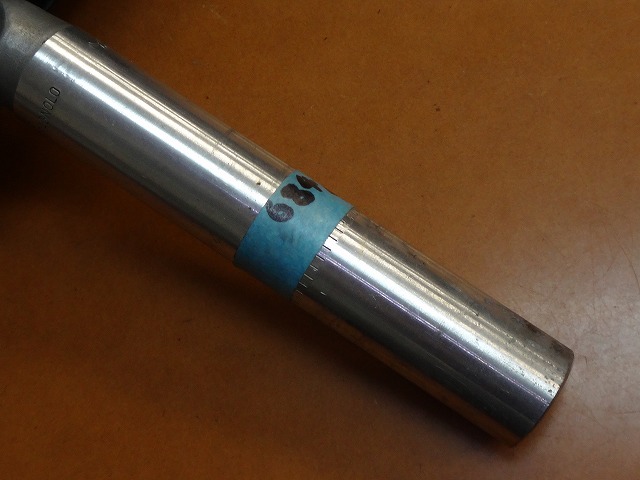
but the overall length of the seatpost is quite short.
Fujita Saddle made a seatpost called Hyper Rider,
but the regular model is even shorter (the box itself is short).

It's right at the limit, so it can't be used on sloping frames.
I doubt there's even such a thing as a sloping frame with a 25.0mm seatpost.