Another day, another wheel (and so on).

I can't show the rim before the rebuild for various reasons, but
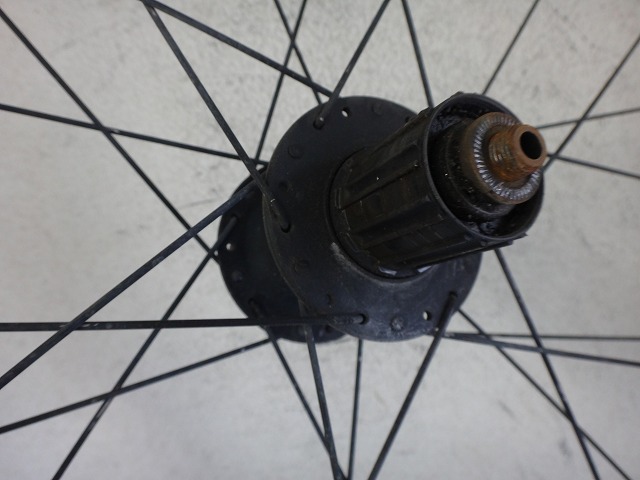
a customer gave me a rear wheel that was built with
XT's original disc brake hub.

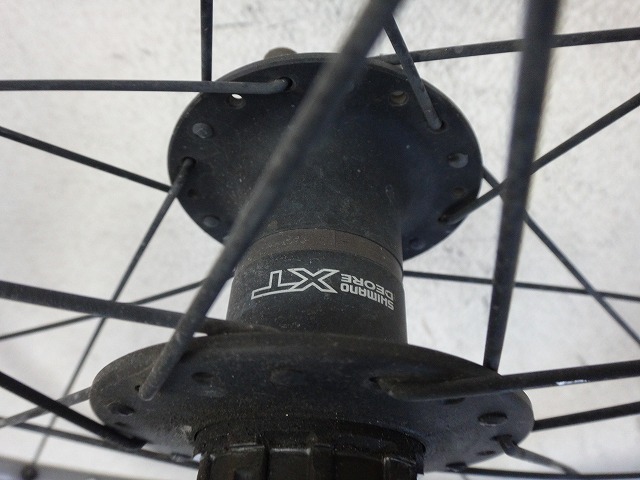
The rear hub is an FH-M755,
the M750 series XT from when XCTR was the M950 series.
The M950 series XCTR doesn't have a disc brake version.
I don't know if Shimano was thinking
"Pure XC duty is fine with V-brakes; disc brakes are DH-class parts"
or maybe
"If we mess up releasing disc brakes on XCTR, that's scary—let's release them on XT first,"
but in any case, the 755 series disc was not only XT's
but Shimano's very first disc brake.
The rotor mounting method wasn't centerlock either.

This next part isn't really related to the current job, but
it seems like now is the only chance I'll get to write about it, so I'm going off on a tangent.
V-brake is Shimano's product name for what's technically called a "long-arm cantilever brake."
It's not really a generic term.
So saying "Brand X's V-brake" isn't technically accurate.
That said, I'll keep using V-brake going forward, but
the arms of typical V-brakes (including non-Shimano brands)
move in an arc like a metronome pendulum.
However, Shimano's higher-end V-brake models use
a mechanism called "parallel link,"
which makes the shoe move nearly horizontally.
This prevents the shoes from wearing diagonally,
and stops the dreaded "dive-in" where a diagonally-worn shoe digs into the rim.
But adopting parallel link naturally adds weight.
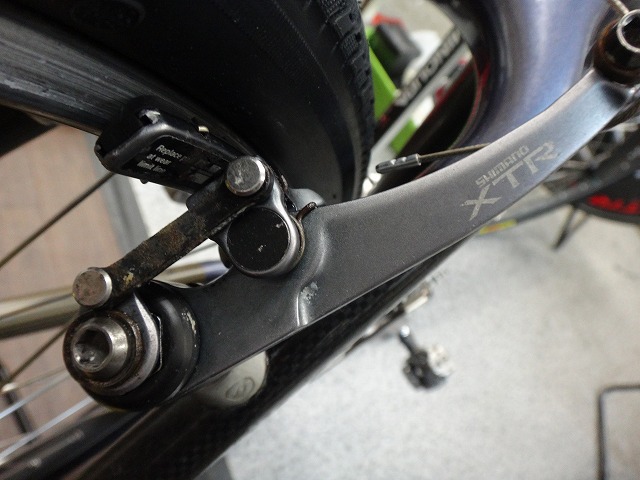
The XCTR in the photo above is a BR-M951, an improved version of the BR-M950.
The BR-M950 had cutouts in its parallel link plate,
and the parallel link would flex when squeezing the brake lever hard past initial contact,
which was a drawback, but
the BR-M951 improved this somewhat.
By the M950 series XCTR era, parallel link was adopted on
XT's BR-M750 and LX's BR-M570,
but when it comes to braking power, the beefier-armed LX was clearly strongest,
followed by XT, then XCTR—the opposite of the component tier.
Published weight for a complete front/rear brake set:
XCTR BR-M950 was 395g, M951 was 394g,
XT BR-M750 was 455g,
LX BR-M570 was 542g,
and Deore BR-M510 was 420g.
Deore was lighter because it didn't use parallel link.
When Shimano adopted disc brakes for XCTR starting with the M960 series,
they were saying at the time "With the new XCTR, there's virtually no weight difference between V-brake and disc brake!"
Though in reality the V-brake was probably still dozens of grams lighter.
The problem here is that the M960 series V-brake, the BR-M960,
had much beefier arms than the M950 series
and tipped the scales at a claimed 484g.
Making the V-brake roughly 100g heavier to make the weight difference from the disc brake look smaller?
That's some cheap misdirection. From the BR-M95X it's a hundred-plus grams heavier—
or so I thought at the time.
Though it is true that disc brakes had better stopping power than V-brakes even back then.

Back to the topic.
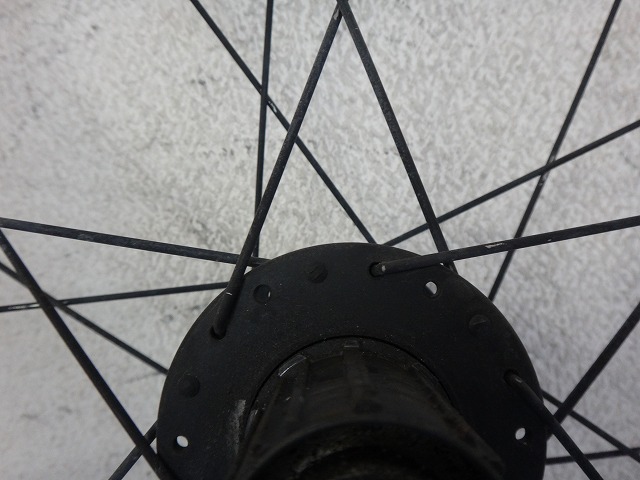
The rear wheel before rebuild
was a 24H rim and 36H hub, built with holes skipped.
Since the spoke orientation doesn't twist with this hole-skipping pattern, there's no problem there.
The build pattern is reverse Italian, and
when counting hub holes it's a 6-6 build, but spoke overlap is 2-cross,
so it's equivalent to an "almost" 4-4 build on a 24H hub.
I've written before that with the same hub and rim,
if you have an X-cross build on a Y-hole hub and Y/X is the same,
the spoke trajectories are identical—same length, same angle.
So a 36H 6-spoke build (36/6) and a 24H 4-spoke build (24/4)
have identical spoke trajectories.
Which means looking at this final cross pattern, it's 36/6, so
if a (non-existent) FH-M775 24H hub were built 4-spoke,
the spoke trajectories would be... not quite identical.
Since the 36H holes would be viewed as 24H holes, the spacing between holes
would have dense and sparse areas, which prevents them from being truly identical.
But you could say they're "almost" the same.
After the rebuild, as mentioned in the title,
it becomes a Nomulabo wheel No. 1 rim,
but the XR300 rim only comes in 32H maximum (unless you special order).
So I decided to rebuild with a 24H rim, and

I drew a development diagram for building a wheel with a 36H hub and 24H rim
in the hub-to-rim-to-hub format.
Not directly related to this job, but
I also drew the case of building with a 32H hub and 24H rim.
In that case, you get a 2:1 build.
If you want the spoke trajectory to come out right,
in radial lacing the
spoke line needs to be perpendicular to the horizontal line,
and in tangential lacing,
even if the spoke line is angled, as long as it repeats at the same angle,
just doing tangential lacing means the final cross resultant
lands on the radial line—OK.
What I mean is

when 0-spoke lacing with different hub and rim hole counts,
if the spoke line in the development diagram is perpendicular to the horizontal line,
the spoke trajectory becomes radial,
making it "radial lacing."
If it's not perpendicular, the 0-spoke trajectory
appears twisted and doesn't qualify as true radial lacing in the strict sense.

Even if the spoke line connecting rim hole and hub hole
deviates from the radial line by some angle,
if it's offset by the same plus-or-minus angle from perpendicular
and this pattern repeats,

you can convert it to tangential lacing (though odd numbers like 18H with 9H per side won't work).
The resultant of this final cross is radial, so
you can build a wheel with a proper spoke trajectory.
The freewheel side of the diagram I showed earlier—the 32H hub 24H rim 2:1 build—
corresponds to this case.
I drew it in XI lacing, but you could also draw the spoke lines in Ж lacing.
When actually building, you need to be careful that the valve hole phase doesn't end up wrong.

There's a front wheel from a while back that I literally said I wouldn't even touch:
a 32H dynamo hub and a 20H Cosmic Carbon rim
force-laced together.
Since the Cosmic Carbon 20H rim is actually a rear rim,
the holes in the rim wall are at different heights left and right,
which itself feels weird for a front wheel,
but setting that aside, I drew the 0-spoke lacing—three pairs of tangential—to see what happens.

When you convert it to tangential lacing, you get this.
Even if you shift the center rim line left and right from this state,
you cannot make all the tangential lacing final cross resultants
land on the radial line.
In other words, with a 20H rim and 32H hub,
it's impossible to build a wheel where the spoke pull direction isn't twisted.
That front wheel had abnormally loose tension and lots of variation
(a mix of loose spokes and super loose spokes),
and the customer asked me to inspect it, but I told them that's not a wheel—that's a death trap.
I told them it could cause serious injury, but
I bet they're still riding it.

The spokes before rebuild were black Star Bright from Sapim,

and they were magnetic.

I was kind of amazed by that,
so I hesitated to write that the black paint job on the spokes looked cheap,
but I ended up writing it anyway.


The hub gets a full overhaul.


↑Freewheel side


↑Non-freewheel side
No significant wear found.

Wheel's built.
Writing this article takes several times longer than actually building the wheel.


I went with JIS lacing.
Ignoring the flange hole spacing, by hole count
the freewheel side is 6-spoke and the non-freewheel side is 8-spoke, making it a 6-4 build,
but in reality the freewheel side is 2-cross and the non-freewheel side is 3-cross, so
I'll call it "roughly a 4-6 build."
The key point is incorporating left-right asymmetric spoke counts.
On the freewheel side I used black Leader spokes, and on the non-freewheel side black Comp,
which amounts to Champion/Comp configuration.
For black spokes, the 14-gauge plain spoke option
is Sapim Leader anyway.
Also, I tied the non-freewheel side spokes.

Cleaned rust off the sprocket and washed it, cleaned the hub body,
and cleaned rust off the parts of the disc rotor where the pads don't make contact.
I can't show the rim before the rebuild for various reasons, but
a customer gave me a rear wheel that was built with
XT's original disc brake hub.
The rear hub is an FH-M755,
the M750 series XT from when XCTR was the M950 series.
The M950 series XCTR doesn't have a disc brake version.
I don't know if Shimano was thinking
"Pure XC duty is fine with V-brakes; disc brakes are DH-class parts"
or maybe
"If we mess up releasing disc brakes on XCTR, that's scary—let's release them on XT first,"
but in any case, the 755 series disc was not only XT's
but Shimano's very first disc brake.
The rotor mounting method wasn't centerlock either.
This next part isn't really related to the current job, but
it seems like now is the only chance I'll get to write about it, so I'm going off on a tangent.
V-brake is Shimano's product name for what's technically called a "long-arm cantilever brake."
It's not really a generic term.
So saying "Brand X's V-brake" isn't technically accurate.
That said, I'll keep using V-brake going forward, but
the arms of typical V-brakes (including non-Shimano brands)
move in an arc like a metronome pendulum.
However, Shimano's higher-end V-brake models use
a mechanism called "parallel link,"
which makes the shoe move nearly horizontally.
This prevents the shoes from wearing diagonally,
and stops the dreaded "dive-in" where a diagonally-worn shoe digs into the rim.
But adopting parallel link naturally adds weight.
The XCTR in the photo above is a BR-M951, an improved version of the BR-M950.
The BR-M950 had cutouts in its parallel link plate,
and the parallel link would flex when squeezing the brake lever hard past initial contact,
which was a drawback, but
the BR-M951 improved this somewhat.
By the M950 series XCTR era, parallel link was adopted on
XT's BR-M750 and LX's BR-M570,
but when it comes to braking power, the beefier-armed LX was clearly strongest,
followed by XT, then XCTR—the opposite of the component tier.
Published weight for a complete front/rear brake set:
XCTR BR-M950 was 395g, M951 was 394g,
XT BR-M750 was 455g,
LX BR-M570 was 542g,
and Deore BR-M510 was 420g.
Deore was lighter because it didn't use parallel link.
When Shimano adopted disc brakes for XCTR starting with the M960 series,
they were saying at the time "With the new XCTR, there's virtually no weight difference between V-brake and disc brake!"
Though in reality the V-brake was probably still dozens of grams lighter.
The problem here is that the M960 series V-brake, the BR-M960,
had much beefier arms than the M950 series
and tipped the scales at a claimed 484g.
Making the V-brake roughly 100g heavier to make the weight difference from the disc brake look smaller?
That's some cheap misdirection. From the BR-M95X it's a hundred-plus grams heavier—
or so I thought at the time.
Though it is true that disc brakes had better stopping power than V-brakes even back then.
Back to the topic.
The rear wheel before rebuild
was a 24H rim and 36H hub, built with holes skipped.
Since the spoke orientation doesn't twist with this hole-skipping pattern, there's no problem there.
The build pattern is reverse Italian, and
when counting hub holes it's a 6-6 build, but spoke overlap is 2-cross,
so it's equivalent to an "almost" 4-4 build on a 24H hub.
I've written before that with the same hub and rim,
if you have an X-cross build on a Y-hole hub and Y/X is the same,
the spoke trajectories are identical—same length, same angle.
So a 36H 6-spoke build (36/6) and a 24H 4-spoke build (24/4)
have identical spoke trajectories.
Which means looking at this final cross pattern, it's 36/6, so
if a (non-existent) FH-M775 24H hub were built 4-spoke,
the spoke trajectories would be... not quite identical.
Since the 36H holes would be viewed as 24H holes, the spacing between holes
would have dense and sparse areas, which prevents them from being truly identical.
But you could say they're "almost" the same.
After the rebuild, as mentioned in the title,
it becomes a Nomulabo wheel No. 1 rim,
but the XR300 rim only comes in 32H maximum (unless you special order).
So I decided to rebuild with a 24H rim, and

I drew a development diagram for building a wheel with a 36H hub and 24H rim
in the hub-to-rim-to-hub format.
Not directly related to this job, but
I also drew the case of building with a 32H hub and 24H rim.
In that case, you get a 2:1 build.
If you want the spoke trajectory to come out right,
in radial lacing the
spoke line needs to be perpendicular to the horizontal line,
and in tangential lacing,
even if the spoke line is angled, as long as it repeats at the same angle,
just doing tangential lacing means the final cross resultant
lands on the radial line—OK.
What I mean is
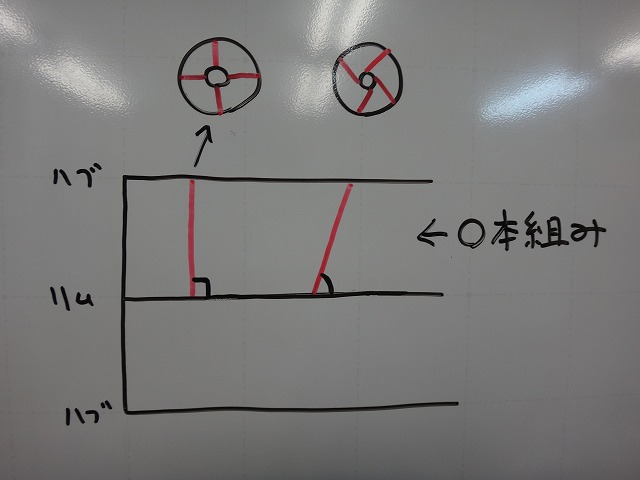
when 0-spoke lacing with different hub and rim hole counts,
if the spoke line in the development diagram is perpendicular to the horizontal line,
the spoke trajectory becomes radial,
making it "radial lacing."
If it's not perpendicular, the 0-spoke trajectory
appears twisted and doesn't qualify as true radial lacing in the strict sense.
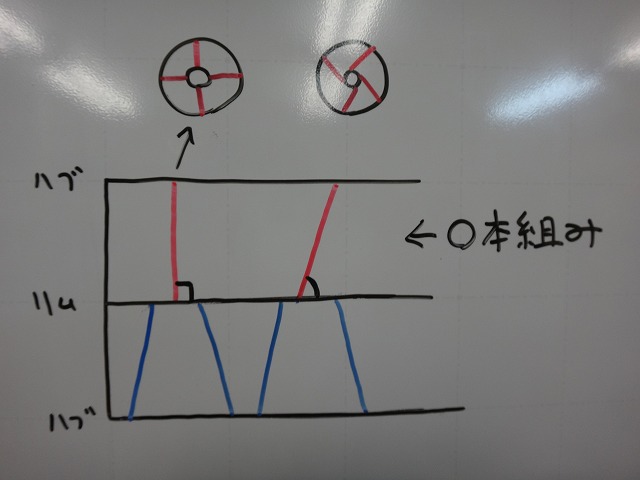
Even if the spoke line connecting rim hole and hub hole
deviates from the radial line by some angle,
if it's offset by the same plus-or-minus angle from perpendicular
and this pattern repeats,

you can convert it to tangential lacing (though odd numbers like 18H with 9H per side won't work).
The resultant of this final cross is radial, so
you can build a wheel with a proper spoke trajectory.
The freewheel side of the diagram I showed earlier—the 32H hub 24H rim 2:1 build—
corresponds to this case.
I drew it in XI lacing, but you could also draw the spoke lines in Ж lacing.
When actually building, you need to be careful that the valve hole phase doesn't end up wrong.
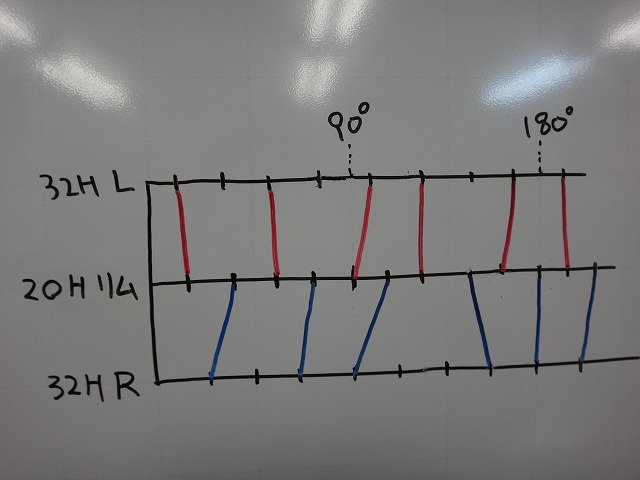
There's a front wheel from a while back that I literally said I wouldn't even touch:
a 32H dynamo hub and a 20H Cosmic Carbon rim
force-laced together.
Since the Cosmic Carbon 20H rim is actually a rear rim,
the holes in the rim wall are at different heights left and right,
which itself feels weird for a front wheel,
but setting that aside, I drew the 0-spoke lacing—three pairs of tangential—to see what happens.
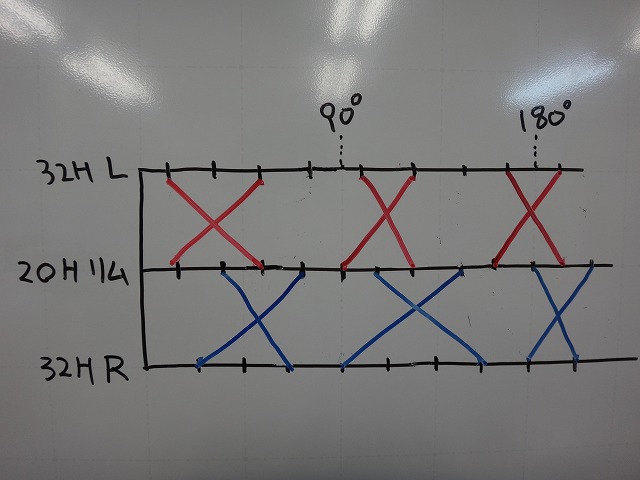
When you convert it to tangential lacing, you get this.
Even if you shift the center rim line left and right from this state,
you cannot make all the tangential lacing final cross resultants
land on the radial line.
In other words, with a 20H rim and 32H hub,
it's impossible to build a wheel where the spoke pull direction isn't twisted.
That front wheel had abnormally loose tension and lots of variation
(a mix of loose spokes and super loose spokes),
and the customer asked me to inspect it, but I told them that's not a wheel—that's a death trap.
I told them it could cause serious injury, but
I bet they're still riding it.
The spokes before rebuild were black Star Bright from Sapim,
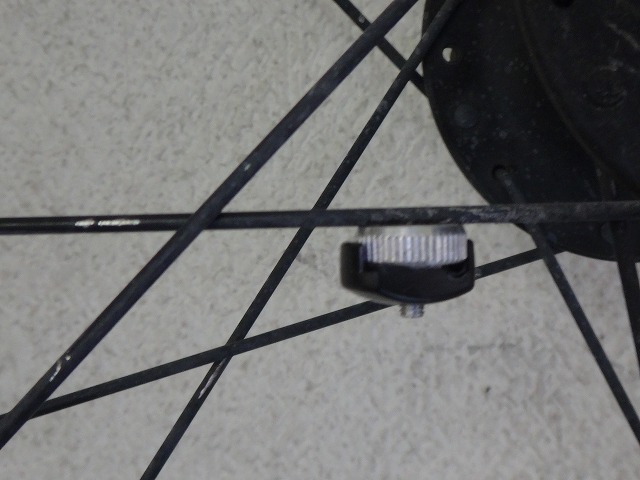
and they were magnetic.
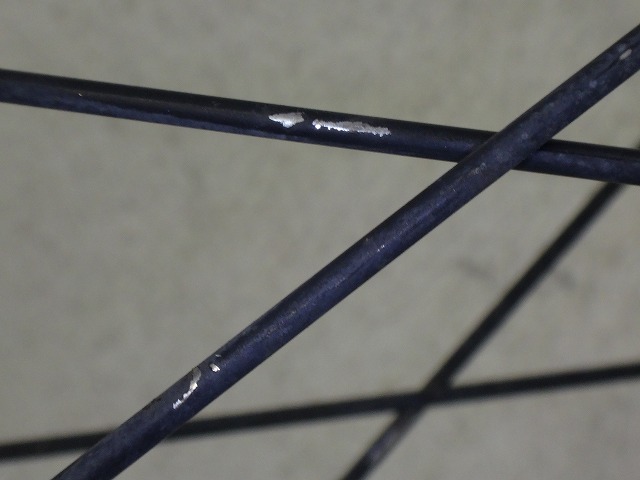
I was kind of amazed by that,
so I hesitated to write that the black paint job on the spokes looked cheap,
but I ended up writing it anyway.
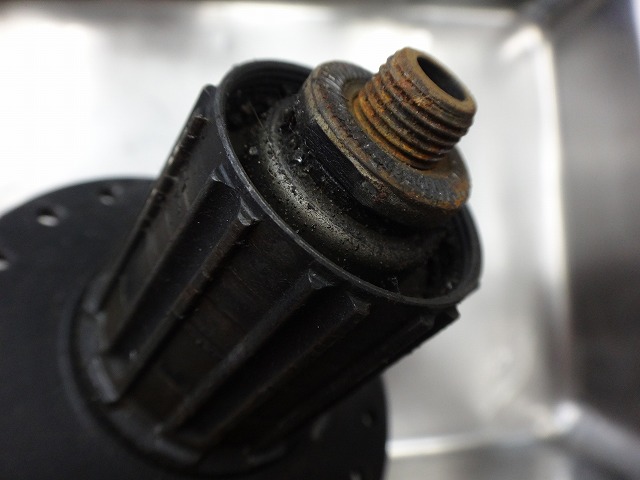
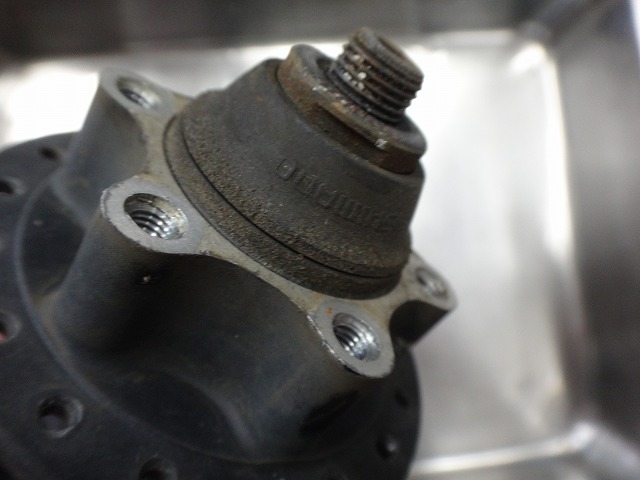
The hub gets a full overhaul.

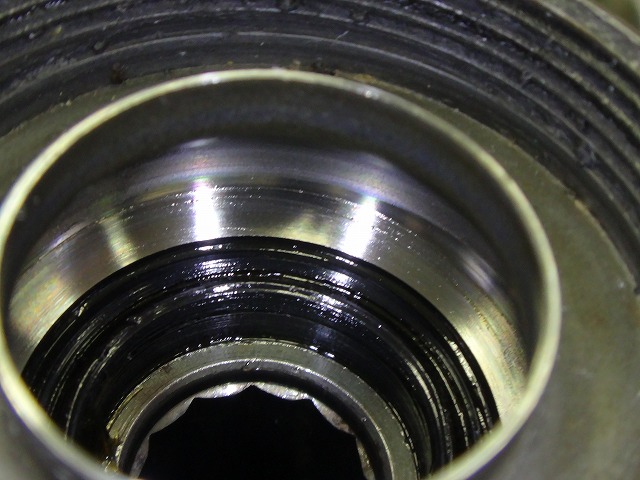
↑Freewheel side
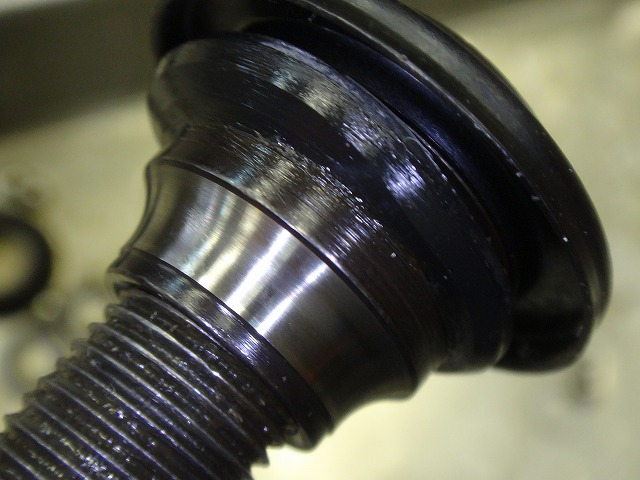
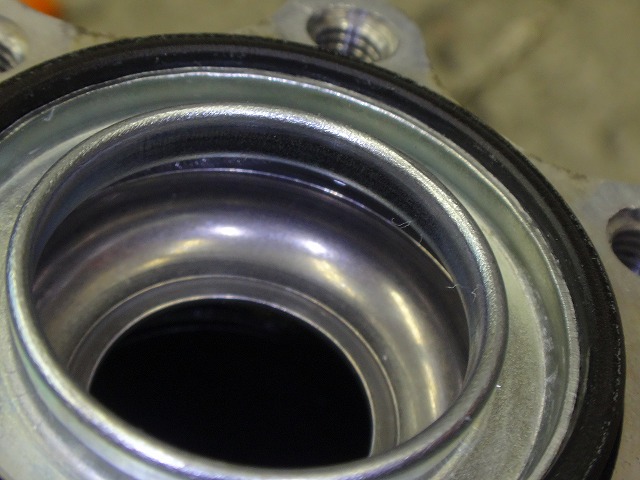
↑Non-freewheel side
No significant wear found.
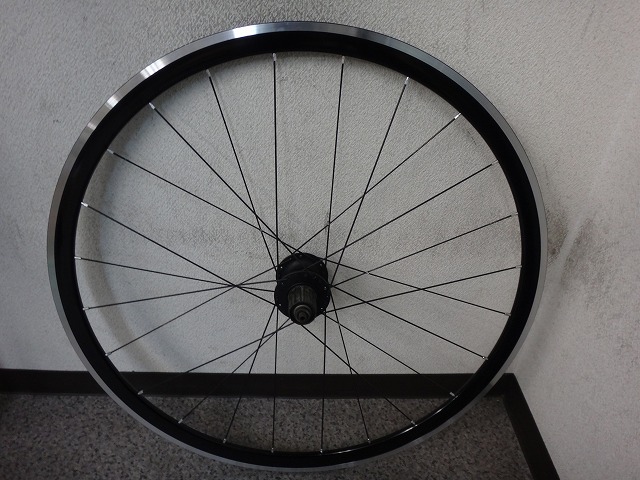
Wheel's built.
Writing this article takes several times longer than actually building the wheel.
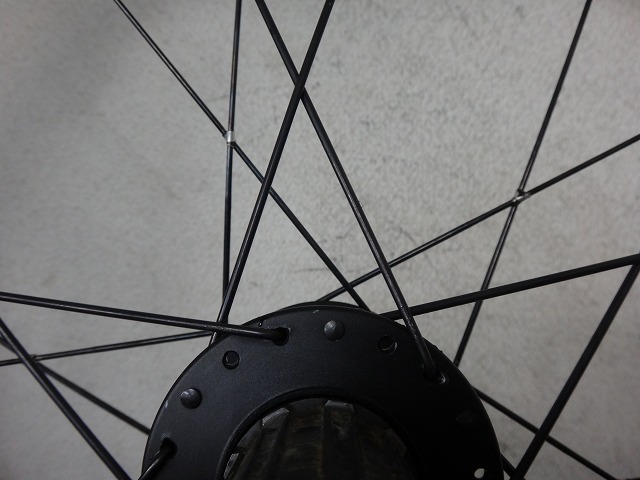

I went with JIS lacing.
Ignoring the flange hole spacing, by hole count
the freewheel side is 6-spoke and the non-freewheel side is 8-spoke, making it a 6-4 build,
but in reality the freewheel side is 2-cross and the non-freewheel side is 3-cross, so
I'll call it "roughly a 4-6 build."
The key point is incorporating left-right asymmetric spoke counts.
On the freewheel side I used black Leader spokes, and on the non-freewheel side black Comp,
which amounts to Champion/Comp configuration.
For black spokes, the 14-gauge plain spoke option
is Sapim Leader anyway.
Also, I tied the non-freewheel side spokes.
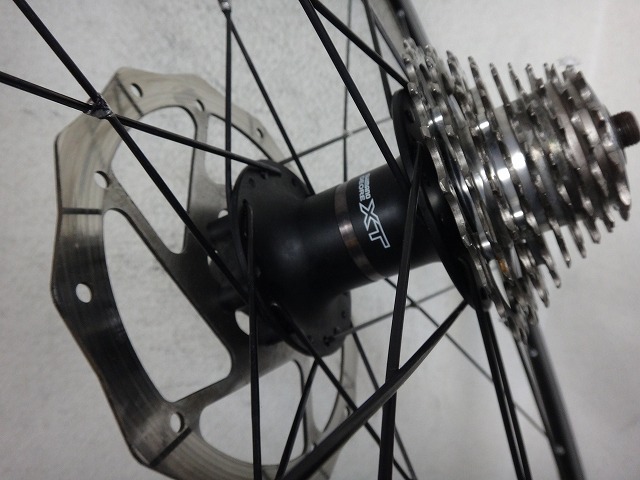
Cleaned rust off the sprocket and washed it, cleaned the hub body,
and cleaned rust off the parts of the disc rotor where the pads don't make contact.