About wheel centering
"I read on some blog that if you inflate to high pressure and ride, centering issues resolve themselves. There's a view that says you don't need to be neurotic about centering under no-load conditions. What do you think? Especially with carbon wheels—isn't it more pronounced?"
I received a comment like this.
Let me answer this.
First, about the part that says "if you inflate to high pressure and ride, centering issues resolve themselves"—that's way too vague and makes it obvious they don't understand wheels at all.
When air pressure causes rim drift, it (and rim drift from aging too) always moves toward the freehub side. And only by a tiny amount.
It's possible that if the rim is slightly drifted toward the non-freehub side, inflating to a certain pressure might result in perfect centering. But a rear wheel that's drifted toward the freehub side won't center itself.
I don't know that blog or its meaning, but at minimum with that phrasing, it's saying "drift from inflation is always guided toward center." That's not how it works.
Also, I think rim drift from inflation happens at the moment of inflation, but that phrasing says "you further need actual riding." That makes no sense either.
Plus, the amount of rim drift from inflation differs between tubular, tube-type clincher, and tubeless, and varies by rim too.
Furthermore, the amount of rim drift per PSI isn't constant.
To give concrete examples: with a WH-6800 rear wheel and 23C tubeless tires, centering drift is barely noticeable at 6-7 PSI. Observable drift starts appearing around 8 PSI.
I've written about this elsewhere before, but there was a case where an Easton EA90RT paired with tubeless tires produced customer-noticeable centering drift, and at the customer's request I centered the wheel under the pressure they'd actually use.
Mavic rear wheels in most cases have the rim drifted toward the non-freehub side (→here), and I once wondered "are they intentionally setting it so centering happens during inflation?" But the amount of drift isn't consistent, sometimes it is centered, and most importantly, front wheels with rim brakes—which don't need to drift at all—are often drifted anyway, so I concluded they simply lack the ability to build proper wheels.
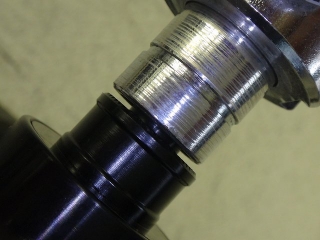
↑Even inflating beyond the UST tubeless tire limit to over 10 PSI won't close this gap.
If someone can say "you don't need to be neurotic about this," I question their sanity.
So you might ask: wouldn't it work to intentionally drift the rim slightly toward the non-freehub side to account for aging and inflation drift? But adjusting that amount precisely while considering the rider's inflation pressure and how resistant the rim is to drifting—that's impossible. So I use zero-load perfect centering as my standard.
For aging, I actually did drift my own rear wheel about one paper thickness toward the non-freehub side to investigate it. And as mentioned, I've done this in actual practice at customer request too.
I think the drift amount from inflation after achieving perfect centering under zero-load is something you can say "you don't need to be neurotic about." But the "you don't need to be neurotic" in that comment is hot air from someone who can't even center wheels properly.
So for example, if you have an off-the-shelf perfect centered rear wheel under zero-load (like Racing Zero basically comes), and inflation drifts it toward the freehub side—would you ignore that?
Well, according to this guy's view, "inflation and riding resolve centering drift," so a zero-load perfect centered rear wheel wouldn't drift at all from inflation. Apparently the rear wheel uses its judgment about which way to drift and conveniently recenters itself.
In the image above, the rim is drifted toward the freehub side (left), but normally spoke rub only happens on the left side
(if you loosen spokes enough to get rub on the right side, it doesn't function as a proper rear wheel).
I wrote about this recently too, but with wide rims and direct-mount brakes with minimal adjustment range, you sometimes can't even achieve proper setup.
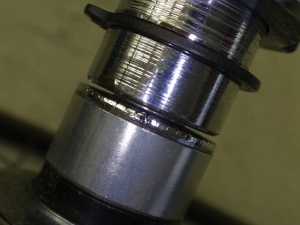
↑This is an off-the-shelf WH-7801C rear wheel, and after being shown this condition, if you accept someone saying "drift like this doesn't need neurotic attention" or "inflation and riding will resolve the centering drift, it's fine" and they hand it back to you unchanged—well, unfortunately you don't need me. Please, feel free to use it as-is.
Edit: Someone commented that the image looks like it has an Evolite hub, not a Zonda.
Sorry, it's not a Zonda—I was mistaken.
I confused it because there was an article listing both Zonda and 7801 together.
Thank you for the correction.
The source image is (→here).
As for whether carbon wheels are more pronounced with inflation effects—in the case of Cosmic Pro Carbon SL, because the tire and nipples are separated (= high rim depth), it's a condition with less effect.
Not just Mavic, but with carbon tubeless rims you'd rarely inflate above 8 PSI anyway, so observable centering drift wouldn't be pronounced.
If conditions combine—low rim depth, light rim, tubeless tire—you might get observable drift in actual use, but if you start from zero-load perfect centering, there's nothing to worry about.
In other words, you do need to care about whether the initial state is perfectly centered.
If you really must, I'll do individual setup for specific tire and pressure combinations.
More important than centering is eliminating rear wheels that are absurdly out of true.
Also, front wheels without spoke rub don't drift from inflation or aging, so there should be no argument against doing centering right.
To make absolute statements about "inflation and riding will resolve centering drift" without mentioning initial condition is clearly wrong. And someone saying this stuff probably lacks the technical ability to do that individual customization anyway, so they're not worth listening to. That's my view.
Borrowing the language from the comment above: "because you're neurotic about no-load centering, you can then be relaxed about drift from inflation"—not "you don't need to be neurotic about no-load centering either." That's ridiculous.
Thank you for the comment.
"I read on some blog that if you inflate to high pressure and ride, centering issues resolve themselves. There's a view that says you don't need to be neurotic about centering under no-load conditions. What do you think? Especially with carbon wheels—isn't it more pronounced?"
I received a comment like this.
Let me answer this.
First, about the part that says "if you inflate to high pressure and ride, centering issues resolve themselves"—that's way too vague and makes it obvious they don't understand wheels at all.
When air pressure causes rim drift, it (and rim drift from aging too) always moves toward the freehub side. And only by a tiny amount.
It's possible that if the rim is slightly drifted toward the non-freehub side, inflating to a certain pressure might result in perfect centering. But a rear wheel that's drifted toward the freehub side won't center itself.
I don't know that blog or its meaning, but at minimum with that phrasing, it's saying "drift from inflation is always guided toward center." That's not how it works.
Also, I think rim drift from inflation happens at the moment of inflation, but that phrasing says "you further need actual riding." That makes no sense either.
Plus, the amount of rim drift from inflation differs between tubular, tube-type clincher, and tubeless, and varies by rim too.
Furthermore, the amount of rim drift per PSI isn't constant.
To give concrete examples: with a WH-6800 rear wheel and 23C tubeless tires, centering drift is barely noticeable at 6-7 PSI. Observable drift starts appearing around 8 PSI.
I've written about this elsewhere before, but there was a case where an Easton EA90RT paired with tubeless tires produced customer-noticeable centering drift, and at the customer's request I centered the wheel under the pressure they'd actually use.
Mavic rear wheels in most cases have the rim drifted toward the non-freehub side (→here), and I once wondered "are they intentionally setting it so centering happens during inflation?" But the amount of drift isn't consistent, sometimes it is centered, and most importantly, front wheels with rim brakes—which don't need to drift at all—are often drifted anyway, so I concluded they simply lack the ability to build proper wheels.
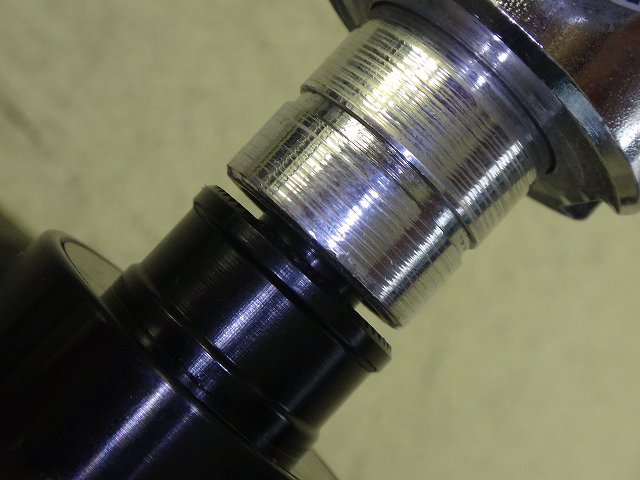
↑Even inflating beyond the UST tubeless tire limit to over 10 PSI won't close this gap.
If someone can say "you don't need to be neurotic about this," I question their sanity.
So you might ask: wouldn't it work to intentionally drift the rim slightly toward the non-freehub side to account for aging and inflation drift? But adjusting that amount precisely while considering the rider's inflation pressure and how resistant the rim is to drifting—that's impossible. So I use zero-load perfect centering as my standard.
For aging, I actually did drift my own rear wheel about one paper thickness toward the non-freehub side to investigate it. And as mentioned, I've done this in actual practice at customer request too.
I think the drift amount from inflation after achieving perfect centering under zero-load is something you can say "you don't need to be neurotic about." But the "you don't need to be neurotic" in that comment is hot air from someone who can't even center wheels properly.
So for example, if you have an off-the-shelf perfect centered rear wheel under zero-load (like Racing Zero basically comes), and inflation drifts it toward the freehub side—would you ignore that?
Well, according to this guy's view, "inflation and riding resolve centering drift," so a zero-load perfect centered rear wheel wouldn't drift at all from inflation. Apparently the rear wheel uses its judgment about which way to drift and conveniently recenters itself.
In the image above, the rim is drifted toward the freehub side (left), but normally spoke rub only happens on the left side
(if you loosen spokes enough to get rub on the right side, it doesn't function as a proper rear wheel).
I wrote about this recently too, but with wide rims and direct-mount brakes with minimal adjustment range, you sometimes can't even achieve proper setup.

↑This is an off-the-shelf WH-7801C rear wheel, and after being shown this condition, if you accept someone saying "drift like this doesn't need neurotic attention" or "inflation and riding will resolve the centering drift, it's fine" and they hand it back to you unchanged—well, unfortunately you don't need me. Please, feel free to use it as-is.
Edit: Someone commented that the image looks like it has an Evolite hub, not a Zonda.
Sorry, it's not a Zonda—I was mistaken.
I confused it because there was an article listing both Zonda and 7801 together.
Thank you for the correction.
The source image is (→here).
As for whether carbon wheels are more pronounced with inflation effects—in the case of Cosmic Pro Carbon SL, because the tire and nipples are separated (= high rim depth), it's a condition with less effect.
Not just Mavic, but with carbon tubeless rims you'd rarely inflate above 8 PSI anyway, so observable centering drift wouldn't be pronounced.
If conditions combine—low rim depth, light rim, tubeless tire—you might get observable drift in actual use, but if you start from zero-load perfect centering, there's nothing to worry about.
In other words, you do need to care about whether the initial state is perfectly centered.
If you really must, I'll do individual setup for specific tire and pressure combinations.
More important than centering is eliminating rear wheels that are absurdly out of true.
Also, front wheels without spoke rub don't drift from inflation or aging, so there should be no argument against doing centering right.
To make absolute statements about "inflation and riding will resolve centering drift" without mentioning initial condition is clearly wrong. And someone saying this stuff probably lacks the technical ability to do that individual customization anyway, so they're not worth listening to. That's my view.
Borrowing the language from the comment above: "because you're neurotic about no-load centering, you can then be relaxed about drift from inflation"—not "you don't need to be neurotic about no-load centering either." That's ridiculous.
Thank you for the comment.