I've empirically observed that a rear wheel, which was definitely perfectly centered when built,
will show the rim drifting slightly toward the freewheel side when inspected after a year or so of use or several thousand km,
though of course I'm excluding cases where the nipple has loosened from the spoke threads.
Strictly speaking, the drift from long-term use occurs not in the "rear wheel" itself but in
"wheels with dish."
So a fixed-gear rear wheel without dish won't drift,
but a disc brake-equipped front wheel will drift.
That said, with disc front wheels, because the dish amount is small,
I've never actually observed any noticeable drift.
If a fixed-gear rear wheel using only one gear on each side were to show center drift,
that would mean drivetrain stress is also a cause,
but I have no significant observational evidence of this from experience.
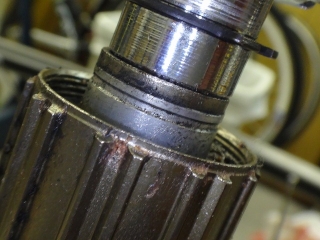
↑This is from when I took apart a rear wheel I'd built with an R450 rim and rebuilt it on an Open Pro,
and I did a certain experiment while disassembling the rear wheel.
According to the image data, the photo date was February 13, 2016,
about two years ago, but I'd been planning to write this article since then.
This is the incident in question(→here).
The 32H rim from Nomu Lab Wheel No. 5 was out of stock at the time,
so I rebuilt it with a 32H Open Pro.
The experiment was:
Starting from a perfectly centered, wobble-free state,
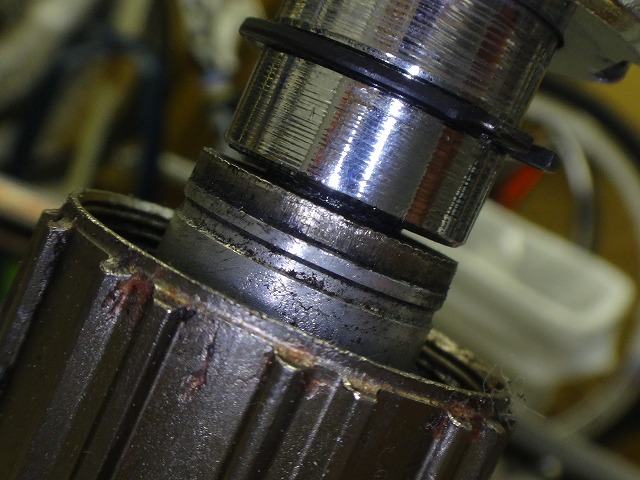
I marked the freewheel-side center gauge position,
then loosened both left and right nipples by exactly one full turn
and applied the center gauge to the freewheel side again
to see what would happen.
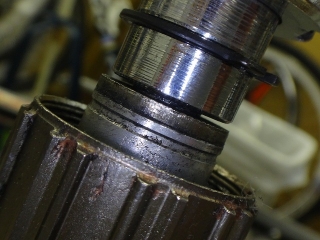
This is what happened.
I applied the gauge on the freewheel side because I already knew the experimental result
(I wanted to photograph the gap on the hub side).
When I say the nipples were loosened by exactly one full turn,
it's probably not perfectly precise 360° increments for every spoke.
Some might be 358.2° and others 360.9°,
but I was quite careful to turn them to approximately 360°.
Actually, even if the center is slightly off, as long as there's no wobble it's fine,
and offset rims are okay too (the R450 isn't), but
I started with a non-offset rim in perfectly centered condition to be thorough.
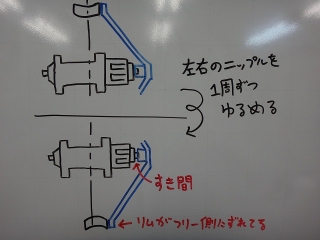
↑This is what I mean.
What I can confirm here is that in wheels with dish,
the rim's lateral movement per nipple rotation differs between left and right sides.
This varies by conditions, but from experience,
one full rotation on the freewheel side roughly equals three-quarters of a rotation on the non-freewheel side.
I'll explain the "conditions" later.
This is useful knowledge for wheel building too.
What I've noticed is that
wheels used long-term (or left sitting for years)
experience a drop in spoke tension,
(as I mentioned earlier, excluding nipple thread loosening),
and this is because the spokes have stretched.
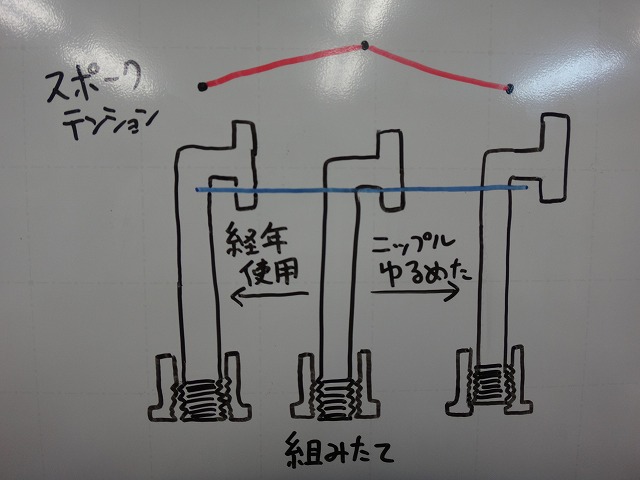
If stretching occurs, that means
the spoke length is very slightly increasing.
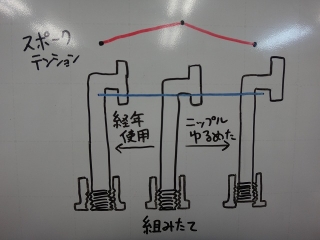
So, speaking somewhat roughly,
the effect on rim lateral movement is the same whether spokes stretch from long-term use
or are intentionally loosened to extend their effective length.
This is the "reason the rim drifts toward the freewheel side with age."
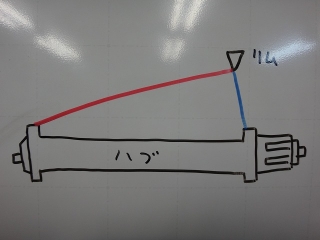
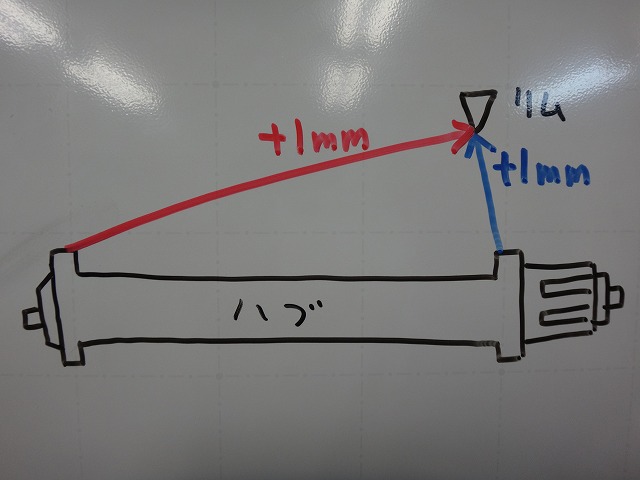
The rim isn't even centered, but I've drawn an extremely exaggerated wheel as shown above.
If from this state the spokes stretch by the same amount (say, 1mm)
or the nipples are loosened by the same amount,
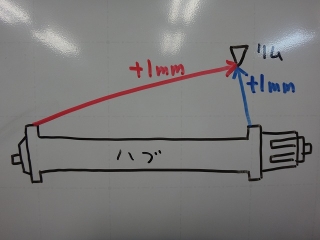
the rim should shift toward the freewheel side.
This is because the same 1mm is distributed laterally at different ratios
on the left and right sides.
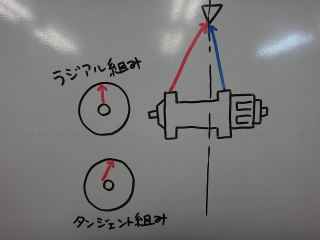
The premise of "the same 1mm" isn't strictly accurate for spoke stretch.
When nipples are loosened by exactly one full turn, spokes stretch by "the same length,"
but since a dished rear wheel has different spoke lengths on each side,
I think spoke stretch occurs at a proportional rate to the original length.
For example, with a Shimano hub and Open Pro rim in 32H, if the non-freewheel side is 6x pattern,
spoke length is 295mm, and if radial-laced, it's 281mm.
If spokes stretch 0.1% from there, the 6x pattern stretches 0.295mm
and the radial pattern stretches 0.281mm, but
from experience, there's no doubt that
"radial-laced patterns drift faster."
Radial-laced spokes have no angle loss relative to rim movement, so
in terms of magnitude, angle loss is a greater factor
than the proportional length effect.
This is also one of the conditions for the nipple rotation per lateral movement mentioned earlier—
the non-freewheel radial-laced side balances with very little nipple rotation
compared to the freewheel side rotation. Perhaps freewheel one full turn to non-freewheel two-thirds turn,
or roughly half-plus. This also varies with hub dimensions.
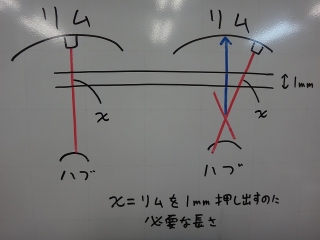
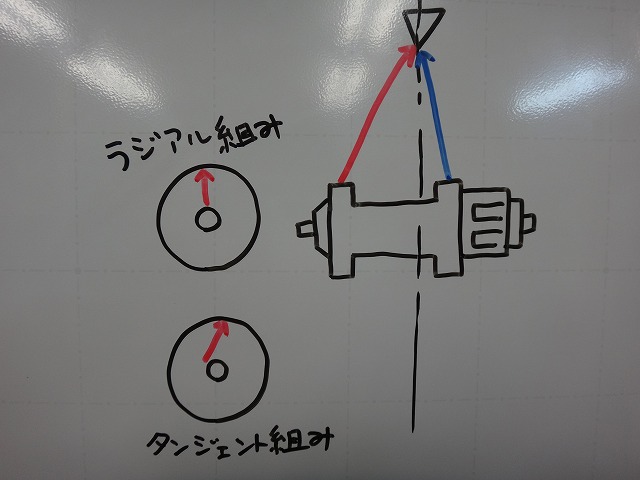
My theory is this.
Think of this as a flat diagram, not a wheel with thickness on both sides.
Radial-laced spokes act directly along their trajectory,
while tangent-laced spokes act along the radial line passing through their final crossing (the blue line in the diagram)—
the length needed to push the rim out by 1mm is greater for tangent lacing.
"Since hub-to-rim relationship relies on spoke 'pulling' rather than 'pushing,' your terminology is wrong"
—I expect this kind of comment, but what I mean is that the rim,
already pulled inward by tension, shifts outward as tension relaxes,
which I'm calling "pushing" in appearance.
And perhaps this is just my imagination, but
2:1 laced non-freewheel spokes seem to stretch faster
than equal-sided lacing.
One might think "2:1 lacing has higher non-freewheel tension than equal-sided lacing, so it stretches more easily,"
but that's incorrect.
If that were true, then a normal wheel (equal-sided rear wheel)
would be "freewheel-side has higher tension, so freewheel-side spokes stretch easier,
therefore with age the rim drifts non-freewheel-side."
But that's not what happens, so
regarding center drift from aging, spoke tension is a smaller factor
than the angle difference from dish.
Since radial non-freewheel lacing definitely drifts faster from experience,
with 2:1 lacing essentially using radial lacing on the non-freewheel side,
that impression may just be an artifact of that condition.
As mentioned in the previous article,
when I inspected Nomu Lab Wheel No. 1's rear wheel after four years of no maintenance,
the rim had drifted freewheel-side, and I told the customer beforehand
"probably, if you apply the freewheel-side measurement to the non-freewheel side, there will be a gap at the rim,"
correctly predicting the freewheel-side drift.
I once had a triathlon customer with a Campagnolo Racing Zero rear wheel that,
when checked a year after being perfectly centered,
had drifted more than expected.
Virtually no wobble, and definitely no contact with anyone else.
My personal daily-use rear wheel was built with the rim set inboard toward the non-freewheel side by about a sheet of paper,
and I check it with a center gauge every time I change the tubular tire,
and it became perfectly centered after about a year and a half.
Center drift from long-term use definitely happens, but
when I write about this, I worry that some colleagues will start saying things like
"Ah, that's from lots of riding" about every minor freewheel-side center drift.
You definitely didn't know this before reading this. For sure.
In reality, significant drift doesn't happen in the short term.
I'm tolerant of minor freewheel-side center drift (when it's truly minor)
but I flatly declare that non-freewheel-side center drift means "it was off from the start,"
and here's why.
Anyone who inspects a reasonable number of Campagnolo/Fulcrum rear wheels knows
that when the rim is drifted, it's almost always toward the freewheel side.
Even on new wheels.
It seems that during the months to couple of years between assembly and sale,
spoke stretch causes drift. This happens particularly with aluminum spoke models.
The fact that I almost never see this amount of drift on front wheels,
while commonly seeing it on rear wheels, is another reason I think this.
Both front and rear were probably perfectly centered at the factory inspection stage.
There's an exception—wheels that drift almost always toward the non-freewheel side (and dramatically so): R-SYS.
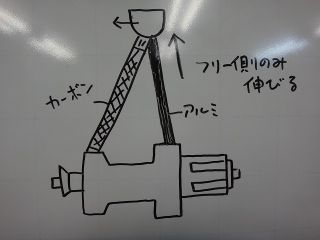
In R-SYS-type rear wheels, only the non-freewheel-side spokes are carbon, and carbon doesn't stretch.
The factor causing drift from spoke stretch exists only on the freewheel side.
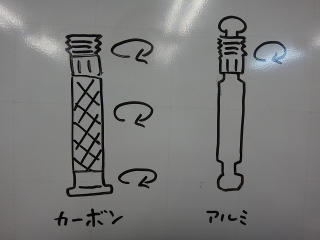
Both Mavic aluminum and carbon spokes have large-diameter threads and strong thread-locking compound,
so nipple loosening from aging is basically nonexistent.
Plus, with carbon spokes, the spoke head, carbon spoke section, and nipple threads
form a single unit, so they virtually never rotate naturally.
Regarding R-SYS rear wheel center drift,
when it drifted non-freewheel-side
(→here)(→here)(→here)(→here)(→here)
(→here)←this article contains foreshadowing for today's article
(→here)(→here)(→here)(→here)(→here)
(→here)(→here)(→here)(→here)(→here)
(→here)(→here)(→here)(→here)(→here)
(→here)(→here),
and when it drifted freewheel-side
(→here)(→here)(→here)
(→here)←unusual for R-SYS, the rim drifted freewheel-side, as noted
I've tabulated both. While I won't claim this is exhaustive,
since I wasn't selectively extracting cases, this probably qualifies as "statistics"...
Besides, the amount of drift when it does happen is pretty intense.
One more important thing: R-SYS has the largest left-right difference in
rim movement per nipple rotation of any rear wheel.
The movement for one freewheel rotation matches one-half or less
on the non-freewheel side.
With all-aluminum Kiširium, the freewheel is radial-laced, but
still the rim movement per nipple rotation is greater on the non-freewheel side.
Dish is a greater factor than whether it's radial or tangent laced.
R-SYS has non-freewheel radial lacing, so
"the more-recumbent spoke angle side + radial lacing" conditions combine
creating a larger left-right difference in lateral movement per nipple rotation than Kiširium.
Next, regarding the recent Reynolds rear wheel retensioning(→here)
the amount of supplementation needed exceeded what could fit in the article,
so I'm adding it here.
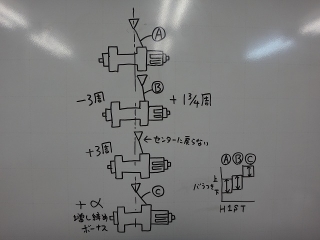
I showed the customer the initial freewheel-side H1ST (A) measurement
in the zero-drift state.
From there, because further tightening of the tight freewheel side was difficult,
I loosened the non-freewheel side 3 full turns
and tightened the freewheel side 1 + 1/2 + 1/4 turns.
At this point I also did minor radial truing, but
this barely relates to tension amount.
At this point, with the rim shifted maximally freewheel-side,
I showed the customer the freewheel-side H1ST (B).
Despite the non-freewheel side being loose, A and B are nearly identical (B slightly higher).
From here on, I don't touch the freewheel side except for minor lateral truing.
From there, I tightened the non-freewheel side 3 more full turns.
Since I've tightened the freewheel side 1 and 3/4 turns,
the rim won't return all the way to center.
From here I could theoretically tighten the non-freewheel side one-sidedly
until the rim reaches center,
and this bonus tightening's worth of
additional nipple rotation should be less than
the 1 and 3/4 turns of freewheel tightening shown above.
That's indeed what happened.
The final centered state's freewheel-side H1ST (C)
had its lower variance limit matching or slightly exceeding H1ST (A)'s upper limit,
which I showed to the customer.
Addendum: On an unrelated note, a comment I received quite a while back stated
"When building a rear wheel, the center drifts even though I'm rotating the same amount of nipples left and right,"
and that's because they're rotating the same amount left and right.
will show the rim drifting slightly toward the freewheel side when inspected after a year or so of use or several thousand km,
though of course I'm excluding cases where the nipple has loosened from the spoke threads.
Strictly speaking, the drift from long-term use occurs not in the "rear wheel" itself but in
"wheels with dish."
So a fixed-gear rear wheel without dish won't drift,
but a disc brake-equipped front wheel will drift.
That said, with disc front wheels, because the dish amount is small,
I've never actually observed any noticeable drift.
If a fixed-gear rear wheel using only one gear on each side were to show center drift,
that would mean drivetrain stress is also a cause,
but I have no significant observational evidence of this from experience.
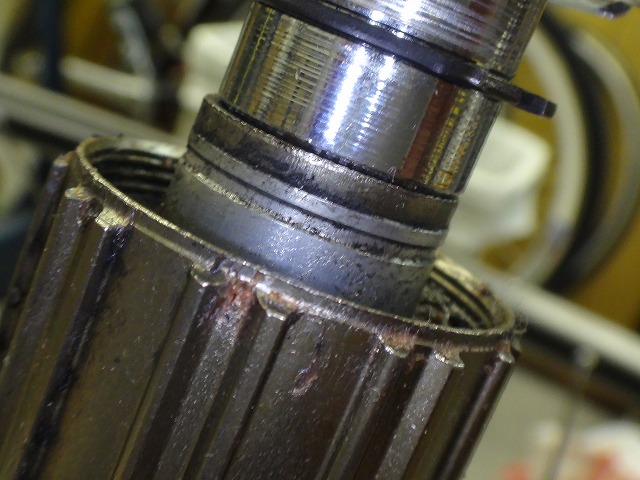
↑This is from when I took apart a rear wheel I'd built with an R450 rim and rebuilt it on an Open Pro,
and I did a certain experiment while disassembling the rear wheel.
According to the image data, the photo date was February 13, 2016,
about two years ago, but I'd been planning to write this article since then.
This is the incident in question(→here).
The 32H rim from Nomu Lab Wheel No. 5 was out of stock at the time,
so I rebuilt it with a 32H Open Pro.
The experiment was:
Starting from a perfectly centered, wobble-free state,
I marked the freewheel-side center gauge position,
then loosened both left and right nipples by exactly one full turn
and applied the center gauge to the freewheel side again
to see what would happen.
This is what happened.
I applied the gauge on the freewheel side because I already knew the experimental result
(I wanted to photograph the gap on the hub side).
When I say the nipples were loosened by exactly one full turn,
it's probably not perfectly precise 360° increments for every spoke.
Some might be 358.2° and others 360.9°,
but I was quite careful to turn them to approximately 360°.
Actually, even if the center is slightly off, as long as there's no wobble it's fine,
and offset rims are okay too (the R450 isn't), but
I started with a non-offset rim in perfectly centered condition to be thorough.

↑This is what I mean.
What I can confirm here is that in wheels with dish,
the rim's lateral movement per nipple rotation differs between left and right sides.
This varies by conditions, but from experience,
one full rotation on the freewheel side roughly equals three-quarters of a rotation on the non-freewheel side.
I'll explain the "conditions" later.
This is useful knowledge for wheel building too.
What I've noticed is that
wheels used long-term (or left sitting for years)
experience a drop in spoke tension,
(as I mentioned earlier, excluding nipple thread loosening),
and this is because the spokes have stretched.
If stretching occurs, that means
the spoke length is very slightly increasing.
So, speaking somewhat roughly,
the effect on rim lateral movement is the same whether spokes stretch from long-term use
or are intentionally loosened to extend their effective length.
This is the "reason the rim drifts toward the freewheel side with age."

The rim isn't even centered, but I've drawn an extremely exaggerated wheel as shown above.
If from this state the spokes stretch by the same amount (say, 1mm)
or the nipples are loosened by the same amount,
the rim should shift toward the freewheel side.
This is because the same 1mm is distributed laterally at different ratios
on the left and right sides.
The premise of "the same 1mm" isn't strictly accurate for spoke stretch.
When nipples are loosened by exactly one full turn, spokes stretch by "the same length,"
but since a dished rear wheel has different spoke lengths on each side,
I think spoke stretch occurs at a proportional rate to the original length.
For example, with a Shimano hub and Open Pro rim in 32H, if the non-freewheel side is 6x pattern,
spoke length is 295mm, and if radial-laced, it's 281mm.
If spokes stretch 0.1% from there, the 6x pattern stretches 0.295mm
and the radial pattern stretches 0.281mm, but
from experience, there's no doubt that
"radial-laced patterns drift faster."
Radial-laced spokes have no angle loss relative to rim movement, so
in terms of magnitude, angle loss is a greater factor
than the proportional length effect.
This is also one of the conditions for the nipple rotation per lateral movement mentioned earlier—
the non-freewheel radial-laced side balances with very little nipple rotation
compared to the freewheel side rotation. Perhaps freewheel one full turn to non-freewheel two-thirds turn,
or roughly half-plus. This also varies with hub dimensions.
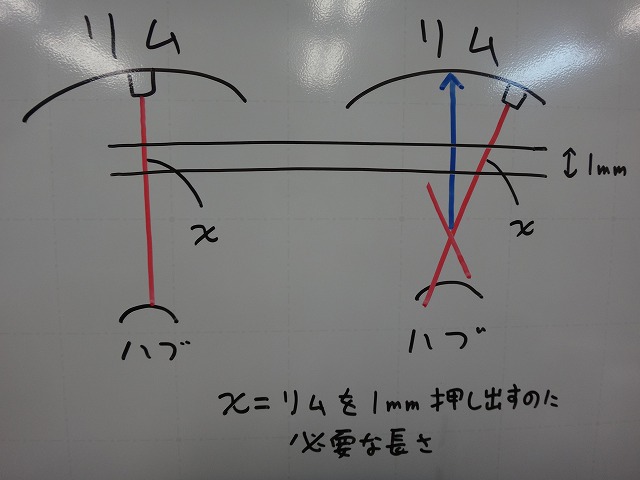
My theory is this.
Think of this as a flat diagram, not a wheel with thickness on both sides.
Radial-laced spokes act directly along their trajectory,
while tangent-laced spokes act along the radial line passing through their final crossing (the blue line in the diagram)—
the length needed to push the rim out by 1mm is greater for tangent lacing.
"Since hub-to-rim relationship relies on spoke 'pulling' rather than 'pushing,' your terminology is wrong"
—I expect this kind of comment, but what I mean is that the rim,
already pulled inward by tension, shifts outward as tension relaxes,
which I'm calling "pushing" in appearance.
And perhaps this is just my imagination, but
2:1 laced non-freewheel spokes seem to stretch faster
than equal-sided lacing.
One might think "2:1 lacing has higher non-freewheel tension than equal-sided lacing, so it stretches more easily,"
but that's incorrect.
If that were true, then a normal wheel (equal-sided rear wheel)
would be "freewheel-side has higher tension, so freewheel-side spokes stretch easier,
therefore with age the rim drifts non-freewheel-side."
But that's not what happens, so
regarding center drift from aging, spoke tension is a smaller factor
than the angle difference from dish.
Since radial non-freewheel lacing definitely drifts faster from experience,
with 2:1 lacing essentially using radial lacing on the non-freewheel side,
that impression may just be an artifact of that condition.
As mentioned in the previous article,
when I inspected Nomu Lab Wheel No. 1's rear wheel after four years of no maintenance,
the rim had drifted freewheel-side, and I told the customer beforehand
"probably, if you apply the freewheel-side measurement to the non-freewheel side, there will be a gap at the rim,"
correctly predicting the freewheel-side drift.
I once had a triathlon customer with a Campagnolo Racing Zero rear wheel that,
when checked a year after being perfectly centered,
had drifted more than expected.
Virtually no wobble, and definitely no contact with anyone else.
My personal daily-use rear wheel was built with the rim set inboard toward the non-freewheel side by about a sheet of paper,
and I check it with a center gauge every time I change the tubular tire,
and it became perfectly centered after about a year and a half.
Center drift from long-term use definitely happens, but
when I write about this, I worry that some colleagues will start saying things like
"Ah, that's from lots of riding" about every minor freewheel-side center drift.
You definitely didn't know this before reading this. For sure.
In reality, significant drift doesn't happen in the short term.
I'm tolerant of minor freewheel-side center drift (when it's truly minor)
but I flatly declare that non-freewheel-side center drift means "it was off from the start,"
and here's why.
Anyone who inspects a reasonable number of Campagnolo/Fulcrum rear wheels knows
that when the rim is drifted, it's almost always toward the freewheel side.
Even on new wheels.
It seems that during the months to couple of years between assembly and sale,
spoke stretch causes drift. This happens particularly with aluminum spoke models.
The fact that I almost never see this amount of drift on front wheels,
while commonly seeing it on rear wheels, is another reason I think this.
Both front and rear were probably perfectly centered at the factory inspection stage.
There's an exception—wheels that drift almost always toward the non-freewheel side (and dramatically so): R-SYS.
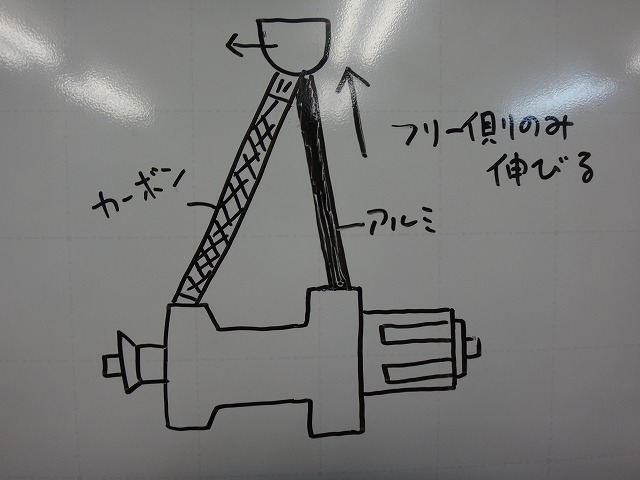
In R-SYS-type rear wheels, only the non-freewheel-side spokes are carbon, and carbon doesn't stretch.
The factor causing drift from spoke stretch exists only on the freewheel side.
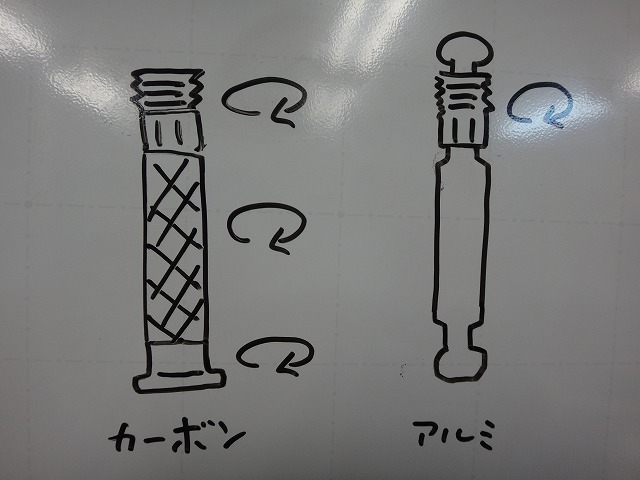
Both Mavic aluminum and carbon spokes have large-diameter threads and strong thread-locking compound,
so nipple loosening from aging is basically nonexistent.
Plus, with carbon spokes, the spoke head, carbon spoke section, and nipple threads
form a single unit, so they virtually never rotate naturally.
Regarding R-SYS rear wheel center drift,
when it drifted non-freewheel-side
(→here)(→here)(→here)(→here)(→here)
(→here)←this article contains foreshadowing for today's article
(→here)(→here)(→here)(→here)(→here)
(→here)(→here)(→here)(→here)(→here)
(→here)(→here)(→here)(→here)(→here)
(→here)(→here),
and when it drifted freewheel-side
(→here)(→here)(→here)
(→here)←unusual for R-SYS, the rim drifted freewheel-side, as noted
I've tabulated both. While I won't claim this is exhaustive,
since I wasn't selectively extracting cases, this probably qualifies as "statistics"...
Besides, the amount of drift when it does happen is pretty intense.
One more important thing: R-SYS has the largest left-right difference in
rim movement per nipple rotation of any rear wheel.
The movement for one freewheel rotation matches one-half or less
on the non-freewheel side.
With all-aluminum Kiširium, the freewheel is radial-laced, but
still the rim movement per nipple rotation is greater on the non-freewheel side.
Dish is a greater factor than whether it's radial or tangent laced.
R-SYS has non-freewheel radial lacing, so
"the more-recumbent spoke angle side + radial lacing" conditions combine
creating a larger left-right difference in lateral movement per nipple rotation than Kiširium.
Next, regarding the recent Reynolds rear wheel retensioning(→here)
the amount of supplementation needed exceeded what could fit in the article,
so I'm adding it here.

I showed the customer the initial freewheel-side H1ST (A) measurement
in the zero-drift state.
From there, because further tightening of the tight freewheel side was difficult,
I loosened the non-freewheel side 3 full turns
and tightened the freewheel side 1 + 1/2 + 1/4 turns.
At this point I also did minor radial truing, but
this barely relates to tension amount.
At this point, with the rim shifted maximally freewheel-side,
I showed the customer the freewheel-side H1ST (B).
Despite the non-freewheel side being loose, A and B are nearly identical (B slightly higher).
From here on, I don't touch the freewheel side except for minor lateral truing.
From there, I tightened the non-freewheel side 3 more full turns.
Since I've tightened the freewheel side 1 and 3/4 turns,
the rim won't return all the way to center.
From here I could theoretically tighten the non-freewheel side one-sidedly
until the rim reaches center,
and this bonus tightening's worth of
additional nipple rotation should be less than
the 1 and 3/4 turns of freewheel tightening shown above.
That's indeed what happened.
The final centered state's freewheel-side H1ST (C)
had its lower variance limit matching or slightly exceeding H1ST (A)'s upper limit,
which I showed to the customer.
Addendum: On an unrelated note, a comment I received quite a while back stated
"When building a rear wheel, the center drifts even though I'm rotating the same amount of nipples left and right,"
and that's because they're rotating the same amount left and right.