Another day with wheels (and so on).

A customer brought in a Colima Medium rear wheel for service.
It has the same rim height as the company's "Aero" model, but
initially the Medium was designed with a lighter rim than the Aero, and spokes that were CX-RAY,
while the Aero used CX spokes,
so with both rim and spokes being lighter, the Medium was an extremely light model by comparison to Aero (past tense).
Colima makes a low-profile rim called Winium,
but the original Medium's front wheel was lighter than the Winium, while the rear wheel was only marginally heavier.
This reversal happens because of spoke count—
for complete wheels, the Medium came 18H front and 24H rear,
while the Winium came 24H front and 24H rear.

I pulled out some Colima catalogs to write about all these details
and shot tons of photos for the article,
but then realized they heavily overlapped with my previous original Medium article (→here)
so quite a few photos got cut. That's why today I'm touching on things not covered before.

The rear hub is a Colima piercing hub.
Before this hub, there was a non-piercing version,
and that rear hub had a weak seal between the hub body and the freewheel body,
allowing water to enter the hub. So with the crazy idea that instead of waterproofing,
we should improve drainage, they drilled holes in the hub shell—that's this piercing hub.

As for rear hub dimensions, it's narrow flange, which isn't really praiseworthy.
There was an earlier hub where the non-drive side was also outpoke tangent laced with a hooking style,
but it had much wider flanges, so I'm not sure why they made this choice.

The drive side is 3-cross tangent laced with a hooking style, counted by the number of crosses.
The flange shape is designed so the spoke head won't easily pull free even with lower spoke tension.
Shimano's disc brakes—not MTB's XTRA, but XT was the first appearance,
and that XT was the M750 series, so the disc brake part number is M755,
making it BR-M755 for brakes, HB-M755 for front hubs,
and FH-M755 for rear hubs (→here).
Shortly after came the Deore M510 series disc hub—
HB-M555, FH-M555—an ambitious design
(the part number weirdly is M555 instead of M515),
but this too had a hooking style like this Colima hub,
and since there was something to be ashamed of, it was discontinued almost immediately.
The successor model HB-M525, FH-M525 returned to a normal rear hub design.

↑M555 hub

↑M525 hub
The thing to be ashamed of is that the spoke head hooking was weak,
so when a spoke broke during riding AND the wheel was built a bit loosely,
the hook would disengage and the wheel would start to come apart.
So after that, Shimano never released another hub with this kind of structure.

The drive side spokes do have bent necks, but
the flattening is oriented 90° different to the direction of the neck bend compared to normal spokes—
they're a custom order item. Since these are for the Medium, the spokes are equivalent to CX-RAY.

This rim has a strong directional bias in its spoke holes,
and building it without following this bias causes problems.

Colima rims from this era have
the opposite relationship between valve hole and spoke hole runout compared to most rims in the world—
what this blog calls a reverse rim.

↑This is a Fulcrum Speed 55C, and
after going to wide rims, the Bora and Speed models became normal rims.
I just noticed this recently.

The same content appears in the linked article, but
for a normal rim doing symmetrical Italian lacing left-drop,
for a normal rim doing 4-cross Italian lacing right-drop,
with a reverse rim this flips, so it becomes left-drop.

↑These are the old spokes from before the rebuild, which I won't use anymore,
but the threaded section is shorter than standard spokes.

I installed the original nipples both ways to take close-up photos.

The short threads on the spoke are related to the fact that
the nipple threads start immediately without any lead-in.
When considering this, whether to set spoke length correction values for reverse nipples
or just use standard nipples, the latter is easier,
so I won't reuse these nipples. Also, these nipples are brass,
but the new nipples after the rebuild are aluminum.

Built.

Laced hub 24H semi-competition 4-cross lacing.
Truing comes later.
It originally came with a Campagnolo freewheel body, but
after the rebuild it'll use a Shimano freewheel body.

Next, a different job. A customer brought in a rear Aero wheel.

The rear hub is a piercing hub, but an older type.
So is the Medium's piercing hub I mentioned earlier also new? No—
it's actually the oldest-generation version. I'll explain that later.

This is Aero, not Medium, so
the spokes are CX-equivalent rather than CX-RAY.
All else being equal, CX is slightly less prone to spoke breakage,
but that's about the only difference.

This rim is also reverse hole, so with 4-cross Italian left-drop hub setup,
I should have started the temporary lacing as a reverse rim, but
I mistakenly started it as a normal rim.Not blurry for the article; it just happened to work out.
If you get the hole runout or right-drop/left-drop wrong,
you end up with the valve hole sitting inside the final cross like in this photo—ugly.

Built.

Black hub 24H black semi-competition 4-cross lacing.
Truing comes later.
The freewheel body is Campagnolo, same as before the rebuild,
but the spoke color is black per customer request.
As mentioned in the linked article, the original Medium's rim
is really floppy when you push on the side—it feels sketchy.
Apparently Colima got worried too, because
the later-generation Medium switched to the same rim as the Aero,
differing only in whether the spokes were CX-RAY or CX—basically a cost-cutting move.
There are manufacturers who make ultra-light carbon frames
that aren't positioned as flagships, aren't supplied to pro teams, and are marketed as
"made purely for weight-obsessed amateurs." The original Medium was positioned that way too.
Let me look at what Colima nervously put in their catalog as a disclaimer:

The Medium is the lightest wheel in our lineup (←not the Winium),
but it needs to be used on really smooth road surfaces.
Also, not recommended for bigger racers.

The Medium is Colima's lightest wheel, but
it's designed for smooth, flat roads. Also not recommended for guys who race a lot or are heavy.

Regarding the Medium we released in 2005,
the customers we have in mind are those who don't race,
riding only a few thousand km a year.
That covers the original Medium.
Now for the later Medium with the Aero rim:

↑Like the Rosetta Stone, printed in both French and English.

Medium Wheel
For people who seriously don't road race,
or only ride a few thousand km annually—a lightweight wheel.
The Medium uses the same rim and hub as the Aero.
By using super-light spokes (CX-RAY),
it's 120g lighter per set than the Aero,
but the Medium has lower stiffness.

↑Different year, same text
My rough translation was my doing. Sorry about that.
I suspect that people who didn't understand this philosophy used them and broke them,
resulting in so many complaints that Colima was forced to change specs or discontinue the model.
You have to understand that weapons come with their own fragility and risk.
Next, about freewheel bodies.

Both are piercing hubs, but from different eras.
Of the two here, the Medium is older and the Aero is newer, but—

Oh, this is the flange I touched on earlier—
the spoke head seats pretty solidly.

The freewheel body differs.
The one on the right is from this Aero hub—the newer version.

This Colima hub shaft has a 5mm hex hole on only one end,
and between these two hubs, the hex-hole end is different—
one has it on the left, the other on the right.

With a 5mm Allen key inserted in the hub shaft,
you tighten and loosen each end using a 15mm hub wrench, but—

the shaft has no tapers or shoulders, just uniform dimensions,
so except for the hex hole, left and right are interchangeable.
So even though the Aero hub has a left hex hole,
you could assemble it with the hole on the right instead.

Colima freewheel bodies are divided into those for S-hubs
and those for others (non-S MCC, Aero, Medium, Winium),
and this one is the older type for the "others" group.
It has individual springs on each ratchet pawl—
the same design Campagnolo used for 8-9S freewheel bodies back in the day.

There's no rubber seal or anything like that, but—

if you measure the outside diameter of the part just outside the pawls—


it's 34.7mm. For the newer non-S-hub version, this diameter is 32.5mm,
so the old type (34.7mm) and new type (32.5mm) aren't compatible.
Both of these are Campagnolo bodies so it doesn't matter, but
with Shimano bodies, the old type never came in 11S.
So if the Aero happened to have a Shimano 10S freewheel body,
you couldn't upgrade to 11S without replacing the hub.

I reassembled it with a right hex hole.
No deep meaning to it.

Next, the freewheel body from this Medium.
For convenience I'll call it the oldest-generation type.

The pawl springs are a poultry spring design, same as Evolite hubs and such.
Supply of this same freewheel body no longer exists.
It has a rubber seal, and the maximum outside diameter at that section is around 34.2mm;
since the shaft and ratchet diameters are the same, water resistance is questionable
(well, it was already questionable anyway), but swapping to the older body should theoretically be possible.
However, for Shimano bodies there's no 11S version.
Given this situation, the Medium might have needed a hub replacement for the rebuild.
By the way, non-S-hub freewheel bodies cost ¥14,000 pre-tax for both old and new,
and Evolite hubs cost ¥13,000. With rebuilds there are also labor and spoke costs, though...
Finally. Actually, the Medium—whether original or later—
was never sold as a rim alone. The Aero and Winium were.
So measuring a Medium rim is a rare opportunity.
The linked article has original Medium measured weights, and
as expected this Medium has the same rim as the Aero.
Also, this Aero rim is the wide-rim version and
has balance weights (around 10g?) attached.
So by comparing measured weights of these rims
you could learn things like "the original Medium really is different from the later one"
or "Colima barely changed rim weight with the wide-rim transition."
But I don't feel any need to compile and present all this stuff to my readers,
so I'm not going to post the numbers here.
↑Wow, what a stuck-up jerk, acting all important and mysterious like that. Bad vibes.

Sooorry for the wait!
Please check out this image!

It's the Medium!

The wide-rim Aero!
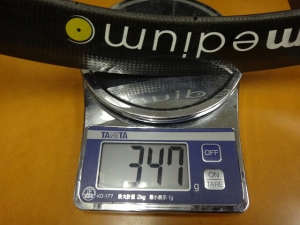
I also pulled the original Medium image from the linked article!
↑Stop that right now!

A customer brought in a Colima Medium rear wheel for service.
It has the same rim height as the company's "Aero" model, but
initially the Medium was designed with a lighter rim than the Aero, and spokes that were CX-RAY,
while the Aero used CX spokes,
so with both rim and spokes being lighter, the Medium was an extremely light model by comparison to Aero (past tense).
Colima makes a low-profile rim called Winium,
but the original Medium's front wheel was lighter than the Winium, while the rear wheel was only marginally heavier.
This reversal happens because of spoke count—
for complete wheels, the Medium came 18H front and 24H rear,
while the Winium came 24H front and 24H rear.

I pulled out some Colima catalogs to write about all these details
and shot tons of photos for the article,
but then realized they heavily overlapped with my previous original Medium article (→here)
so quite a few photos got cut. That's why today I'm touching on things not covered before.

The rear hub is a Colima piercing hub.
Before this hub, there was a non-piercing version,
and that rear hub had a weak seal between the hub body and the freewheel body,
allowing water to enter the hub. So with the crazy idea that instead of waterproofing,
we should improve drainage, they drilled holes in the hub shell—that's this piercing hub.

As for rear hub dimensions, it's narrow flange, which isn't really praiseworthy.
There was an earlier hub where the non-drive side was also outpoke tangent laced with a hooking style,
but it had much wider flanges, so I'm not sure why they made this choice.

The drive side is 3-cross tangent laced with a hooking style, counted by the number of crosses.
The flange shape is designed so the spoke head won't easily pull free even with lower spoke tension.
Shimano's disc brakes—not MTB's XTRA, but XT was the first appearance,
and that XT was the M750 series, so the disc brake part number is M755,
making it BR-M755 for brakes, HB-M755 for front hubs,
and FH-M755 for rear hubs (→here).
Shortly after came the Deore M510 series disc hub—
HB-M555, FH-M555—an ambitious design
(the part number weirdly is M555 instead of M515),
but this too had a hooking style like this Colima hub,
and since there was something to be ashamed of, it was discontinued almost immediately.
The successor model HB-M525, FH-M525 returned to a normal rear hub design.

↑M555 hub

↑M525 hub
The thing to be ashamed of is that the spoke head hooking was weak,
so when a spoke broke during riding AND the wheel was built a bit loosely,
the hook would disengage and the wheel would start to come apart.
So after that, Shimano never released another hub with this kind of structure.

The drive side spokes do have bent necks, but
the flattening is oriented 90° different to the direction of the neck bend compared to normal spokes—
they're a custom order item. Since these are for the Medium, the spokes are equivalent to CX-RAY.

This rim has a strong directional bias in its spoke holes,
and building it without following this bias causes problems.

Colima rims from this era have
the opposite relationship between valve hole and spoke hole runout compared to most rims in the world—
what this blog calls a reverse rim.

↑This is a Fulcrum Speed 55C, and
after going to wide rims, the Bora and Speed models became normal rims.
I just noticed this recently.

The same content appears in the linked article, but
for a normal rim doing symmetrical Italian lacing left-drop,
for a normal rim doing 4-cross Italian lacing right-drop,
with a reverse rim this flips, so it becomes left-drop.

↑These are the old spokes from before the rebuild, which I won't use anymore,
but the threaded section is shorter than standard spokes.

I installed the original nipples both ways to take close-up photos.

The short threads on the spoke are related to the fact that
the nipple threads start immediately without any lead-in.
When considering this, whether to set spoke length correction values for reverse nipples
or just use standard nipples, the latter is easier,
so I won't reuse these nipples. Also, these nipples are brass,
but the new nipples after the rebuild are aluminum.

Built.

Laced hub 24H semi-competition 4-cross lacing.
Truing comes later.
It originally came with a Campagnolo freewheel body, but
after the rebuild it'll use a Shimano freewheel body.

Next, a different job. A customer brought in a rear Aero wheel.

The rear hub is a piercing hub, but an older type.
So is the Medium's piercing hub I mentioned earlier also new? No—
it's actually the oldest-generation version. I'll explain that later.

This is Aero, not Medium, so
the spokes are CX-equivalent rather than CX-RAY.
All else being equal, CX is slightly less prone to spoke breakage,
but that's about the only difference.

This rim is also reverse hole, so with 4-cross Italian left-drop hub setup,
I should have started the temporary lacing as a reverse rim, but
I mistakenly started it as a normal rim.
If you get the hole runout or right-drop/left-drop wrong,
you end up with the valve hole sitting inside the final cross like in this photo—ugly.

Built.

Black hub 24H black semi-competition 4-cross lacing.
Truing comes later.
The freewheel body is Campagnolo, same as before the rebuild,
but the spoke color is black per customer request.
As mentioned in the linked article, the original Medium's rim
is really floppy when you push on the side—it feels sketchy.
Apparently Colima got worried too, because
the later-generation Medium switched to the same rim as the Aero,
differing only in whether the spokes were CX-RAY or CX—basically a cost-cutting move.
There are manufacturers who make ultra-light carbon frames
that aren't positioned as flagships, aren't supplied to pro teams, and are marketed as
"made purely for weight-obsessed amateurs." The original Medium was positioned that way too.
Let me look at what Colima nervously put in their catalog as a disclaimer:

The Medium is the lightest wheel in our lineup (←not the Winium),
but it needs to be used on really smooth road surfaces.
Also, not recommended for bigger racers.

The Medium is Colima's lightest wheel, but
it's designed for smooth, flat roads. Also not recommended for guys who race a lot or are heavy.

Regarding the Medium we released in 2005,
the customers we have in mind are those who don't race,
riding only a few thousand km a year.
That covers the original Medium.
Now for the later Medium with the Aero rim:

↑Like the Rosetta Stone, printed in both French and English.

Medium Wheel
For people who seriously don't road race,
or only ride a few thousand km annually—a lightweight wheel.
The Medium uses the same rim and hub as the Aero.
By using super-light spokes (CX-RAY),
it's 120g lighter per set than the Aero,
but the Medium has lower stiffness.

↑Different year, same text
My rough translation was my doing. Sorry about that.
I suspect that people who didn't understand this philosophy used them and broke them,
resulting in so many complaints that Colima was forced to change specs or discontinue the model.
You have to understand that weapons come with their own fragility and risk.
Next, about freewheel bodies.

Both are piercing hubs, but from different eras.
Of the two here, the Medium is older and the Aero is newer, but—

Oh, this is the flange I touched on earlier—
the spoke head seats pretty solidly.

The freewheel body differs.
The one on the right is from this Aero hub—the newer version.

This Colima hub shaft has a 5mm hex hole on only one end,
and between these two hubs, the hex-hole end is different—
one has it on the left, the other on the right.

With a 5mm Allen key inserted in the hub shaft,
you tighten and loosen each end using a 15mm hub wrench, but—

the shaft has no tapers or shoulders, just uniform dimensions,
so except for the hex hole, left and right are interchangeable.
So even though the Aero hub has a left hex hole,
you could assemble it with the hole on the right instead.

Colima freewheel bodies are divided into those for S-hubs
and those for others (non-S MCC, Aero, Medium, Winium),
and this one is the older type for the "others" group.
It has individual springs on each ratchet pawl—
the same design Campagnolo used for 8-9S freewheel bodies back in the day.

There's no rubber seal or anything like that, but—

if you measure the outside diameter of the part just outside the pawls—


it's 34.7mm. For the newer non-S-hub version, this diameter is 32.5mm,
so the old type (34.7mm) and new type (32.5mm) aren't compatible.
Both of these are Campagnolo bodies so it doesn't matter, but
with Shimano bodies, the old type never came in 11S.
So if the Aero happened to have a Shimano 10S freewheel body,
you couldn't upgrade to 11S without replacing the hub.

I reassembled it with a right hex hole.
No deep meaning to it.

Next, the freewheel body from this Medium.
For convenience I'll call it the oldest-generation type.

The pawl springs are a poultry spring design, same as Evolite hubs and such.
Supply of this same freewheel body no longer exists.
It has a rubber seal, and the maximum outside diameter at that section is around 34.2mm;
since the shaft and ratchet diameters are the same, water resistance is questionable
(well, it was already questionable anyway), but swapping to the older body should theoretically be possible.
However, for Shimano bodies there's no 11S version.
Given this situation, the Medium might have needed a hub replacement for the rebuild.
By the way, non-S-hub freewheel bodies cost ¥14,000 pre-tax for both old and new,
and Evolite hubs cost ¥13,000. With rebuilds there are also labor and spoke costs, though...
Finally. Actually, the Medium—whether original or later—
was never sold as a rim alone. The Aero and Winium were.
So measuring a Medium rim is a rare opportunity.
The linked article has original Medium measured weights, and
as expected this Medium has the same rim as the Aero.
Also, this Aero rim is the wide-rim version and
has balance weights (around 10g?) attached.
So by comparing measured weights of these rims
you could learn things like "the original Medium really is different from the later one"
or "Colima barely changed rim weight with the wide-rim transition."
But I don't feel any need to compile and present all this stuff to my readers,
so I'm not going to post the numbers here.
↑Wow, what a stuck-up jerk, acting all important and mysterious like that. Bad vibes.

Sooorry for the wait!
Please check out this image!

It's the Medium!

The wide-rim Aero!
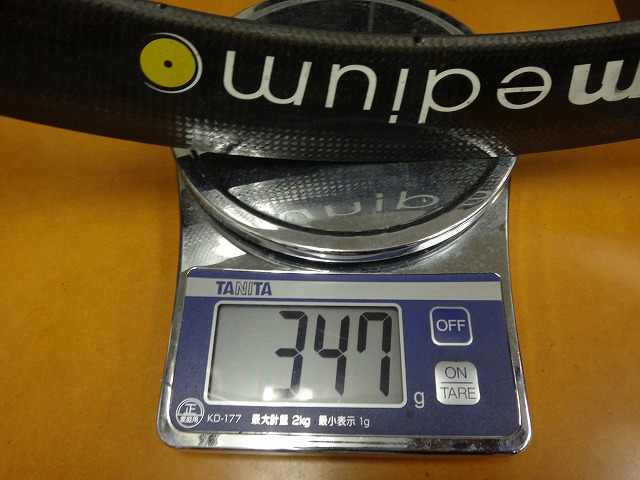
I also pulled the original Medium image from the linked article!
↑Stop that right now!
Products Mentioned in This Article
- 🛒 Sapim CX-RAY spoke
- 🛒 Kolima Winium bicycle rim
- 🛒 Shimano XT disc brake M755
- 🛒 Campagnolo freewheel body
* Amazon affiliate links — prices may vary
Original Japanese post: のむラボ日記 #4213