Another day, another wheel (and so on).
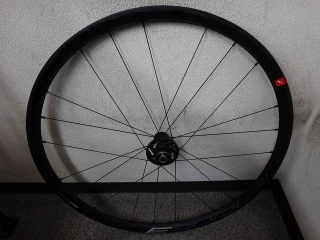
I received a front wheel with a Racing 3 DB rim from a customer.
The rotor mount uses center-lock, but
most manufacturers' lock rings, including Shimano,
are in the form of male threads—basically a hollow bolt design.
This doesn't change whether you use an external or internal tightening tool.
However, with Fulcrum's disc brake-ready complete wheels,
the lock ring side has female threads—essentially a nut-style design—
and the tool you use is limited to external tightening.
Since the structure is designed together with the hub body,
you can't use anything other than the included lock ring.
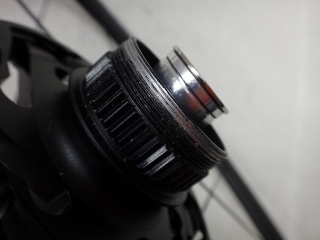
The male-threaded side of the hub body has damaged threads.
Since the rotor won't stay fixed and spins forever,
the wheel itself is now unusable.

↑The metal shavings had even scattered into the dust seal area.
I don't know whether the current owner caused this damage
or if they bought it cheap from someone else who did.
As a proposal to make this wheel usable somehow,
I suggested to the customer that we could reassemble it
by treating a 28H Shimano RS770 hub's right side—
skipping holes—as a 21H hub.
There are previous examples of the reverse situation,
assembling a 21H hub with a 28H rim
(→here) and (→here)
so this would be basically the same thing.
The difference is that unlike rim holes,
the unused hub flange holes don't need to be sealed.
By the way, I only propose this for front wheels.
Even having one side with 7 broken-head spokes is scary enough,
and on a rear wheel, the 7H radial side has the rotor mount,
so it's best to avoid it.
The RS770 hub's design follows the CX75 lineage, so
the flange holes have slits. If we did a left-right reverse different-gauge build,
we could even use Sapim CX on the 7H side,
but the issue is that CX doesn't have stable black supply,
and even in silver, the available lengths are limited.
So the conversation had stalled there...
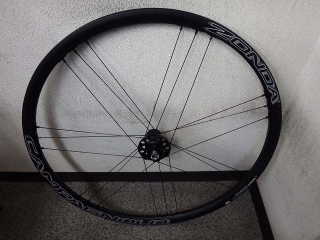
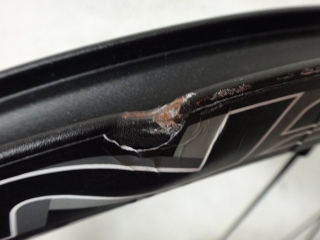
Then the customer came back and said, "I found a Zonda DB
where the rim is the one that's messed up, so can you make a frankenbike out of both?"
Whaaaaaat?!
That's pushing it way too far!
If they'd asked me beforehand, "Can you build this with a Zonda DB hub?"

↑I would've said, "Fulcrum's 2:1 phase doesn't match Campagnolo's G3,
so it's impossible."
But they've already bought the stuff, so there's no help for it.
Like the Concorde fallacy or something, I've come this far,
so it'd be a waste not to see it through. Guess I'm doing it.
As it turns out, Zonda DB and Racing 3 DB are
quite different in both hub and rim design.
Well, Campagnolo and Fulcrum are
completely separate companies (officially speaking).
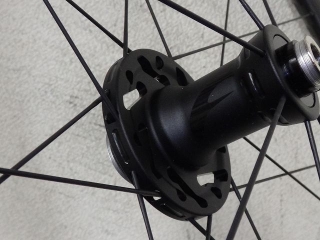
This is the Racing 3 DB hub. It has weight-reducing cutouts
that also exist on the rim brake model—like ice cream
scooped with a spoon.
If it weren't a black hub, the dirt would really show
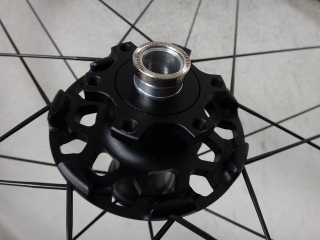
This is the Zonda DB hub.
This one happens to be 6-bolt spec,
but center-lock versions also exist.
The customer mentioned that rotation felt gritty,
but it turned out the bearing adjustment was just too tight.
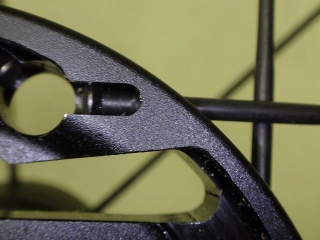
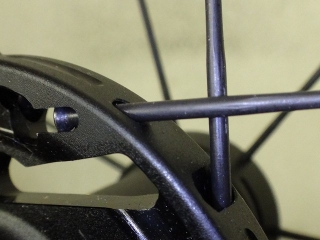
The Racing 3 DB hub design requires spokes to be straight
for a certain distance below the spoke head.
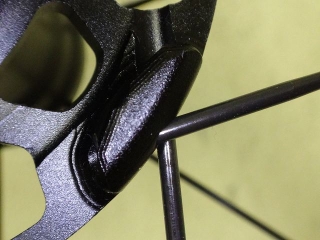
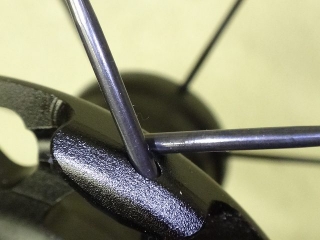
On the Zonda DB, though, the spoke heads sit right at the edge
of the flange, so there seems to be some flexibility
in spoke-head angle.
This is significant.
By coincidence this time, things worked out well,
so it looks like we can assemble a Zonda DB hub with a Racing 3 DB rim.
But what if it were the other way around? Well,
since I've already bought the materials, I'd have to build it anyway,
which is probably what I'd end up doing.
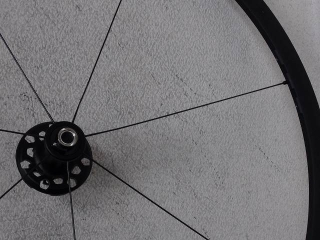
I carefully disassembled the Zonda DB.
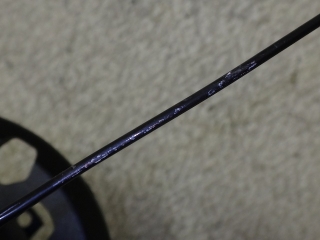
It appears the rim failure happened from a crash, as
the spokes on the right side (7-spoke side) have scratches
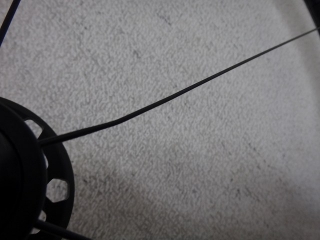
and are bent.
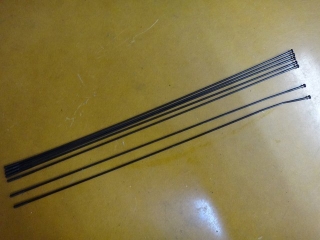
↑Zonda DB right side, 7 spokes
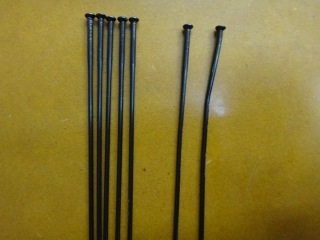
Two of them were unreusable.
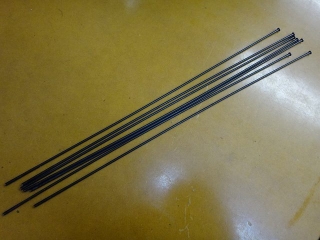
↑This is the Racing 3 DB right side, 7 spokes.
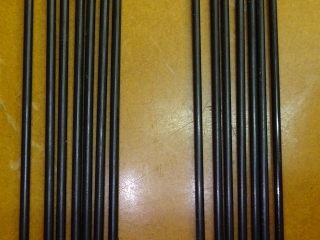
↑On the left is Racing 3 DB, on the right is Zonda DB—
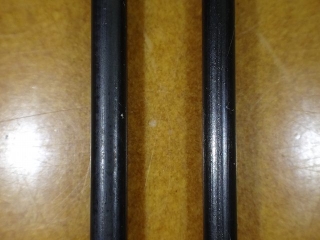
the Racing 3 DB has a thicker butted section on the spokes.
Zonda DB uses the same gauge on both sides.
I believe the original Zonda DB used left-right different-gauge,
but in the catalog's initial 2017 model
(when Zonda and Bora One got DB spec),
both sides were listed as 2.0-1.6-2.0mm.
For Racing 3 DB, Fulcrum's catalog doesn't mention
left-right different-gauge builds at all
(I checked non-English language catalogs too).
On the aluminum spokes of Racing Zero DB,
they do something intricate: the width looks the same from the side,
but the lower-spoke side is thicker front and rear—
yet the catalog doesn't mention this either.
Racing 3 DB's lower-spoke side is 2.0-1.8-2.0mm,
same as Competè.
Racing 3 DB's higher-spoke side and Zonda DB's both sides are
2.0-1.6-2.0mm, which is
slightly thicker than the 1.5mm butted section of Revolution and Laser,
probably pushing the limit to prevent flutter
with round-section spokes.
Regardless of spoke material, Fulcrum is more sophisticated
in theory—using different spoke counts left-right as counterbalance
for left-right reverse different-gauge builds on disc brake wheels.
Since there's no mention in the catalog, owners of Racing 3 DB
might never realize the spokes differ in gauge between sides,
yet they went to all this trouble anyway. That's impressive.
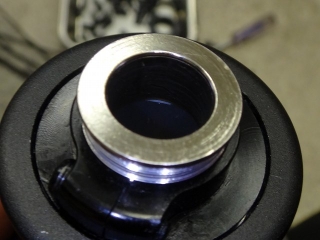
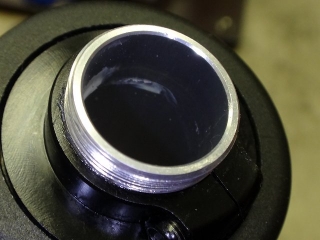
↑Racing 3 DB
↑Zonda DB
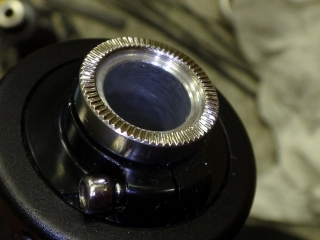
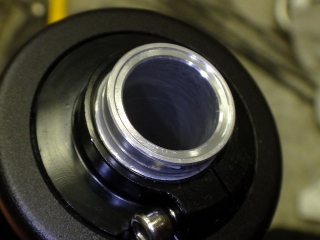
Regarding hub differences, Racing 3 DB supports
through-axles up to 15mm diameter, while
Zonda DB only goes up to 12mm.
By swapping end parts, the Racing 3 DB could theoretically
fit on non-BOOST standard 29-inch MTBs
or transitional-era cyclocross with 100×15mm front forks—
I'm really reaching for use cases here,
and honestly, nobody runs them that way.
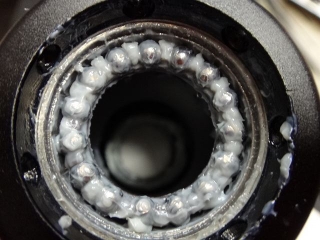
↑Racing 3 DB
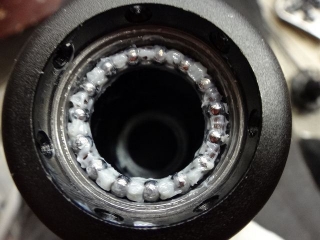
↑Zonda DB
The retainer ball count is the same.
The diameter of the cones pressed into the hub body is also the same.
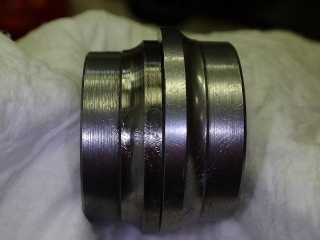
However, the axle diameter differs, so the cone locknut shape varies.
In the image above, we've aligned the bottom edges,
making the difference in part outer diameter easy to see—
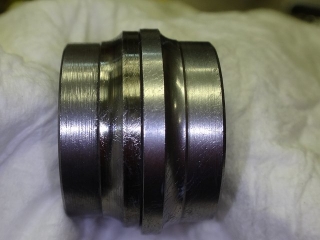
but the bearing contact surface width is the same.
I'm returning the Racing 3 DB hub to the customer, but
the point is, some parts from it can be used for Zonda DB repairs
and some can't.
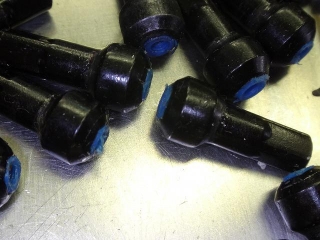
The nipples are 16.5mm-long aluminum,
designed to resist breaking by having larger corresponding rim holes
than generic nipples and a 4mm (or sometimes marked as 3.95mm)
square wrench socket to avoid stripping.
Also, there's nylon embedded on the outer edge for anti-loosening.
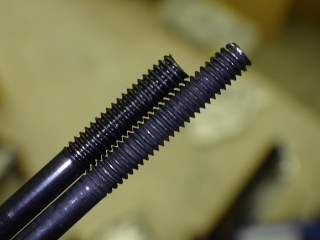
↑The short threaded section is CX-RAY, and the one about 4mm longer
is from Zonda DB and Racing 3 DB spokes.
Because of this length difference, the complete wheel spokes
reach the blue nylon.
About those complete-wheel nipples: compared to generic nipples,
the thread starts earlier (shallower gum line) and
the threaded section leans slightly inward.
With complete-wheel nipples paired with generic spokes,
the spoke end won't reach the nylon.
But you still get basically the same number of engaged threads
as with normal nipples, so wheels build fine.
Thread-locking compound is applied to the threads,
same as with generic nipples.
I'm explaining this because, with Zonda DB and Racing 3 DB,
spoke length differs due to rim height, hub dimensions, and
(on the higher-spoke side) build method differences.
When combining Zonda DB hub with Racing 3 DB rim,
we found we couldn't build it without cutting spokes—
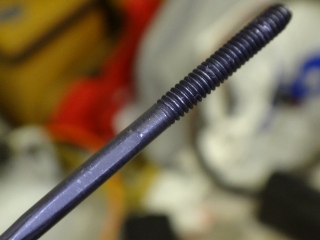
but these round-section spokes have a flat gripping surface
just before the thread start, so machining was impossible,
which is why I built it with generic spokes instead.
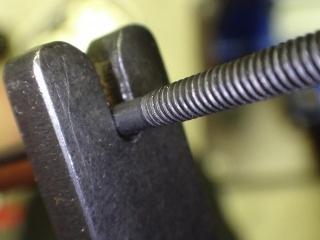
This is the genuine Fulcrum tool, and
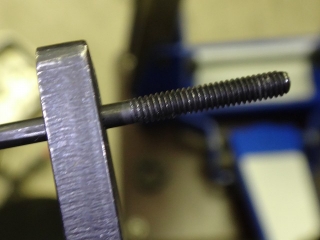
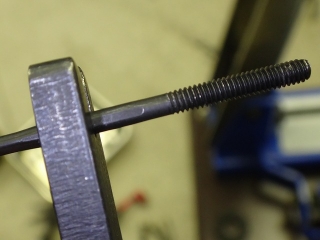
↑about this much of the flat surface serves as the grip.

Built!
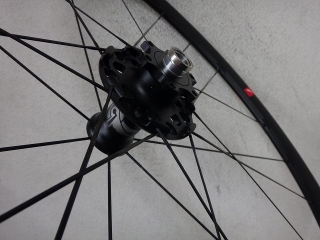
Black CX Sprint / CX-RAY reverse different-gauge build.
Just to be clear: CX Sprint is the 7-spoke side.
Hub with Campagnolo logo and
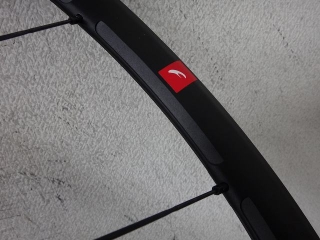
rim with Fulcrum logo—
the forbidden-fruit combination is absolutely thrilling. Hehehehe.
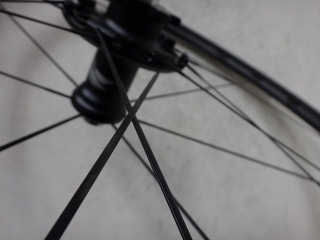
Regarding the final cross on the tangent side (left),
I consulted with the customer about whether to braid,
not braid, or braid and braze, and we decided to braid and braze.
Since we're using generic materials, future repairs
will be straightforward
(though I won't comment on whether the neighborhood shops can handle it).
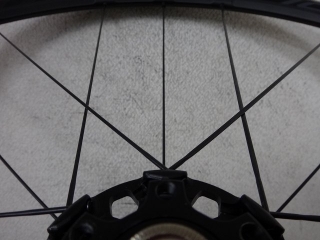
Initially I tried to build it using pure original spokes,
but that didn't work out.
The image above shows Plan B: racing with CX Sprint on the left
and Racing 3 DB equiv (Competè) on the right,
changing spokes as we go. The final cross has aero spokes on the right.
That didn't work either, and Plan C—right side 14 CX Sprint,
left side 7 CX-RAY—ended up being the answer.
Racing 3 DB and Zonda DB differ in pretty much everything,
and the rims are quite different too.
Zonda DB uses the tubeless-incompatible C17 rim,
Racing 3 DB uses the 2WAY-FIT C19 rim, so
weight-wise Racing 3 DB is at a disadvantage,
but the varied wall thickness and aggressive weight reduction
have brought the actual difference pretty close together.
Well, I actually weighed both rims separately,
so I know the results—but I'm telling nobody.
I mean, individual rim weights are juicy info,
why would I share that?
↑Man, that's cold.
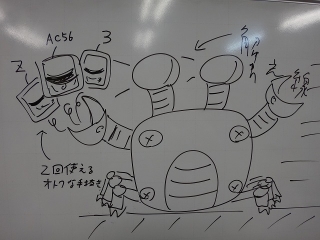
Sorry For The Delay! I've Been Recycling Images From The ENVE
(February 20th) Post And Its Opening Music!
So After ENVE, I Got Started On Zonda DB And Racing 3 DB,
But Things Were Rough Going, So It Took A While!
Anyway, Please Look At This Image!
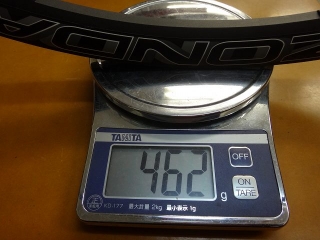
This Is Zonda DB!
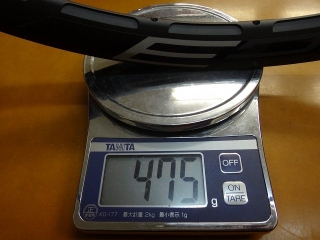
This Is Racing 3 DB!
With Campagnolo And Fulcrum Rims,
The Rim Height And Weight Differ Quite A Bit
Front To Rear, So If You're Not Comparing
The Same Side (This Time, Both Fronts),
The Comparison Won't Be Valid!
↑Stop It!

I received a front wheel with a Racing 3 DB rim from a customer.
The rotor mount uses center-lock, but
most manufacturers' lock rings, including Shimano,
are in the form of male threads—basically a hollow bolt design.
This doesn't change whether you use an external or internal tightening tool.
However, with Fulcrum's disc brake-ready complete wheels,
the lock ring side has female threads—essentially a nut-style design—
and the tool you use is limited to external tightening.
Since the structure is designed together with the hub body,
you can't use anything other than the included lock ring.

The male-threaded side of the hub body has damaged threads.
Since the rotor won't stay fixed and spins forever,
the wheel itself is now unusable.

↑The metal shavings had even scattered into the dust seal area.
I don't know whether the current owner caused this damage
or if they bought it cheap from someone else who did.
As a proposal to make this wheel usable somehow,
I suggested to the customer that we could reassemble it
by treating a 28H Shimano RS770 hub's right side—
skipping holes—as a 21H hub.
There are previous examples of the reverse situation,
assembling a 21H hub with a 28H rim
(→here) and (→here)
so this would be basically the same thing.
The difference is that unlike rim holes,
the unused hub flange holes don't need to be sealed.
By the way, I only propose this for front wheels.
Even having one side with 7 broken-head spokes is scary enough,
and on a rear wheel, the 7H radial side has the rotor mount,
so it's best to avoid it.
The RS770 hub's design follows the CX75 lineage, so
the flange holes have slits. If we did a left-right reverse different-gauge build,
we could even use Sapim CX on the 7H side,
but the issue is that CX doesn't have stable black supply,
and even in silver, the available lengths are limited.
So the conversation had stalled there...


Then the customer came back and said, "I found a Zonda DB
where the rim is the one that's messed up, so can you make a frankenbike out of both?"
Whaaaaaat?!
That's pushing it way too far!
If they'd asked me beforehand, "Can you build this with a Zonda DB hub?"

↑I would've said, "Fulcrum's 2:1 phase doesn't match Campagnolo's G3,
so it's impossible."
But they've already bought the stuff, so there's no help for it.
Like the Concorde fallacy or something, I've come this far,
so it'd be a waste not to see it through. Guess I'm doing it.
As it turns out, Zonda DB and Racing 3 DB are
quite different in both hub and rim design.
Well, Campagnolo and Fulcrum are
completely separate companies (officially speaking).

This is the Racing 3 DB hub. It has weight-reducing cutouts
that also exist on the rim brake model—like ice cream
scooped with a spoon.

This is the Zonda DB hub.
This one happens to be 6-bolt spec,
but center-lock versions also exist.
The customer mentioned that rotation felt gritty,
but it turned out the bearing adjustment was just too tight.


The Racing 3 DB hub design requires spokes to be straight
for a certain distance below the spoke head.


On the Zonda DB, though, the spoke heads sit right at the edge
of the flange, so there seems to be some flexibility
in spoke-head angle.
This is significant.
By coincidence this time, things worked out well,
so it looks like we can assemble a Zonda DB hub with a Racing 3 DB rim.
But what if it were the other way around? Well,
since I've already bought the materials, I'd have to build it anyway,
which is probably what I'd end up doing.

I carefully disassembled the Zonda DB.

It appears the rim failure happened from a crash, as
the spokes on the right side (7-spoke side) have scratches

and are bent.

↑Zonda DB right side, 7 spokes

Two of them were unreusable.

↑This is the Racing 3 DB right side, 7 spokes.

↑On the left is Racing 3 DB, on the right is Zonda DB—

the Racing 3 DB has a thicker butted section on the spokes.
Zonda DB uses the same gauge on both sides.
I believe the original Zonda DB used left-right different-gauge,
but in the catalog's initial 2017 model
(when Zonda and Bora One got DB spec),
both sides were listed as 2.0-1.6-2.0mm.
For Racing 3 DB, Fulcrum's catalog doesn't mention
left-right different-gauge builds at all
(I checked non-English language catalogs too).
On the aluminum spokes of Racing Zero DB,
they do something intricate: the width looks the same from the side,
but the lower-spoke side is thicker front and rear—
yet the catalog doesn't mention this either.
Racing 3 DB's lower-spoke side is 2.0-1.8-2.0mm,
same as Competè.
Racing 3 DB's higher-spoke side and Zonda DB's both sides are
2.0-1.6-2.0mm, which is
slightly thicker than the 1.5mm butted section of Revolution and Laser,
probably pushing the limit to prevent flutter
with round-section spokes.
Regardless of spoke material, Fulcrum is more sophisticated
in theory—using different spoke counts left-right as counterbalance
for left-right reverse different-gauge builds on disc brake wheels.
Since there's no mention in the catalog, owners of Racing 3 DB
might never realize the spokes differ in gauge between sides,
yet they went to all this trouble anyway. That's impressive.


↑Racing 3 DB


↑Zonda DB
Regarding hub differences, Racing 3 DB supports
through-axles up to 15mm diameter, while
Zonda DB only goes up to 12mm.
By swapping end parts, the Racing 3 DB could theoretically
fit on non-BOOST standard 29-inch MTBs
or transitional-era cyclocross with 100×15mm front forks—
I'm really reaching for use cases here,
and honestly, nobody runs them that way.

↑Racing 3 DB

↑Zonda DB
The retainer ball count is the same.
The diameter of the cones pressed into the hub body is also the same.

However, the axle diameter differs, so the cone locknut shape varies.
In the image above, we've aligned the bottom edges,
making the difference in part outer diameter easy to see—

but the bearing contact surface width is the same.
I'm returning the Racing 3 DB hub to the customer, but
the point is, some parts from it can be used for Zonda DB repairs
and some can't.

The nipples are 16.5mm-long aluminum,
designed to resist breaking by having larger corresponding rim holes
than generic nipples and a 4mm (or sometimes marked as 3.95mm)
square wrench socket to avoid stripping.
Also, there's nylon embedded on the outer edge for anti-loosening.

↑The short threaded section is CX-RAY, and the one about 4mm longer
is from Zonda DB and Racing 3 DB spokes.
Because of this length difference, the complete wheel spokes
reach the blue nylon.
About those complete-wheel nipples: compared to generic nipples,
the thread starts earlier (shallower gum line) and
the threaded section leans slightly inward.
With complete-wheel nipples paired with generic spokes,
the spoke end won't reach the nylon.
But you still get basically the same number of engaged threads
as with normal nipples, so wheels build fine.
Thread-locking compound is applied to the threads,
same as with generic nipples.
I'm explaining this because, with Zonda DB and Racing 3 DB,
spoke length differs due to rim height, hub dimensions, and
(on the higher-spoke side) build method differences.
When combining Zonda DB hub with Racing 3 DB rim,
we found we couldn't build it without cutting spokes—

but these round-section spokes have a flat gripping surface
just before the thread start, so machining was impossible,
which is why I built it with generic spokes instead.

This is the genuine Fulcrum tool, and


↑about this much of the flat surface serves as the grip.

Built!

Black CX Sprint / CX-RAY reverse different-gauge build.
Just to be clear: CX Sprint is the 7-spoke side.
Hub with Campagnolo logo and

rim with Fulcrum logo—
the forbidden-fruit combination is absolutely thrilling. Hehehehe.

Regarding the final cross on the tangent side (left),
I consulted with the customer about whether to braid,
not braid, or braid and braze, and we decided to braid and braze.
Since we're using generic materials, future repairs
will be straightforward

Initially I tried to build it using pure original spokes,
but that didn't work out.
The image above shows Plan B: racing with CX Sprint on the left
and Racing 3 DB equiv (Competè) on the right,
changing spokes as we go. The final cross has aero spokes on the right.
That didn't work either, and Plan C—right side 14 CX Sprint,
left side 7 CX-RAY—ended up being the answer.
Racing 3 DB and Zonda DB differ in pretty much everything,
and the rims are quite different too.
Zonda DB uses the tubeless-incompatible C17 rim,
Racing 3 DB uses the 2WAY-FIT C19 rim, so
weight-wise Racing 3 DB is at a disadvantage,
but the varied wall thickness and aggressive weight reduction
have brought the actual difference pretty close together.
Well, I actually weighed both rims separately,
so I know the results—but I'm telling nobody.
I mean, individual rim weights are juicy info,
why would I share that?
↑Man, that's cold.

Sorry For The Delay! I've Been Recycling Images From The ENVE
(February 20th) Post And Its Opening Music!
So After ENVE, I Got Started On Zonda DB And Racing 3 DB,
But Things Were Rough Going, So It Took A While!
Anyway, Please Look At This Image!

This Is Zonda DB!

This Is Racing 3 DB!
With Campagnolo And Fulcrum Rims,
The Rim Height And Weight Differ Quite A Bit
Front To Rear, So If You're Not Comparing
The Same Side (This Time, Both Fronts),
The Comparison Won't Be Valid!
↑Stop It!