There's a Japanese manufacturer called Maruni that specializes in puncture repair supplies,

and the tire levers I use for work are Maruni brand.

I've been using them for over ten years now, so the tip of the lever is worn down.
These tire levers are extremely easy to use and they don't break
(at least, I've never seen one break myself).
Recently, I got notification from one of my wholesalers—let's call them Wholesaler A—that
starting August 2nd of this year, Maruni products would be increasing in price and
fixed pricing would be eliminated in favor of open pricing.
Looking at the price revision list, I saw patches and rubber cement listed,
but there was no mention of the tire levers.
I hastily checked Wholesaler A's procurement website and found
they no longer carry the tire levers themselves.
As far as I know, these are the easiest tire levers to use, so
if they're being discontinued, that would be a real problem.
Wholesaler A carries basically all other Maruni products,
so there's no reason they wouldn't carry just the tire levers.
For example, it's not like there's some competing tire lever from another brand
that they're forced to sell, which is why they'd exclude Maruni's competing product.
By the way, at Wholesaler A, the sales format is
a three-piece set with one red, one yellow, and one blue,
and most orders are for those three-piece sets.

From a different wholesaler—let's call them Wholesaler B—
I tried stocking tire levers from the Viva brand (ビバ),
which mainly produces touring bike parts.
Like Maruni, they come in a three-color set,

and apparently not wanting to bother relabeling such an inexpensive item with their own brand,
they were sold with Maruni branding right on them.
Wholesaler B's price is the old fixed price: 390 yen before tax.
So the per-unit cost works out to 130 yen each.
After investigating further,

I found that another wholesaler—Wholesaler C—sells them individually,
and while they had decent stock, I bought them all up.
According to the staff at Wholesaler C,
this tire lever isn't actually being discontinued.
Well, I don't want them to disappear, so from this whole situation
I'm planning to stock up extra on these.
These tire levers probably have pretty broad distribution in the market,
so even if I buy out the stock at several wholesalers,
it's not the kind of product where I can monopolize the supply.

Wholesaler C also carried black in addition to red, yellow, and blue.
This is a color I've never seen before.

This side has exactly the same shape,

but the side with the Maruni marking is unmarked and the shape is slightly different.
Wholesaler C's individual sales have no fixed price.
For the selling price at our shop, rather than making it a loss leader,
I set the retail price at 80 yen including tax, which is frankly as high as it should go.
The earlier three-piece set's unit cost of 130 yen was before tax,
so in comparison that's about 76 yen.

Since I'm not doing set bundles, of course you're also welcome to buy multiple of the same color.
What Wholesaler C said about "not being discontinued" is
for now actually true—after I bought out their stock, their inventory was replenished after a while.
Though I bought that out too, of course.
So I'll be getting a bunch of additional stock soon.
The amount isn't huge financially, so I can stock without worrying,
but since I can confidently say these are easy to use,
I ordered a large quantity.
I've been known to buy out stock before—like when I cleared out
the original Selle Italia Flight with Colima embroidery from Colima
(I see the inventory every day, so I know some other shop bought a few while I was on my buying spree)—
but that was possible because it was a discontinued item.
Buying out all of these tire levers is impossible, as I mentioned earlier.
Looking at how Panda loss leaders like our 400-yen butyl tubes
and 150-yen CO₂ cartridges sell,
if I were certain these were being discontinued, I'd stock 1,000 units.
But since they don't break, unlike tubes and cartridges
where repeat purchases from the same customer are expected from loss or refill needs,
that's the difference with this lever.
Bonus
On other tire levers I own

↑This is a flat tire lever (the gum-stick type).
Similar-shaped levers come from various manufacturers,
with Michelin's probably being the most famous.
This one is from Gomitalia brand, which is probably quite rare.
Gomitalia—literally "Gum-Italy"—doesn't sound that great in Japanese, though.
It was a manufacturer particularly famous for tubular tires,
and their WO tires were what's called open tubulars—
tubular tires with the bead attached without sewing, flat like a piece of dried kelp.
Similar tubular tire types include Vittoria's old Open Corsa CX
and Veloflex's WO tires.
This style of tire lever includes options like Zéfal's Z-LEVERS,
but Continental is somewhat hard to get.
You can find individual tire lever sales through overseas online shops,
but through Japanese wholesalers,
there's a "Continental saddle bag" that's available,
a pretty slim saddle bag that fits about two ultra-thin butyl tubes,
and you can only get one of these levers
when you buy the set that comes with one ultra-thick tube
and two flat tire levers in that saddle bag.

Personally, I find this style of tire lever hard to use,
but according to interviews with customers for this article,
there are definitely passionate fans out there.
Also, since they're straight rather than curved in an arch,
they're easy to insert last when packing a saddle bag full,
and according to some opinions, if you place them like a bottom panel,
the shape stabilizes the bag's contents.


↑This is an IRC tire lever,
and it's the only tire lever I use for work besides Maruni.
On the end opposite the lever, it says "MOUNTING",
which is supposedly for using this tire lever to drop tubeless tires into the rim center,
though lately with so many manufacturers using their own proprietary tubeless rim standards,
I've never actually used that side.
By the way, I did once break one of these with a MAVIC Road UST tubeless tire (2nd generation).


The lighting makes it look different, but this is the same tire lever in the same color as before.
Since it was hard to fit in a saddle bag, I ground down the mounting side.

By classification, it might look like a flat type, but
it lacks that particular flatness, so I'd call it a different thing.
It definitely feels different in use too.

↑This is a tire lever from PB, the Swiss company famous for hex keys.
It's short in length, and its size makes it clear
it's not for cars or motorcycles—it's definitely a bicycle tool.

Honestly, if it didn't say PB on it, it wouldn't be worth buying specially,
and while I wouldn't call it hard to use,
it's not particularly easy to use either.
This tire lever doesn't have "MOUNTING" written on it,
but owning one does let you flex to certain people—
the fact that PB made something like this
functions as the article's value in itself, I think.


↑This is a Vittoria tire lever.
It's recent, with a different shape from the old version,
and the logo in the snap-together connector hole
shows the current Vittoria logo,
but it's still a three-color Italian tricolor set like the old one.
When you realize out on the road that you've forgotten your tire lever
or you've broken one, a last resort is to
use a quick release lever instead of a tire lever
(though plenty of recent quick releases have shapes that don't work for this),
but I've seen some tire levers that seem like they have less capability
than even a quick release lever.
For me, that applies to the old Vittoria.

The snap-together part looks like this.

There's no ulterior motive to taking that close-up, just so you know.
And here are some article links that probably aren't particularly related
(→here)(→here).

↑This is a tire lever from Silca, a pump maker now under American ownership,
a two-piece set.
The characteristic of these is that you can flex based on the price—
they cost 2,100 yen before tax.

Whoa, looking cool!
Bundled together with a SILCA-branded band!
If wearing anything other than Rapha or Assos gear
gives them hives (cheap fabric allergy),
and they think water spoils in bottle cages that aren't King titanium,
this finish would definitely win their hearts!

The material is a combination of nylon and metal,

but the lever portion itself is metal.
It shouldn't cause any particular problems with carbon rims
(and there's no way they weren't thinking of carbon rims),
but on aluminum rims with very thin bead hook sections like MAVIC Open Pro Disc rims or Stans rims,
you might want to avoid using them.

↑This is an early Campagnolo tire lever.
Before Silca came out, this was the standard high-end tire lever.
At the time of writing, the pre-tax list price is 551 yen per unit.

This side has a part number engraved: TL-7Z414110,

and the manufacturing date is July 2006.

↑This is a later/current version.
There's no Campagnolo engraving.
The part number on the other side is exactly the same as the early version,

but this one is from September 2015
and the engraving was removed sometime before this.

↑This is a Fulcrum-branded tire lever.
It's not "a tire lever made by Fulcrum."
The only wholesaler in Japan that carries Fulcrum
had this specially made as a prize for race participants,
so it's not available through any other distribution channel.
When you buy a Fulcrum wheel and it comes with a tire lever,
it's the same unlabeled black lever as the later Campagnolo version—
which I think is why Campagnolo removed their engraving.

The engraving on this side is exactly the same as Campagnolo,

and the manufacturing date is April 2016.

↑This is from a customer's personal collection—I got permission to photograph it for the article.
Earlier I said the Fulcrum-branded tire lever was a Japan-only special order with no other distribution,
but I was wrong.
Apparently, it came with a Fulcrum wheel purchased through overseas online retailers.

And here's another mystery: this side has no engraving at all.
This doesn't happen on Campagnolo levers either.
Maybe they deliberately did this
to insist that "since there's no engraving, it's not the Japanese wholesaler's special order."

Both are dated July 2018.
Random tangent, but the watch manufacturer Longines has a model called Heritage Legend Diver
that's a reissue of the original Legend Diver from around 1959-61 (Ref.7150).
The first reissue was a limited edition.
Then the Legend Diver becomes a regular production model shortly after,
but the specs were changed—probably so people who bought it thinking
it was limited wouldn't feel bad.
The original Legend Diver and first reissue are no-date versions,
but the regular production Legend Diver has
a date window at the 3 o'clock position.
The first reissue is no-date, but
the price isn't particularly high and
very few of them are in circulation.
I've had two chances to buy one before,
but both times I hesitated and it sold out.
The saying "when you want something, that's when you should buy it" is really true.


↑This is a tubular tire lever from Most, the parts brand of Pinarello.
While they produced quite a lot,
it was a one-time special production run,
and it's listed as final stock, but wholesalers have plenty.
By the way, they're sold individually.
At 760 yen before tax, it's not cheap either.
I've written about it here before,
it's really easy to use for removing tubular tires,
and since you really only need one for the job,
if you're using tubular tires and interested, try ordering
from your local Pinarello dealer.
Earlier I said I only use Maruni and IRC levers for work,
but I need to correct that.
I almost always use this one when removing tubular tires.

↑This is a tire lever belonging to a customer who's also a member of my cycling team.
It's Maruni, but in a sense it's not Maruni.
It's a rare tire lever that I don't even have.
It's at least 25 years old.

It says "Earth," which is a Maruni brand.

Though it's hard to see in the picture,
there's a globe with a diagonal sash, "EARTH" written on it,
and "MARUNI" written below.

This is Maruni's bead wax case from
one version before the current one,
and instead of a sash across the globe, it's a horizontal band,
and instead of "EARTH," it says "MARUNI,"
but the Earth brand naming lingers.
The current bead wax case has no globe mark.
The rubber cement tubes and cans still have this mark though.
The owner of this Earth tire lever
bought two of our Maruni blue ones.
Considering that even the Earth lever itself
should last a lifetime as long as you don't lose it."

and the tire levers I use for work are Maruni brand.

I've been using them for over ten years now, so the tip of the lever is worn down.
These tire levers are extremely easy to use and they don't break
(at least, I've never seen one break myself).
Recently, I got notification from one of my wholesalers—let's call them Wholesaler A—that
starting August 2nd of this year, Maruni products would be increasing in price and
fixed pricing would be eliminated in favor of open pricing.
Looking at the price revision list, I saw patches and rubber cement listed,
but there was no mention of the tire levers.
I hastily checked Wholesaler A's procurement website and found
they no longer carry the tire levers themselves.
As far as I know, these are the easiest tire levers to use, so
if they're being discontinued, that would be a real problem.
Wholesaler A carries basically all other Maruni products,
so there's no reason they wouldn't carry just the tire levers.
For example, it's not like there's some competing tire lever from another brand
that they're forced to sell, which is why they'd exclude Maruni's competing product.
By the way, at Wholesaler A, the sales format is
a three-piece set with one red, one yellow, and one blue,
and most orders are for those three-piece sets.

From a different wholesaler—let's call them Wholesaler B—
I tried stocking tire levers from the Viva brand (ビバ),
which mainly produces touring bike parts.
Like Maruni, they come in a three-color set,

and apparently not wanting to bother relabeling such an inexpensive item with their own brand,
they were sold with Maruni branding right on them.
Wholesaler B's price is the old fixed price: 390 yen before tax.
So the per-unit cost works out to 130 yen each.
After investigating further,

I found that another wholesaler—Wholesaler C—sells them individually,
and while they had decent stock, I bought them all up.
According to the staff at Wholesaler C,
this tire lever isn't actually being discontinued.
Well, I don't want them to disappear, so from this whole situation
I'm planning to stock up extra on these.
These tire levers probably have pretty broad distribution in the market,
so even if I buy out the stock at several wholesalers,
it's not the kind of product where I can monopolize the supply.

Wholesaler C also carried black in addition to red, yellow, and blue.
This is a color I've never seen before.

This side has exactly the same shape,

but the side with the Maruni marking is unmarked and the shape is slightly different.
Wholesaler C's individual sales have no fixed price.
For the selling price at our shop, rather than making it a loss leader,
I set the retail price at 80 yen including tax, which is frankly as high as it should go.
The earlier three-piece set's unit cost of 130 yen was before tax,
so in comparison that's about 76 yen.

Since I'm not doing set bundles, of course you're also welcome to buy multiple of the same color.
What Wholesaler C said about "not being discontinued" is
Though I bought that out too, of course.
So I'll be getting a bunch of additional stock soon.
The amount isn't huge financially, so I can stock without worrying,
but since I can confidently say these are easy to use,
I ordered a large quantity.
I've been known to buy out stock before—like when I cleared out
the original Selle Italia Flight with Colima embroidery from Colima
but that was possible because it was a discontinued item.
Buying out all of these tire levers is impossible, as I mentioned earlier.
Looking at how Panda loss leaders like our 400-yen butyl tubes
and 150-yen CO₂ cartridges sell,
if I were certain these were being discontinued, I'd stock 1,000 units.
But since they don't break, unlike tubes and cartridges
where repeat purchases from the same customer are expected from loss or refill needs,
that's the difference with this lever.
Bonus
On other tire levers I own

↑This is a flat tire lever (the gum-stick type).
Similar-shaped levers come from various manufacturers,
with Michelin's probably being the most famous.
This one is from Gomitalia brand, which is probably quite rare.
Gomitalia—literally "Gum-Italy"—doesn't sound that great in Japanese, though.
It was a manufacturer particularly famous for tubular tires,
and their WO tires were what's called open tubulars—
tubular tires with the bead attached without sewing, flat like a piece of dried kelp.
Similar tubular tire types include Vittoria's old Open Corsa CX
and Veloflex's WO tires.
This style of tire lever includes options like Zéfal's Z-LEVERS,
but Continental is somewhat hard to get.
You can find individual tire lever sales through overseas online shops,
but through Japanese wholesalers,
there's a "Continental saddle bag" that's available,
a pretty slim saddle bag that fits about two ultra-thin butyl tubes,
and you can only get one of these levers
when you buy the set that comes with one ultra-thick tube
and two flat tire levers in that saddle bag.

Personally, I find this style of tire lever hard to use,
but according to interviews with customers for this article,
there are definitely passionate fans out there.
Also, since they're straight rather than curved in an arch,
they're easy to insert last when packing a saddle bag full,
and according to some opinions, if you place them like a bottom panel,
the shape stabilizes the bag's contents.


↑This is an IRC tire lever,
and it's the only tire lever I use for work besides Maruni.
On the end opposite the lever, it says "MOUNTING",
which is supposedly for using this tire lever to drop tubeless tires into the rim center,
though lately with so many manufacturers using their own proprietary tubeless rim standards,
I've never actually used that side.
By the way, I did once break one of these with a MAVIC Road UST tubeless tire (2nd generation).


The lighting makes it look different, but this is the same tire lever in the same color as before.
Since it was hard to fit in a saddle bag, I ground down the mounting side.

By classification, it might look like a flat type, but
it lacks that particular flatness, so I'd call it a different thing.
It definitely feels different in use too.

↑This is a tire lever from PB, the Swiss company famous for hex keys.
It's short in length, and its size makes it clear
it's not for cars or motorcycles—it's definitely a bicycle tool.

Honestly, if it didn't say PB on it, it wouldn't be worth buying specially,
and while I wouldn't call it hard to use,
it's not particularly easy to use either.
This tire lever doesn't have "MOUNTING" written on it,
but owning one does let you flex to certain people—
the fact that PB made something like this
functions as the article's value in itself, I think.


↑This is a Vittoria tire lever.
It's recent, with a different shape from the old version,
and the logo in the snap-together connector hole
shows the current Vittoria logo,
but it's still a three-color Italian tricolor set like the old one.
When you realize out on the road that you've forgotten your tire lever
or you've broken one, a last resort is to
use a quick release lever instead of a tire lever
(though plenty of recent quick releases have shapes that don't work for this),
but I've seen some tire levers that seem like they have less capability
than even a quick release lever.
For me, that applies to the old Vittoria.

The snap-together part looks like this.

There's no ulterior motive to taking that close-up, just so you know.
And here are some article links that probably aren't particularly related
(→here)(→here).

↑This is a tire lever from Silca, a pump maker now under American ownership,
a two-piece set.
The characteristic of these is that you can flex based on the price—
they cost 2,100 yen before tax.

Whoa, looking cool!
Bundled together with a SILCA-branded band!
If wearing anything other than Rapha or Assos gear
gives them hives (cheap fabric allergy),
and they think water spoils in bottle cages that aren't King titanium,
this finish would definitely win their hearts!

The material is a combination of nylon and metal,

but the lever portion itself is metal.
It shouldn't cause any particular problems with carbon rims
(and there's no way they weren't thinking of carbon rims),
but on aluminum rims with very thin bead hook sections like MAVIC Open Pro Disc rims or Stans rims,
you might want to avoid using them.

↑This is an early Campagnolo tire lever.
Before Silca came out, this was the standard high-end tire lever.
At the time of writing, the pre-tax list price is 551 yen per unit.

This side has a part number engraved: TL-7Z414110,

and the manufacturing date is July 2006.

↑This is a later/current version.
There's no Campagnolo engraving.
The part number on the other side is exactly the same as the early version,

but this one is from September 2015
and the engraving was removed sometime before this.

↑This is a Fulcrum-branded tire lever.
It's not "a tire lever made by Fulcrum."
The only wholesaler in Japan that carries Fulcrum
had this specially made as a prize for race participants,
so it's not available through any other distribution channel.
When you buy a Fulcrum wheel and it comes with a tire lever,
it's the same unlabeled black lever as the later Campagnolo version—
which I think is why Campagnolo removed their engraving.

The engraving on this side is exactly the same as Campagnolo,
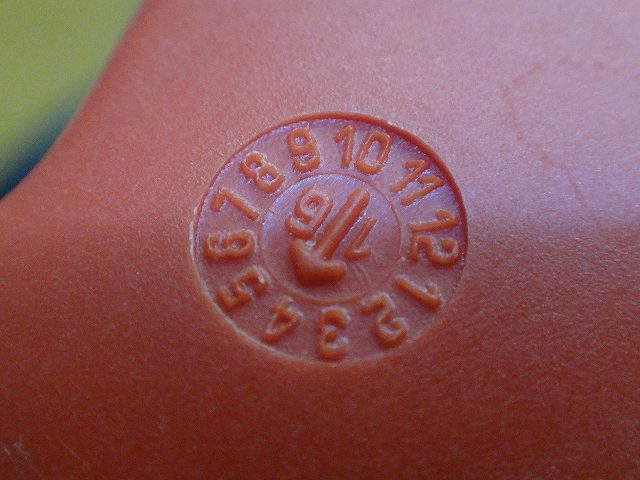
and the manufacturing date is April 2016.

↑This is from a customer's personal collection—I got permission to photograph it for the article.
Earlier I said the Fulcrum-branded tire lever was a Japan-only special order with no other distribution,
but I was wrong.
Apparently, it came with a Fulcrum wheel purchased through overseas online retailers.

And here's another mystery: this side has no engraving at all.
This doesn't happen on Campagnolo levers either.
Maybe they deliberately did this
to insist that "since there's no engraving, it's not the Japanese wholesaler's special order."

Both are dated July 2018.
Random tangent, but the watch manufacturer Longines has a model called Heritage Legend Diver
that's a reissue of the original Legend Diver from around 1959-61 (Ref.7150).
The first reissue was a limited edition.
Then the Legend Diver becomes a regular production model shortly after,
but the specs were changed—probably so people who bought it thinking
it was limited wouldn't feel bad.
The original Legend Diver and first reissue are no-date versions,
but the regular production Legend Diver has
a date window at the 3 o'clock position.
The first reissue is no-date, but
the price isn't particularly high and
very few of them are in circulation.
I've had two chances to buy one before,
but both times I hesitated and it sold out.
The saying "when you want something, that's when you should buy it" is really true.


↑This is a tubular tire lever from Most, the parts brand of Pinarello.
While they produced quite a lot,
it was a one-time special production run,
and it's listed as final stock, but wholesalers have plenty.
By the way, they're sold individually.
At 760 yen before tax, it's not cheap either.
I've written about it here before,
it's really easy to use for removing tubular tires,
and since you really only need one for the job,
if you're using tubular tires and interested, try ordering
from your local Pinarello dealer.
Earlier I said I only use Maruni and IRC levers for work,
but I need to correct that.
I almost always use this one when removing tubular tires.

↑This is a tire lever belonging to a customer who's also a member of my cycling team.
It's Maruni, but in a sense it's not Maruni.
It's a rare tire lever that I don't even have.
It's at least 25 years old.

It says "Earth," which is a Maruni brand.

Though it's hard to see in the picture,
there's a globe with a diagonal sash, "EARTH" written on it,
and "MARUNI" written below.

This is Maruni's bead wax case from
one version before the current one,
and instead of a sash across the globe, it's a horizontal band,
and instead of "EARTH," it says "MARUNI,"
but the Earth brand naming lingers.
The current bead wax case has no globe mark.
The rubber cement tubes and cans still have this mark though.
The owner of this Earth tire lever
bought two of our Maruni blue ones.
Considering that even the Earth lever itself
should last a lifetime as long as you don't lose it."
Products Mentioned in This Article
* Amazon affiliate links — prices may vary
Original Japanese post: のむラボ日記 #5880