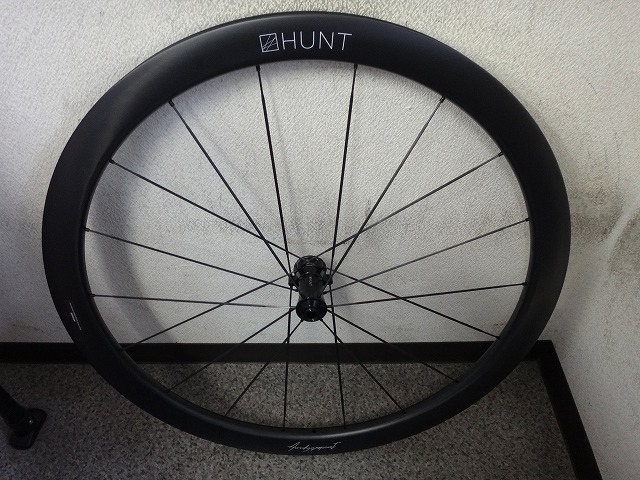
A customer left me a wheel with HUNT carbon spokes for inspection.
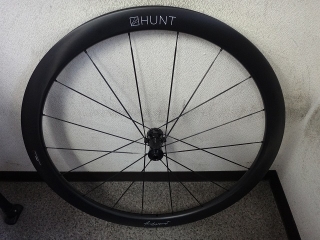
This is separate from the wheel with carbon spokes I replaced and repaired the other day.
It was inspected around June 17th this year
but I didn't write an article about it. I only took photos of the front wheel.
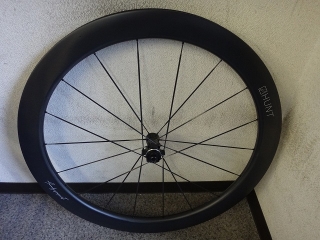
↑This is the front wheel from the other day, but actually the rim height is different.
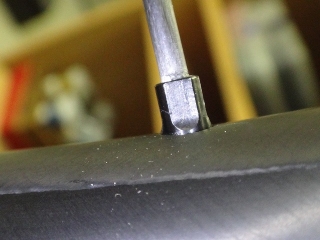
This is the nipple-type component integrated with the spoke
on the wheel inspected in June,
and the grip portion stands out solidly from the rim.
This is determined by the dimensions of the hub and rim, and as a small factor
how much tension was applied, but the one with the higher rim height from the other day
had only about half the flat surface of the grip portion protruding,
which made the work difficult.
Moreover, between this spoke and the nut serving as the built-in nipple
a rather strong threadlocker is applied for the thread diameter,
and when trying to get initial rotation, when it breaks loose
it goes "crack!" and before reaching that point the carbon spoke twists or
the square portion of the nipple-type component nearly rounds out from the force applied,
so I touched it very carefully and nervously.
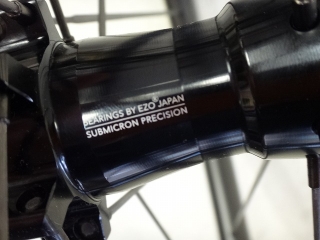
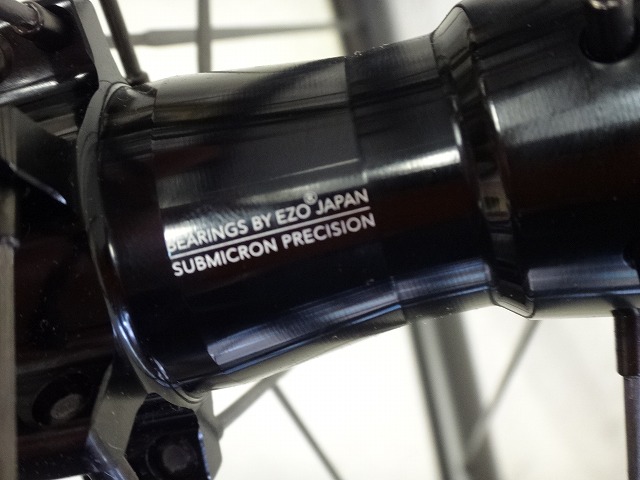
On the hub body there is a laser etching stating
that Japanese EZO bearings are used.
EZO refers to Ezo (Hokkaido) and is the bearing from Kita Nihon Seiki (Northern Japan Precision).
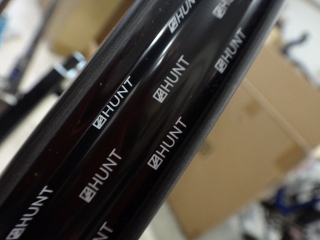
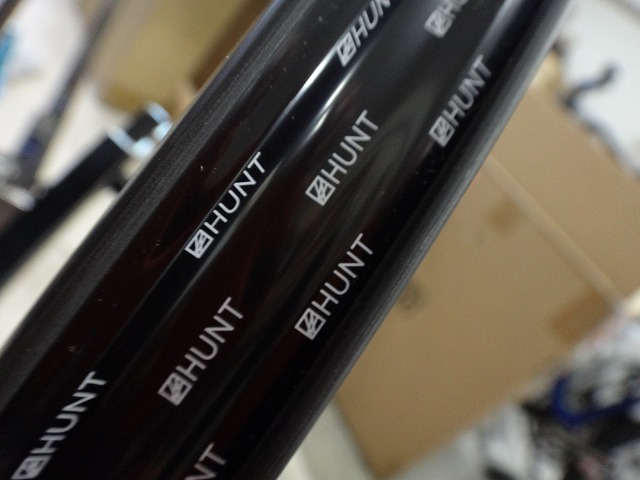
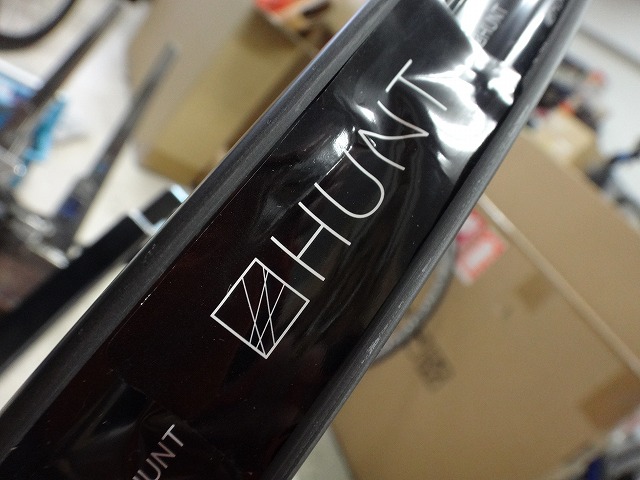
For work purposes the rim tape needs to be removed,
but aside from that, this rim tape with the HUNT name on it
lacks flexibility to conform to the rim shape,
and in the phase shown in the image above it happens to be applied cleanly,
but the width doesn't match the rim and even in the image
the tape doesn't reach to the far left edge.
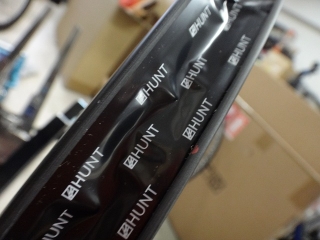

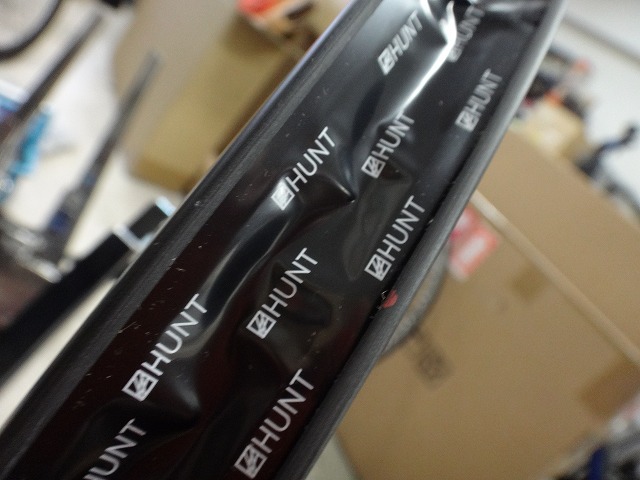
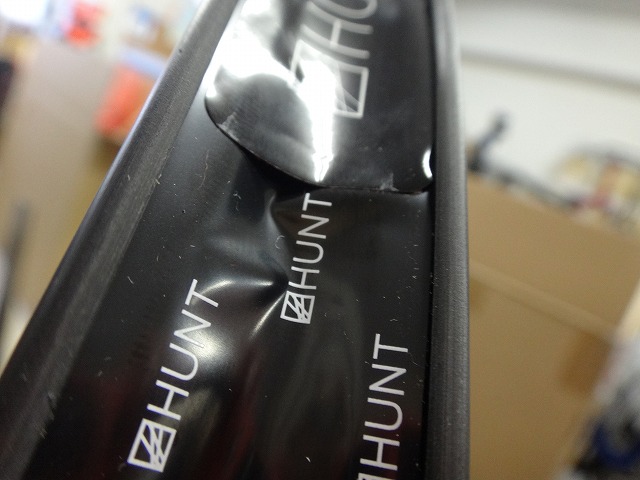
In addition, there are many phases where it's stiff and wrinkled,
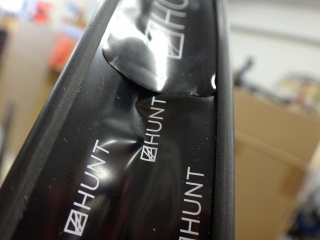
and the end of the tape peels up like this,
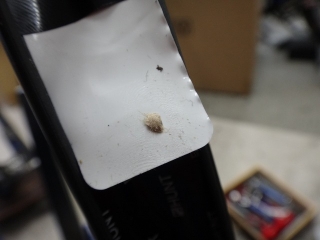
with cardboard fibers from shipping caught in the gap.

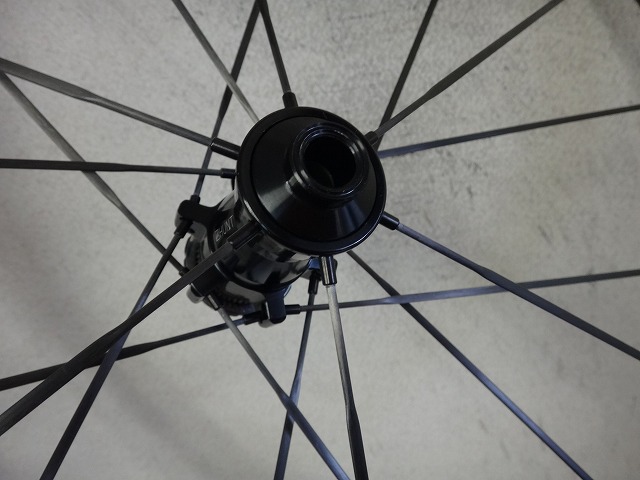
↑This is the front wheel from the inspection in June,
and regardless of rim height, both the rear wheels are equal-number lacing with 12×2, or 24H,
and the front wheel is somehow 2:1 lacing with 12+6, or
18H, which is quite an aggressive specification.
With this carbon spoke
(though not all carbon spokes are this way)
I think stiffness can be ensured to the degree that
most people wouldn't complain about it.
With steel spokes at 100% spoke weight ratio,
18H front would probably be impossible.
The absolute asshole wheel that pulls this off with a 65% spoke weight ratio
is the Roval Rapide CLX.
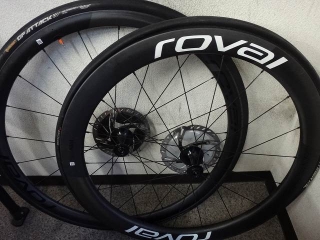
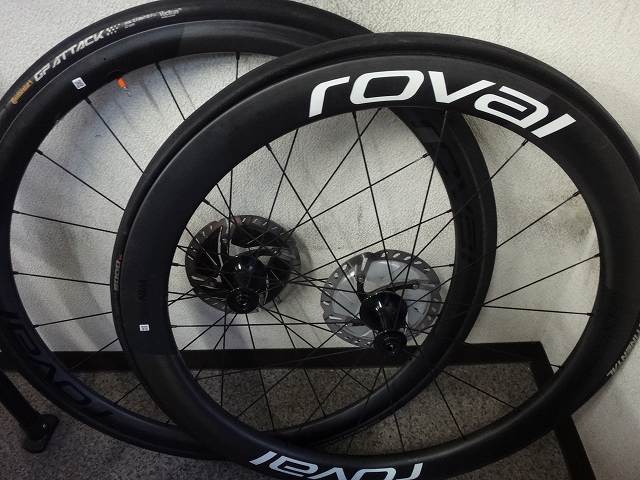
↑I'm not criticizing something I've never seen.
The image above is the Rapide CLX and Alpinist,
brought in for inspection, and I only photographed the front wheel.
The Alpinist has separate image material that I shot in April this year,
and since it has value as an article, I'll write about it separately.
If I had the resources and equipment to do wind tunnel testing,
I'd try various things on wheels with the same rim height (especially front wheels)
to see how air resistance decreases when spoke count changes,
but having such means at hand seems to cloud judgment
about the overall performance elements of wheels,
and I can't seem to think about how risky
a 12+6, 18H front wheel with steel spokes really is.
Don't take lightly the fact that there are only 6 spokes (steel ones) on the right side.
Whether it's asymmetric or symmetric diameter lacing,
if the 6-spoke side used aero-lite instead of aero-comp,
(by my assessment, even that wouldn't be enough)
the wheel would be somewhat better.
I once re-laced a CLX64 wheel with different spoke weight ratio
(→here), and contrary to my prediction,
the issue the customer had wasn't with the rear wheel but the front.
Even that CLX64 front wheel is 3×7 for 21H.
To then remove 3 more spokes, one pair, without changing the spoke weight ratio
doesn't seem to show serious thought about wheels.
I call what's generally known as spoke tension (hereafter ST)
"second-ST."
In contrast, the simple numerical value (without units) that appears on the spoke tension meter
I call "first-ST."
Since checking first-ST is necessary to derive the general spoke tension,
I gave that the second number.
First-ST varies with the tension meter used, so I call it
D1ST when the meter is DT, H1ST when Hozan, and P1ST when Park Tool.
If these standards were perfectly uniform,
each first-ST would of course yield the same second-ST.
Regarding Park Tool tension meters,
there's somewhat larger individual variation between meters that are said to be the same,
but for home use there's sufficient accuracy.
"On the most simple wheel—a front wheel with radial lacing, equal-number lacing,
no ochoko (offset) for rim brakes, same spoke count—"
and limiting to steel spokes only,
if the second-ST is the same, the wheel stiffness wouldn't be the same...
With the same second-ST, the larger the spoke weight ratio,
the less deformation the spoke experiences.
In other words, perhaps first-ST better expresses
how resistant spokes are to deformation.
When applying a Hozan meter in the fore-aft spoke direction,
at the same second-ST (just over 130 kgf), the H1ST is
about 140 for 14-gauge plain like Campagnolo (100%),
about 130 for 14-gauge base comp (just under 85%),
about 190 for CX (nearly 100%), and about 130 for CX-RAY (just under 65%).
Getting H1ST to 140 with comp is virtually impossible.
It's not absolutely impossible, but it depends on choosing the rim and nipple.
Plus, even comp would start showing some deformation.
If you build comp to its limit so CX reaches an H1ST of 130 softly,
regarding spoke deformation, the wheels would feel almost identical,
but in that case the Campagnolo would just be a wheel unnecessarily heavy in the spoke section.
Looking only at this H1ST, 85% comp and 65% CX-RAY are both 130!
CX-RAY transcends spoke weight ratio and looks superior! But
this is because the measurement point is applied from the fore-aft spoke direction,
so flat spokes just measure favorably.
CX-RAY fits through round holes so Hozan's meter can be applied from the side too,
but spokes like CX that don't fit through normal round holes
don't fit in the concave portion at the tip of the Hozan measurement point,
so they can't be measured.
By this method, the numerically strongest steel spoke
is Mavic's current—dangerously thin and wide—
aero spoke, with an H1ST around 205.
Using only second-ST numbers, you can't even roughly express wheel stiffness,
and rather first-ST including spoke weight ratio
expresses a single spoke's resistance to deformation more,
and when spoke count changes, wheel stiffness changes too,
but this can be tracked to some degree by "spoke quantity" (spoke weight ratio × spoke count),
so within my evaluation framework there's a "third-ST" based on spoke quantity and first-ST
as a standard for evaluating wheel stiffness,
and this aligns fairly well with popular opinion on individual wheels,
so it's extremely convenient, but
it's confidential trade information, so I won't detail it here.
This wasn't thought up to give Nomulab wheels an unfair advantage either—
the strongest third-ST wheel would be Racing Zero or Shamal Ultra.
Well, even if Racing Zero is strongest in third-ST,
that's just excellent in the evaluation standard for spoke tension relationship (resistance to deformation),
and for example, in limited situations where aerodynamics is a major performance factor
(like fixed-gear or time trial),
Racing Zero isn't necessarily strongest.
Also, this only applies to spoked wheels—
button lacing and disc wheels far exceed
spoked wheels in resistance to deformation.
When I regularly re-build pieces of crap like ZIPP, ENVE, Reynolds, or Roval,
and customers say it's stiffer now or has better feel,
that can be restated as the third-ST evaluation becoming higher
(which is actually happening).
I've written that narrow-flange rear hubs
can only be built into laterally stiff wheels,
and equal-number lacing with radial non-drive-side rear wheels
are without exception garbage, but
this is when spoke material is steel.
When spoke material changes, the logic of steel spokes and
what we've learned experientially about wheels no longer applies.
With aluminum or carbon spokes,
even building with a narrow-flange rear hub might achieve
lateral stiffness that most people wouldn't complain about,
and maybe even an absurd 12+6, 18H front wheel is fine.
The H1ST of an off-the-peg Racing Zero is
around 235 for the front and drive-side rear.
This is an unreachable number for steel spokes
(maybe with 13-gauge plain or old Rolf 120% spokes if the rim could take mega tension),
but the aluminum spokes of Racing Zero have about a 70% spoke weight ratio.
In other words, spokes that are only slightly heavier than CX-RAY in spoke weight ratio
but more deformation-resistant than CX can be obtained in aluminum.
Some person from a certain brand whose name we shouldn't speak,
who fled in the night without explaining warranty on wheels they sold,
once spouted "aluminum spokes have no physical significance"
but that's idiocy from someone who doesn't even understand spoke weight ratio,
and there's no way a 70% spoke weight ratio steel spoke 16H front wheel
and a Racing Zero front wheel (also 16H) have the same stiffness.
Therefore, they have physical significance.
Racing Zero spokes reaching H1ST of 235,
but what about second-ST? I have documentation for
Campagnolo's Shamal Ultra built with the same spokes,
with front wheel upper limit of 130 kgf and rear drive-side upper limit of 150 kgf—
not extraordinarily high numbers, so again
judging wheel stiffness by second-ST alone is impossible.
Both Racing Zero and Shamal Ultra in second-ST terms are
"spoke tension at 130 kgf, 16H front wheel," so
↑I'd probably judge just from this wording
"this must be a terrible flexy wheel on descents" or something.
Documentation on second-ST for Campagnolo Fulcrum aluminum spokes
is probably not published to the general public,
but since there's a lot to say about this, I'll write a separate article.

↑This is an inspection sheet for Crank Brothers' Iodine,
an MTB wheel.
What's written is the second-ST, and the image has a shine because
it's a laminated card.
Because second-ST is written and it's laminated,
this might be more for informing users
rather than a builder's inspection record.
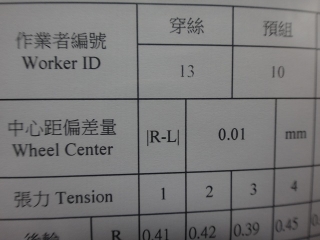
↑This is an inspection sheet for a Roval wheel.
Numbered spokes have values around 0.4 written,
which is the DT tension meter's first-ST, meaning D1ST.
The builder doesn't need to know spoke gauge or second-ST.
Managing by first-ST alone produces the same result,
and it eliminates the effort and potential errors in converting to second-ST.
For HUNT's UD carbon spokes this time,
my rough impression from first-ST would be
comparable to steel aero spokes around 85% spoke weight ratio.
As sample values increase, this could shift in the future.
Roughly speaking, it's such that if you replaced them with
steel spokes slightly thicker than CX Sprint or
flattened comp, then
just gripping the spokes with eyes closed
(this is also fuzzy but it's how first-ST evaluates)
you couldn't tell them from the original carbon spokes.
So the 12+6, 18H front wheel from the start
amounts to flattened full-comp equivalent,
and while spoke count is still on the low side in my view,
it's far better than the Roval Rapide CLX
built with full aero-lite (65% spoke weight ratio).
The HUNT UD carbon spoke documentation also writes
only second-ST like an upper limit of 120 kgf.
So aside from truing or spoke replacement,
for rim replacement you'd need to know the off-the-peg wheel's first-ST.
If the spoke weight ratio of this carbon spoke could be found,
evaluation would become possible like "same stiffness feel as 85% spoke weight ratio steel aero spokes,
but this carbon spoke is lighter at ○○% spoke weight ratio, so superior."
Also, same as before—
if it greatly exceeds steel spoke limits,
"if lateral stiffness is acceptable, we could use narrow-flange hubs or
non-drive-side radial lacing, which would be aerodynamically more favorable"
so there's potential in that direction.
Also no need for tangential lacing if stiffness is assured.
Lightweight does this with tension-structure carbon spokes though.
HUNT's UD carbon spokes,
in terms of spoke weight ratio or nomulab wheel philosophy,
are extremely superior wheel material.
But for clarity, this comments specifically on
HUNT UD carbon spokes, not
HUNT carbon spoke wheels in general, since
HUNT rims aren't that light in height-to-weight ratio.
And I don't know about other brands' carbon spokes,
so I haven't reached some big conclusion like
"carbon spokes are completely superior to steel spokes!"
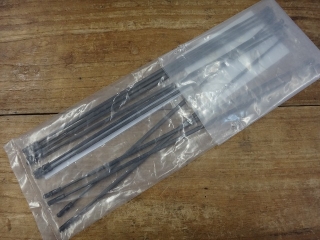
I dug up the June HUNT images to write
this article because discovering spoke weight ratio
created article value.
From the customer with the spoke replacement job the other day,
I received 10 non-drive-side spokes in a bag and
4 drive-side spokes loose, but
with 10 of the same spoke and a scale measuring 0.1g increments,
spoke weight ratio is determinable.
The aluminum portion adhered to both ends of carbon spokes
is integral, so I count that as part of the spoke.
So about that spoke weight ratio...
there's no way I'm just telling you that easily.
That's all for today.
↑wow what a disagreeable guy

Sorry for the wait!
About the HUNT UD carbon spoke weight ratio—
I posted nearly simultaneously with nearly identical titles before:
the gecko article "Moonlight gecko" (→here) and
the frog article "Croak Croak" (→here),
I'll reveal it if the frog article gets more applause votes!
It'll probably be impossible though!

S-stop...futile resistance!

What!? It reversed!?
...Please look at this image!
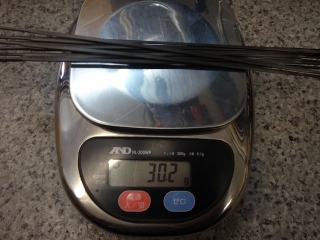
Nominal 278mm, 10 spokes: 30.2g,
Weight per mm is 0.010863309...g so
the spoke weight ratio is 42.2%!
↑Stop it!!
This is separate from the wheel with carbon spokes I replaced and repaired the other day.
It was inspected around June 17th this year
but I didn't write an article about it. I only took photos of the front wheel.

↑This is the front wheel from the other day, but actually the rim height is different.

This is the nipple-type component integrated with the spoke
on the wheel inspected in June,
and the grip portion stands out solidly from the rim.
This is determined by the dimensions of the hub and rim, and as a small factor
how much tension was applied, but the one with the higher rim height from the other day
had only about half the flat surface of the grip portion protruding,
which made the work difficult.
Moreover, between this spoke and the nut serving as the built-in nipple
a rather strong threadlocker is applied for the thread diameter,
and when trying to get initial rotation, when it breaks loose
it goes "crack!" and before reaching that point the carbon spoke twists or
the square portion of the nipple-type component nearly rounds out from the force applied,
so I touched it very carefully and nervously.
On the hub body there is a laser etching stating
that Japanese EZO bearings are used.
EZO refers to Ezo (Hokkaido) and is the bearing from Kita Nihon Seiki (Northern Japan Precision).
For work purposes the rim tape needs to be removed,
but aside from that, this rim tape with the HUNT name on it
lacks flexibility to conform to the rim shape,
and in the phase shown in the image above it happens to be applied cleanly,
but the width doesn't match the rim and even in the image
the tape doesn't reach to the far left edge.
In addition, there are many phases where it's stiff and wrinkled,
and the end of the tape peels up like this,

with cardboard fibers from shipping caught in the gap.
↑This is the front wheel from the inspection in June,
and regardless of rim height, both the rear wheels are equal-number lacing with 12×2, or 24H,
and the front wheel is somehow 2:1 lacing with 12+6, or
18H, which is quite an aggressive specification.
With this carbon spoke
(though not all carbon spokes are this way)
I think stiffness can be ensured to the degree that
most people wouldn't complain about it.
With steel spokes at 100% spoke weight ratio,
18H front would probably be impossible.
The absolute asshole wheel that pulls this off with a 65% spoke weight ratio
is the Roval Rapide CLX.
↑I'm not criticizing something I've never seen.
The image above is the Rapide CLX and Alpinist,
brought in for inspection, and I only photographed the front wheel.
The Alpinist has separate image material that I shot in April this year,
and since it has value as an article, I'll write about it separately.
If I had the resources and equipment to do wind tunnel testing,
I'd try various things on wheels with the same rim height (especially front wheels)
to see how air resistance decreases when spoke count changes,
but having such means at hand seems to cloud judgment
about the overall performance elements of wheels,
and I can't seem to think about how risky
a 12+6, 18H front wheel with steel spokes really is.
Don't take lightly the fact that there are only 6 spokes (steel ones) on the right side.
Whether it's asymmetric or symmetric diameter lacing,
if the 6-spoke side used aero-lite instead of aero-comp,
(by my assessment, even that wouldn't be enough)
the wheel would be somewhat better.
I once re-laced a CLX64 wheel with different spoke weight ratio
(→here), and contrary to my prediction,
the issue the customer had wasn't with the rear wheel but the front.
Even that CLX64 front wheel is 3×7 for 21H.
To then remove 3 more spokes, one pair, without changing the spoke weight ratio
doesn't seem to show serious thought about wheels.
I call what's generally known as spoke tension (hereafter ST)
"second-ST."
In contrast, the simple numerical value (without units) that appears on the spoke tension meter
I call "first-ST."
Since checking first-ST is necessary to derive the general spoke tension,
I gave that the second number.
First-ST varies with the tension meter used, so I call it
D1ST when the meter is DT, H1ST when Hozan, and P1ST when Park Tool.
If these standards were perfectly uniform,
each first-ST would of course yield the same second-ST.
Regarding Park Tool tension meters,
there's somewhat larger individual variation between meters that are said to be the same,
but for home use there's sufficient accuracy.
"On the most simple wheel—a front wheel with radial lacing, equal-number lacing,
no ochoko (offset) for rim brakes, same spoke count—"
and limiting to steel spokes only,
if the second-ST is the same, the wheel stiffness wouldn't be the same...
With the same second-ST, the larger the spoke weight ratio,
the less deformation the spoke experiences.
In other words, perhaps first-ST better expresses
how resistant spokes are to deformation.
When applying a Hozan meter in the fore-aft spoke direction,
at the same second-ST (just over 130 kgf), the H1ST is
about 140 for 14-gauge plain like Campagnolo (100%),
about 130 for 14-gauge base comp (just under 85%),
about 190 for CX (nearly 100%), and about 130 for CX-RAY (just under 65%).
Getting H1ST to 140 with comp is virtually impossible.
It's not absolutely impossible, but it depends on choosing the rim and nipple.
Plus, even comp would start showing some deformation.
If you build comp to its limit so CX reaches an H1ST of 130 softly,
regarding spoke deformation, the wheels would feel almost identical,
but in that case the Campagnolo would just be a wheel unnecessarily heavy in the spoke section.
Looking only at this H1ST, 85% comp and 65% CX-RAY are both 130!
CX-RAY transcends spoke weight ratio and looks superior! But
this is because the measurement point is applied from the fore-aft spoke direction,
so flat spokes just measure favorably.
CX-RAY fits through round holes so Hozan's meter can be applied from the side too,
but spokes like CX that don't fit through normal round holes
don't fit in the concave portion at the tip of the Hozan measurement point,
so they can't be measured.
By this method, the numerically strongest steel spoke
is Mavic's current—dangerously thin and wide—
aero spoke, with an H1ST around 205.
Using only second-ST numbers, you can't even roughly express wheel stiffness,
and rather first-ST including spoke weight ratio
expresses a single spoke's resistance to deformation more,
and when spoke count changes, wheel stiffness changes too,
but this can be tracked to some degree by "spoke quantity" (spoke weight ratio × spoke count),
so within my evaluation framework there's a "third-ST" based on spoke quantity and first-ST
as a standard for evaluating wheel stiffness,
and this aligns fairly well with popular opinion on individual wheels,
so it's extremely convenient, but
it's confidential trade information, so I won't detail it here.
This wasn't thought up to give Nomulab wheels an unfair advantage either—
the strongest third-ST wheel would be Racing Zero or Shamal Ultra.
Well, even if Racing Zero is strongest in third-ST,
that's just excellent in the evaluation standard for spoke tension relationship (resistance to deformation),
and for example, in limited situations where aerodynamics is a major performance factor
(like fixed-gear or time trial),
Racing Zero isn't necessarily strongest.
Also, this only applies to spoked wheels—
button lacing and disc wheels far exceed
spoked wheels in resistance to deformation.
When I regularly re-build pieces of crap like ZIPP, ENVE, Reynolds, or Roval,
and customers say it's stiffer now or has better feel,
that can be restated as the third-ST evaluation becoming higher
(which is actually happening).
I've written that narrow-flange rear hubs
can only be built into laterally stiff wheels,
and equal-number lacing with radial non-drive-side rear wheels
are without exception garbage, but
this is when spoke material is steel.
When spoke material changes, the logic of steel spokes and
what we've learned experientially about wheels no longer applies.
With aluminum or carbon spokes,
even building with a narrow-flange rear hub might achieve
lateral stiffness that most people wouldn't complain about,
and maybe even an absurd 12+6, 18H front wheel is fine.
The H1ST of an off-the-peg Racing Zero is
around 235 for the front and drive-side rear.
This is an unreachable number for steel spokes
(maybe with 13-gauge plain or old Rolf 120% spokes if the rim could take mega tension),
but the aluminum spokes of Racing Zero have about a 70% spoke weight ratio.
In other words, spokes that are only slightly heavier than CX-RAY in spoke weight ratio
but more deformation-resistant than CX can be obtained in aluminum.
Some person from a certain brand whose name we shouldn't speak,
who fled in the night without explaining warranty on wheels they sold,
once spouted "aluminum spokes have no physical significance"
but that's idiocy from someone who doesn't even understand spoke weight ratio,
and there's no way a 70% spoke weight ratio steel spoke 16H front wheel
and a Racing Zero front wheel (also 16H) have the same stiffness.
Therefore, they have physical significance.
Racing Zero spokes reaching H1ST of 235,
but what about second-ST? I have documentation for
Campagnolo's Shamal Ultra built with the same spokes,
with front wheel upper limit of 130 kgf and rear drive-side upper limit of 150 kgf—
not extraordinarily high numbers, so again
judging wheel stiffness by second-ST alone is impossible.
Both Racing Zero and Shamal Ultra in second-ST terms are
"spoke tension at 130 kgf, 16H front wheel," so
↑I'd probably judge just from this wording
"this must be a terrible flexy wheel on descents" or something.
Documentation on second-ST for Campagnolo Fulcrum aluminum spokes
is probably not published to the general public,
but since there's a lot to say about this, I'll write a separate article.
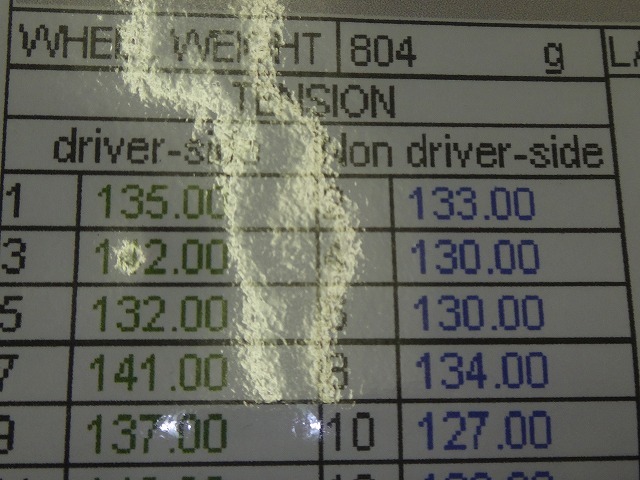
↑This is an inspection sheet for Crank Brothers' Iodine,
an MTB wheel.
What's written is the second-ST, and the image has a shine because
it's a laminated card.
Because second-ST is written and it's laminated,
this might be more for informing users
rather than a builder's inspection record.

↑This is an inspection sheet for a Roval wheel.
Numbered spokes have values around 0.4 written,
which is the DT tension meter's first-ST, meaning D1ST.
The builder doesn't need to know spoke gauge or second-ST.
Managing by first-ST alone produces the same result,
and it eliminates the effort and potential errors in converting to second-ST.
For HUNT's UD carbon spokes this time,
my rough impression from first-ST would be
comparable to steel aero spokes around 85% spoke weight ratio.
As sample values increase, this could shift in the future.
Roughly speaking, it's such that if you replaced them with
steel spokes slightly thicker than CX Sprint or
flattened comp, then
just gripping the spokes with eyes closed
(this is also fuzzy but it's how first-ST evaluates)
you couldn't tell them from the original carbon spokes.
So the 12+6, 18H front wheel from the start
amounts to flattened full-comp equivalent,
and while spoke count is still on the low side in my view,
it's far better than the Roval Rapide CLX
built with full aero-lite (65% spoke weight ratio).
The HUNT UD carbon spoke documentation also writes
only second-ST like an upper limit of 120 kgf.
So aside from truing or spoke replacement,
for rim replacement you'd need to know the off-the-peg wheel's first-ST.
If the spoke weight ratio of this carbon spoke could be found,
evaluation would become possible like "same stiffness feel as 85% spoke weight ratio steel aero spokes,
but this carbon spoke is lighter at ○○% spoke weight ratio, so superior."
Also, same as before—
if it greatly exceeds steel spoke limits,
"if lateral stiffness is acceptable, we could use narrow-flange hubs or
non-drive-side radial lacing, which would be aerodynamically more favorable"
so there's potential in that direction.
Also no need for tangential lacing if stiffness is assured.
HUNT's UD carbon spokes,
in terms of spoke weight ratio or nomulab wheel philosophy,
are extremely superior wheel material.
But for clarity, this comments specifically on
HUNT UD carbon spokes, not
HUNT carbon spoke wheels in general, since
HUNT rims aren't that light in height-to-weight ratio.
And I don't know about other brands' carbon spokes,
so I haven't reached some big conclusion like
"carbon spokes are completely superior to steel spokes!"

I dug up the June HUNT images to write
this article because discovering spoke weight ratio
created article value.
From the customer with the spoke replacement job the other day,
I received 10 non-drive-side spokes in a bag and
4 drive-side spokes loose, but
with 10 of the same spoke and a scale measuring 0.1g increments,
spoke weight ratio is determinable.
The aluminum portion adhered to both ends of carbon spokes
is integral, so I count that as part of the spoke.
So about that spoke weight ratio...
there's no way I'm just telling you that easily.
That's all for today.
↑wow what a disagreeable guy

Sorry for the wait!
About the HUNT UD carbon spoke weight ratio—
I posted nearly simultaneously with nearly identical titles before:
the gecko article "Moonlight gecko" (→here) and
the frog article "Croak Croak" (→here),
I'll reveal it if the frog article gets more applause votes!
It'll probably be impossible though!

S-stop...futile resistance!

What!? It reversed!?
...Please look at this image!

Nominal 278mm, 10 spokes: 30.2g,
Weight per mm is 0.010863309...g so
the spoke weight ratio is 42.2%!
↑Stop it!!