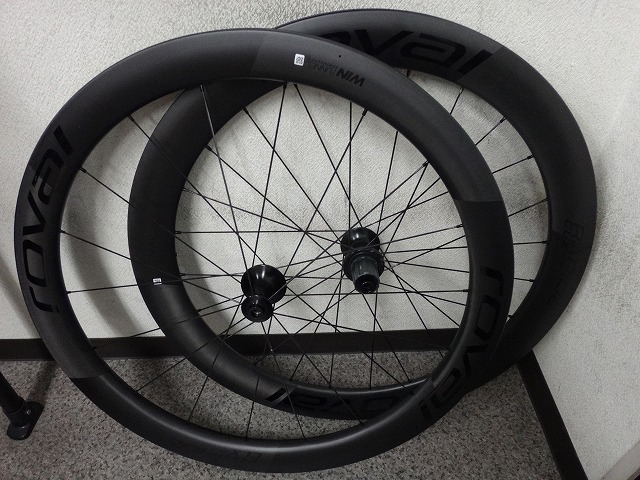
I received the front and rear wheels of a Rapide CLX from a customer.
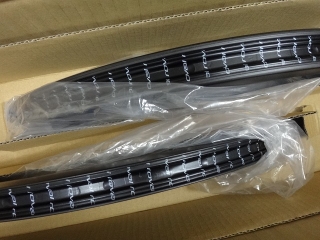
They came in a box labeled Alpinist CLX,
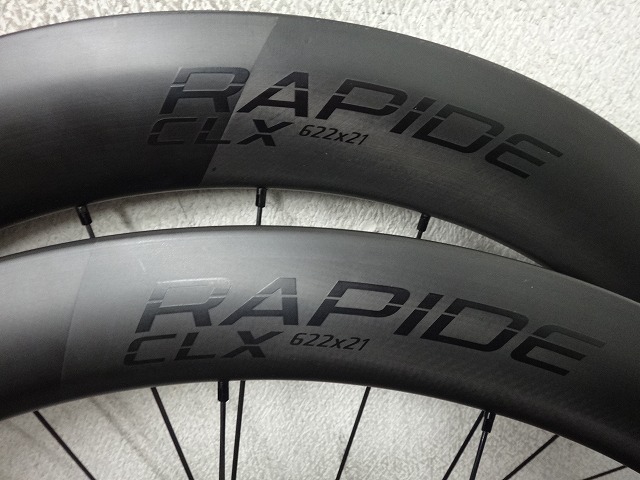
but from this image alone I can definitively say these are not Alpinist wheels.
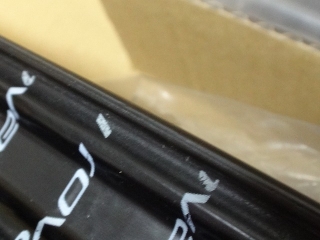
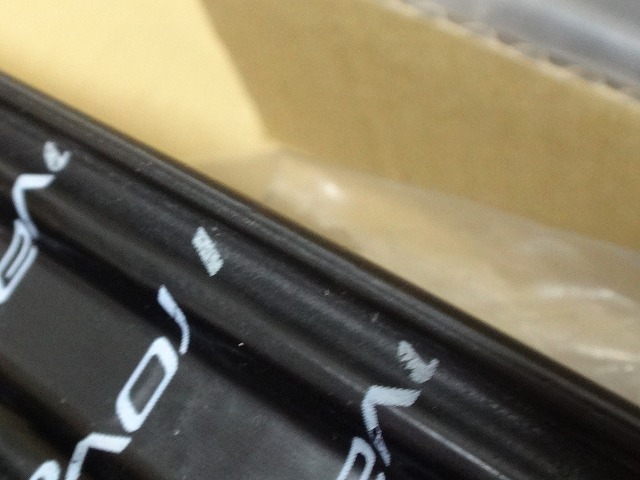
The Alpinist CLX front and rear rims and the Rapide CLX rear rim
have normal (that is, thin) bead hook thickness,

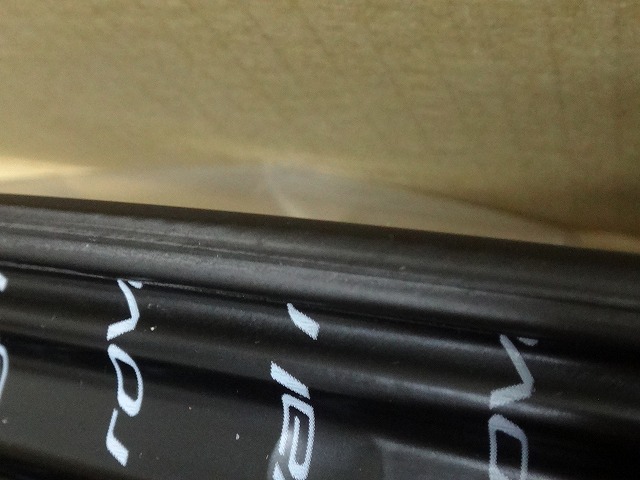
but the Rapide CLX front rim has (according to Roval's thinking,
the rim shape continuing from the tire sidewall being aerodynamically advantageous
is a more important factor than rim weight itself)
an exceptionally thick bead hook width.
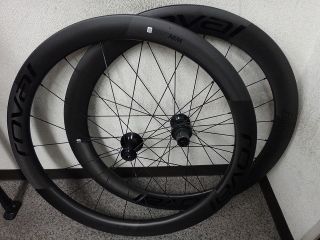
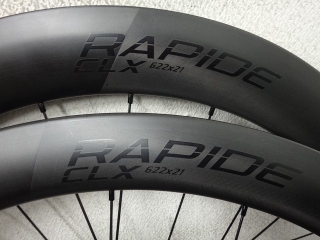
The front wheel is a 51mm deep rim, and the rear wheel is a 60mm deep rim.
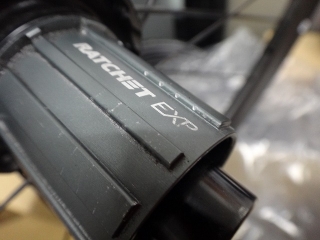
At first glance they look brand new they're so clean,
but there are signs of the cassette being installed and used.
Both wheels on this set have about 5mm of lateral runout,
and the customer wants them straightened.
5mm is an enormous figure as far as wheel precision goes.
I thought maybe the customer was exaggerating and it wasn't really that bad,
but when I checked, both wheels really did have about 5mm of runout.
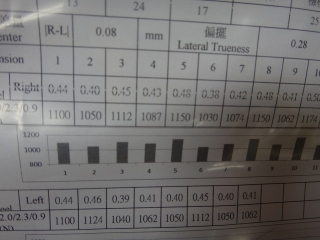
Also, Roval includes a wheel build inspection sheet with their wheels,
and according to it,
the front wheel's center offset this time is 0.30mm,
and the rear wheel's center offset is 0.08mm.
The image above is from the rear wheel.
If there were a method to detect down to 1/100th of a millimeter precision,
I'd think they might as well dial it in further.
I don't understand the reasoning behind saying it's off by 0.30mm (not 0.3mm)
but "oh well, it's fine!"
Also, the values around 0.4-0.45 on the table
are the first spoke tension measured with a DT tension meter, what we call D1ST,
and the values around 1100 below that are spoke tension in the conventional sense,
what I call second spoke tension in this blog.
If you own Roval wheels, you'd understand instantly, but
despite the 2:1 build supposedly having nearly equal spoke tension left and right,
when you squeeze the spokes, both front and rear wheels
the tangent-laced side with more spokes definitely deforms more slackly.
With wheels like Bora or Bora WTO disc brake versions, which also have 2:1 lacing
and similar spoke counts,
the left-right difference in deformation (not left-right difference in spoke tension)
is much less. This comes from differences in spoke gauge and shape,
left-right differences in the effective diameter of high-low flanges,
and spoke trajectory (the crossing angle of tangent lacing), and so on—
Roval's understanding of these principles is frankly very poor.
To put it bluntly, they're such crappy wheels that I can't believe
they came from the same intellectual level as the people who build Tarmac frames.
I'm not bashing Roval wheels out of any personal preference.
I do think it's pretty egregious that they come bundled with complete bikes.
But if the people actually using them really think they're good,
we wouldn't get so many brought in to the shop.
Regarding these wheels:
if they left the factory per the inspection sheet,
then the lateral and radial runout and center offset we're seeing
far exceeds what could happen from transit damage or minimal aging use.
Whether it was the wheel owner or the shop, I don't know,
but somebody definitely messed with these wheels.
Edit: The customer confirmed they haven't messed with these wheels
and that they were also the original owner.
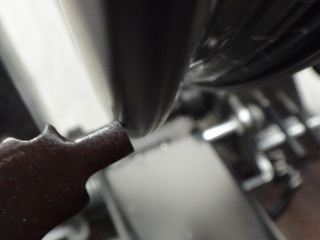
Starting with the front wheel.
I found the phase with the most lateral runout
and adjusted it so the truing stand gauge just barely touched.
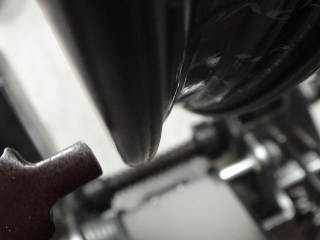
At other phases, there's roughly this much gap.
With this amount of runout, there should be deformation
in the spokes near the runout phase,
but the spokes showed no abnormalities.
At a phase 90 degrees perpendicular to the worst lateral runout,
where lateral runout shouldn't be affecting the center gauge reading,
the temporary center measurement was
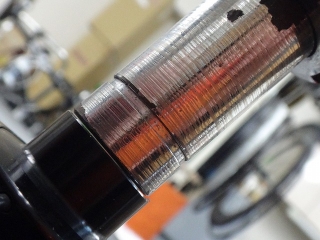

↑this.
Far more than 0.30mm.
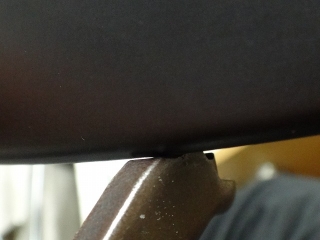
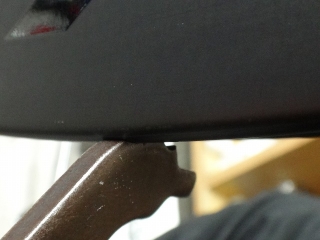
The photos aren't great, but there's radial runout too.
There's radial runout at multiple locations.
You can see the wobble and eccentricity even just looking at the rim
spinning freely in the air without the stand—
it's running that much. With asymmetric lacing wheels,
chasing down radial runout is somewhat difficult.
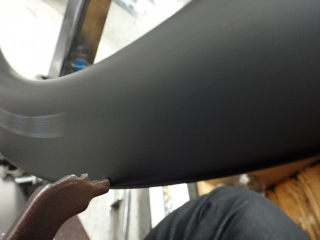
I chased down the lateral and radial runout.
The wheel in the image above is rotating.
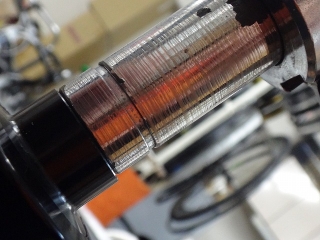
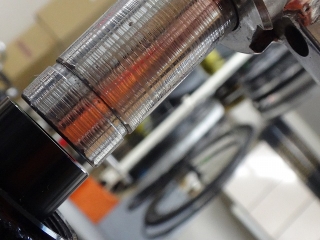
In theory, I tried to reduce center offset as I was chasing the runout,
but it's barely changed.
However, I did avoid the offset getting worse.
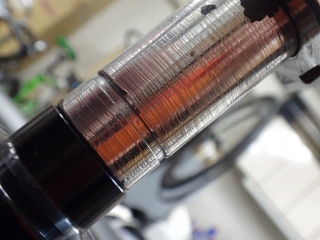
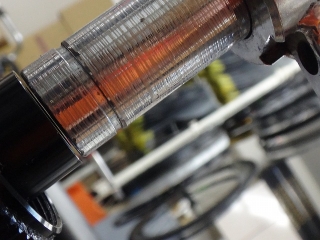
This is my second round of stress-relief tightening on center.\
I didn't photograph the first round.
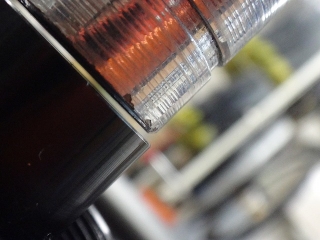
Zoomed in it looks like this.

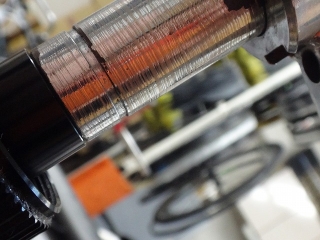
Center is dialed in.
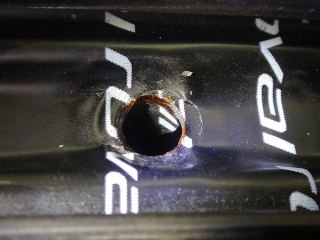
Next, the rear wheel.
When I spin the wheel, it sounds like
a hard pebble bouncing inside the rim.
But this isn't actually a pebble—
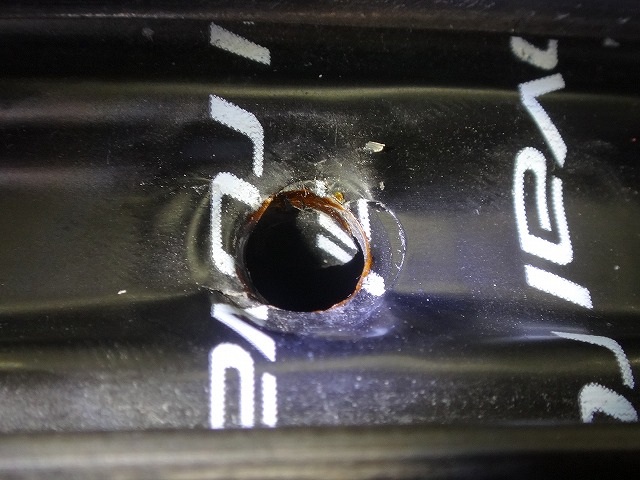
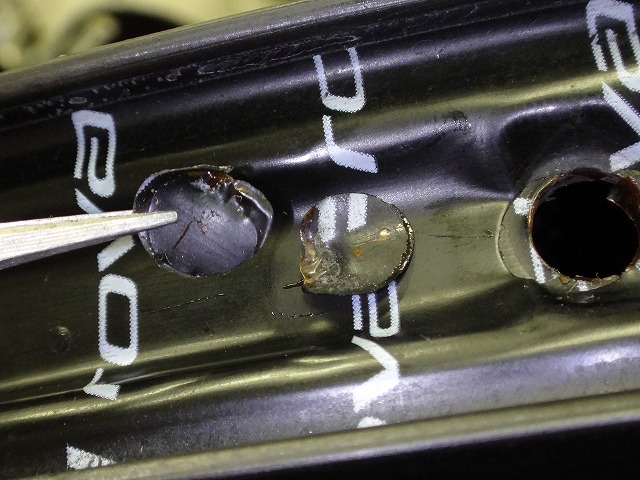
it's rim tape scrap that was cut from the valve hole
that fell inside the rim.
In the image above, you can see where it's hanging on
like the final state of a can opener,
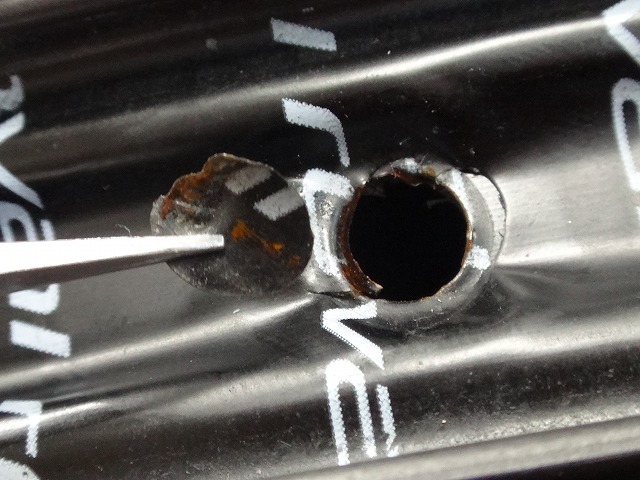
but the rim tape around the valve hole is double-layered,
so there's another piece of tape that fell inside the rim separate from this.
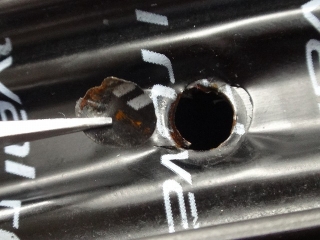
I tore off and recovered the visible piece.

I also recovered the piece that fell inside the rim.
From experience I know this, but
if you didn't know, the hard rattling sound it makes
would make you not believe it's just a piece of tape.
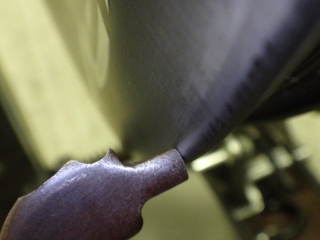
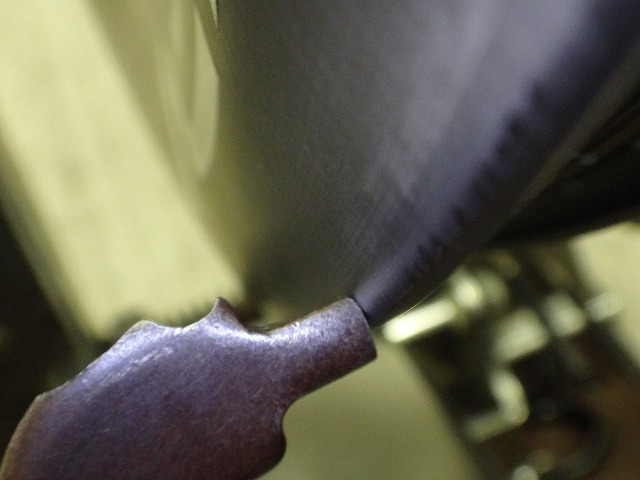
↑phase with the most runout
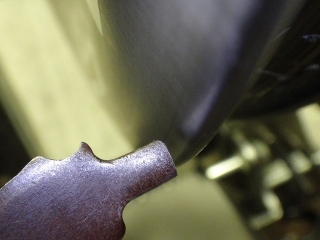
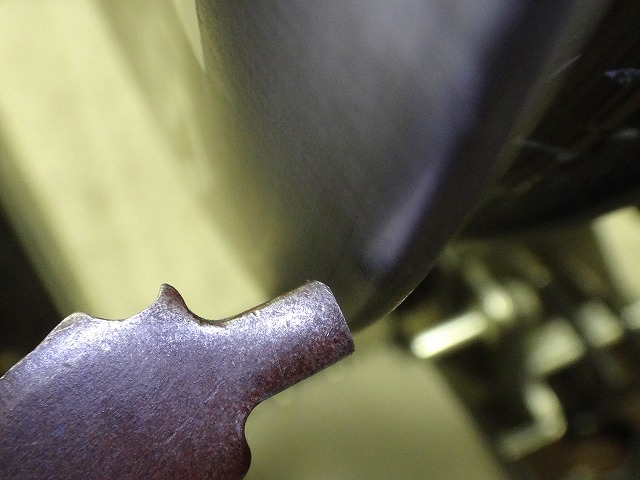
↑most other phases
Better than the front wheel, but there were phases with notable runout.
No spoke deformation.
Not the kind of runout that happens from just riding it.
It's the kind you'd get if nipples were loose in one spot,
but the worst runout phase actually has the nipple tighter.
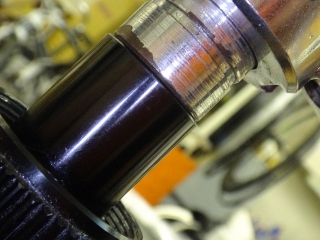
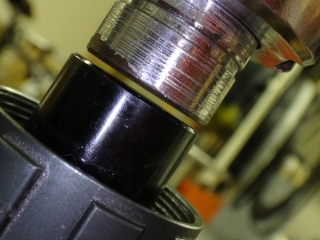
Temporary center measurement avoiding the worst runout phase, same as the front.
Both wheels have the rim shifted toward the more-spoke side,
but since the more-spoke side nipples are easier to turn,
maybe someone tried to fix this sloppy wheel
by tightening the more-spoke side and caused the offset?
According to the inspection sheet, the center offset should be 0.08mm.
Huh, 80 microns—I didn't know you could see that clearly by eye.
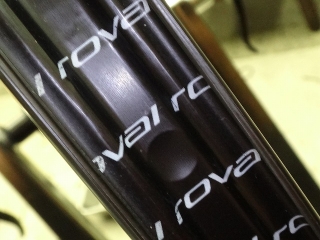
The nipples on this wheel can be turned from the outer side too,
but they don't have the typical rounded inner-side grip edges
that easily strip, so rather than risk damaging the tape,
I'm adjusting from the inside.

↑this is with the wheel rotating, and this rim tape—
at a slower speed and under fluorescent light, you can see
what I can't capture in photos: an orange band appears
and seems to move opposite to the wheel's rotation direction.
This is what's called a Benham's top effect.
It's a highly reproducible phenomenon, so if you ever get the chance,
try it when you change a tire.
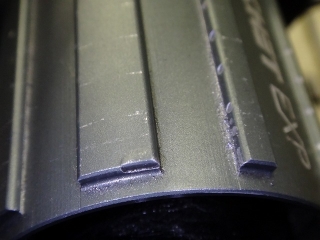
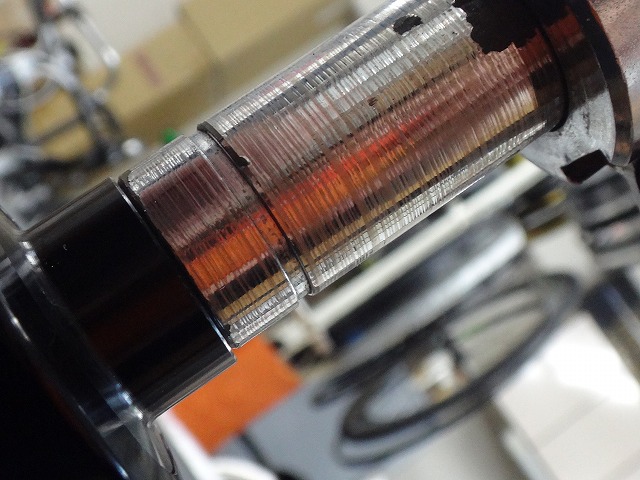
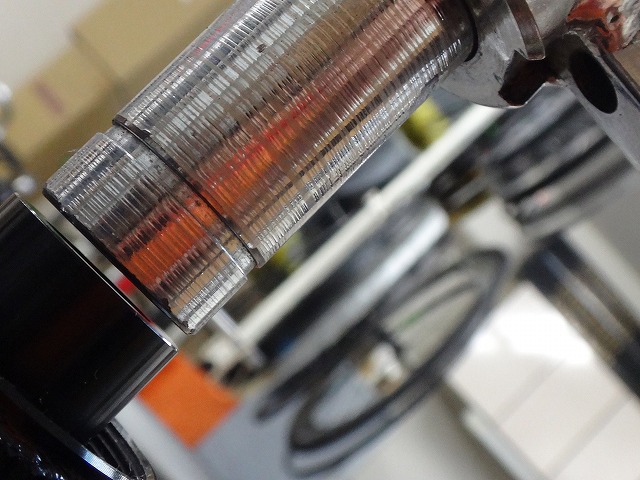
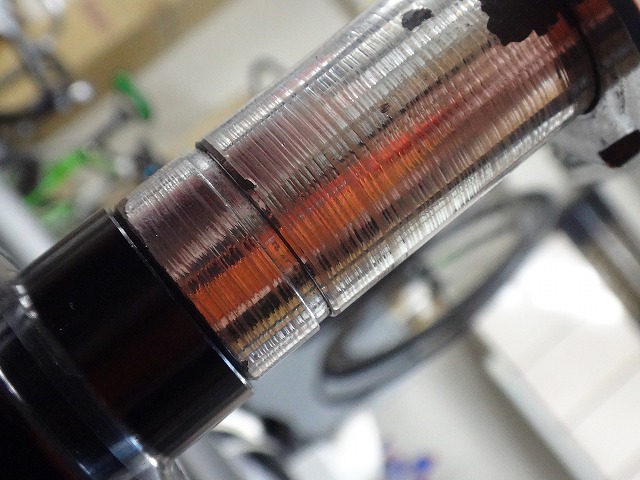
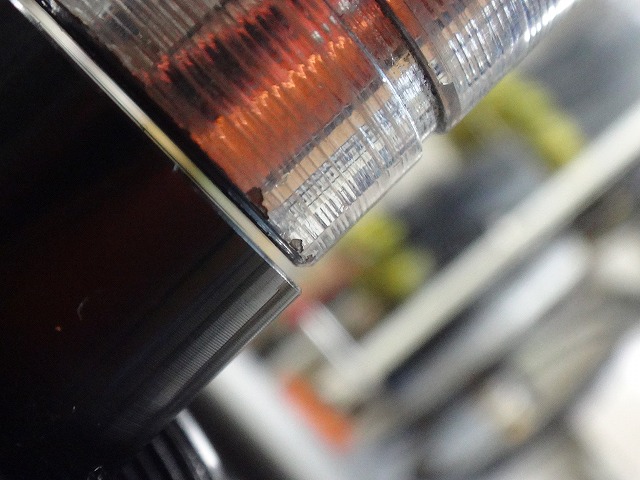
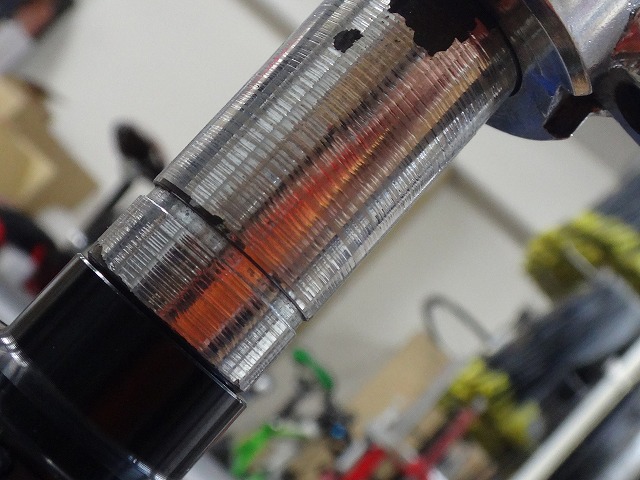
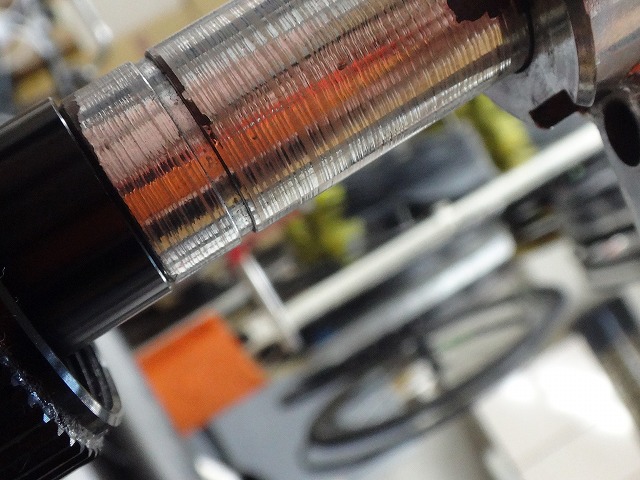
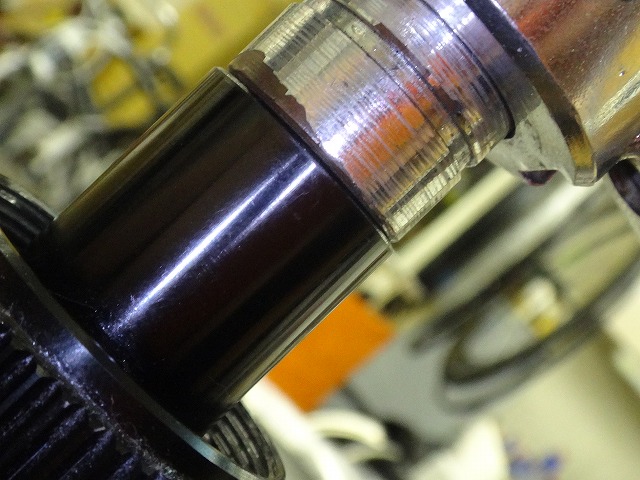
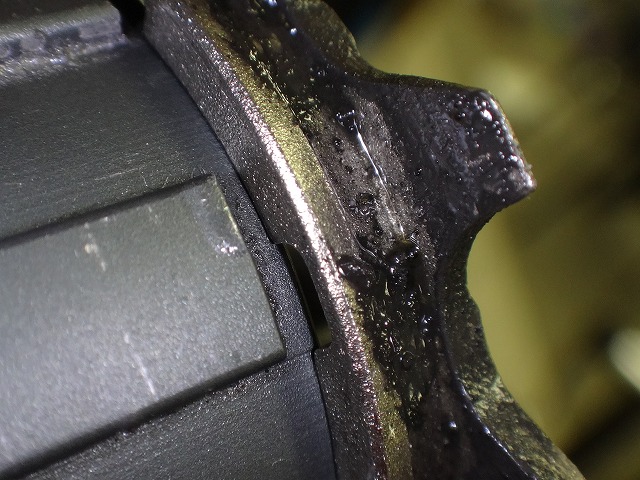
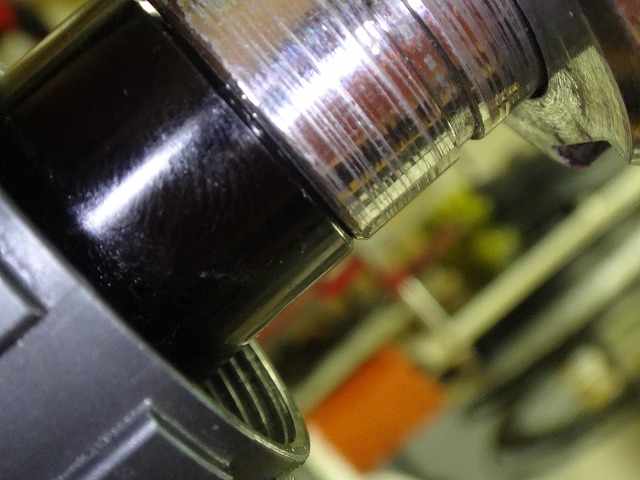
On the freewheel body's single thin spline tooth,
counterclockwise to the next tooth, there's burring
from the cassette's top gear being installed in the wrong phase.
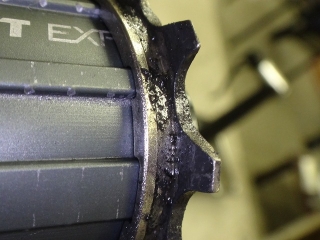
I reinstalled just the cassette's top gear
in the correct phase.

Now I offset just the cassette phase
counterclockwise by one tooth.
This time the top gear won't seat fully,
but with modern lock rings that have long threads,
I can hand-turn it almost one tooth before
using a tool to crank it down hard,
and that creates the characteristic burring on the spline.

↑the location of the burring and
the spot where the cassette groove doesn't align are perfectly matching.
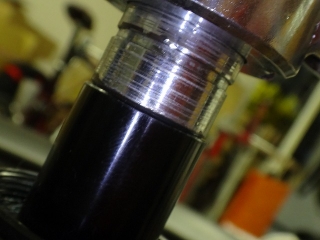

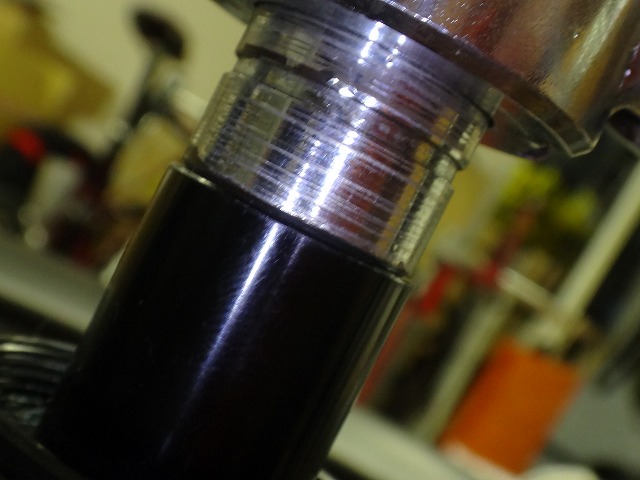
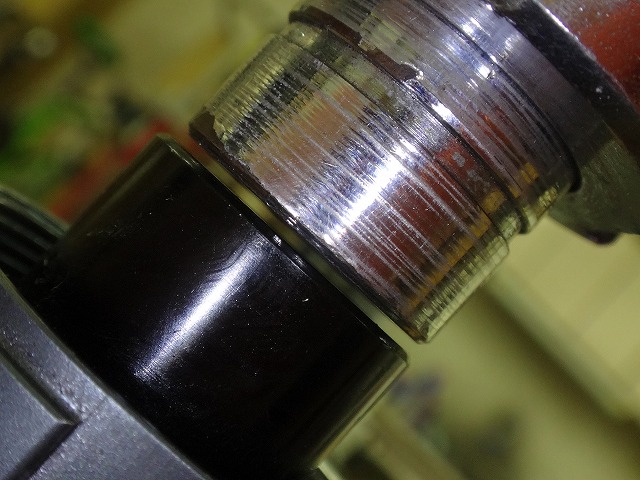
The center offset at the point when I finished chasing the runout.
Seems like it's reduced just slightly compared to the initial temporary center.
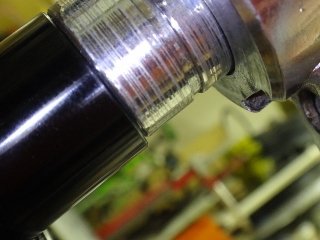
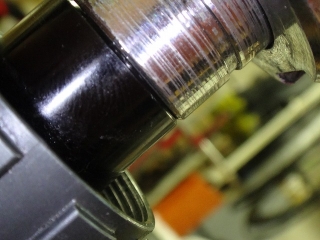
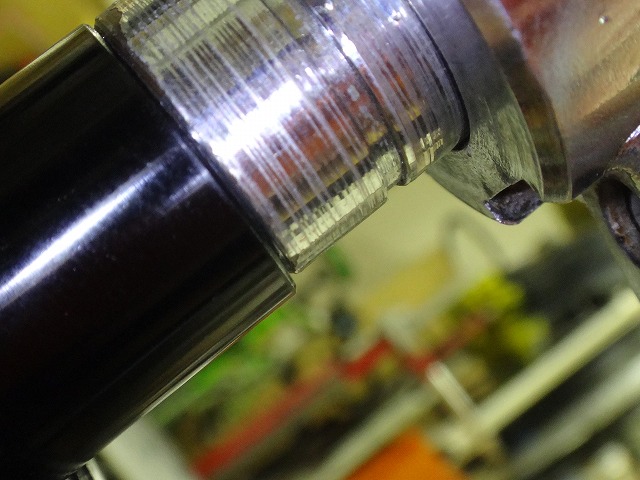
Center is in.
I've been centering both wheels by tightening as much as possible,
so compared to when they arrived the tension is higher,
but if you want to fix the slackness itself,
you'd need reverse asymmetric lacing and relacing.
Since they only asked for runout correction,
I did what I could within the scope of just truing.
The Rapide CLX front wheel has a 2:1 lacing pair, but it's 6 pairs / 18H
instead of 7 pairs / 21H—an incredibly odd spoke count.
Because the rim hole spacing widened and the more-spoke side became 12H,
compared to wheels like the CLX 50 the final crossing angle got wider,
but the final crossing position got closer to the hub flange,
so relacing effectiveness is nearly lost.
Actually, separately, I have another Rapide CLX front wheel on hold
where the customer wants me to rebuild it completely to fix it somehow—
but it's pretty much unsalvageable.
I'll do my best, but that's coming later, soon.
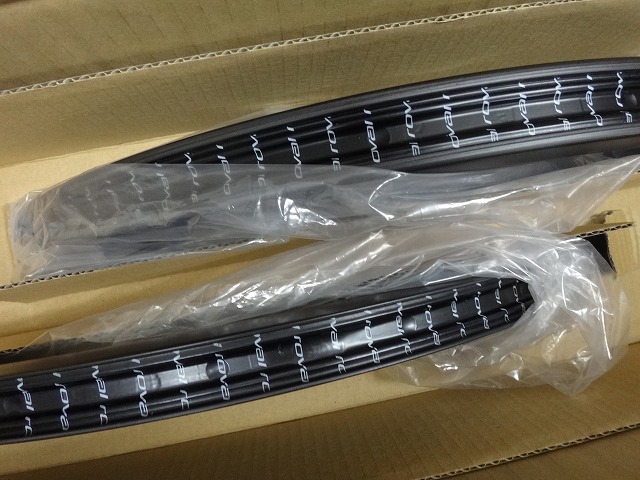
They came in a box labeled Alpinist CLX,
but from this image alone I can definitively say these are not Alpinist wheels.
The Alpinist CLX front and rear rims and the Rapide CLX rear rim
have normal (that is, thin) bead hook thickness,
but the Rapide CLX front rim has (according to Roval's thinking,
the rim shape continuing from the tire sidewall being aerodynamically advantageous
is a more important factor than rim weight itself)
an exceptionally thick bead hook width.
The front wheel is a 51mm deep rim, and the rear wheel is a 60mm deep rim.
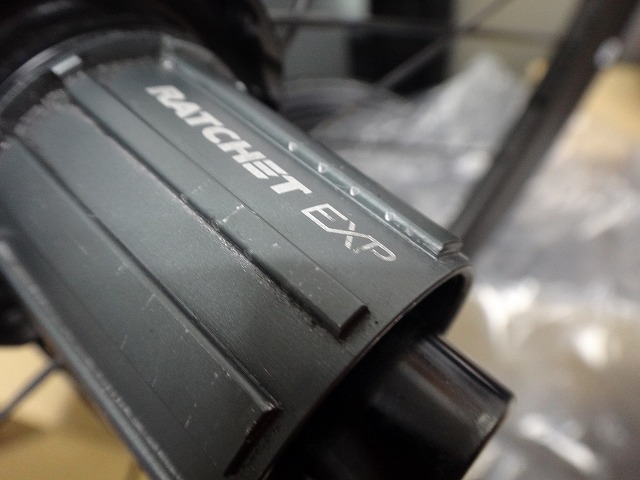
At first glance they look brand new they're so clean,
but there are signs of the cassette being installed and used.
Both wheels on this set have about 5mm of lateral runout,
and the customer wants them straightened.
5mm is an enormous figure as far as wheel precision goes.
I thought maybe the customer was exaggerating and it wasn't really that bad,
but when I checked, both wheels really did have about 5mm of runout.
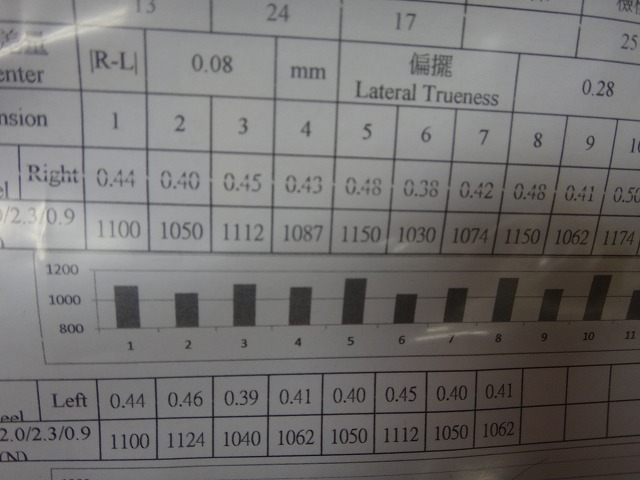
Also, Roval includes a wheel build inspection sheet with their wheels,
and according to it,
the front wheel's center offset this time is 0.30mm,
and the rear wheel's center offset is 0.08mm.
The image above is from the rear wheel.
If there were a method to detect down to 1/100th of a millimeter precision,
I'd think they might as well dial it in further.
I don't understand the reasoning behind saying it's off by 0.30mm (not 0.3mm)
but "oh well, it's fine!"
Also, the values around 0.4-0.45 on the table
are the first spoke tension measured with a DT tension meter, what we call D1ST,
and the values around 1100 below that are spoke tension in the conventional sense,
what I call second spoke tension in this blog.
If you own Roval wheels, you'd understand instantly, but
despite the 2:1 build supposedly having nearly equal spoke tension left and right,
when you squeeze the spokes, both front and rear wheels
the tangent-laced side with more spokes definitely deforms more slackly.
With wheels like Bora or Bora WTO disc brake versions, which also have 2:1 lacing
and similar spoke counts,
the left-right difference in deformation (not left-right difference in spoke tension)
is much less. This comes from differences in spoke gauge and shape,
left-right differences in the effective diameter of high-low flanges,
and spoke trajectory (the crossing angle of tangent lacing), and so on—
Roval's understanding of these principles is frankly very poor.
To put it bluntly, they're such crappy wheels that I can't believe
they came from the same intellectual level as the people who build Tarmac frames.
I'm not bashing Roval wheels out of any personal preference.
I do think it's pretty egregious that they come bundled with complete bikes.
But if the people actually using them really think they're good,
we wouldn't get so many brought in to the shop.
Regarding these wheels:
if they left the factory per the inspection sheet,
then the lateral and radial runout and center offset we're seeing
far exceeds what could happen from transit damage or minimal aging use.
Whether it was the wheel owner or the shop, I don't know,
but somebody definitely messed with these wheels.
Edit: The customer confirmed they haven't messed with these wheels
and that they were also the original owner.
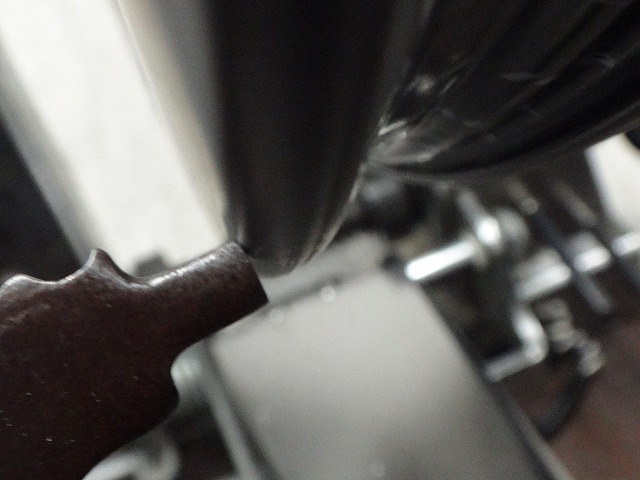
Starting with the front wheel.
I found the phase with the most lateral runout
and adjusted it so the truing stand gauge just barely touched.
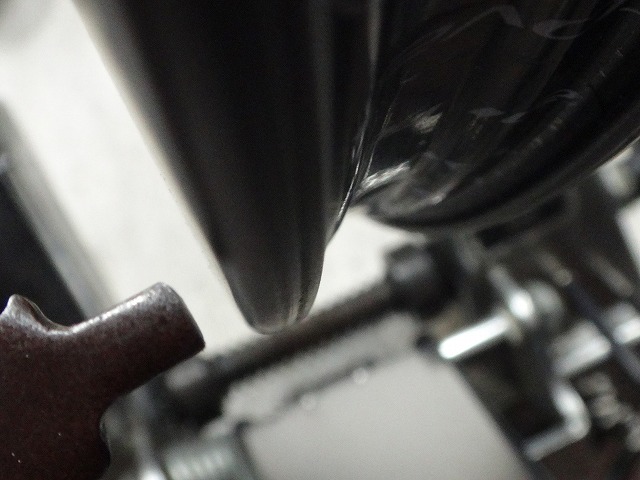
At other phases, there's roughly this much gap.
With this amount of runout, there should be deformation
in the spokes near the runout phase,
but the spokes showed no abnormalities.
At a phase 90 degrees perpendicular to the worst lateral runout,
where lateral runout shouldn't be affecting the center gauge reading,
the temporary center measurement was
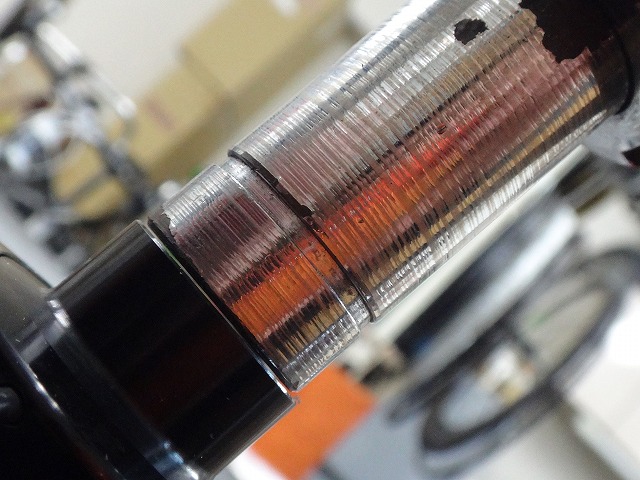
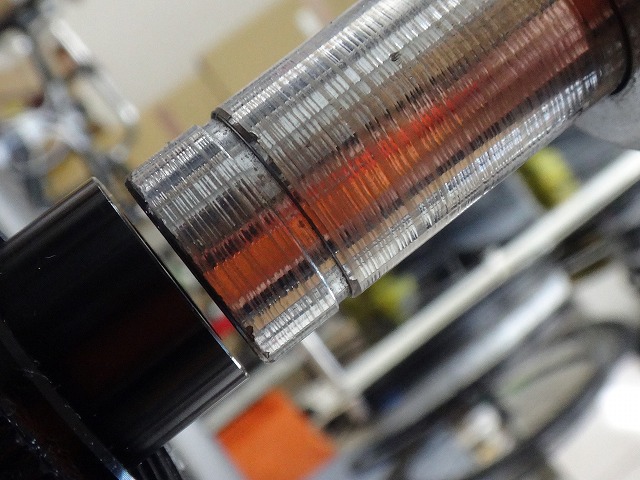
↑this.
Far more than 0.30mm.

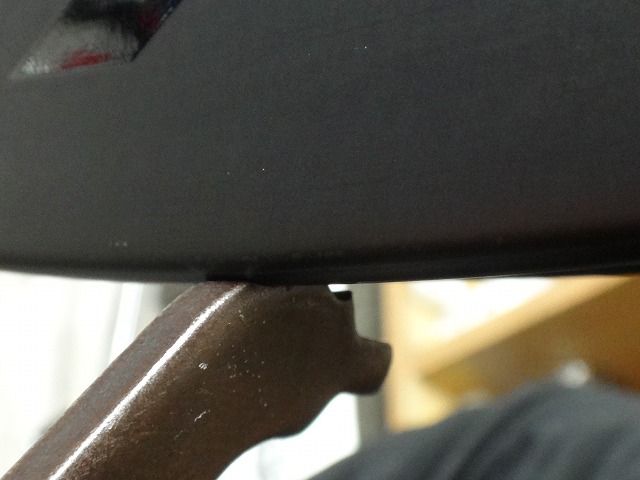
The photos aren't great, but there's radial runout too.
There's radial runout at multiple locations.
You can see the wobble and eccentricity even just looking at the rim
spinning freely in the air without the stand—
it's running that much. With asymmetric lacing wheels,
chasing down radial runout is somewhat difficult.
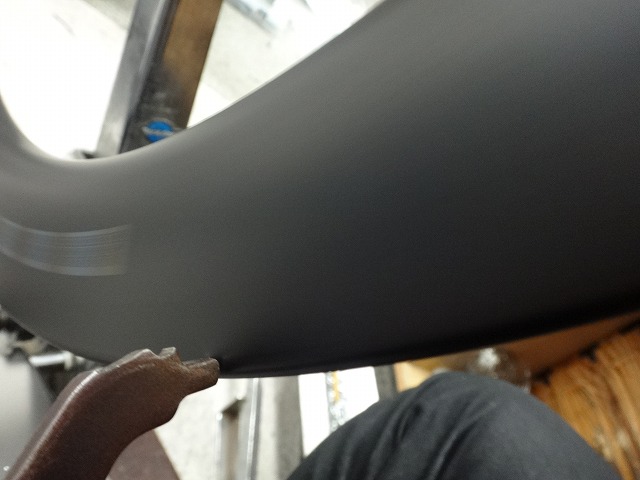
I chased down the lateral and radial runout.
The wheel in the image above is rotating.
In theory, I tried to reduce center offset as I was chasing the runout,
but it's barely changed.
However, I did avoid the offset getting worse.

This is my second round of stress-relief tightening on center.\
I didn't photograph the first round.
Zoomed in it looks like this.
Center is dialed in.
Next, the rear wheel.
When I spin the wheel, it sounds like
a hard pebble bouncing inside the rim.
But this isn't actually a pebble—
it's rim tape scrap that was cut from the valve hole
that fell inside the rim.
In the image above, you can see where it's hanging on
like the final state of a can opener,
but the rim tape around the valve hole is double-layered,
so there's another piece of tape that fell inside the rim separate from this.
I tore off and recovered the visible piece.
I also recovered the piece that fell inside the rim.
From experience I know this, but
if you didn't know, the hard rattling sound it makes
would make you not believe it's just a piece of tape.
↑phase with the most runout
↑most other phases
Better than the front wheel, but there were phases with notable runout.
No spoke deformation.
Not the kind of runout that happens from just riding it.
It's the kind you'd get if nipples were loose in one spot,
but the worst runout phase actually has the nipple tighter.

Temporary center measurement avoiding the worst runout phase, same as the front.
Both wheels have the rim shifted toward the more-spoke side,
but since the more-spoke side nipples are easier to turn,
maybe someone tried to fix this sloppy wheel
by tightening the more-spoke side and caused the offset?
According to the inspection sheet, the center offset should be 0.08mm.
Huh, 80 microns—I didn't know you could see that clearly by eye.
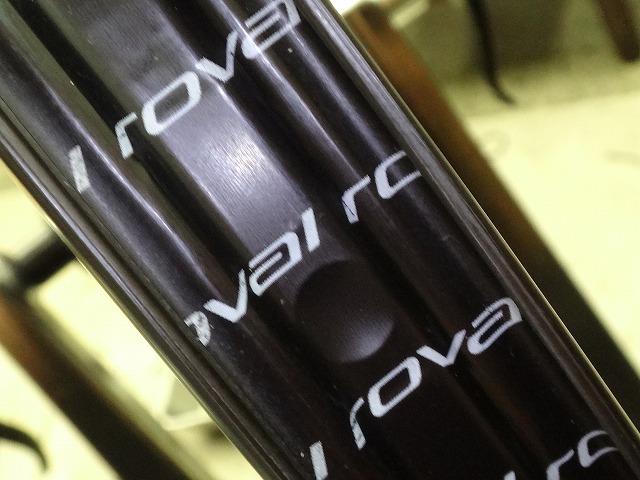
The nipples on this wheel can be turned from the outer side too,
but they don't have the typical rounded inner-side grip edges
that easily strip, so rather than risk damaging the tape,
I'm adjusting from the inside.
↑this is with the wheel rotating, and this rim tape—
at a slower speed and under fluorescent light, you can see
what I can't capture in photos: an orange band appears
and seems to move opposite to the wheel's rotation direction.
This is what's called a Benham's top effect.
It's a highly reproducible phenomenon, so if you ever get the chance,
try it when you change a tire.
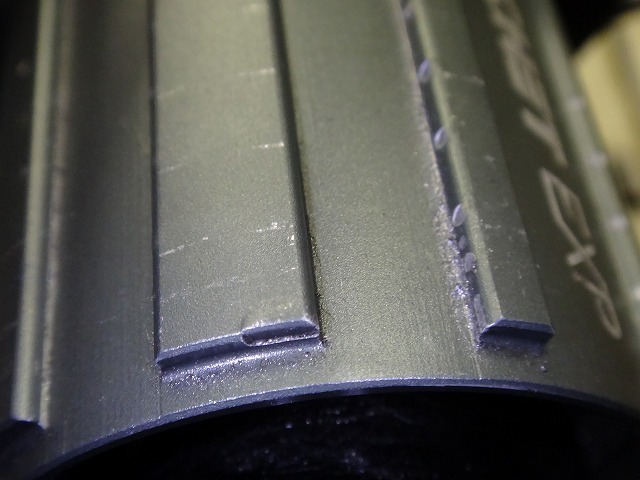
On the freewheel body's single thin spline tooth,
counterclockwise to the next tooth, there's burring
from the cassette's top gear being installed in the wrong phase.

I reinstalled just the cassette's top gear
in the correct phase.

Now I offset just the cassette phase
counterclockwise by one tooth.
This time the top gear won't seat fully,
but with modern lock rings that have long threads,
I can hand-turn it almost one tooth before
using a tool to crank it down hard,
and that creates the characteristic burring on the spline.
↑the location of the burring and
the spot where the cassette groove doesn't align are perfectly matching.
The center offset at the point when I finished chasing the runout.
Seems like it's reduced just slightly compared to the initial temporary center.
Center is in.
I've been centering both wheels by tightening as much as possible,
so compared to when they arrived the tension is higher,
but if you want to fix the slackness itself,
you'd need reverse asymmetric lacing and relacing.
Since they only asked for runout correction,
I did what I could within the scope of just truing.
The Rapide CLX front wheel has a 2:1 lacing pair, but it's 6 pairs / 18H
instead of 7 pairs / 21H—an incredibly odd spoke count.
Because the rim hole spacing widened and the more-spoke side became 12H,
compared to wheels like the CLX 50 the final crossing angle got wider,
but the final crossing position got closer to the hub flange,
so relacing effectiveness is nearly lost.
Actually, separately, I have another Rapide CLX front wheel on hold
where the customer wants me to rebuild it completely to fix it somehow—
but it's pretty much unsalvageable.
I'll do my best, but that's coming later, soon.