Not another wheel day (and so on).
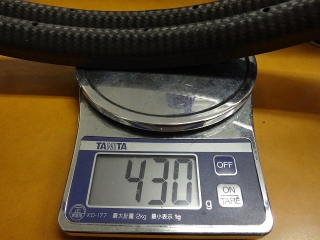
I received some ultra-lightweight tubular rims from a customer.
Just so you know, the image above is the weight of "2 rims."
The EDGE 25 rim early model and the AX Lightness Ultra 25T rim
both have a claimed weight of 195g, and I've seen actual measurements under 200g,
but these rims both came in at 210g range—pretty close to that.
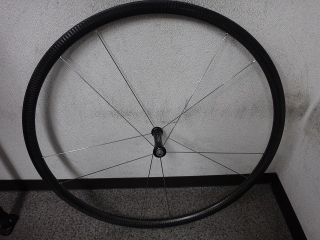

So I did a temporary build.
Front wheel: 20H spokes paired with 10H,
rear wheel: 24H spokes paired with 12H in a temporary setup.
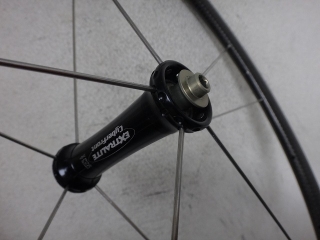
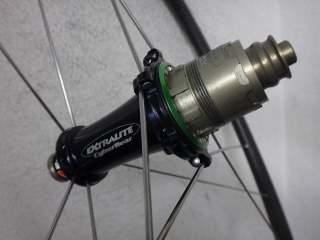
The hubs are ExtraLight Cyber hubs on both front and rear
with straight spoke configuration.
The rear freeside has a clustered flange, so spoke length calculation is unusual.
Normally at our shop, if we built this with CX-RAY straight spokes or similar, that'd be fine,
but the customer ordered carbon spokes for this wheel elsewhere,
so I needed to verify the length precisely.
I had 99% confidence, but not 100%, so
I did a temporary build with throwaway spokes.
If I end up having to discard measurement spokes or some CX-RAY straight spokes from our inventory
due to a mistake during the actual build,
that's all on me for doing it my own way, sounlike some certain Shinoyama hack
I won't charge the customer for it.
ExtraLight's manufacturer website does have
a spoke length chart based on rim inner diameter,
but ExtraLight's definition of rim inner diameter is unique, and
even accounting for that, something still doesn't add up, so
I did a temporary build just to be safe.
Based on my spoke length calculations,
the difference between what ExtraLight calls "spoke end length"
and my rim inner diameter definition, after accounting for the discrepancy,
differs in quantity between the front and rear left radial lacing
and the rear right 2-cross clustered flange pattern.
ExtraLight's published lengths are in 1mm increments, but
the issue isn't something like whether to round 285.5mm to 285mm or 286mm
and end up off by 1mm.
This is unrelated to this particular job, but
in my calculation formula, 285.49mm rounds to 285mm,
and 285.50mm rounds to 286mm.
But I think it's odd that a difference of a hundredth of a millimeter
gets multiplied by 100 to become a 1mm difference, so
in the range of around 285.4–285.6mm, I often cut at 285.5mm.
If it were something like "ExtraLight and my formula always differ by 3mm shorter on my side
due to rim inner diameter interpretation,"
that would be a clean, quantifiable difference.
But in reality (by my length standard), the radial lacing side shows a minus difference
while the tangent lacing side shows a plus difference.
Even trusting their published values, the left and right spokes and nipples
won't have matching end-face relationships, yet the wheel is barely buildable.
Schmorke's off-the-shelf wheels appear to trust this—here.
In the wheel example from that linked article,
there's a left-right discrepancy, but both sides run long,
and the freeside especially was nearly bottoming out.
I suspect that's because it's a disc brake wheel,
so both sides use tangent lacing.
So with this wheel, if I trust the rear right side length,
I'd end up in nearly the same situation.
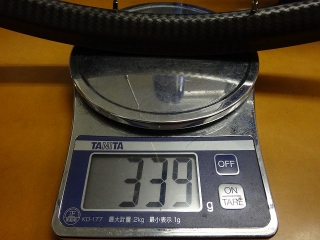
↑Front wheel weight
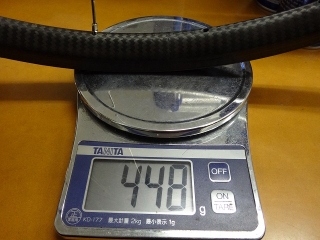
↑Rear wheel weight
I used 14-gauge plain spokes, so
if the carbon spokes happened to have a specific gravity of 50%,
with half the density per spoke and twice the number of spokes,
the final weight should come out roughly the same.
The nipples are brass, and brass nipples are generally about 3 times heavier than aluminum nipples,
so if I'd built it with aluminum nipples, with a third of the density and twice the quantity,
the nipple section weight alone would be roughly two-thirds of this.
For the rear wheel, that's roughly a 4g difference, so
for the wheel as a whole, it's within error margins.
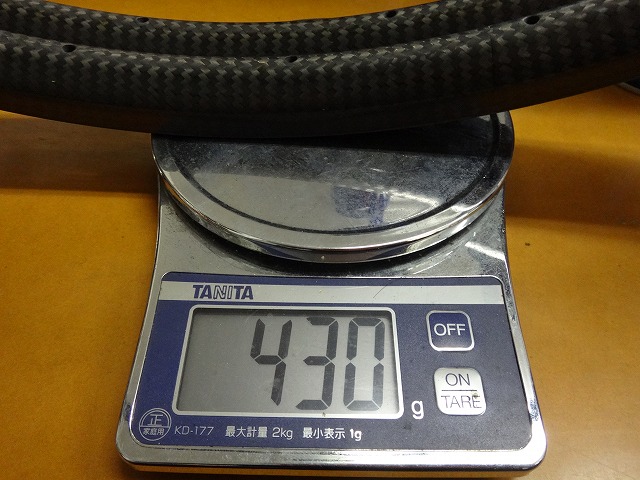
I received some ultra-lightweight tubular rims from a customer.
Just so you know, the image above is the weight of "2 rims."
The EDGE 25 rim early model and the AX Lightness Ultra 25T rim
both have a claimed weight of 195g, and I've seen actual measurements under 200g,
but these rims both came in at 210g range—pretty close to that.

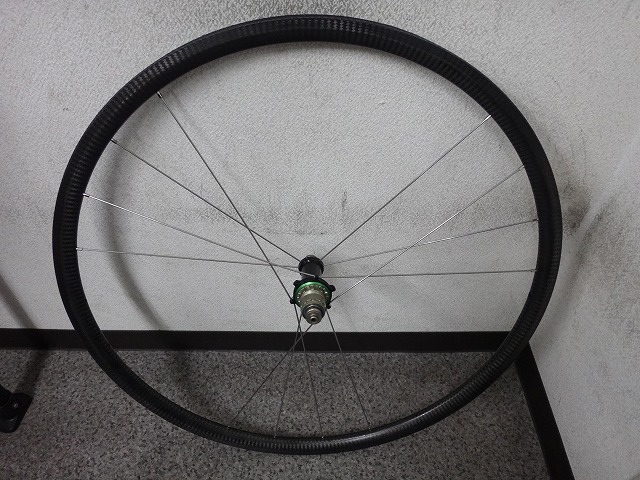
So I did a temporary build.
Front wheel: 20H spokes paired with 10H,
rear wheel: 24H spokes paired with 12H in a temporary setup.


The hubs are ExtraLight Cyber hubs on both front and rear
with straight spoke configuration.
The rear freeside has a clustered flange, so spoke length calculation is unusual.
Normally at our shop, if we built this with CX-RAY straight spokes or similar, that'd be fine,
but the customer ordered carbon spokes for this wheel elsewhere,
so I needed to verify the length precisely.
I had 99% confidence, but not 100%, so
I did a temporary build with throwaway spokes.
If I end up having to discard measurement spokes or some CX-RAY straight spokes from our inventory
due to a mistake during the actual build,
that's all on me for doing it my own way, so
I won't charge the customer for it.
ExtraLight's manufacturer website does have
a spoke length chart based on rim inner diameter,
but ExtraLight's definition of rim inner diameter is unique, and
even accounting for that, something still doesn't add up, so
I did a temporary build just to be safe.
Based on my spoke length calculations,
the difference between what ExtraLight calls "spoke end length"
and my rim inner diameter definition, after accounting for the discrepancy,
differs in quantity between the front and rear left radial lacing
and the rear right 2-cross clustered flange pattern.
ExtraLight's published lengths are in 1mm increments, but
the issue isn't something like whether to round 285.5mm to 285mm or 286mm
and end up off by 1mm.
This is unrelated to this particular job, but
in my calculation formula, 285.49mm rounds to 285mm,
and 285.50mm rounds to 286mm.
But I think it's odd that a difference of a hundredth of a millimeter
gets multiplied by 100 to become a 1mm difference, so
in the range of around 285.4–285.6mm, I often cut at 285.5mm.
If it were something like "ExtraLight and my formula always differ by 3mm shorter on my side
due to rim inner diameter interpretation,"
that would be a clean, quantifiable difference.
But in reality (by my length standard), the radial lacing side shows a minus difference
while the tangent lacing side shows a plus difference.
Even trusting their published values, the left and right spokes and nipples
won't have matching end-face relationships, yet the wheel is barely buildable.
Schmorke's off-the-shelf wheels appear to trust this—here.
In the wheel example from that linked article,
there's a left-right discrepancy, but both sides run long,
and the freeside especially was nearly bottoming out.
I suspect that's because it's a disc brake wheel,
so both sides use tangent lacing.
So with this wheel, if I trust the rear right side length,
I'd end up in nearly the same situation.
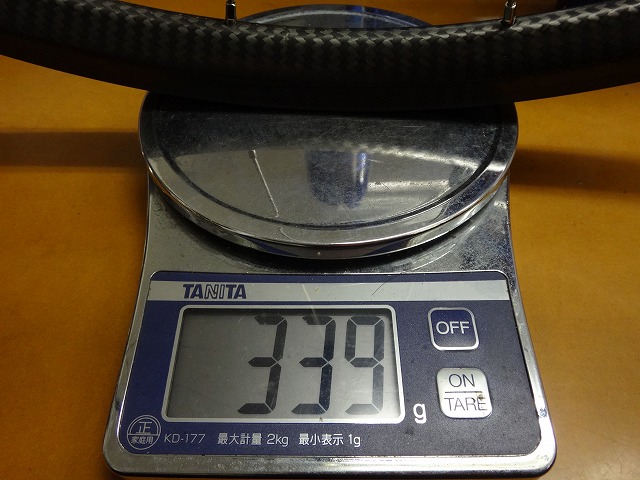
↑Front wheel weight
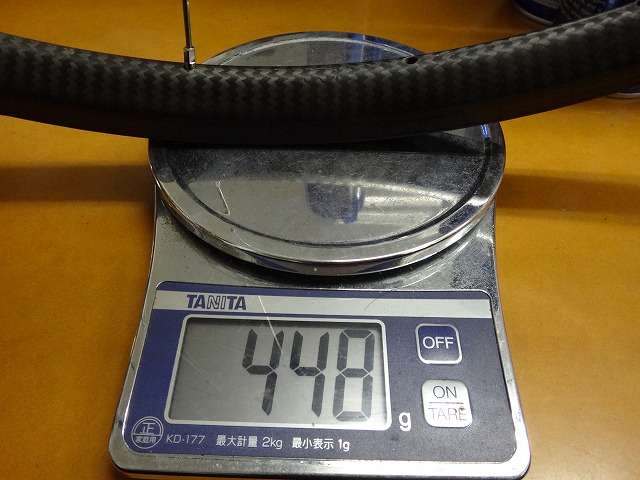
↑Rear wheel weight
I used 14-gauge plain spokes, so
if the carbon spokes happened to have a specific gravity of 50%,
with half the density per spoke and twice the number of spokes,
the final weight should come out roughly the same.
The nipples are brass, and brass nipples are generally about 3 times heavier than aluminum nipples,
so if I'd built it with aluminum nipples, with a third of the density and twice the quantity,
the nipple section weight alone would be roughly two-thirds of this.
For the rear wheel, that's roughly a 4g difference, so
for the wheel as a whole, it's within error margins.