About the rear hub of the 660 (roku-roku-maru) hub,
also known as the
Six60 (シックスシックスティー) hub.
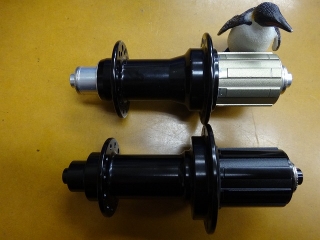
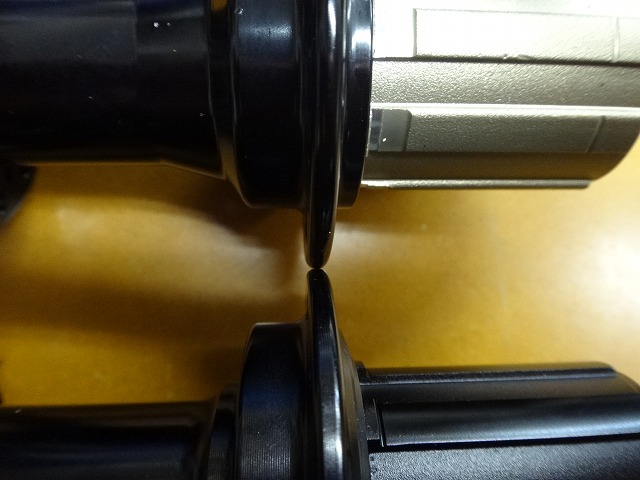
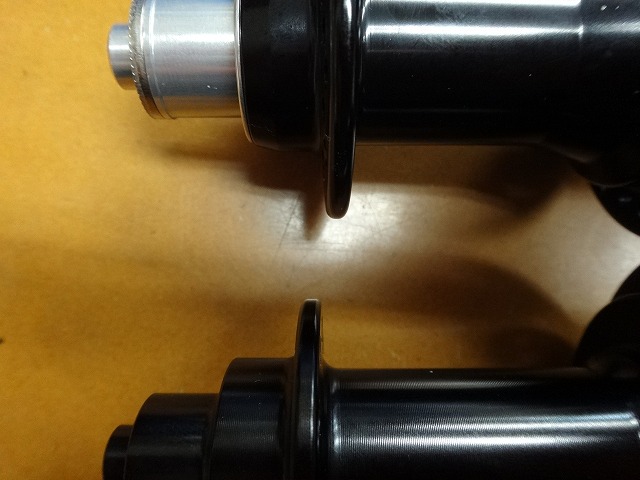
↑The top image is an Evolite rear hub, the bottom is a 660 rear hub.
The Haibatsu GT is preventing the hub from rolling.
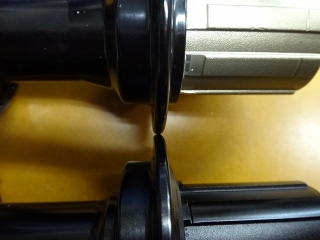
When roughly aligning the right flange position,
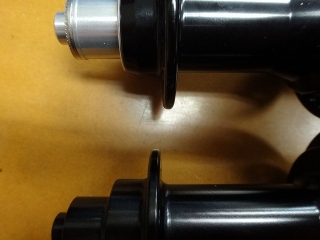
the left flange is noticeably wider on the 660 hub than just the flange thickness alone.
The 660 rear hub, as an 11-speed hub,
has dimensions that could be called ultra-wide flange,
with flange width clearly exceeding 60mm.
A freehub body with this kind of flange width is quite rare.
Shimano's BOOST rear hubs have some models in the 62mm range,
but to achieve comparable flange width to an MTB rear hub
with wide flanges at 130mm width while implementing them at 130mm,
you can understand just how wide this is.
Years ago, Reynolds, before switching to DT-made hubs, had a rear hub
for universal spokes with a 10-speed that
had flange width of roughly 59mm,
but that also, quite wide as it was, didn't exceed 60mm.
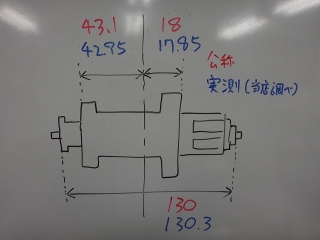
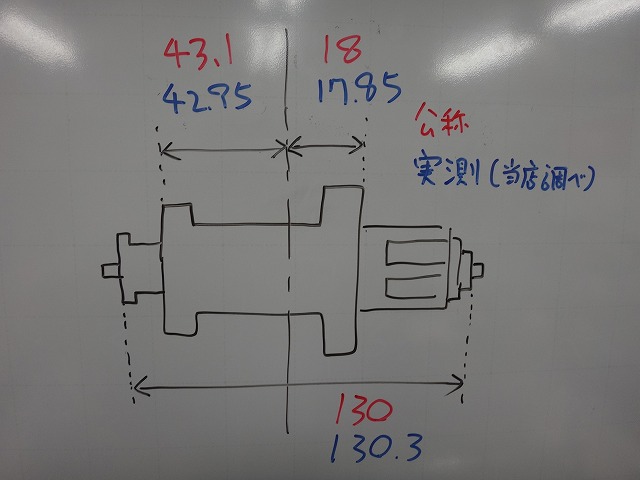
The values in the image above are the manufacturer's specs and my measured values.
Since there's no significant difference,
whichever you use, spoke length remains nearly unchanged.
The Evolite hub has flange width specifications of
left + right as 36.825 + 16.425
totaling 53.25mm,
but Novatech's flange width specifications measure from the center of flange thickness,
so direct comparison isn't possible.
If the hub center to right flange outside were truly in the 16mm range,
the free side would immediately become extremely tight,
making it difficult to build a proper wheel.
My measurements, the 660 hub manufacturer, and Shimano all
measure flange width outside to outside.
And, "the wider the flanges, the better the lateral stiffness, right?
The right flange width is constrained by the freehub body design,
so only the left flange width can be widened, which means terrible dishing
and greater spoke tension difference between left and right, but
that can be dealt with, however imperfectly, using different diameter different number of spokes or offset rims,"
is what I always say,
but now I understand why manufacturers don't make
ultra-wide flange freehub bodies.
The spoke tension difference between left and right is enormous.
If the 660 hub, roughly 61mm wide, were split 41:20 instead of 43:18,
it would have been considerably better.
With a 130mm width hub, if the freehub were 9-speed,
the right flange width could be around 20-21mm,
but with an 11-speed hub, it's typically less than 19mm.
A 1-2mm difference in left flange width
you won't notice while building the wheel,
but with the right flange, you definitely will.
The 660 hub, by my measurements,
has right flange width so narrow it barely falls under 18mm,
yet the left flange is made as wide as possible,
so spoke tension difference between left and right is quite large.
If with this hub you used a non-offset rim with equal diameter both sides (like all CX-RAY)
and built it 4-0 laced, low-tension radial lacing
produces large spoke tension variation,
so you might end up in a state where
"the free side tension is nearly maxed out and the wheel center is true,
but one or several spokes on the non-free side,
when pushed and wiggled with your finger shake loosely (tension unmeasurable),
are so slack."
Even if you wanted to tension more, if the free side is already maxed, you can't,
and moreover, because the left flange is wide,
the lateral component of spoke trajectory is strong,
so the left-right difference in rim movement per nipple turn also becomes large.
Even if not radial lacing on the non-free side
but equal diameter equal count left-right tangent lacing,
with the free side already quite tensioned and center true,
and the non-free side clearly slack,
first tighten the free side one full nipple turn per spoke
(assuming tightening is possible),
the non-free side nipples have strong lateral component in spoke trajectory,
so you can only tighten a bit more than half a turn.
If you tighten the non-free side beyond that,
the rim shifts toward the non-free side, which becomes a problem.
I always say about Tni's Evo disc rear hub (current model is Evo disc II)
"because it's reverse high-low flange, it's the kind of hub you could use as a test question
for building it so the non-free side doesn't get unnecessarily slack,"
and the 660 hub is also the kind of test question
where tensioning the non-free side is difficult.
If you have the choice, an offset rim is recommended.
Really, with this 660 rear hub,
I can't imagine building a proper wheel with
equal diameter both sides or non-free side radial lacing.
On the other hand, if done well, as a 130mm width hub
there's hope of achieving unparalleled lateral stiffness.
also known as the
Six60 (シックスシックスティー) hub.

↑The top image is an Evolite rear hub, the bottom is a 660 rear hub.
The Haibatsu GT is preventing the hub from rolling.
When roughly aligning the right flange position,
the left flange is noticeably wider on the 660 hub than just the flange thickness alone.
The 660 rear hub, as an 11-speed hub,
has dimensions that could be called ultra-wide flange,
with flange width clearly exceeding 60mm.
A freehub body with this kind of flange width is quite rare.
Shimano's BOOST rear hubs have some models in the 62mm range,
but to achieve comparable flange width to an MTB rear hub
with wide flanges at 130mm width while implementing them at 130mm,
you can understand just how wide this is.
Years ago, Reynolds, before switching to DT-made hubs, had a rear hub
for universal spokes with a 10-speed that
had flange width of roughly 59mm,
but that also, quite wide as it was, didn't exceed 60mm.
The values in the image above are the manufacturer's specs and my measured values.
Since there's no significant difference,
whichever you use, spoke length remains nearly unchanged.
The Evolite hub has flange width specifications of
left + right as 36.825 + 16.425
totaling 53.25mm,
but Novatech's flange width specifications measure from the center of flange thickness,
so direct comparison isn't possible.
If the hub center to right flange outside were truly in the 16mm range,
the free side would immediately become extremely tight,
making it difficult to build a proper wheel.
My measurements, the 660 hub manufacturer, and Shimano all
measure flange width outside to outside.
And, "the wider the flanges, the better the lateral stiffness, right?
The right flange width is constrained by the freehub body design,
so only the left flange width can be widened, which means terrible dishing
and greater spoke tension difference between left and right, but
that can be dealt with, however imperfectly, using different diameter different number of spokes or offset rims,"
is what I always say,
but now I understand why manufacturers don't make
ultra-wide flange freehub bodies.
The spoke tension difference between left and right is enormous.
If the 660 hub, roughly 61mm wide, were split 41:20 instead of 43:18,
it would have been considerably better.
With a 130mm width hub, if the freehub were 9-speed,
the right flange width could be around 20-21mm,
but with an 11-speed hub, it's typically less than 19mm.
A 1-2mm difference in left flange width
you won't notice while building the wheel,
but with the right flange, you definitely will.
The 660 hub, by my measurements,
has right flange width so narrow it barely falls under 18mm,
yet the left flange is made as wide as possible,
so spoke tension difference between left and right is quite large.
If with this hub you used a non-offset rim with equal diameter both sides (like all CX-RAY)
and built it 4-0 laced, low-tension radial lacing
produces large spoke tension variation,
so you might end up in a state where
"the free side tension is nearly maxed out and the wheel center is true,
but one or several spokes on the non-free side,
when pushed and wiggled with your finger shake loosely (tension unmeasurable),
are so slack."
Even if you wanted to tension more, if the free side is already maxed, you can't,
and moreover, because the left flange is wide,
the lateral component of spoke trajectory is strong,
so the left-right difference in rim movement per nipple turn also becomes large.
Even if not radial lacing on the non-free side
but equal diameter equal count left-right tangent lacing,
with the free side already quite tensioned and center true,
and the non-free side clearly slack,
first tighten the free side one full nipple turn per spoke
(assuming tightening is possible),
the non-free side nipples have strong lateral component in spoke trajectory,
so you can only tighten a bit more than half a turn.
If you tighten the non-free side beyond that,
the rim shifts toward the non-free side, which becomes a problem.
I always say about Tni's Evo disc rear hub (current model is Evo disc II)
"because it's reverse high-low flange, it's the kind of hub you could use as a test question
for building it so the non-free side doesn't get unnecessarily slack,"
and the 660 hub is also the kind of test question
where tensioning the non-free side is difficult.
If you have the choice, an offset rim is recommended.
Really, with this 660 rear hub,
I can't imagine building a proper wheel with
equal diameter both sides or non-free side radial lacing.
On the other hand, if done well, as a 130mm width hub
there's hope of achieving unparalleled lateral stiffness.