I'm transferring components and need to cut a Campagnolo 10S chain
and rejoin it on a different frame,
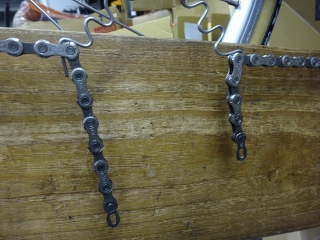
Campagnolo's 10S chain
maintains strict standards about the "virgin link"—the outer link
that has never had a chain pin press-fitted—allowing the connecting pin
only through virgin outer links.
On the initial assembly, there's a warning that says "don't adjust link count at the outer link end,"
so length adjustment is done on the inner link side,
leaving the outer link end as a virgin link.
The 11S and 12S chains work the same way on initial assembly,
but during 11S and 12S chain reconnection,
they allow "using a connecting pin at locations where a chain pin was removed
by someone other than the manufacturer."
As a safety measure in exchange for this,
the specification is to "compress and crimp the pin head with a dedicated tool
after installing the connecting pin."
For 13S, currently only Ecalibur exists,
and it uses a dedicated link system.
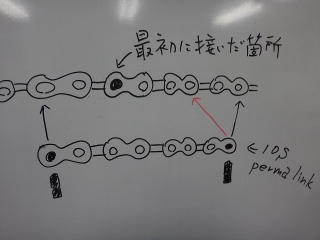
For 10S chains, after the initial assembly,
if you need to cut the chain and reuse it for any reason,
you're supposed to use Campagnolo's Permalink,
and connecting pins aren't sold individually.
The Permalink is a replacement chain section with 7 links
that has virgin outer links on both ends,
and the instruction is to replace 7 links excluding the original connection point
when you first assembled the chain.
At this time, following the red arrow route in the diagram above,
if you replace 5 links instead,
you can also increase the chain length by one pitch (2 links).
However, this Permalink currently has a retail price of ¥3,714 including tax,
which is expensive relative to the full chain price, so
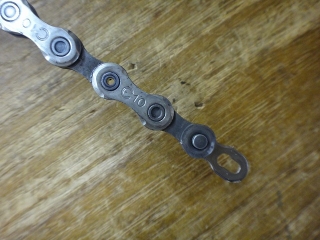
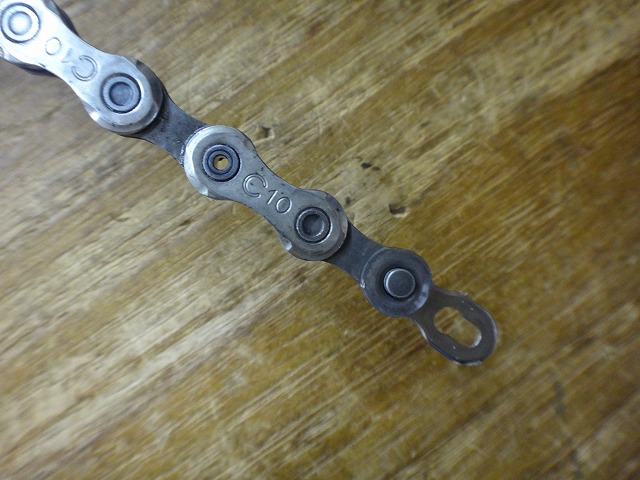
I decided to use KMC's Campagnolo 10S missing link
"CL559C" instead to join it.
The "C" at the end of the part number indicates it's for Campagnolo.
It comes in a pack of two with a retail price of ¥1,782 including tax.
At our shop, we also sell individual pieces.
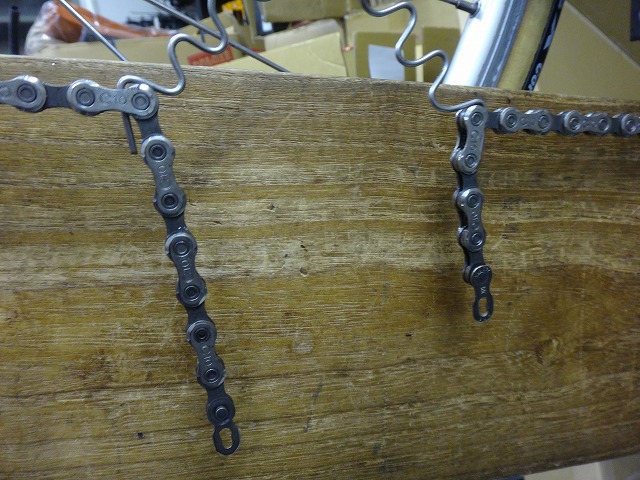
In the image above, the hollow pin is the original connecting pin from assembly.
I always find where the original connection was made and remove the pin
from the adjacent outer link's
left side when viewing the bike from the right and with the chain stay below.
When the original pin is also on the left side like this time,
if it's on the right side, I remove the right side of the adjacent outer link,
temporarily remove the chain from the frame,
reverse it, and reinstall it.
This is because Shimano recommends installation in that orientation
(→here),
but since I'm using a missing link this time, I remove the pin so that
both sides of the link adjacent to the original connecting pin link become inner links,
so this doesn't apply.
Also, even if I wanted to install the connecting pin in Shimano's recommended orientation,
with a Permalink, one side will necessarily go against that.
It can't be helped.
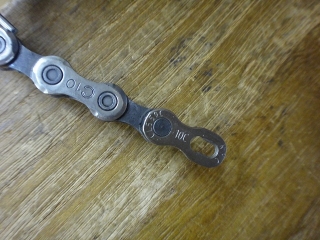
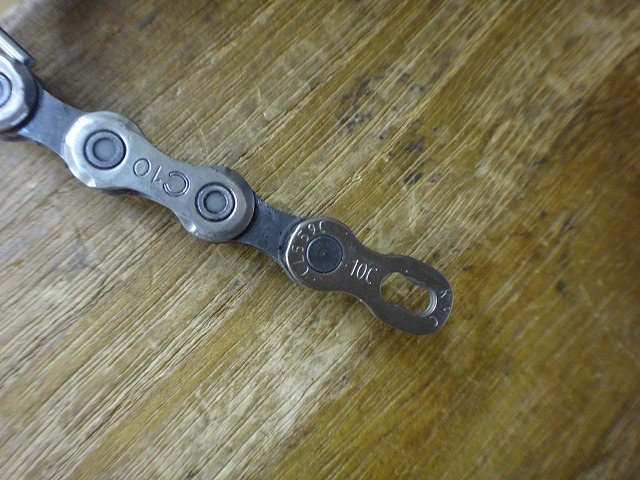
The other side looks like this.

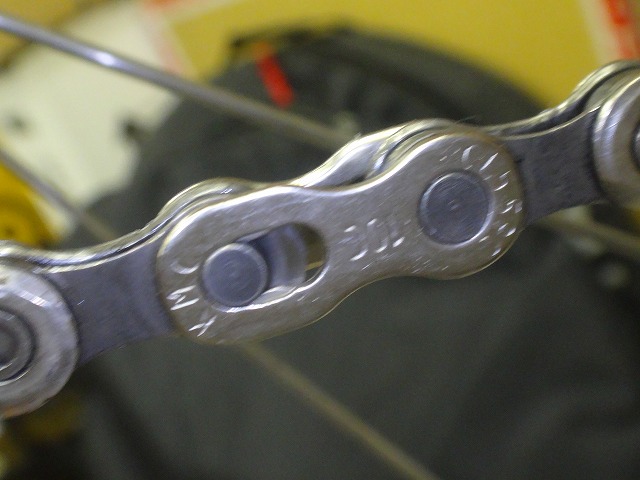
I've joined it.
Looking at how manufacturer-complete bikes are assembled,
when viewing from the right and looking at the chain stay below,
the orientation these kinds of links are installed in is almost certainly
"the left side has the elongated hole," just like in the image above.
This is probably a remnant from when there was a directional requirement
on the "Connex link" used to join Wippermann (Vippelmann) chains
that existed before missing links,
which specified the left elongated hole.
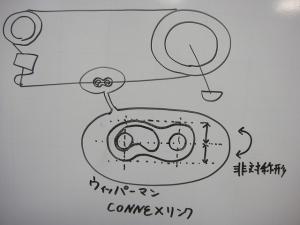
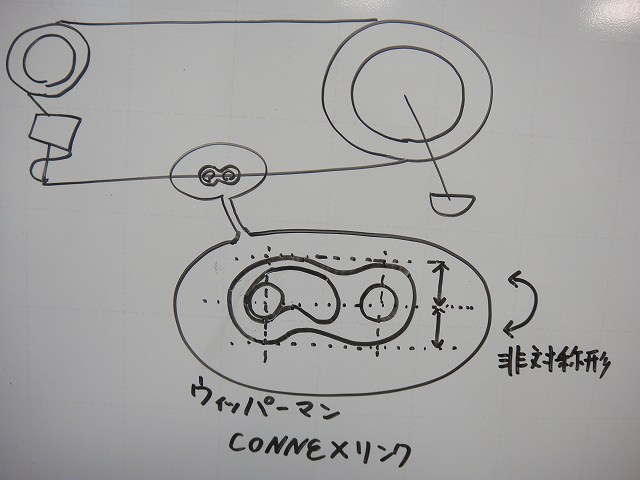
↑This is an image I pulled from an old article, but
the Connex link has an asymmetrical shape top and bottom,
and when installed with a left elongated hole (chevron-shaped hole),
the protruding side of the plate
(except when passing through the upper pulley of the rear derailleur)
faces the outer perimeter of the chain, so there's no problem,
but if installed with a right elongated hole (heart-shaped hole),
problems can occur when passing through the sprocket.
If we stop here with the story,
it would just be "I saved money by using a missing link instead of a Permalink."
Of course, I didn't do this arbitrarily—
I explained it to the customer beforehand.
They might say "I don't mind the extra cost, please do it with the genuine method."
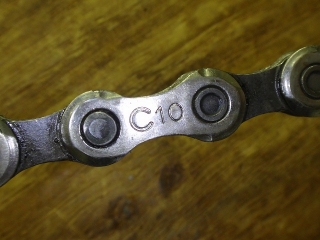
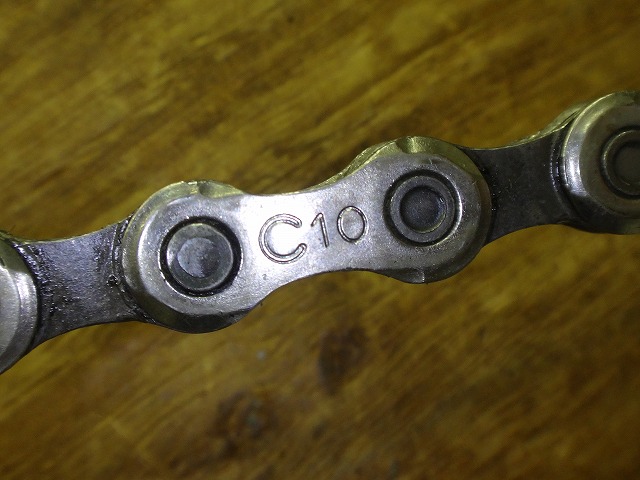
↑This is the outer link 6 pitches away from the original connecting pin,
but it's unmistakably a Shimano connecting pin that's been installed.
There are traces of it being snapped off, and the pin protrudes
enough on both sides of the outer plate to catch on the clips.
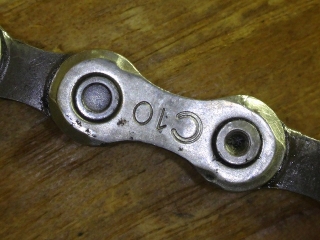
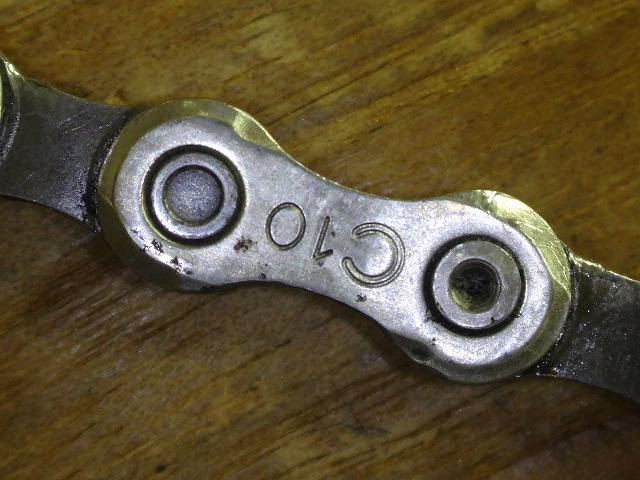
The same link viewed from the back (the left side of the bike).
The reason you shouldn't remove a connecting pin is
because you shouldn't repeatedly expand the holes in the outer link plate
through press-fitting, but
if we're replacing this with a missing link anyway,
there's no problem punching it out.
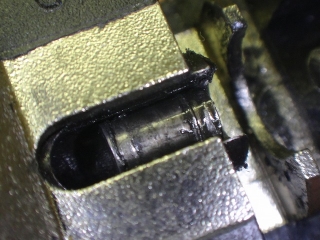
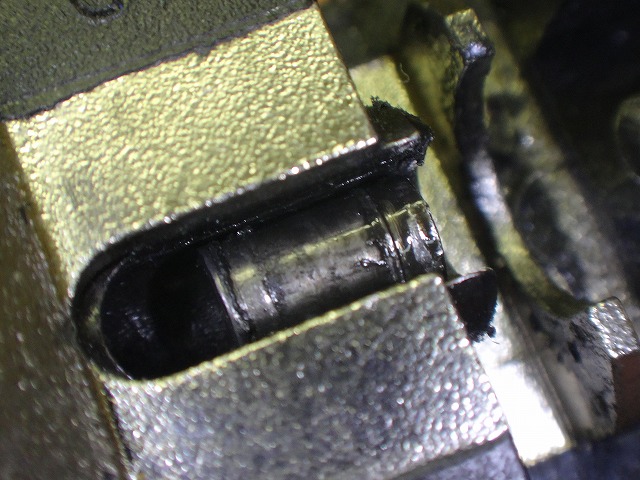
I removed the pin.
What shocked me was how incredibly loose the pin was.
To put it without exaggeration, I could turn the handle
of the chain breaker with just my index finger.
With this situation, there was definitely a possibility that the chain
could have broken while riding (technically the pin popped out).
So, the story became: "I thought I could do it for the cost of one missing link
instead of a Permalink, but ended up needing two missing links."
My reflection is that if I had noticed the Shimano pin from the start,
one missing link would have been enough.
The original chain wasn't assembled by me,
but going forward, do I really need to be that suspicious of everything...?
Note: I found an article (→here) writing about almost the same story.
I could have just pasted the link without drawing a new Permalink diagram,
but oh well.
and rejoin it on a different frame,
Campagnolo's 10S chain
maintains strict standards about the "virgin link"—the outer link
that has never had a chain pin press-fitted—allowing the connecting pin
only through virgin outer links.
On the initial assembly, there's a warning that says "don't adjust link count at the outer link end,"
so length adjustment is done on the inner link side,
leaving the outer link end as a virgin link.
The 11S and 12S chains work the same way on initial assembly,
but during 11S and 12S chain reconnection,
they allow "using a connecting pin at locations where a chain pin was removed
by someone other than the manufacturer."
As a safety measure in exchange for this,
the specification is to "compress and crimp the pin head with a dedicated tool
after installing the connecting pin."
For 13S, currently only Ecalibur exists,
and it uses a dedicated link system.

For 10S chains, after the initial assembly,
if you need to cut the chain and reuse it for any reason,
you're supposed to use Campagnolo's Permalink,
and connecting pins aren't sold individually.
The Permalink is a replacement chain section with 7 links
that has virgin outer links on both ends,
and the instruction is to replace 7 links excluding the original connection point
when you first assembled the chain.
At this time, following the red arrow route in the diagram above,
if you replace 5 links instead,
you can also increase the chain length by one pitch (2 links).
However, this Permalink currently has a retail price of ¥3,714 including tax,
which is expensive relative to the full chain price, so
I decided to use KMC's Campagnolo 10S missing link
"CL559C" instead to join it.
The "C" at the end of the part number indicates it's for Campagnolo.
It comes in a pack of two with a retail price of ¥1,782 including tax.
At our shop, we also sell individual pieces.
In the image above, the hollow pin is the original connecting pin from assembly.
I always find where the original connection was made and remove the pin
from the adjacent outer link's
left side when viewing the bike from the right and with the chain stay below.
When the original pin is also on the left side like this time,
if it's on the right side, I remove the right side of the adjacent outer link,
temporarily remove the chain from the frame,
reverse it, and reinstall it.
This is because Shimano recommends installation in that orientation
(→here),
but since I'm using a missing link this time, I remove the pin so that
both sides of the link adjacent to the original connecting pin link become inner links,
so this doesn't apply.
Also, even if I wanted to install the connecting pin in Shimano's recommended orientation,
with a Permalink, one side will necessarily go against that.
It can't be helped.
The other side looks like this.
I've joined it.
Looking at how manufacturer-complete bikes are assembled,
when viewing from the right and looking at the chain stay below,
the orientation these kinds of links are installed in is almost certainly
"the left side has the elongated hole," just like in the image above.
This is probably a remnant from when there was a directional requirement
on the "Connex link" used to join Wippermann (Vippelmann) chains
that existed before missing links,
which specified the left elongated hole.
↑This is an image I pulled from an old article, but
the Connex link has an asymmetrical shape top and bottom,
and when installed with a left elongated hole (chevron-shaped hole),
the protruding side of the plate
(except when passing through the upper pulley of the rear derailleur)
faces the outer perimeter of the chain, so there's no problem,
but if installed with a right elongated hole (heart-shaped hole),
problems can occur when passing through the sprocket.
If we stop here with the story,
it would just be "I saved money by using a missing link instead of a Permalink."
Of course, I didn't do this arbitrarily—
I explained it to the customer beforehand.
They might say "I don't mind the extra cost, please do it with the genuine method."
↑This is the outer link 6 pitches away from the original connecting pin,
but it's unmistakably a Shimano connecting pin that's been installed.
There are traces of it being snapped off, and the pin protrudes
enough on both sides of the outer plate to catch on the clips.
The same link viewed from the back (the left side of the bike).
The reason you shouldn't remove a connecting pin is
because you shouldn't repeatedly expand the holes in the outer link plate
through press-fitting, but
if we're replacing this with a missing link anyway,
there's no problem punching it out.
I removed the pin.
What shocked me was how incredibly loose the pin was.
To put it without exaggeration, I could turn the handle
of the chain breaker with just my index finger.
With this situation, there was definitely a possibility that the chain
could have broken while riding (technically the pin popped out).
So, the story became: "I thought I could do it for the cost of one missing link
instead of a Permalink, but ended up needing two missing links."
My reflection is that if I had noticed the Shimano pin from the start,
one missing link would have been enough.
The original chain wasn't assembled by me,
but going forward, do I really need to be that suspicious of everything...?
Note: I found an article (→here) writing about almost the same story.
I could have just pasted the link without drawing a new Permalink diagram,
but oh well.