Long ago, Campagnolo had a touring component group called Rally (RALLY).
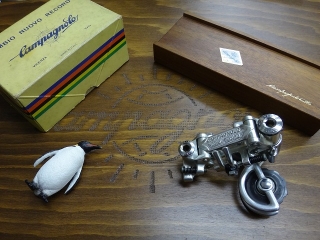
I don't have the original vertical-mount Rally, so I grabbed a Nuovo Record from the same era instead.
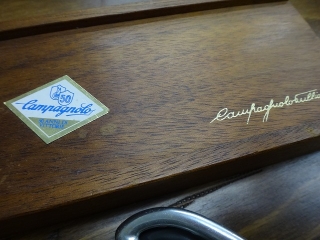
Oops, my hand slipped.
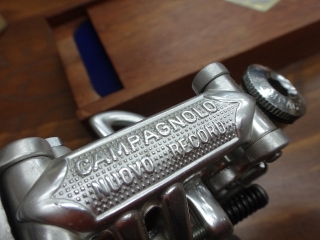
The original Rally shared the same pantograph design as this Nuovo Record. Like this:
/:::::::::::::\
\:::::::::::::/
It has squares arranged like a Clou de Paris on a clock face, with the word RALLY written across them.
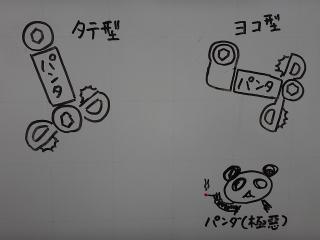
About vertical and horizontal derailleur types: when the frame mounting bolt and the pulley cage pivot bolt are roughly on the same axis, the pantograph faces vertically when mounted to the frame—that's the vertical type. When the frame mounting bolt location and the pantograph position form an L-shape, the pantograph faces horizontally when mounted—that's the horizontal type. All modern rear derailleurs are basically horizontal.
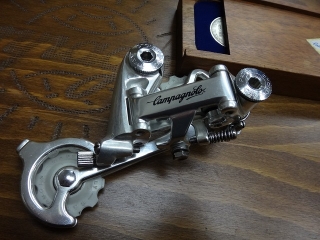
This rear derailleur is from the final generation of Rally, the horizontal-type version.
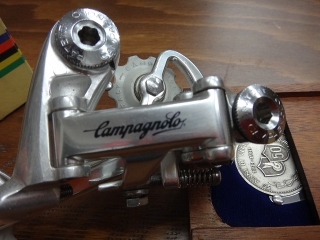
It doesn't say "Rally" anywhere on it, but the model name is definitely Rally.
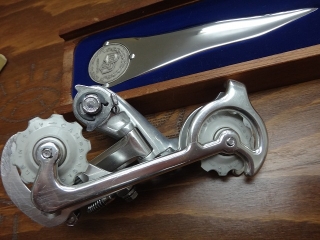
Being a touring component, it has an extremely long pulley cage. I once thought that the distance between pulley bolts on road derailleur pulleys would never exceed that of this Rally.
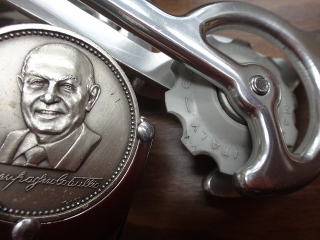
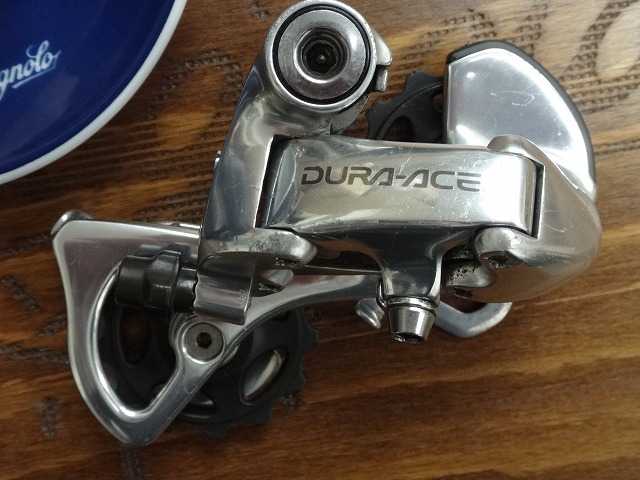
The white pulleys mean it's contemporary with the C Record. The white pulleys are 10T, and even if a larger-capacity rear derailleur is used, when the pulley tooth count is larger, the distance between pulley bolts doesn't necessarily get longer. So in terms of length competition, the 10T pulley final-generation Rally has the advantage. Some people occasionally say "Does Shimano not realize the advantage of big pulleys?" But in the 7700 9-speed era, only Dura-Ace adopted the big pulley.
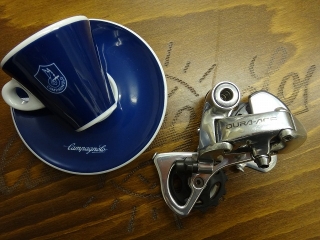
↑This one.
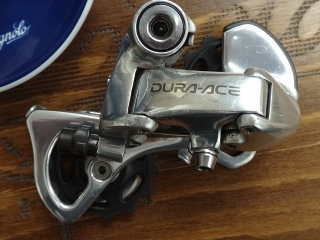

The pulleys have proper Dura-Ace markings too.
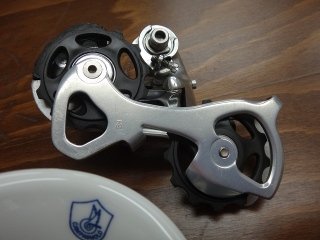
Before the inevitable correction arrives, let me come clean: this is the 7700-series front-triple rear derailleur, the RD-7703. Both pulleys are 13T, and the Altegra and 105 front-triple derailleurs from the same era had 11T pulleys and extremely long pulley cages as the spec, so the Dura-Ace-only specification isn't a lie.

↑This is the 9-speed XTRA rear derailleur, the RD-M953 SGS. SGS has a longer pulley cage than GS.
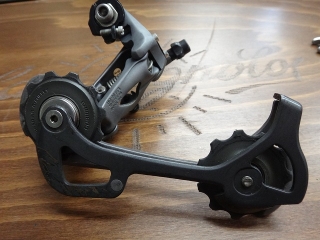
The largest low gear on MTB sprockets from that era was 34T. That's the same as Shimano 12-speed road component's maximum tooth count, but since this is for front triples with 11T pulleys, I thought the pulley cage basically wouldn't get any longer than this. The pulley bolt center distance on this XTRA rear derailleur measured 86.6mm with my calipers (all measurements that follow are my own), while the final Rally measured 90.4mm.
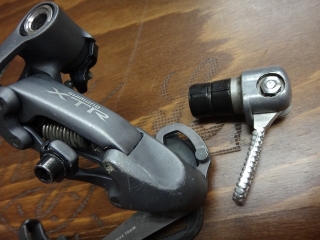
This rear derailleur, by the way, is what's called "low-normal." Without cable tension, the chain sits on the low gear (largest sprocket) rather than the top gear (smallest sprocket), whereas normal top-normal spec is the RD-M952 model number.
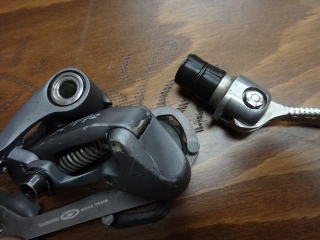
With low-normal, pulling the cable shifts toward the top side. The reason Shimano created a rear derailleur with this spec is that shifting to low gear requires heavy cable pull in normal setup, but with low-normal, the spring returns to help, making low-gear shifting smooth. That's why Shimano called low-normal "Rapid Rise." The key caveat is that with Rapid Rise, the shifter operation is reversed from normal.
With electronic components, which are now standard, front shifting (shifting to the outer ring) is brute-forced by motor power, so it's guaranteed to work. This means riders who lack pedaling technique for front shifts or don't realize that a chain sitting in the top half of the sprocket won't shift to the outer ring can still make front shifts without thinking. It's not "you don't need to think because it shifts," but rather "brute-forcing has become the default," and wear patterns differ between people who understand the mechanics and those who don't. It's worth understanding how it works.
But I'm not here to criticize that. Rather, I'm wondering: if low-normal rear derailleurs exist, shouldn't there also be outer-normal front derailleurs? If a front derailleur existed where the cage faced outer in the unpulled state and pulled inward when the cable was engaged, then outer shifting would use spring return power, making the shift light.
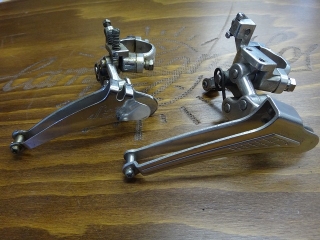
↑Yes, an outer-normal front derailleur. I'm talking about this because I can actually show you examples.
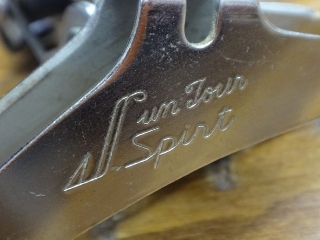

↑Suntour's Spartan.
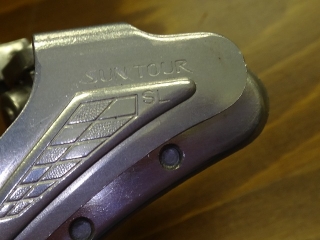
↑Suntour's SL. As the name suggests, it's a lightweight front derailleur for its era, using aluminum (called light alloy back then) for the cage plates.
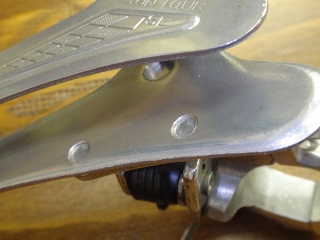
Never been used. With aluminum, even slight use gets chain scuff marks right away.
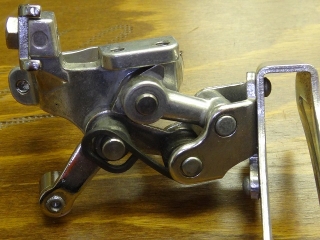
The pantograph shape is the same as the Spartan. The motion-range adjustment screws have been removed, but
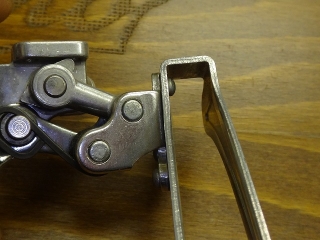
Without cable tension (unpulled), the initial state is outer gear,
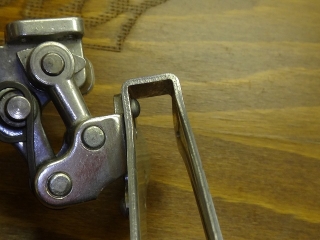
And pulling the cable shifts to inner gear.
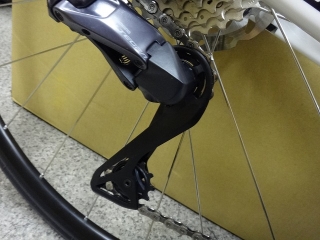
Now for the main event. I assembled an R8100-series 12-speed electronic component set a while back.
With the previous-generation R9100/R8000-series 11-speed electronic components, the single-tension setup caused chain slackness (droopy chain) when shifting to inner×top, which bothered them enough that the electronic components prevented shifting to inner×top in the first place. So if you actually shifted to inner×top, you'd have slackness that you can't shift into—a "latent droopy-chain setting" that goes unnoticed (→here).
Few people use 12T-top sprockets, so counting from top gear, the third sprocket is almost always 13T. Single-tension rear derailleurs don't rotate back as far as double-tension ones, so the rear wheel is extremely hard to remove with inner×13T. The 9100/8000-series rear derailleur pulleys are both 11T, but changing to an aftermarket big pulley makes wheel removal even harder.
The 9200/8100-series rear derailleur pulleys remain 11T top and bottom. But since Dura-Ace now supports 11-34T, I was wondering how they'd handle the inner×top shifting issue, and it turns out the 12-speed electronic components can shift to inner×top. A 54-40T crankset option was added, so the chain length that works with 54×34T... I was puzzled about how they'd avoid droopiness at 40×11T with an 11T pulley and the required cage length, but
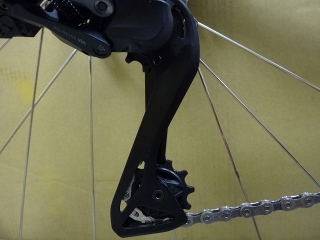
It turned out they made the pulley bolt center distance abnormally long. It corresponds to the longer-cage GS spec from the previous generation, with only this one length available (road rear derailleur pulley spacing: short is SS, long is GS).
This rear derailleur (RD-R8150) has a pulley bolt center distance of 99.6mm by my measurement—longer than the final Rally. The tension adjustment bolt range is also wider, but without cable tension at all, the initial position has the rear derailleur's pantograph so far back it'd hit the frame.
Shimano's 12-speed MTB rear derailleur has 13T pulleys top and bottom, so I haven't measured it, but the pulley cage doesn't look unnecessarily long. The cranksets come single or double, but the double is 38-28T only, so there's not the 16T spread maximum you get on road bikes. However, with sprockets of 10-45T or 10-51T, 13T pulleys are needed or you'd get a ridiculously long cage.
Shimano's 12-speed road rear derailleur is so long that mounted on a small-wheel bike, I'd worry about hitting curbs in right-hand-traffic countries.
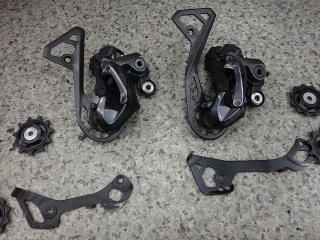
This is a separate issue: someone asked me to swap SS and GS on an 11-speed electronic Altegra RD-R8050, so while disassembling the pulley cage, I measured the GS model's bolt center distance. It's 96.6mm—shorter than the R8150 but already longer than the final Rally. (It's longer than the 9-speed MTB SGS despite nominally being called GS.) The contemporary Dura-Ace rear derailleur (RD-R9150) comes in SS only with a maximum low gear of 30T, not 34T, so Altegra beat Dura-Ace to exceeding the final Rally's length.
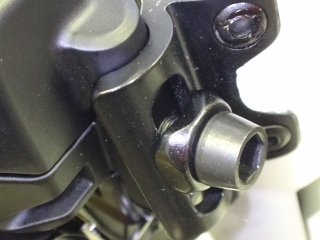
The front derailleur came, as usual, with some ridiculous washer as a supposed feature.
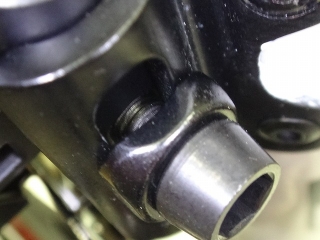
It clearly has poor contact surface area. Especially with electronic components, the motor's brute-force power puts insane stress on the frame bracket, which is not good. So I deliberately swapped it for the old-style washer (→here).

Shimano's coated inner cable, adopted from the 7900-series, has good slipperiness, so Shimano warned that with 7800-series and earlier components, the cable might not be fixable on brakes or derailleurs (the image above shows the officially approved combination). Yet they'll tell such pointless lies while refusing to fix the front derailleur washer downgrade. Also, changing to 4mm Allen key instead of 5mm to fix the brake inner is stupid.
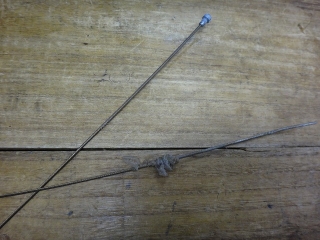
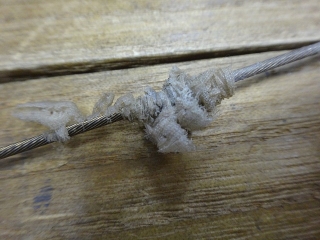
With coated inner cable, the coating sometimes peels during shifting around the outer-cage area due to back-and-forth motion. If you try to pull out a cable with peeling coating through a frame-routed cable hole, the liner gets jammed—a real mess. You have to cut the inner and pull it out from the rear (rear-derailleur side). The image above is a brake inner, but shift inners do the same.
Also, Shimano's STI levers from 7900-series onward have a tight bend where they pull in the shift inner, so the bundle of steel wires just below the barrel-end gets nicked and severed in bits (this isn't as common on Campagnolo Ergopower), but honestly, regular uncoated stainless wire feels like it lasts longer. Truth is, except when using the lever's included cable on first assembly, I deliberately use plain stainless wire on 7900+ components, but I don't just throw it on—I set it up so the initial performance is smoother than just slapping coated cable on, and I also ensure that initial performance persists longer. That coated inner is there so people who can't assemble components properly can still get decent performance by just throwing it together. To me, it's just unwelcome meddling.
Also, as mentioned, coated inners have poor compatibility with frame-routed cables. Modern frames aren't really "dual-compatible" with mechanical and electronic but rather designed primarily for electronic, with frame-routed cable routing that's like "we'll keep mechanical compatible by just swapping the cable stop, so be grateful," which is annoying. Campagnolo, meanwhile, uses plain stainless wire from the start.
Initial performance (brake and shift lever pull lightness) and how long that's maintained on cable-operated component parts varies wildly based on the assembler's knowledge and skill. But switch to disc brakes and electronic shifting, and that variation shrinks a lot. It's not quite "whoever assembles it, it's the same," but close. Component makers would want to go that direction, and fortunately, with a near-monopoly market, it's easy to do planned obsolescence like "wait, you're still running rim brakes and mechanical shifting?"
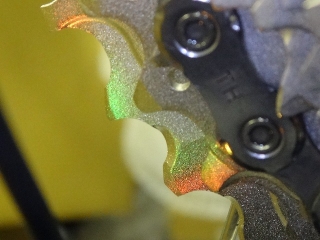
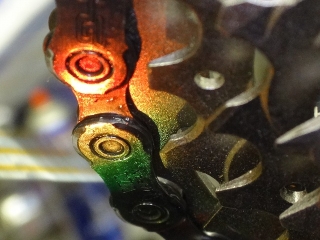
Shimano's 12-speed electronic components have an indicator light on the rear derailleur that changes color by mode. The colors can be blue, yellow, green, or red, and the shift-adjustment mode is yellow. Internally it seems to be a mix of red and green, so the light looks yellow, but when that light hits the chain or sprocket, it disperses into red and green, looking like the image above.

I don't have the original vertical-mount Rally, so I grabbed a Nuovo Record from the same era instead.
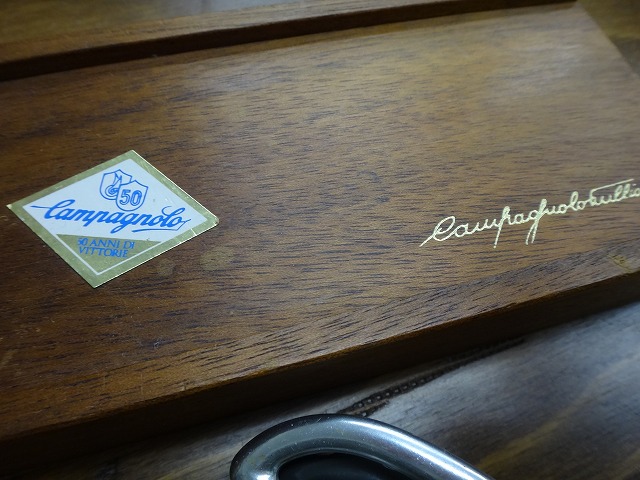
Oops, my hand slipped.
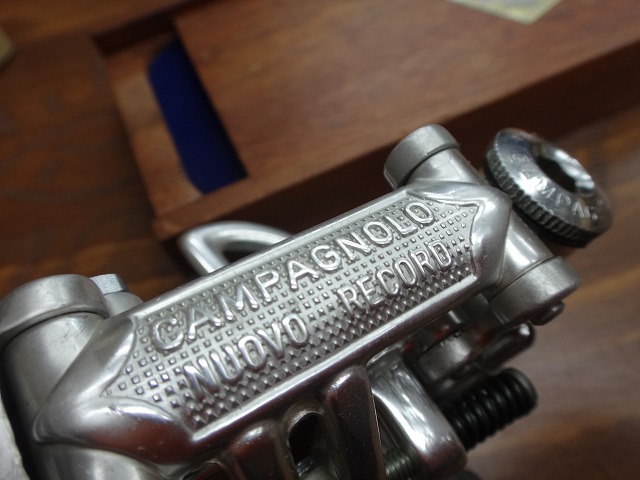
The original Rally shared the same pantograph design as this Nuovo Record. Like this:
/:::::::::::::\
\:::::::::::::/
It has squares arranged like a Clou de Paris on a clock face, with the word RALLY written across them.
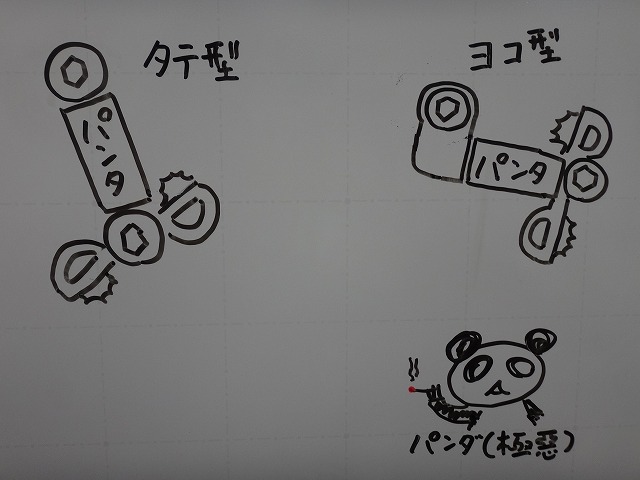
About vertical and horizontal derailleur types: when the frame mounting bolt and the pulley cage pivot bolt are roughly on the same axis, the pantograph faces vertically when mounted to the frame—that's the vertical type. When the frame mounting bolt location and the pantograph position form an L-shape, the pantograph faces horizontally when mounted—that's the horizontal type. All modern rear derailleurs are basically horizontal.

This rear derailleur is from the final generation of Rally, the horizontal-type version.
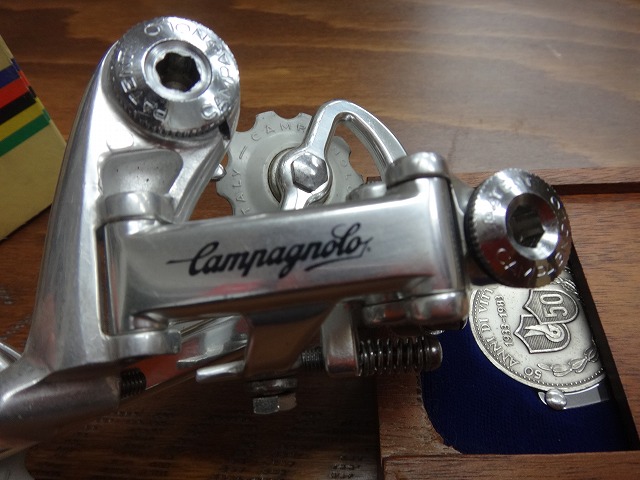
It doesn't say "Rally" anywhere on it, but the model name is definitely Rally.
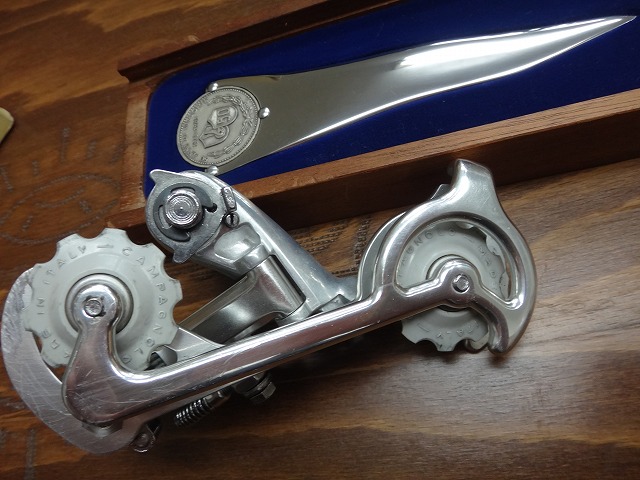
Being a touring component, it has an extremely long pulley cage. I once thought that the distance between pulley bolts on road derailleur pulleys would never exceed that of this Rally.

The white pulleys mean it's contemporary with the C Record. The white pulleys are 10T, and even if a larger-capacity rear derailleur is used, when the pulley tooth count is larger, the distance between pulley bolts doesn't necessarily get longer. So in terms of length competition, the 10T pulley final-generation Rally has the advantage. Some people occasionally say "Does Shimano not realize the advantage of big pulleys?" But in the 7700 9-speed era, only Dura-Ace adopted the big pulley.
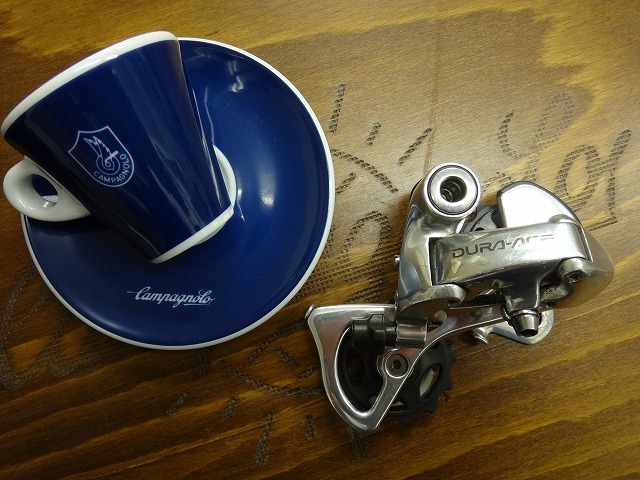
↑This one.
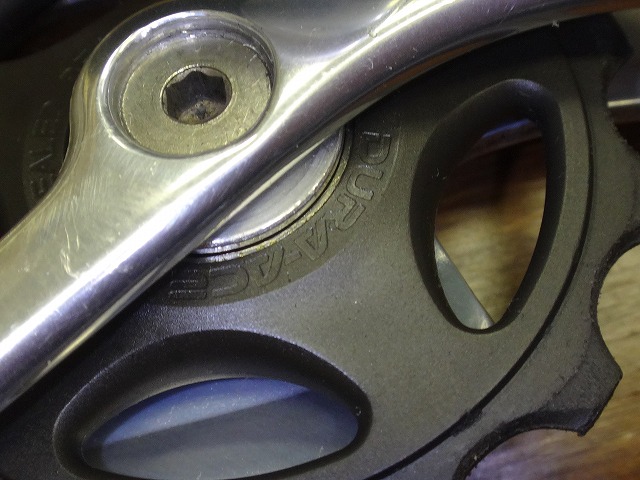
The pulleys have proper Dura-Ace markings too.
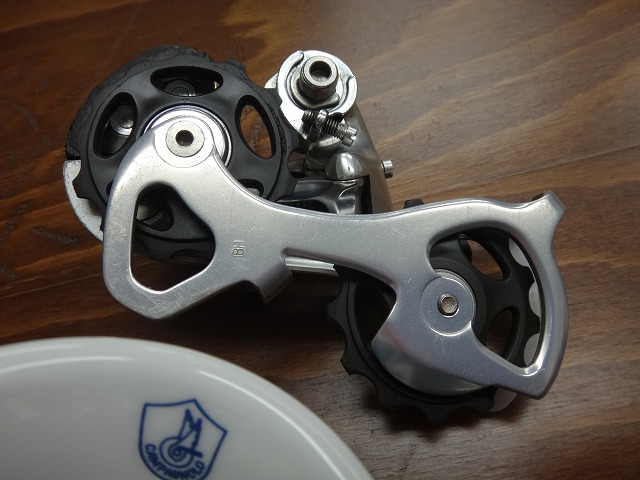
Before the inevitable correction arrives, let me come clean: this is the 7700-series front-triple rear derailleur, the RD-7703. Both pulleys are 13T, and the Altegra and 105 front-triple derailleurs from the same era had 11T pulleys and extremely long pulley cages as the spec, so the Dura-Ace-only specification isn't a lie.
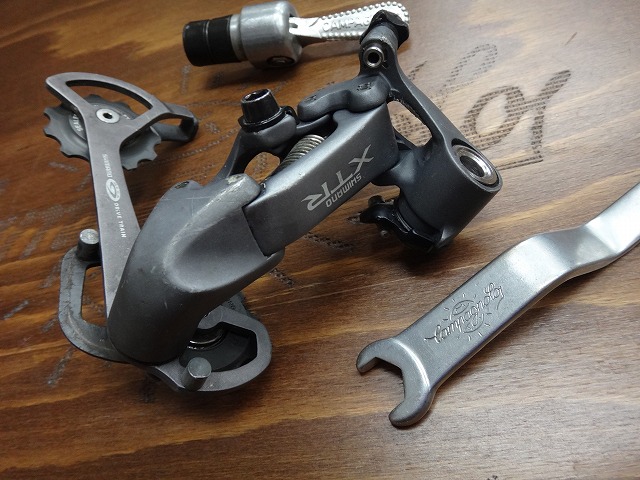
↑This is the 9-speed XTRA rear derailleur, the RD-M953 SGS. SGS has a longer pulley cage than GS.

The largest low gear on MTB sprockets from that era was 34T. That's the same as Shimano 12-speed road component's maximum tooth count, but since this is for front triples with 11T pulleys, I thought the pulley cage basically wouldn't get any longer than this. The pulley bolt center distance on this XTRA rear derailleur measured 86.6mm with my calipers (all measurements that follow are my own), while the final Rally measured 90.4mm.
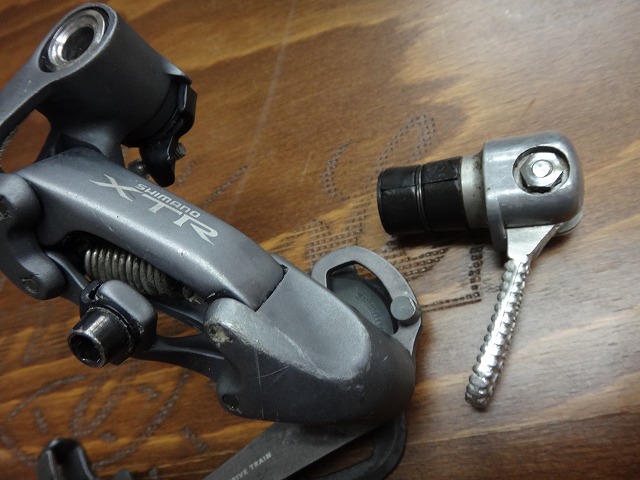
This rear derailleur, by the way, is what's called "low-normal." Without cable tension, the chain sits on the low gear (largest sprocket) rather than the top gear (smallest sprocket), whereas normal top-normal spec is the RD-M952 model number.
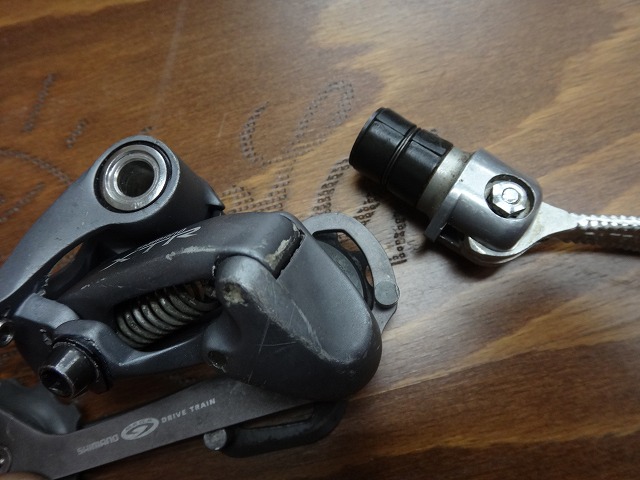
With low-normal, pulling the cable shifts toward the top side. The reason Shimano created a rear derailleur with this spec is that shifting to low gear requires heavy cable pull in normal setup, but with low-normal, the spring returns to help, making low-gear shifting smooth. That's why Shimano called low-normal "Rapid Rise." The key caveat is that with Rapid Rise, the shifter operation is reversed from normal.
With electronic components, which are now standard, front shifting (shifting to the outer ring) is brute-forced by motor power, so it's guaranteed to work. This means riders who lack pedaling technique for front shifts or don't realize that a chain sitting in the top half of the sprocket won't shift to the outer ring can still make front shifts without thinking. It's not "you don't need to think because it shifts," but rather "brute-forcing has become the default," and wear patterns differ between people who understand the mechanics and those who don't. It's worth understanding how it works.
But I'm not here to criticize that. Rather, I'm wondering: if low-normal rear derailleurs exist, shouldn't there also be outer-normal front derailleurs? If a front derailleur existed where the cage faced outer in the unpulled state and pulled inward when the cable was engaged, then outer shifting would use spring return power, making the shift light.
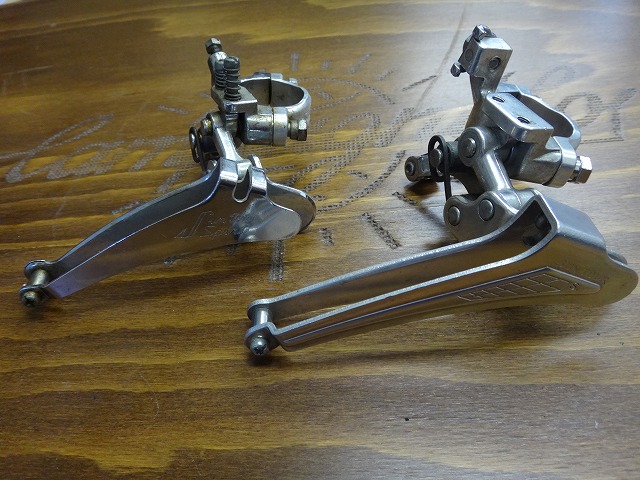
↑Yes, an outer-normal front derailleur. I'm talking about this because I can actually show you examples.
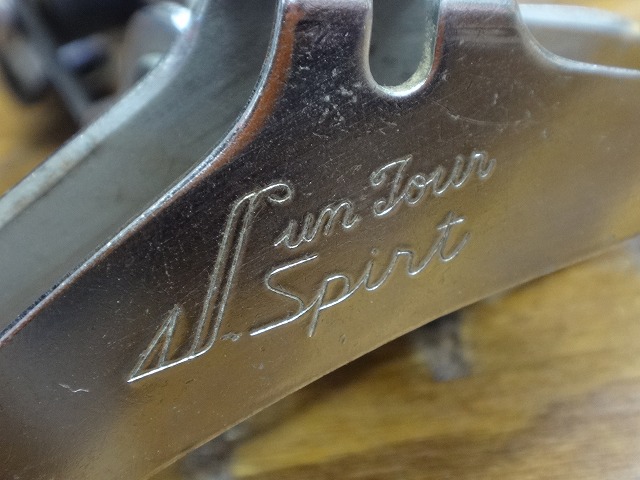

↑Suntour's Spartan.
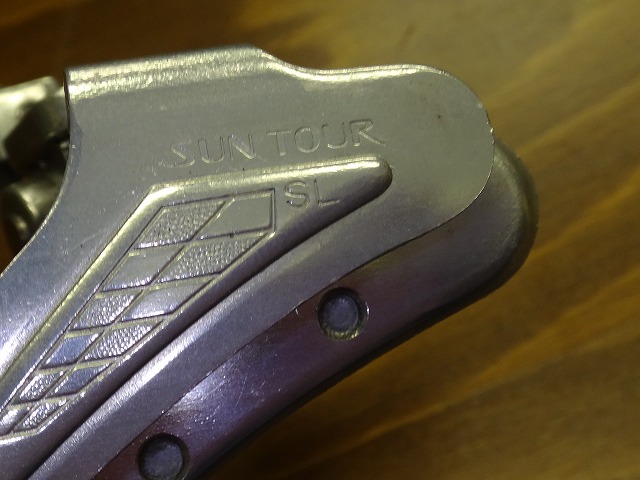
↑Suntour's SL. As the name suggests, it's a lightweight front derailleur for its era, using aluminum (called light alloy back then) for the cage plates.

Never been used. With aluminum, even slight use gets chain scuff marks right away.
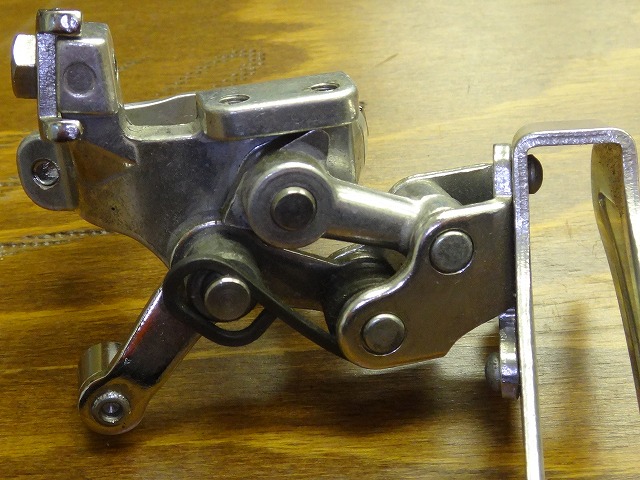
The pantograph shape is the same as the Spartan. The motion-range adjustment screws have been removed, but
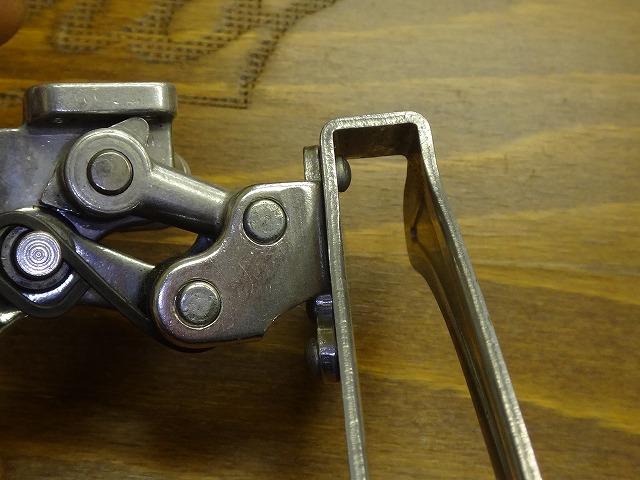
Without cable tension (unpulled), the initial state is outer gear,
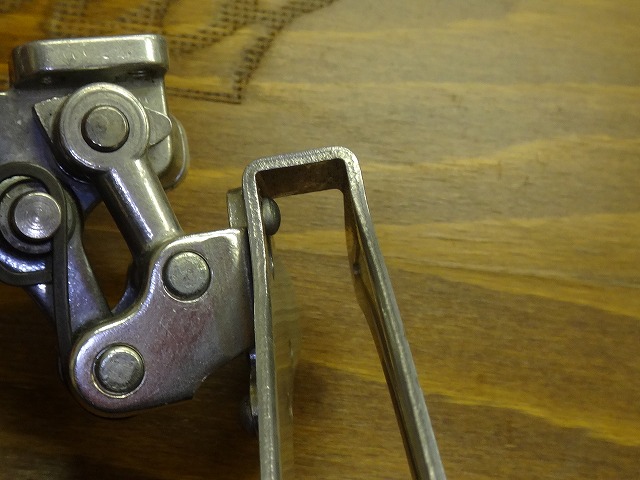
And pulling the cable shifts to inner gear.
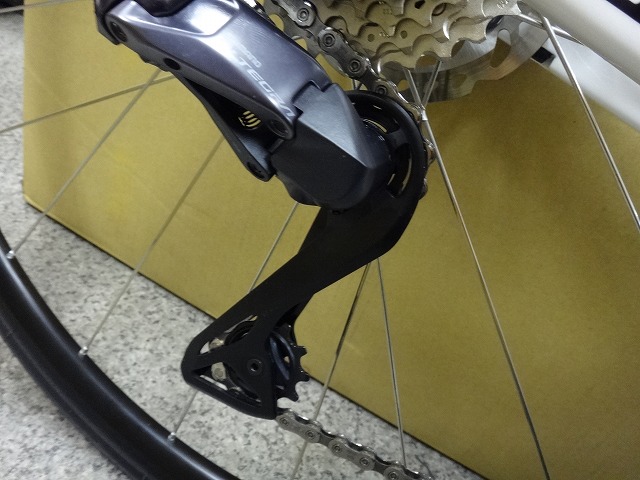
Now for the main event. I assembled an R8100-series 12-speed electronic component set a while back.
With the previous-generation R9100/R8000-series 11-speed electronic components, the single-tension setup caused chain slackness (droopy chain) when shifting to inner×top, which bothered them enough that the electronic components prevented shifting to inner×top in the first place. So if you actually shifted to inner×top, you'd have slackness that you can't shift into—a "latent droopy-chain setting" that goes unnoticed (→here).
Few people use 12T-top sprockets, so counting from top gear, the third sprocket is almost always 13T. Single-tension rear derailleurs don't rotate back as far as double-tension ones, so the rear wheel is extremely hard to remove with inner×13T. The 9100/8000-series rear derailleur pulleys are both 11T, but changing to an aftermarket big pulley makes wheel removal even harder.
The 9200/8100-series rear derailleur pulleys remain 11T top and bottom. But since Dura-Ace now supports 11-34T, I was wondering how they'd handle the inner×top shifting issue, and it turns out the 12-speed electronic components can shift to inner×top. A 54-40T crankset option was added, so the chain length that works with 54×34T... I was puzzled about how they'd avoid droopiness at 40×11T with an 11T pulley and the required cage length, but
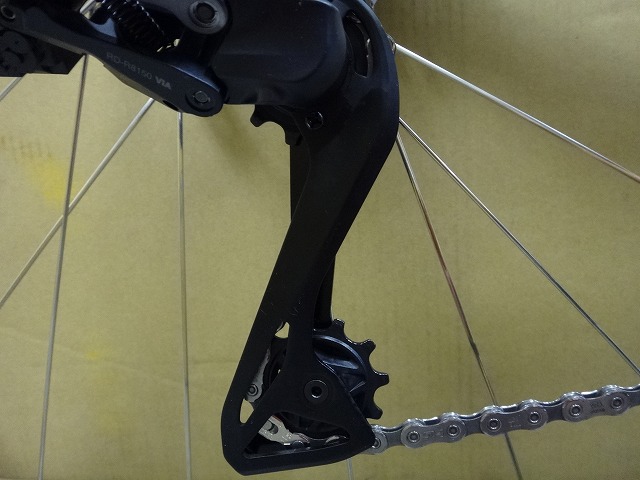
It turned out they made the pulley bolt center distance abnormally long. It corresponds to the longer-cage GS spec from the previous generation, with only this one length available (road rear derailleur pulley spacing: short is SS, long is GS).
This rear derailleur (RD-R8150) has a pulley bolt center distance of 99.6mm by my measurement—longer than the final Rally. The tension adjustment bolt range is also wider, but without cable tension at all, the initial position has the rear derailleur's pantograph so far back it'd hit the frame.
Shimano's 12-speed MTB rear derailleur has 13T pulleys top and bottom, so I haven't measured it, but the pulley cage doesn't look unnecessarily long. The cranksets come single or double, but the double is 38-28T only, so there's not the 16T spread maximum you get on road bikes. However, with sprockets of 10-45T or 10-51T, 13T pulleys are needed or you'd get a ridiculously long cage.
Shimano's 12-speed road rear derailleur is so long that mounted on a small-wheel bike, I'd worry about hitting curbs in right-hand-traffic countries.
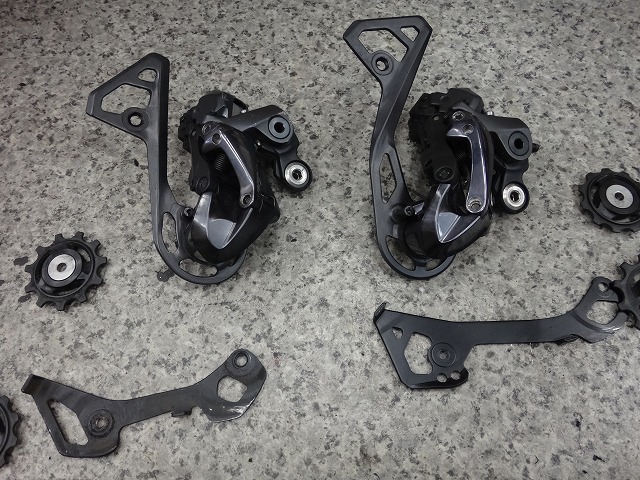
This is a separate issue: someone asked me to swap SS and GS on an 11-speed electronic Altegra RD-R8050, so while disassembling the pulley cage, I measured the GS model's bolt center distance. It's 96.6mm—shorter than the R8150 but already longer than the final Rally. (It's longer than the 9-speed MTB SGS despite nominally being called GS.) The contemporary Dura-Ace rear derailleur (RD-R9150) comes in SS only with a maximum low gear of 30T, not 34T, so Altegra beat Dura-Ace to exceeding the final Rally's length.
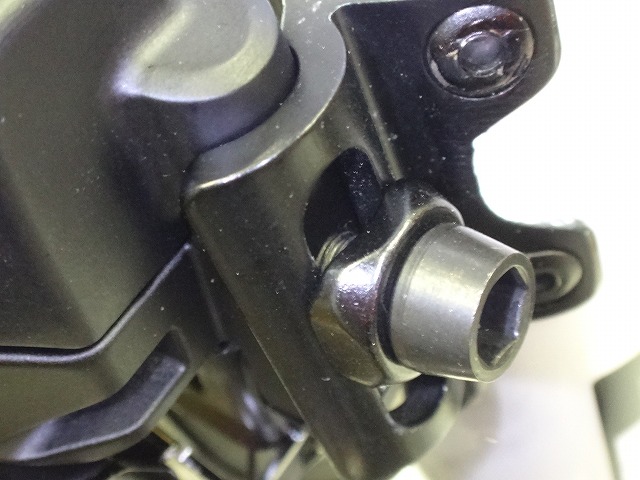
The front derailleur came, as usual, with some ridiculous washer as a supposed feature.
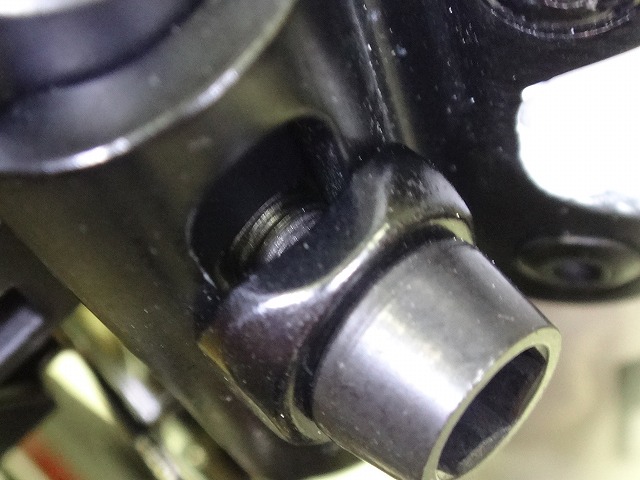
It clearly has poor contact surface area. Especially with electronic components, the motor's brute-force power puts insane stress on the frame bracket, which is not good. So I deliberately swapped it for the old-style washer (→here).
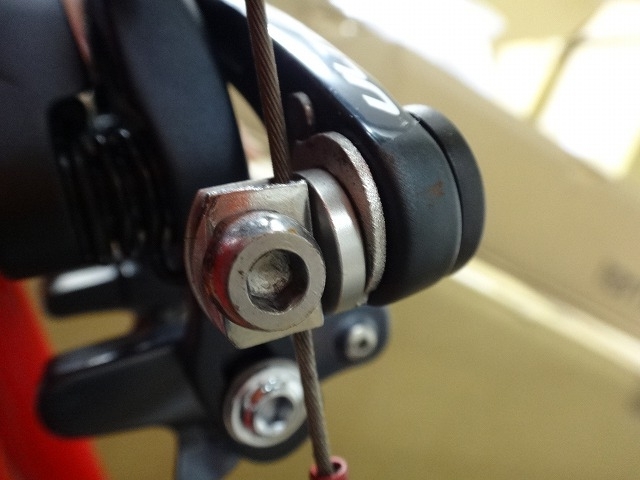
Shimano's coated inner cable, adopted from the 7900-series, has good slipperiness, so Shimano warned that with 7800-series and earlier components, the cable might not be fixable on brakes or derailleurs (the image above shows the officially approved combination). Yet they'll tell such pointless lies while refusing to fix the front derailleur washer downgrade. Also, changing to 4mm Allen key instead of 5mm to fix the brake inner is stupid.
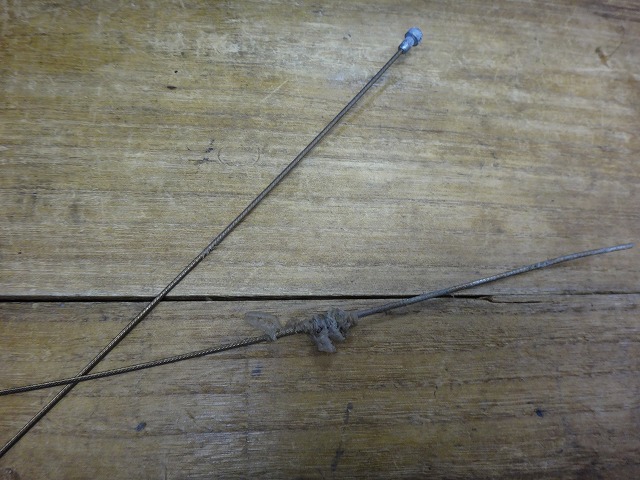

With coated inner cable, the coating sometimes peels during shifting around the outer-cage area due to back-and-forth motion. If you try to pull out a cable with peeling coating through a frame-routed cable hole, the liner gets jammed—a real mess. You have to cut the inner and pull it out from the rear (rear-derailleur side). The image above is a brake inner, but shift inners do the same.
Also, Shimano's STI levers from 7900-series onward have a tight bend where they pull in the shift inner, so the bundle of steel wires just below the barrel-end gets nicked and severed in bits (this isn't as common on Campagnolo Ergopower), but honestly, regular uncoated stainless wire feels like it lasts longer. Truth is, except when using the lever's included cable on first assembly, I deliberately use plain stainless wire on 7900+ components, but I don't just throw it on—I set it up so the initial performance is smoother than just slapping coated cable on, and I also ensure that initial performance persists longer. That coated inner is there so people who can't assemble components properly can still get decent performance by just throwing it together. To me, it's just unwelcome meddling.
Also, as mentioned, coated inners have poor compatibility with frame-routed cables. Modern frames aren't really "dual-compatible" with mechanical and electronic but rather designed primarily for electronic, with frame-routed cable routing that's like "we'll keep mechanical compatible by just swapping the cable stop, so be grateful," which is annoying. Campagnolo, meanwhile, uses plain stainless wire from the start.
Initial performance (brake and shift lever pull lightness) and how long that's maintained on cable-operated component parts varies wildly based on the assembler's knowledge and skill. But switch to disc brakes and electronic shifting, and that variation shrinks a lot. It's not quite "whoever assembles it, it's the same," but close. Component makers would want to go that direction, and fortunately, with a near-monopoly market, it's easy to do planned obsolescence like "wait, you're still running rim brakes and mechanical shifting?"

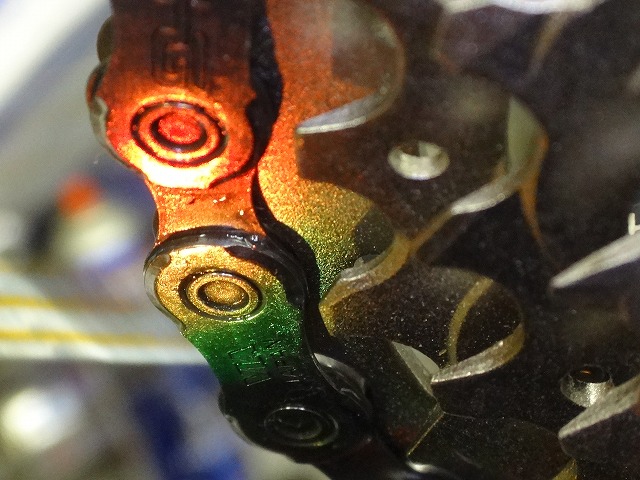
Shimano's 12-speed electronic components have an indicator light on the rear derailleur that changes color by mode. The colors can be blue, yellow, green, or red, and the shift-adjustment mode is yellow. Internally it seems to be a mix of red and green, so the light looks yellow, but when that light hits the chain or sprocket, it disperses into red and green, looking like the image above.
Products Mentioned in This Article
- 🛒 Campagnolo Rally rear derailleur vintage
- 🛒 Shimano Dura-Ace RD-7703 rear derailleur
- 🛒 Shimano XTUR RD-M953 SGS rear derailleur
- 🛒 Suntour Sprinter front derailleur vintage
* Amazon affiliate links — prices may vary
Original Japanese post: のむラボ日記 #6229