Another day at the workbench (details omitted).
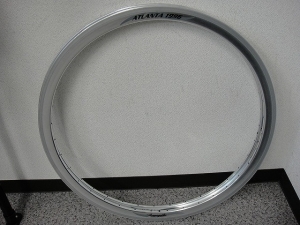
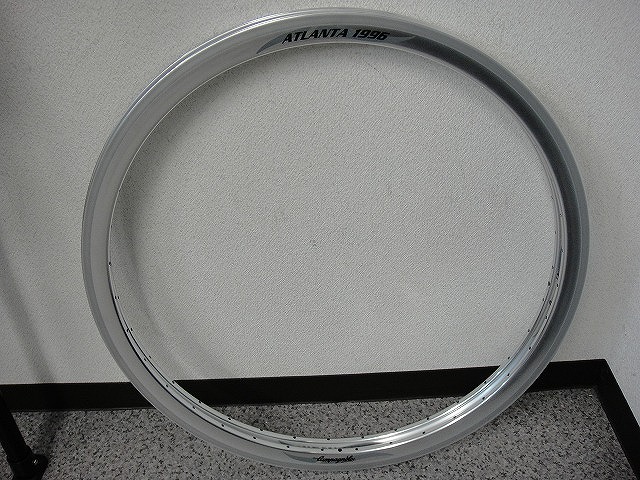
I received a Campagnolo Atlanta 1996 rim from a customer.
Campagnolo had a period where they named their rims
after Olympic host cities followed by the year,
and this is one from that era.
Back then this was considered an aero rim, but now it looks pretty ordinary.
However, given that even 28-hole was standard at the time,
this particular rim is unusually specified as 36-hole for its depth.
It's been a while since I've looked at a customer's rim and thought "I want one." Huff, huff.
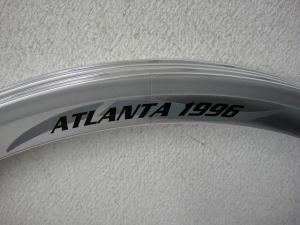
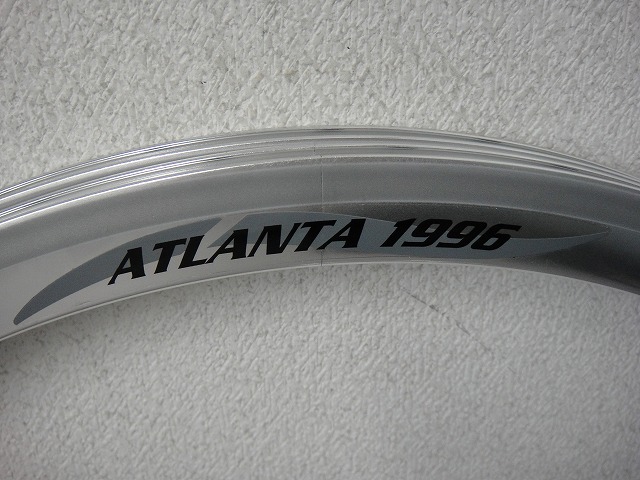
1996 was the year of the Atlanta Olympics.

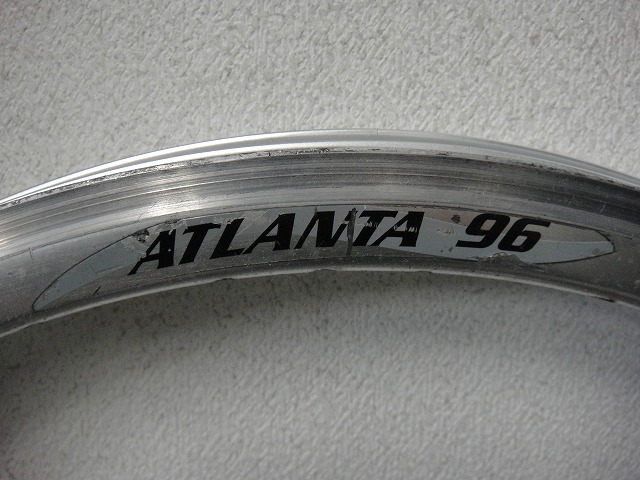
There's also an Atlanta 96 rim, but year 96 AD is (as the title suggests).
No, it's just a different version.
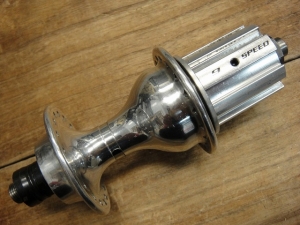
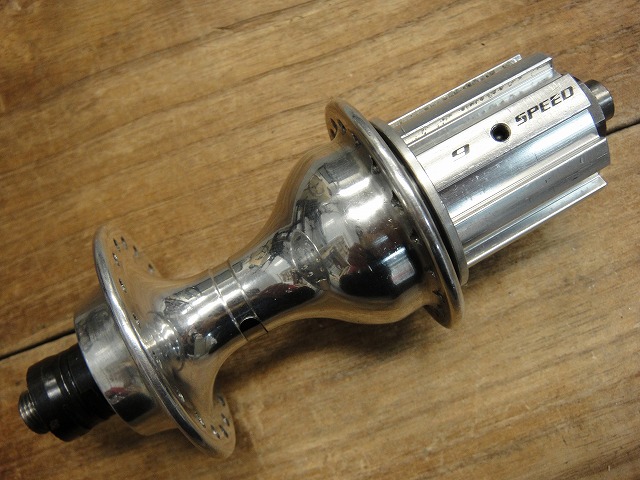
The hub is a Record from that era that I have in my care.
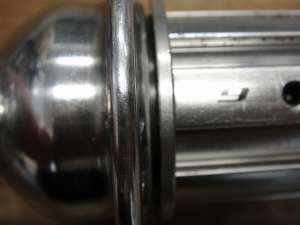
Back when this hub was the latest, if you built a wheel with a Campagnolo hub,
you'd think "the dish is so severe the freewheel side goes tight immediately!"
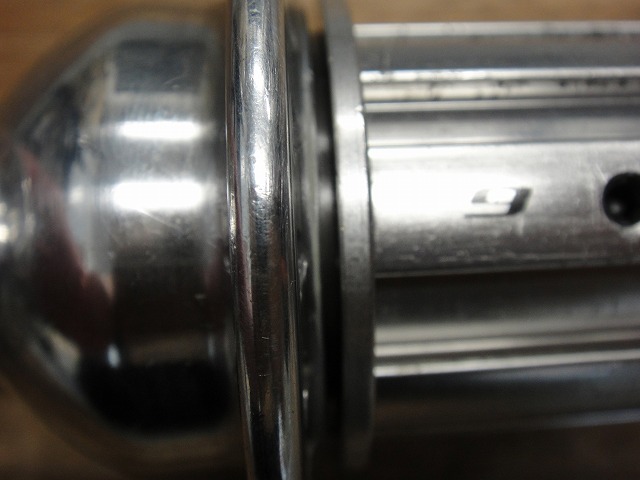
The interior of the freebody isn't a spacer—it's shaped like this.
The position where the low gear sits on the freebody is quite far from the right flange.
The flange width is about 57mm, with the right flange width in the high 18mm range,
but since current 11-speed hubs ended up with similar dimensions,
you could say it was ahead of its time.
(Though that's not necessarily a good thing.)
Since this 9-speed freebody is compatible with both 10-speed and 11-speed,
that shows some foresight.
Given that it has nearly identical dimensions to current 11-speed hubs,
you need asymmetric spoking to get an even wheel tension—it feels like that kind of design.
All the spokes are Campagnolo Comp, so it's a symmetric spoking pattern.
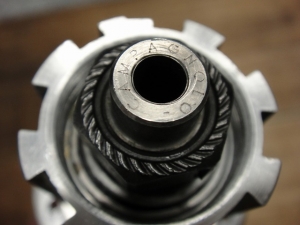
Special version with a titanium axle (standard Record hubs use steel).
The shaft end has "CAMPAGNOLO" laser-engraved on it—such attention to detail!
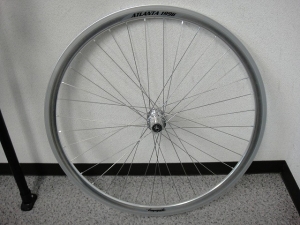
It's built.
Since 36 divided by 4 gives 9 (odd), true tangent spoking
(48-degree lacing in this case) would be possible,
but I went with 48-degree lacing this time.
Unrelated to this wheel, but
I've been surprised lately by how many customers request
28-hole with 48-degree lacing despite it being experimental.
The data collection helps, though. Hehehe.
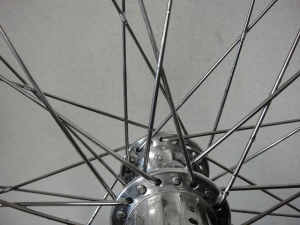
With 36 holes, 4-cross lacing gets quite close to radial.
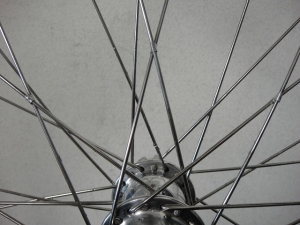
I'm pretty obsessive about bringing the spoke direction on the freewheel side close to radial,
yet on the non-freewheel side, the spoke direction doesn't necessarily align
with the tangent to a circle perpendicular to the spoke extension line—
the reason I use an lacing pattern that "increases n in n-cross lacing
while staying within the hub's bisector"
and the fact that true tangent lacing doesn't actually make the spoke direction
"closest to tangential," making it a very confusing terminology—
these two points are deeply connected to my meal ticket.
I received a Campagnolo Atlanta 1996 rim from a customer.
Campagnolo had a period where they named their rims
after Olympic host cities followed by the year,
and this is one from that era.
Back then this was considered an aero rim, but now it looks pretty ordinary.
However, given that even 28-hole was standard at the time,
this particular rim is unusually specified as 36-hole for its depth.
It's been a while since I've looked at a customer's rim and thought "I want one." Huff, huff.
1996 was the year of the Atlanta Olympics.
There's also an Atlanta 96 rim, but year 96 AD is (as the title suggests).
No, it's just a different version.
The hub is a Record from that era that I have in my care.
Back when this hub was the latest, if you built a wheel with a Campagnolo hub,
you'd think "the dish is so severe the freewheel side goes tight immediately!"
The interior of the freebody isn't a spacer—it's shaped like this.
The position where the low gear sits on the freebody is quite far from the right flange.
The flange width is about 57mm, with the right flange width in the high 18mm range,
but since current 11-speed hubs ended up with similar dimensions,
you could say it was ahead of its time.
(Though that's not necessarily a good thing.)
Since this 9-speed freebody is compatible with both 10-speed and 11-speed,
that shows some foresight.
Given that it has nearly identical dimensions to current 11-speed hubs,
you need asymmetric spoking to get an even wheel tension—it feels like that kind of design.
All the spokes are Campagnolo Comp, so it's a symmetric spoking pattern.
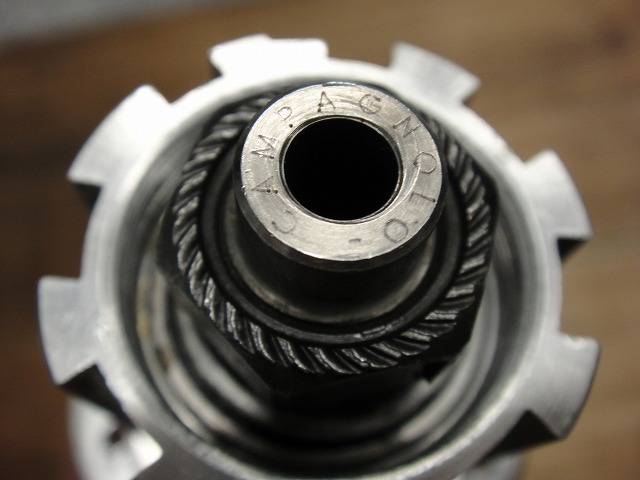
Special version with a titanium axle (standard Record hubs use steel).
The shaft end has "CAMPAGNOLO" laser-engraved on it—such attention to detail!
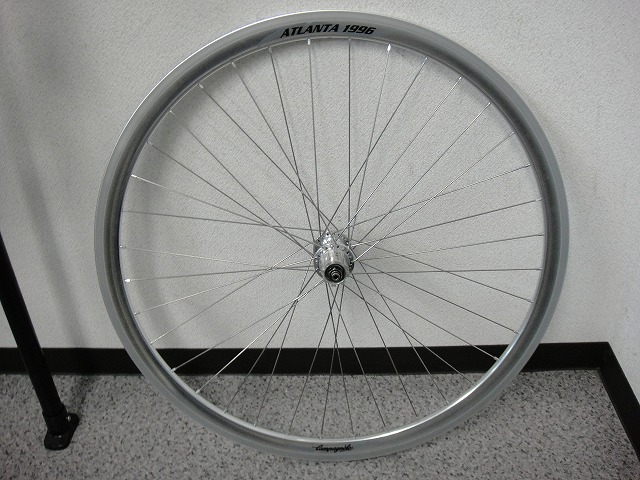
It's built.
Since 36 divided by 4 gives 9 (odd), true tangent spoking
(48-degree lacing in this case) would be possible,
but I went with 48-degree lacing this time.
Unrelated to this wheel, but
I've been surprised lately by how many customers request
28-hole with 48-degree lacing despite it being experimental.
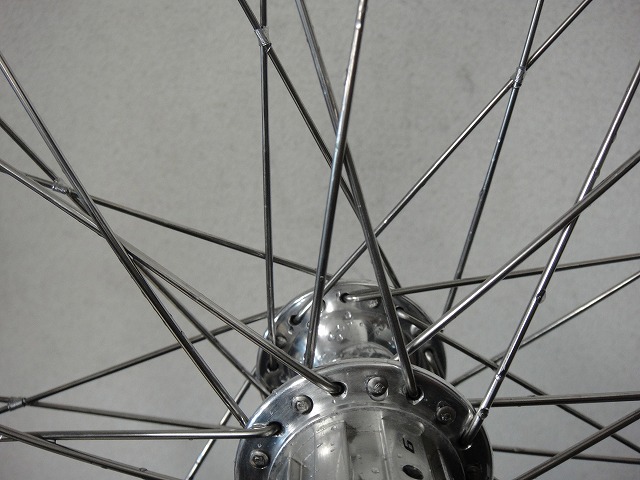
With 36 holes, 4-cross lacing gets quite close to radial.
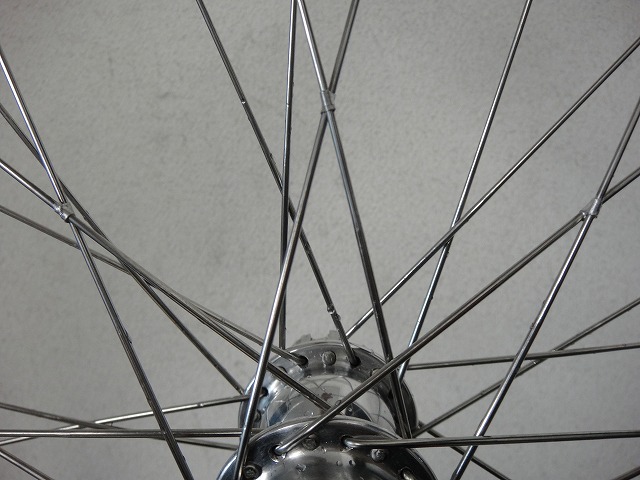
I'm pretty obsessive about bringing the spoke direction on the freewheel side close to radial,
yet on the non-freewheel side, the spoke direction doesn't necessarily align
with the tangent to a circle perpendicular to the spoke extension line—
the reason I use an lacing pattern that "increases n in n-cross lacing
while staying within the hub's bisector"
and the fact that true tangent lacing doesn't actually make the spoke direction
"closest to tangential," making it a very confusing terminology—
these two points are deeply connected to my meal ticket.