I received a Zonda Disc Brake from a customer for inspection.
On the day I checked this one, I was also looking at Racing Zero, Shamal Mille,
and a brand new Bora One 35 WO, but
there wasn't really anything worth writing an article about, so I didn't take any photos.
Lately, most inspection jobs I receive don't make it into articles.
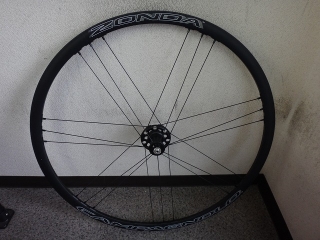
↑ Looks like the rear wheel at first glance, but it's the front
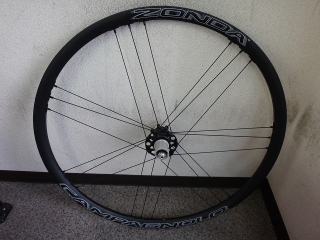
↑ Rear wheel
With Campagnolo's 2018 model lineup,
there are only two wheel types compatible with disc brakes:
Zonda and Bora One 35.
Since the Bora One 35 comes in both WO and tubular versions, strictly speaking there might be three types.
As for the inspection, both front and rear wheels were perfectly centered with essentially no runout.
In other words, there wasn't really anything about this wheel worth writing an article about either.

While stickers do vary somewhat,
please don't apply them right at the outer edge—it makes truing harder.
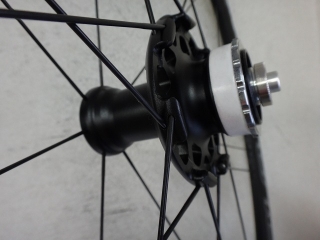
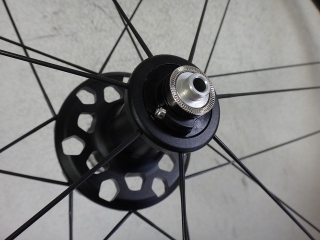
The front wheel is built in G3 pattern aligned with the rotor hub flange.
The spokes are equal diameter on both sides, but given the modest hub flange for the rotor mount,
the need for such high-low flanges (and with unequal spoke counts left and right)
must be what led Campagnolo to this decision.
This makes me wonder if the front wheels I normally build with 64-spoke reverse Italian lacing
should be semi-competition pattern rather than full CX-RAY.
(In practice I build both, though full CX-RAY is more common)
The spokes are double-butted with 2.0mm at both ends,
and based on my measurement with calipers, I thought the butted section was 1.5mm,
but according to the catalog it's 1.6mm.
That 0.1mm difference is huge,
and especially on high-tension factory-built wheels,
it becomes a critical line between whether or not you get lateral deflection.
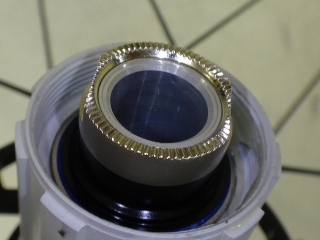
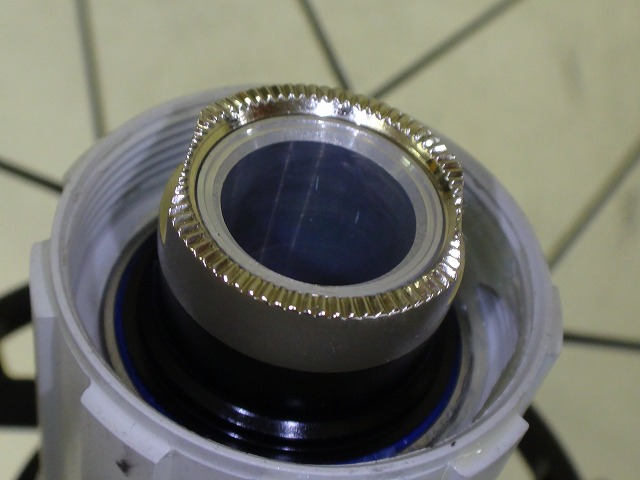
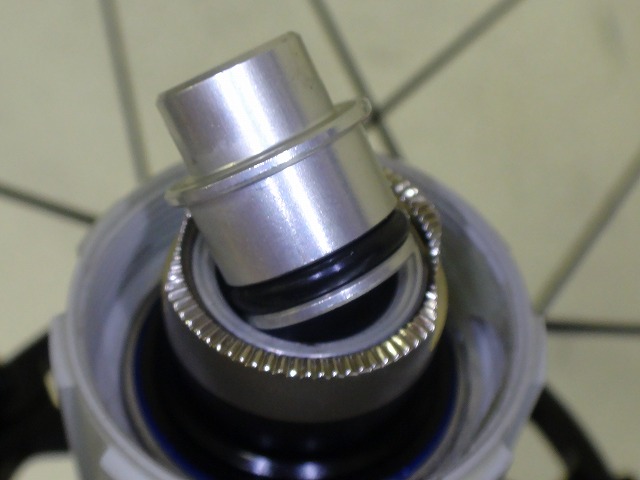
When I went to inspect the rear wheel, the right end cap was missing.
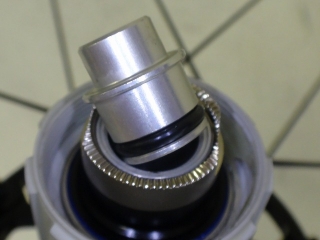
In the factory packaging, plastic protective plugs are inserted into the holes at both ends,
and it apparently came out along with those when they were removed.
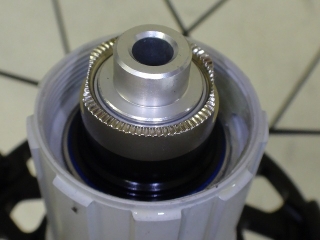
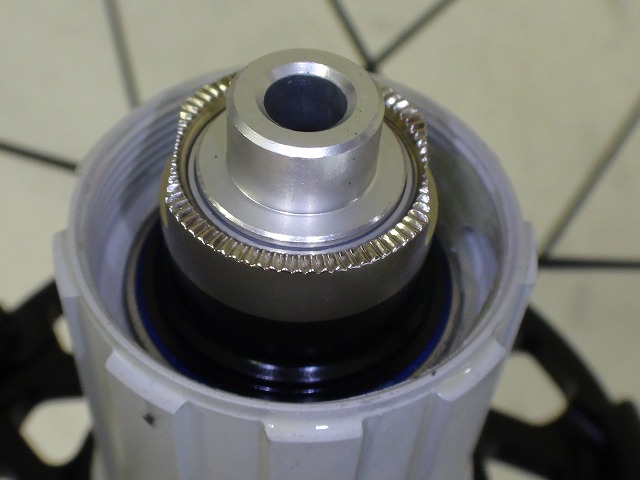
I installed the right end cap.
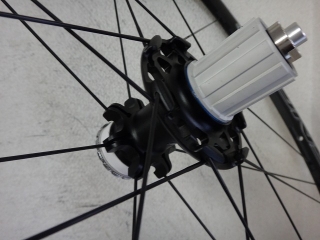
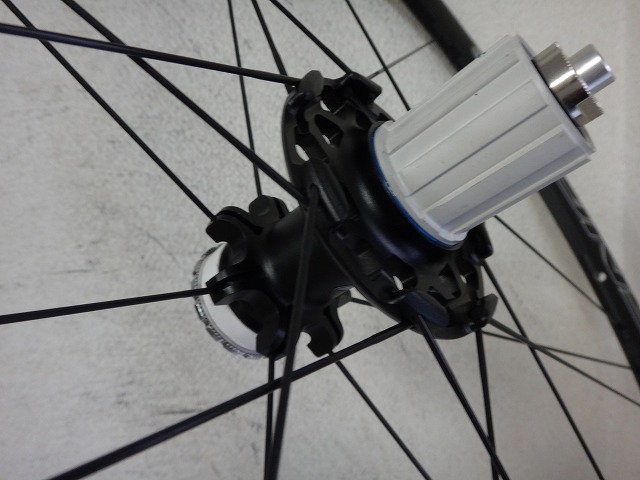
At first glance it looks like a standard G3-pattern rear wheel,
but there's something remarkable going on.
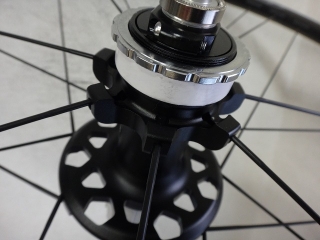
No matter how much you use unequal spoke counts,
building the rotor side in radial pattern is questionable.
You can tell the hub flanges were designed to provide stiffness at the spoke head contact point,
but the question remains.
Looking at how other 2:1 builders handle disc brake wheels:
・Rovål (→here) got spooked and switched religions, using equal spoke count on rear
・Fulcrum MTB (→here) didn't abandon the 2:1 pattern, so
the non-freewheel side ends up with significantly higher tension
I actually view Rovål's nervous change of heart positively, as you can see in the linked article.
In both these examples, the rotor side is tangentially laced,
but I was absolutely floored when I realized something about the Zonda Disc Brake's non-freewheel side radial lacing.
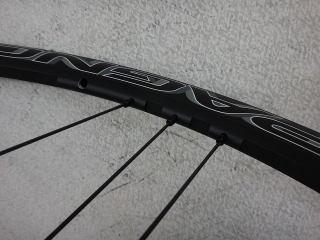
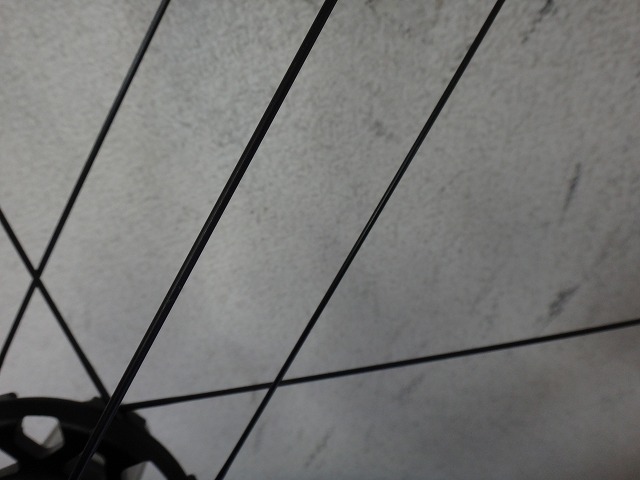
This Zonda has different butted section thicknesses on each side, but
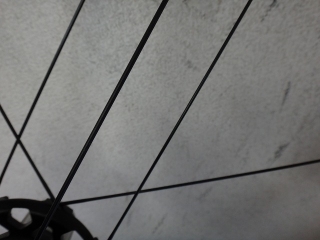
it's actually reverse asymmetric diameter lacing.
Aside from Colima's 12:8H rear wheel, this is the only example I know of. Amazing.
The butted section diameter on the non-freewheel side measured 1.8mm.
If the reason is "the G3 non-freewheel side tension is too high, so we intentionally thicken that side's spokes to reduce secondary spoke tension,"
then rim brake wheels should do the same,
but they don't (and the old C15 rim Zonda didn't use reverse asymmetric diameter either),
so using reverse asymmetric diameter on disc brake wheels suggests
this spec is disc brake-conscious.
I personally think the freewheel side 1.6mm (though I think it's actually 1.5mm) is too thin,
and since the rim doesn't seem particularly light anyway,
I figure it would be fine even if spokes got slightly heavier,
so I think freewheel side 1.8mm / non-freewheel side 2.0mm reverse asymmetric would have worked too.
But I figure Campagnolo knows better, so I support their judgment.
Speaking of thinking the rim is heavy enough that slightly heavier spokes are fine if it means better stiffness—
that reminds me: that R9100 rear wheel I mentioned claiming to be a C60 recently,
I donated it as a prize for the year-end raffle at the practice sessions I organize.
Since I planned that from the start, I needed to disassemble and rebuild it within the year
to verify the rim weight and publish it.
When I rebuilt it, it came out about 15 grams heavier,
but the spoke tension results were excellent.
The original spokes were square aero type with greater specific gravity than C24,
and when I tried tensioning the freewheel side to plain 14-gauge,
the rear wheel came out with a stiffness feel you wouldn't expect from a Shimano wheel.
I told the next owner, "If you ever see a C60 wheel, try gripping the spokes and comparing—they're totally different,"
but I haven't seen many C60 wheels around so that probably won't happen.
The other day when I had business at a colleague's shop,
there was a C60 wheel on display, and
they said "Man, that rim is heavy!" (Have they been reading the shop diary?)
and "There's no way this is gonna sell!"
Well, since we got stock of them, let's work hard to move them.
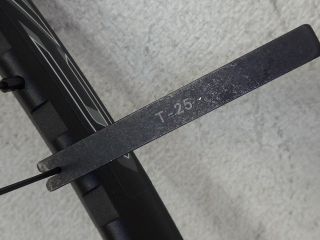
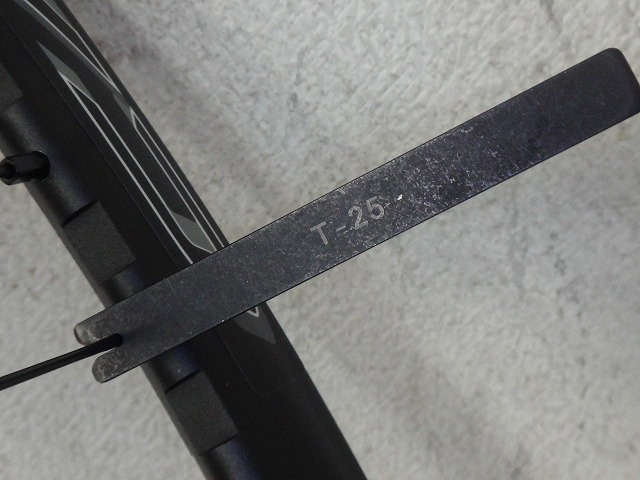
There's a spoke design various makers use where the round spoke is flattened on the rim side
to give a tool grip area.
This was supposedly a new product, so I bought it somewhat on impulse—
a new Campagnolo spoke nipple driver tool that fit perfectly.
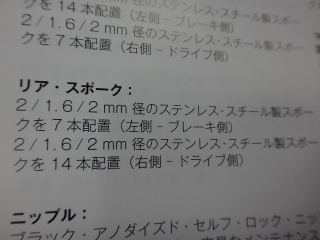
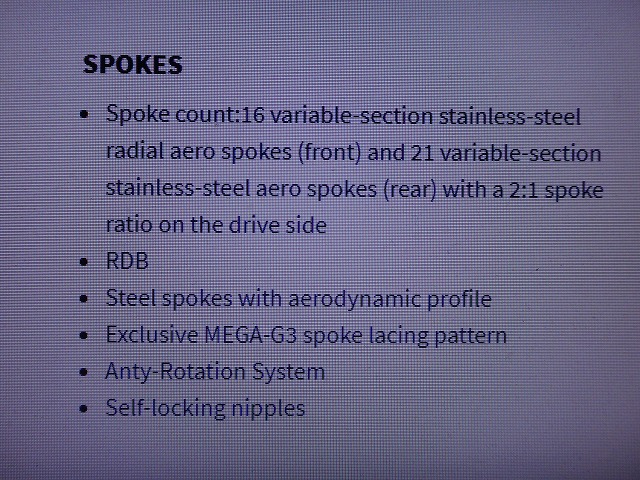
By the way, according to a catalog distributed by Japan's most knowledgeable Campagnolo distributor,
the Zonda Disc Brake rear spokes are listed as 2.0-1.6-2.0mm on both sides,
but this is incorrect.
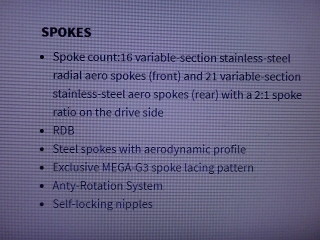
When I checked the official site, it says the Zonda Disc Brake has
aero spokes. And looking closer...
it says "front 16H" so this is clearly a copy-paste error from the standard Zonda description.

Campagnolo has developed disc brake-compatible specs not just for wheels
but for components as well.
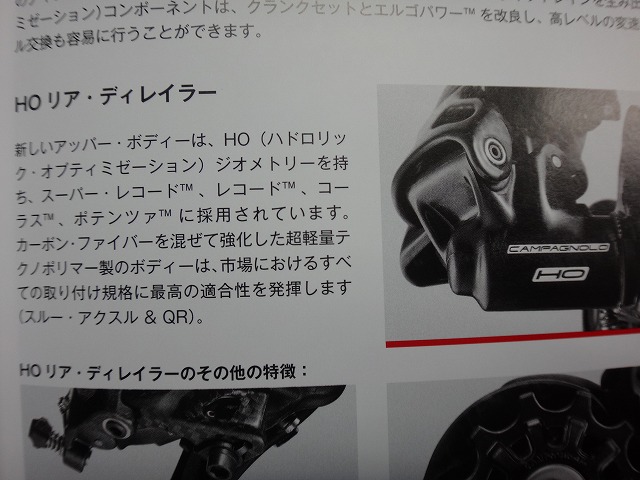
For example, the image above is a rear derailleur, and don't ask how that relates to disc brakes—
just accept it.
Disc brake-compatible models have "HO" marking,
which has nothing to do with HO-scale model railroads,
but is an acronym for
"Hydraulic Optimization."
Some might say "Hydraulic Optimisation" would be more appropriate,
but I'm following what's in the catalog as written.
Since this appears in multiple places, I don't think it's a typo.
If you want to verify this, we have catalogs available at the shop,
so please take one home. We have plenty and they're taking up space.
On the day I checked this one, I was also looking at Racing Zero, Shamal Mille,
and a brand new Bora One 35 WO, but
there wasn't really anything worth writing an article about, so I didn't take any photos.
Lately, most inspection jobs I receive don't make it into articles.
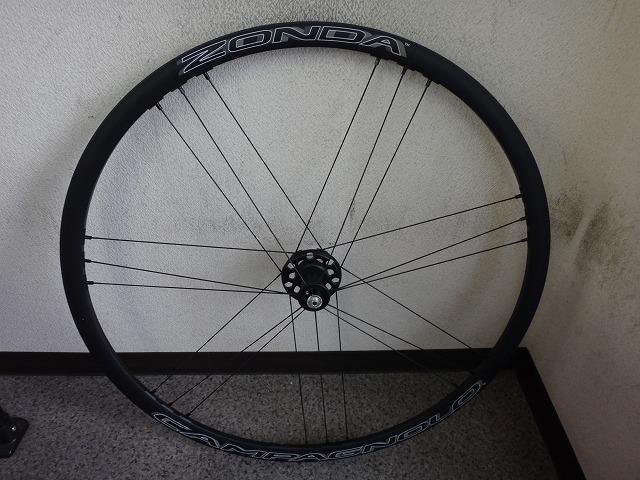
↑ Looks like the rear wheel at first glance, but it's the front

↑ Rear wheel
With Campagnolo's 2018 model lineup,
there are only two wheel types compatible with disc brakes:
Zonda and Bora One 35.
Since the Bora One 35 comes in both WO and tubular versions, strictly speaking there might be three types.
As for the inspection, both front and rear wheels were perfectly centered with essentially no runout.
In other words, there wasn't really anything about this wheel worth writing an article about either.

While stickers do vary somewhat,
please don't apply them right at the outer edge—it makes truing harder.

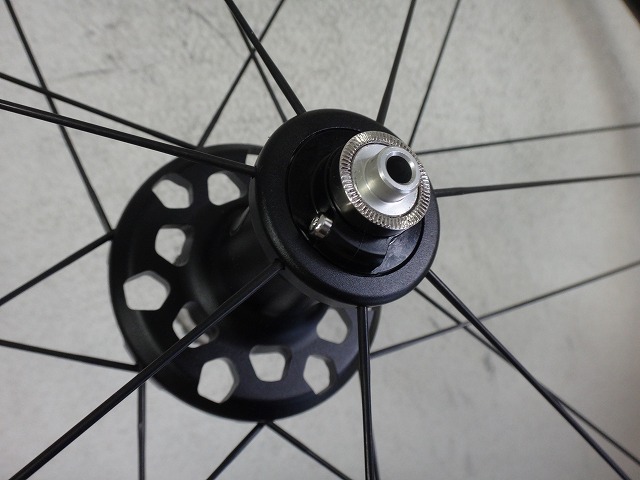
The front wheel is built in G3 pattern aligned with the rotor hub flange.
The spokes are equal diameter on both sides, but given the modest hub flange for the rotor mount,
the need for such high-low flanges (and with unequal spoke counts left and right)
must be what led Campagnolo to this decision.
This makes me wonder if the front wheels I normally build with 64-spoke reverse Italian lacing
should be semi-competition pattern rather than full CX-RAY.
(In practice I build both, though full CX-RAY is more common)
The spokes are double-butted with 2.0mm at both ends,
and based on my measurement with calipers, I thought the butted section was 1.5mm,
but according to the catalog it's 1.6mm.
That 0.1mm difference is huge,
and especially on high-tension factory-built wheels,
it becomes a critical line between whether or not you get lateral deflection.
When I went to inspect the rear wheel, the right end cap was missing.
In the factory packaging, plastic protective plugs are inserted into the holes at both ends,
and it apparently came out along with those when they were removed.
I installed the right end cap.
At first glance it looks like a standard G3-pattern rear wheel,
but there's something remarkable going on.

No matter how much you use unequal spoke counts,
building the rotor side in radial pattern is questionable.
You can tell the hub flanges were designed to provide stiffness at the spoke head contact point,
but the question remains.
Looking at how other 2:1 builders handle disc brake wheels:
・Rovål (→here) got spooked and switched religions, using equal spoke count on rear
・Fulcrum MTB (→here) didn't abandon the 2:1 pattern, so
the non-freewheel side ends up with significantly higher tension
I actually view Rovål's nervous change of heart positively, as you can see in the linked article.
In both these examples, the rotor side is tangentially laced,
but I was absolutely floored when I realized something about the Zonda Disc Brake's non-freewheel side radial lacing.

This Zonda has different butted section thicknesses on each side, but
it's actually reverse asymmetric diameter lacing.
Aside from Colima's 12:8H rear wheel, this is the only example I know of. Amazing.
The butted section diameter on the non-freewheel side measured 1.8mm.
If the reason is "the G3 non-freewheel side tension is too high, so we intentionally thicken that side's spokes to reduce secondary spoke tension,"
then rim brake wheels should do the same,
but they don't (and the old C15 rim Zonda didn't use reverse asymmetric diameter either),
so using reverse asymmetric diameter on disc brake wheels suggests
this spec is disc brake-conscious.
I personally think the freewheel side 1.6mm (though I think it's actually 1.5mm) is too thin,
and since the rim doesn't seem particularly light anyway,
I figure it would be fine even if spokes got slightly heavier,
so I think freewheel side 1.8mm / non-freewheel side 2.0mm reverse asymmetric would have worked too.
But I figure Campagnolo knows better, so I support their judgment.
Speaking of thinking the rim is heavy enough that slightly heavier spokes are fine if it means better stiffness—
that reminds me: that R9100 rear wheel I mentioned claiming to be a C60 recently,
I donated it as a prize for the year-end raffle at the practice sessions I organize.
Since I planned that from the start, I needed to disassemble and rebuild it within the year
to verify the rim weight and publish it.
When I rebuilt it, it came out about 15 grams heavier,
but the spoke tension results were excellent.
The original spokes were square aero type with greater specific gravity than C24,
and when I tried tensioning the freewheel side to plain 14-gauge,
the rear wheel came out with a stiffness feel you wouldn't expect from a Shimano wheel.
I told the next owner, "If you ever see a C60 wheel, try gripping the spokes and comparing—they're totally different,"
but I haven't seen many C60 wheels around so that probably won't happen.
The other day when I had business at a colleague's shop,
there was a C60 wheel on display, and
they said "Man, that rim is heavy!" (Have they been reading the shop diary?)
and "There's no way this is gonna sell!"
Well, since we got stock of them, let's work hard to move them.
There's a spoke design various makers use where the round spoke is flattened on the rim side
to give a tool grip area.
This was supposedly a new product, so I bought it somewhat on impulse—
a new Campagnolo spoke nipple driver tool that fit perfectly.

By the way, according to a catalog distributed by Japan's most knowledgeable Campagnolo distributor,
the Zonda Disc Brake rear spokes are listed as 2.0-1.6-2.0mm on both sides,
but this is incorrect.
When I checked the official site, it says the Zonda Disc Brake has
aero spokes. And looking closer...
it says "front 16H" so this is clearly a copy-paste error from the standard Zonda description.
Campagnolo has developed disc brake-compatible specs not just for wheels
but for components as well.
For example, the image above is a rear derailleur, and don't ask how that relates to disc brakes—
just accept it.
Disc brake-compatible models have "HO" marking,
which has nothing to do with HO-scale model railroads,
but is an acronym for
"Hydraulic Optimization."
Some might say "Hydraulic Optimisation" would be more appropriate,
but I'm following what's in the catalog as written.
Since this appears in multiple places, I don't think it's a typo.
If you want to verify this, we have catalogs available at the shop,
so please take one home. We have plenty and they're taking up space.