Following up from the front wheel.

I built up the rear wheel with a rim from a brand with a ridiculous name.

Evolite hub, 24-hole, semi-comp four-cross laced with solder joint.
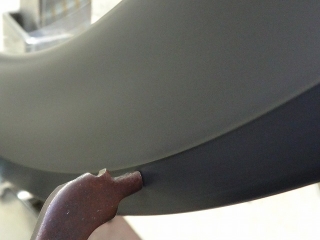
↑The wheel in this image is rotating, and
I've taken care to achieve not just lateral trueness but also radial trueness as cleanly as possible
(or rather, isn't that what wheel building actually is...).
This brand's rims sometimes have an arc-shaped painted line on the rim sidewall, but
the height from the rim's outer circumference doesn't match at all, so
when it rotates it creates a fluttering up-and-down appearance.
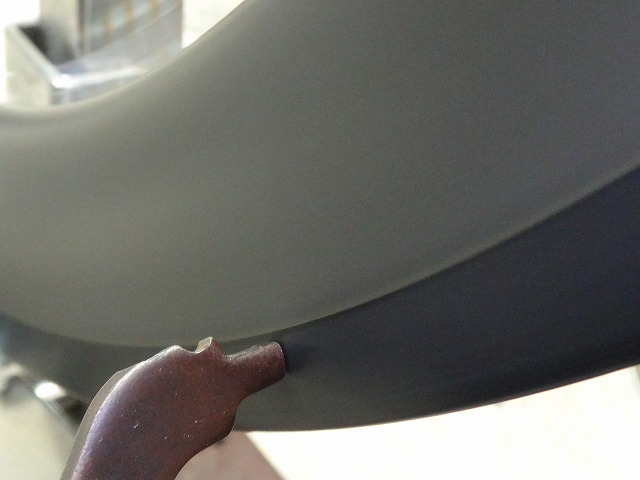
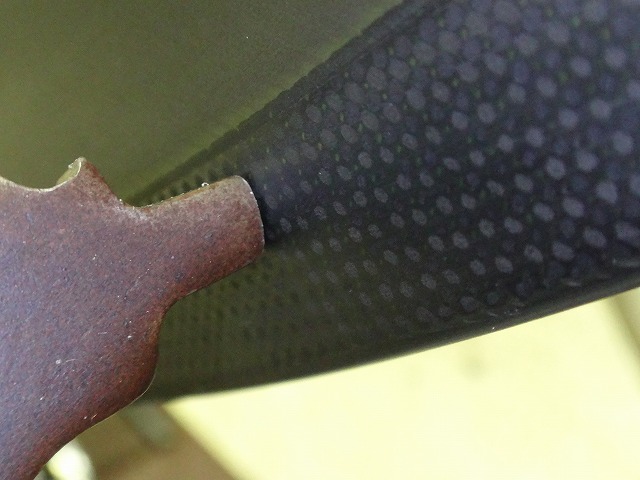
This rim doesn't have logos, paint, or stickers, but
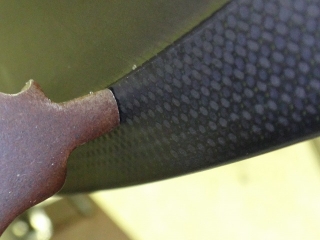
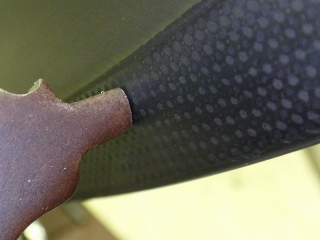
the vertical width of the brake zone varies depending on the phase,
(in the image above, the gauge position is the same, just to be clear)
so when it rotates, it visibly flutters.
Even at the point where the vertical width is narrowest,
there's still sufficient width for the brake shoes, but
with other rims from the same source,
in the case of clinchers there are instructions stating to position the shoes at least 1mm away from the top edge, so
if you do that, it might actually be pretty tight.
The customer left me a tire and tubeless valve, and asked me to check for air loss
using tubeless (→here) without sealant.
When I tested it on the front wheel, it didn't last even a few hours.
I'll be adding sealant.
This rim has a spoke tension upper limit of
180 kgf (kgf will be abbreviated from here on).
With rims having limits like 180 or 200, if you thoughtlessly twist the nipples without limit,
the first thing to break is actually not the rim but something else, so in that sense it's basically unlimited.
That doesn't mean the other materials (hub, spokes, nipples)
can withstand the same tension.
For a rim like the Stans Iron Cross with a limit of 95, I might actually try to tension it near the limit,
but with 180, there aren't even spokes and nipples that can handle that kind of tension in the first place.
At least not with generic materials.
Hozan's tension meter conversion table has an upper limit of 150.
In DT's conversion table the upper limit differs by spoke model, but
for heavier spokes like Champion, Aero Comp, or Alpine III the limit is 240,
and for others it's 180.
In the case of Revolution (2.0-1.5-2.0mm)
it starts to deform around 110, so
I don't think you can tension it up to 180 at all...
If you wanted to measure over 150 with Hozan's tension meter,
you'd measure the first value with DT's meter, find the second value using DT's table,
then take the first value for Hozan at that point to create a conversion table for Hozan.
D1st value = 2nd value = H1st value, so to speak.
According to the instruction sheet that came with the rim,
"As this is a lightweight rim, assembly at approximately 150 kgf high tension is recommended."
Why "lightweight rim" would make "assembly at high tension of approximately 150 kgf" recommended is beyond me
(I'd understand if they said "it's a heavy rim so you can tension it high!" or
"it's a stiff rim for its weight so you can tension it high!"), but
the actual weight measured by the customer is written on the rim bag:
front rim is 454g and rear rim is 455g, so
this isn't particularly a lightweight rim.
That aside, what bothered me was the phrasing "tension it to about 150."
When you tighten a nipple, the spoke becomes tensioned and resists deformation,
but the relationship between how much you tighten the nipple and how much the spoke resists deformation
initially appears to be a proportional line going up and to the right, but
at some point it becomes nearly flat—
"even though you've turned the nipple, the spoke's resistance to deformation hasn't increased much."
The "beaker theory" I might write about here sometime relates to this as well,
and to put it simply:
"beyond a certain point, increasing tension changes the feel of the wheel almost not at all."
This "certain point" varies by spoke gauge,
but it's generally around 120-130, and tensioning beyond that
makes it hard to feel that it's become "stiffer," and
if they're not straight gauge spokes, you're only increasing the risk of spoke breakage,
so there's almost no point in doing it.
Also, most rims have limits around 120, and
rims that can handle even 150 are rare, let alone 180.
So "tension to about 150" is language that would only come from
someone who thinks spoke tension is always proportionally related to wheel stiffness with no ceiling—
basically an idiot. And asking people to do that with generic nipples
without preparing custom nipples for the rim is completely unreasonable.
Or honestly, even if someone takes it seriously and tries to tension to 150,
I think many shops would find it technically difficult or impossible.
Spoke breakage probably won't happen while you're building the wheel, but
the nipple could break.
Campagnolo's Bora rims come with
custom aluminum nipples with a 4mm wrench width (generic nipples are 3.2mm or 3.4mm)
for the tool engagement.
From my rough sense, Bora rims can be tensioned to 150 without immediately breaking,
but Bora's specified tension is 90-115 on the front and
100-125 on the rear freewheel side.
Previously, I had an off-the-shelf wheel from this brand that was experiencing both shoe rub and frame rub,
and through my rebuild I completely eliminated both issues (I've verified this afterwards)
(→here),
but I've never heard of Boras causing shoe rub constantly.
If your theory is sound, you don't need to crank spoke tension to the max.
Considering the risk of component failure beyond the rim, you shouldn't tension to 150 second value.
That flaky frame-rubbing disaster wheel from before—
even in its original state I don't think it was tensioned all the way to 150.
And frankly, even if tensioned to 150 from its off-the-shelf state, it wouldn't solve the frame rub.
So this time, rather than following the 150 instruction, I built both wheels at around 120 or a bit higher.
Even so, I'm confident this wheel has better feel and higher lateral stiffness
than one of this brand's off-the-shelf wheels tensioned to 150,
and the risk of spoke breakage is kept low.
If this brand's off-the-shelf wheel spec
were a semi-comp four-cross build at 150,
it would (technically) be a stiffer wheel than a 120 semi-comp four-cross build,
but at this point I can't think of a left-right mixed-diameter mixed-spoke count build,
and since there's a designer out there who does radial lacing on rear wheels with equal spoke counts on both sides,
if I suddenly started using left-right mixed builds
I'd be accused of plagiarizing my own theory, so
anyone with any pride wouldn't switch approaches.
Besides, by soldering the lacing joint—something this brand dismissed as pointless—
I've made the wheel stiffer within the constraint of roughly 120 on the freewheel side.
Regarding Sapim spokes,
the manufacturer's website lists the strength on the middle section,
and according to that, Race (equivalent to DT's Comp) is 130,
and CX-RAY is 160.
The spoke doesn't snap the moment you reach this value,
but this also suggests that tensioning to 150 carries significant risk.
The spoke tension values in this article—
actually, Hozan, DT, and Sapim use N (Newtons),
while Campagnolo and Stans use kgf.
Since 1 kgf = 9.80665 N, I figured approximating at exactly 10 times
(100 kgf ≈ 1000 N) would be fine,
so I standardized the values in the article to kgf.
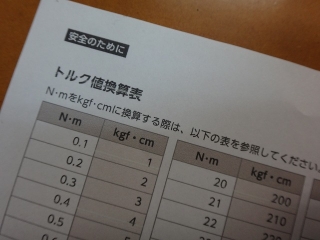
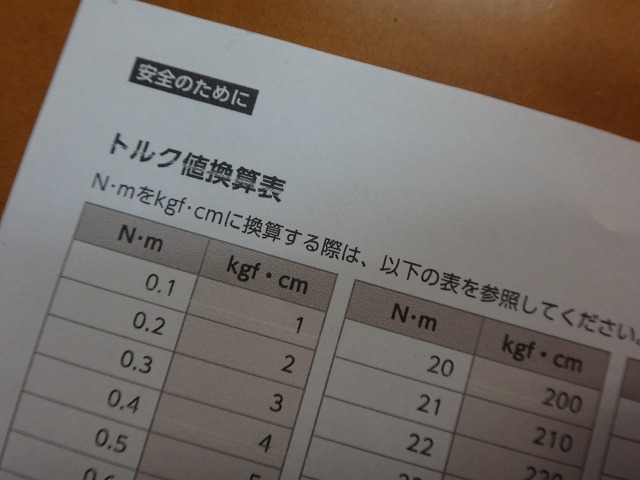
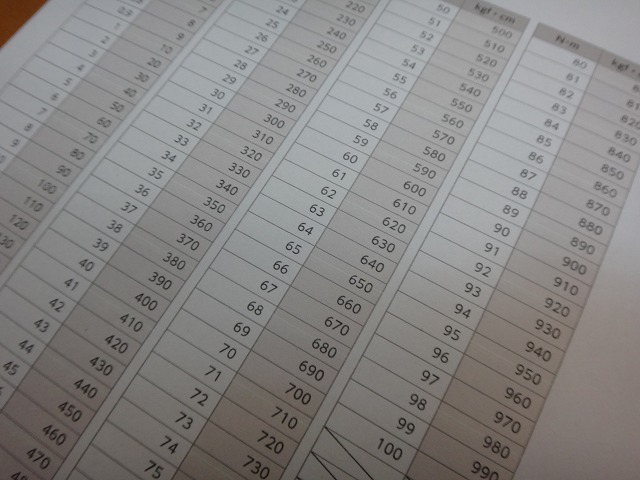
This is the torque value conversion table in Shimano's manual, but

it's consistently 10 times—that is, when converting to N·m,
they're just adding a zero.
For 100 kgf it should be 980 N, not whatever they have there, which makes you wonder,
and I guess you could call it sloppy, but in practice there's no problem with it.
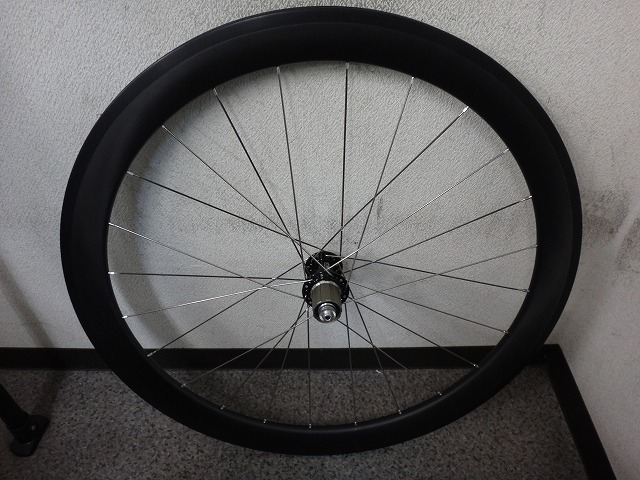
I built up the rear wheel with a rim from a brand with a ridiculous name.
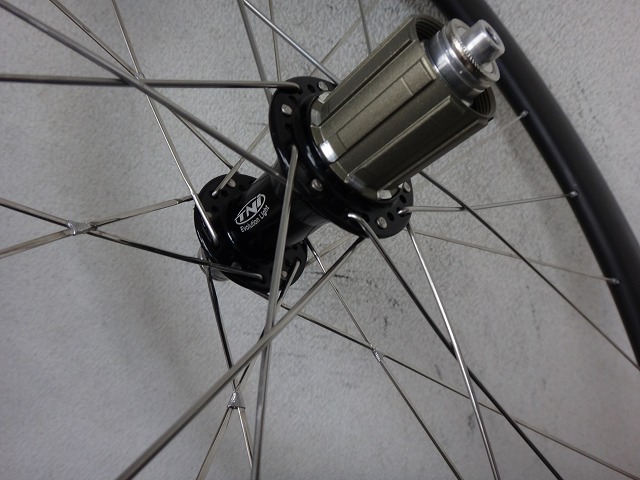
Evolite hub, 24-hole, semi-comp four-cross laced with solder joint.
↑The wheel in this image is rotating, and
I've taken care to achieve not just lateral trueness but also radial trueness as cleanly as possible
This brand's rims sometimes have an arc-shaped painted line on the rim sidewall, but
the height from the rim's outer circumference doesn't match at all, so
when it rotates it creates a fluttering up-and-down appearance.
This rim doesn't have logos, paint, or stickers, but
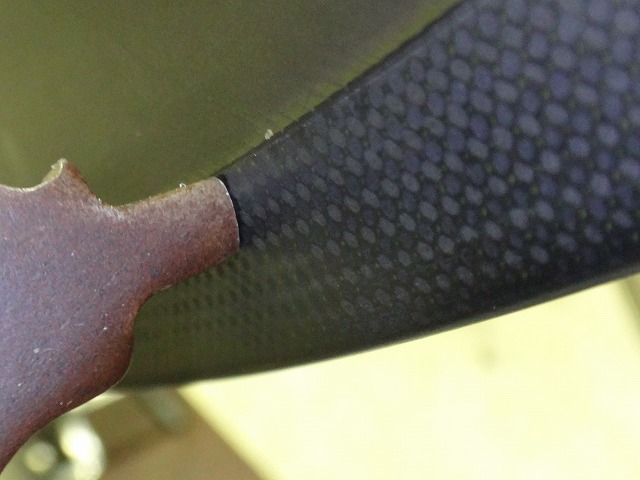
the vertical width of the brake zone varies depending on the phase,
(in the image above, the gauge position is the same, just to be clear)
so when it rotates, it visibly flutters.
Even at the point where the vertical width is narrowest,
there's still sufficient width for the brake shoes, but
with other rims from the same source,
in the case of clinchers there are instructions stating to position the shoes at least 1mm away from the top edge, so
if you do that, it might actually be pretty tight.
The customer left me a tire and tubeless valve, and asked me to check for air loss
using tubeless (→here) without sealant.
When I tested it on the front wheel, it didn't last even a few hours.
I'll be adding sealant.
This rim has a spoke tension upper limit of
180 kgf (kgf will be abbreviated from here on).
With rims having limits like 180 or 200, if you thoughtlessly twist the nipples without limit,
the first thing to break is actually not the rim but something else, so in that sense it's basically unlimited.
That doesn't mean the other materials (hub, spokes, nipples)
can withstand the same tension.
For a rim like the Stans Iron Cross with a limit of 95, I might actually try to tension it near the limit,
but with 180, there aren't even spokes and nipples that can handle that kind of tension in the first place.
At least not with generic materials.
Hozan's tension meter conversion table has an upper limit of 150.
In DT's conversion table the upper limit differs by spoke model, but
for heavier spokes like Champion, Aero Comp, or Alpine III the limit is 240,
and for others it's 180.
In the case of Revolution (2.0-1.5-2.0mm)
it starts to deform around 110, so
I don't think you can tension it up to 180 at all...
If you wanted to measure over 150 with Hozan's tension meter,
you'd measure the first value with DT's meter, find the second value using DT's table,
then take the first value for Hozan at that point to create a conversion table for Hozan.
D1st value = 2nd value = H1st value, so to speak.
According to the instruction sheet that came with the rim,
"As this is a lightweight rim, assembly at approximately 150 kgf high tension is recommended."
Why "lightweight rim" would make "assembly at high tension of approximately 150 kgf" recommended is beyond me
(I'd understand if they said "it's a heavy rim so you can tension it high!" or
"it's a stiff rim for its weight so you can tension it high!"), but
the actual weight measured by the customer is written on the rim bag:
front rim is 454g and rear rim is 455g, so
this isn't particularly a lightweight rim.
That aside, what bothered me was the phrasing "tension it to about 150."
When you tighten a nipple, the spoke becomes tensioned and resists deformation,
but the relationship between how much you tighten the nipple and how much the spoke resists deformation
initially appears to be a proportional line going up and to the right, but
at some point it becomes nearly flat—
"even though you've turned the nipple, the spoke's resistance to deformation hasn't increased much."
The "beaker theory" I might write about here sometime relates to this as well,
and to put it simply:
"beyond a certain point, increasing tension changes the feel of the wheel almost not at all."
This "certain point" varies by spoke gauge,
but it's generally around 120-130, and tensioning beyond that
makes it hard to feel that it's become "stiffer," and
if they're not straight gauge spokes, you're only increasing the risk of spoke breakage,
so there's almost no point in doing it.
Also, most rims have limits around 120, and
rims that can handle even 150 are rare, let alone 180.
So "tension to about 150" is language that would only come from
someone who thinks spoke tension is always proportionally related to wheel stiffness with no ceiling—
basically an idiot. And asking people to do that with generic nipples
without preparing custom nipples for the rim is completely unreasonable.
Or honestly, even if someone takes it seriously and tries to tension to 150,
I think many shops would find it technically difficult or impossible.
Spoke breakage probably won't happen while you're building the wheel, but
the nipple could break.
Campagnolo's Bora rims come with
custom aluminum nipples with a 4mm wrench width (generic nipples are 3.2mm or 3.4mm)
for the tool engagement.
From my rough sense, Bora rims can be tensioned to 150 without immediately breaking,
but Bora's specified tension is 90-115 on the front and
100-125 on the rear freewheel side.
Previously, I had an off-the-shelf wheel from this brand that was experiencing both shoe rub and frame rub,
and through my rebuild I completely eliminated both issues (I've verified this afterwards)
(→here),
but I've never heard of Boras causing shoe rub constantly.
If your theory is sound, you don't need to crank spoke tension to the max.
Considering the risk of component failure beyond the rim, you shouldn't tension to 150 second value.
That flaky frame-rubbing disaster wheel from before—
even in its original state I don't think it was tensioned all the way to 150.
And frankly, even if tensioned to 150 from its off-the-shelf state, it wouldn't solve the frame rub.
So this time, rather than following the 150 instruction, I built both wheels at around 120 or a bit higher.
Even so, I'm confident this wheel has better feel and higher lateral stiffness
than one of this brand's off-the-shelf wheels tensioned to 150,
and the risk of spoke breakage is kept low.
If this brand's off-the-shelf wheel spec
were a semi-comp four-cross build at 150,
it would (technically) be a stiffer wheel than a 120 semi-comp four-cross build,
but at this point I can't think of a left-right mixed-diameter mixed-spoke count build,
and since there's a designer out there who does radial lacing on rear wheels with equal spoke counts on both sides,
if I suddenly started using left-right mixed builds
I'd be accused of plagiarizing my own theory, so
anyone with any pride wouldn't switch approaches.
Besides, by soldering the lacing joint—something this brand dismissed as pointless—
I've made the wheel stiffer within the constraint of roughly 120 on the freewheel side.
Regarding Sapim spokes,
the manufacturer's website lists the strength on the middle section,
and according to that, Race (equivalent to DT's Comp) is 130,
and CX-RAY is 160.
The spoke doesn't snap the moment you reach this value,
but this also suggests that tensioning to 150 carries significant risk.
The spoke tension values in this article—
actually, Hozan, DT, and Sapim use N (Newtons),
while Campagnolo and Stans use kgf.
Since 1 kgf = 9.80665 N, I figured approximating at exactly 10 times
(100 kgf ≈ 1000 N) would be fine,
so I standardized the values in the article to kgf.
This is the torque value conversion table in Shimano's manual, but
it's consistently 10 times—that is, when converting to N·m,
they're just adding a zero.
For 100 kgf it should be 980 N, not whatever they have there, which makes you wonder,
and I guess you could call it sloppy, but in practice there's no problem with it.