This is a continuation of a previous post (→here).

There's some overlap with earlier content, but I'm going to dive deeper specifically into the front wheel regarding how the WH-R9200 series C36 disc hub/tubular rim spec seems impossibly light no matter how I think about it.
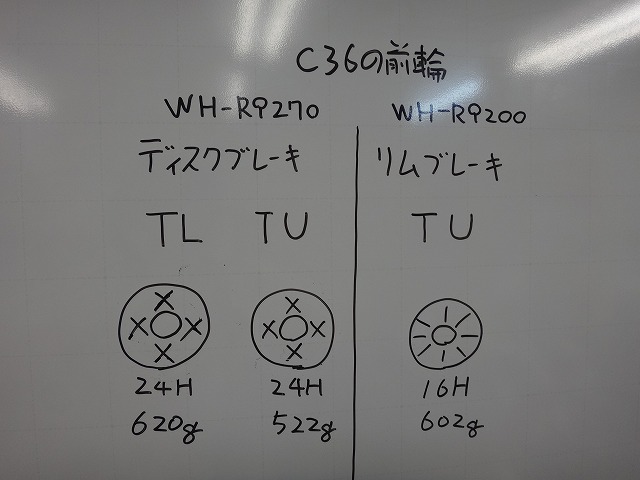
Since the character count gets long, I'll use TL for tubeless and TU for tubular going forward.
The rim brake model doesn't have a TL option.
For all other claimed weights, see the diagram.
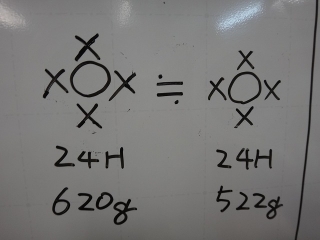
For the disc brake model, the hub and spokes in "sea urchin formation" (without the rim) are considered to weigh roughly the same.
The nipples are identical and the same in number, so for these two wheels there's no need to consider weight differences.
Just recently, a spare parts list was updated and I was able to check the R9200 series wheels, so I looked up spoke lengths.
Numbers in parentheses are estimated individual spoke weights based on spoke specific gravity.
WH-R9270-C36-TL
Left spoke 280.5mm (4.68g)
Right spoke 282mm (4.71g)
WH-R9270-C36-TU
Left spoke 282mm (4.71g)
Right spoke 285mm (4.75g)
So the TL total spoke weight comes to 112.68g, while TU totals 113.52g.
At roughly 1g difference, they're basically the same.
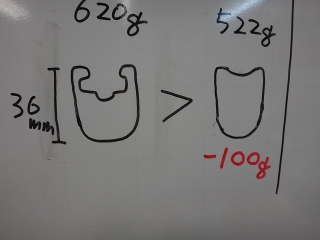
Which means there's roughly a 100g difference in rim weight between the TL and TU versions, both with 36mm rim height.
I'll mark this in red text.
In the diagram the tubular rim appears thinner, but the actual rim width is the same at 28mm external width.
For reference, ENVE's SES3.4 front rim, with dimensions close to Shimano's C36, comes in three specs. All have 38mm rim height and 27.5mm external rim width:
TU (rim brake/with brake zone) at 392g,
TL (rim brake/with brake zone) at 458g,
TL (disc brake/no brake zone) at 387g.
Shimano doesn't offer rim brake TL, and ENVE doesn't offer disc brake TU—that's the difference. But for ENVE, with the same TL rim, the difference between having and not having a brake zone is 71g lighter on the disc brake side, and with the same brake zone but different tire specs, the TU rim is 66g lighter.
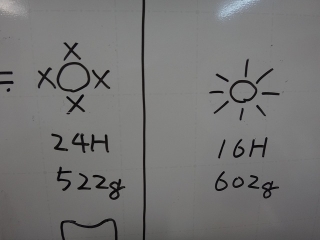
If I tried to express Shimano's C36 the same way, I might be fooled into thinking that with the same TU rim, the disc brake version is 80g lighter... but here's the catch: the ENVE weight differences were for the rim alone, whereas these are for the complete front wheel.
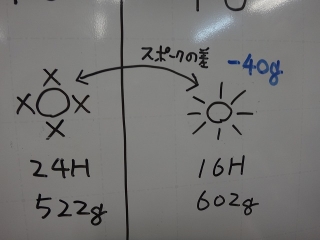
The C36 rim brake TU front wheel has 275mm spokes, with an estimated weight of 4.59g each, and since it's 16H, that's 73.44g total.
As I mentioned, the disc brake TU front wheel has 24H spokes at 113.52g, so the spoke weight difference is about 40g.
I'll mark this in blue text.
So the rim brake TU front wheel has a 40g advantage in spoke weight, yet the complete wheel is 80g heavier. By simple math, that means the TU rim weight difference is 120g.
There's an 8-nipple difference, but that's only about 3g, not a big deal.
The front hubs use 5/32" ball bearings in cup-and-cone design on both, so the disc hub being lighter is pretty much impossible—in fact, the disc hub should be slightly heavier.
If we add that in, the rim weight difference is over 120g.
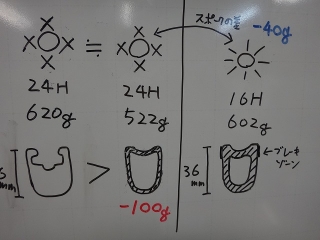
Even if the TU rim brake rim, with its brake zone, was designed with braking in mind compared to the disc brake rim, it's hard to imagine it would be thick enough to account for a 120g weight difference.
For the top diagram, if we're comparing just disc brakes, the blue text is irrelevant. If we're comparing just TU rims, the red text is irrelevant.
If the weights of the two TU wheels, 522g and 602g, were reversed, things would make more sense...
Speaking of something else—the R9200 crankset is considerably heavier than R9100.
Actually, R9100 is also slightly heavier than R9000, but to start:
R9000 is:
55-42T (639g)
54-42T (632g)
53-39T (618g)
52-38T (622g)
52-36T (618g)
50-34T (610g)
Then R9100 is:
55-42T (650g)
54-42T (642g)
53-39T (626g)
52-36T (624g)
50-34T (614g)
R9100 doesn't come in 52-38T.
Also, everything up to this point is for 170mm crank length with BB sold separately.
I assume the same applies to R9200, but below:
54-40T (714g)
52-36T (692g)
50-34T (685g)
The tooth options are narrower, and 54-40T has been added.
Just to be clear, all these weights are without a power meter.
The manufacturer's website describes the FC-R9200 as "optimizing rigidity, strength, weight, and rotational performance"—the kind of phrase used when something isn't necessarily lighter. That made me curious, so I looked it up.
I think you could make a hollow-type glued crankarm lighter with the same rigidity, but they've stopped doing that, probably because of explosion incidents.
If amateur riders in Japan see it happen fairly frequently, I can only imagine what happened to top pros—not that it ever comes out publicly.
As an example of a Dura-Ace crankset with a troubled past: the FC-7410. Even amateurs could notice the flex, and some top pros kept using the previous version. With the FC-R9200, the manufacturing method got closer to the FC-7900, but the 7900 didn't have a reputation for being soft.
When you make a hollow crankarm match the weight of a glued crankarm, rigidity tests or top pro feedback say it feels noodly. So when they made the rigidity the same instead, the weight went up. That's probably what happened here.
Incidentally, the FC-R9200 54-40T is about the same weight as the 105 FC-R7000 50-34T (713.4g).
The CS-R9200 12-speed sprocket apparently comes in only two tooth configs: 11-30T and 11-34T.
The sprocket box has a series of single-digit numbers; for example, 12-speed 11-30T shows 123456791470, which means:
11-12-13-14-15-16-17-19-21-24-27-30T
There's a 11-28T not yet listed on the manufacturer's website or in the spare parts list, but I saw it at a distributor showing 2023 or later as the expected availability.
And this is still 2021. The digit string is 123456789148.
The RD-R9250 basically looks like an MTB rear derailleur with just the chain stabilizer lever removed, but since it doesn't say you can't combine a 54-40T crank with an 11-34T sprocket, you can use 54×34T.
I briefly thought "if the chain length is set for that, won't it sag when you're on 40×11?" But Shimano 12-speed is currently electric-only, so you physically can't chain 40×11 (inner×top), and even if that "potential sag" existed, nobody would know. For now, no problem.
If 105 12-speed mechanical ever comes out, I don't know what'll happen.
For single-tension rear derailleurs and chain tension, see here.
One more thing I noticed: the RD-R9250's supported rear sprocket low gear minimum is 28T.
Wait? The lineup only has 11-30T and 11-34T... so why? (deadpan)
The manufacturer's site says the RD-R9250 has "the widest gear range in Dura-Ace history."
What gear range does that mean? Here are the relevant numbers:
・Total capacity 37T
・Max front chainring tooth difference 16T
・Rear sprocket min teeth 11T
・Rear sprocket max teeth 34T
・Low gear min teeth 28T
・Low gear max teeth 34T
The pulley teeth aren't large like Campagnolo's (which are 12T top and bottom); they're 11T top and bottom.
The M9100 XTR is 13T top and bottom, by comparison.
Making them larger is fine, but even-tooth numbers wear unevenly alternating ways, risking uneven wear, so it's better to avoid... but there we go.
Back when Dura-Ace offered a front triple, the 7700-series 9-speed and 7800-series 10-speed, plus contemporary Altegra and 105 triple-specific rear derailleurs, all used 11T pulleys (except one exception), extending the pulley cage distance to gain capacity.
Those rear derailleurs all had 37T total capacity (29T for a double).
So Dura-Ace's all-time best total capacity was 37T, and the RD-R9250 is the same... or so you'd think. But that earlier "one exception" actually beats it.
That's the RD-7700-GS, which gains capacity differently.
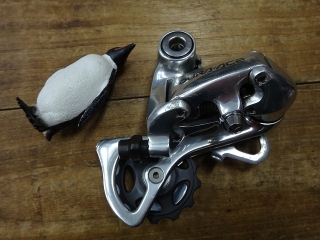

↑ This is the RD-7700-GS.

It uses an enormous 13T pulley—huge for its era—and gains capacity by keeping the pulley distance as short as possible.
Writing out the same specs for RD-7700-GS:
・Total capacity 38T ← All-time Dura-Ace record!
・Max front chainring tooth difference 23T
・Rear sprocket min teeth 11T
・Rear sprocket max teeth 27T
・Low gear min teeth no standard, but 21T minimum (with 11-21T and 12-21T)
・Low gear max teeth 27T
The FC-7703 only came in 53-39-30T, and on the CS-7700, only the 12-27T has that 27T max, so the chain is long enough for 53×27T without sagging at 30×12T with those pulleys and cage distance. Contrast that with the later RD-7800-GS, which used 11T top and bottom, resulting in a much longer pulley cage.
In my book, the RD-7700-GS and RD-6800-GS (→here and →here) are masterpieces—"custom-engineered with incredible effort and ideas, yet those specs never carried forward to later models."
There's some overlap with earlier content, but I'm going to dive deeper specifically into the front wheel regarding how the WH-R9200 series C36 disc hub/tubular rim spec seems impossibly light no matter how I think about it.
Since the character count gets long, I'll use TL for tubeless and TU for tubular going forward.
The rim brake model doesn't have a TL option.
For all other claimed weights, see the diagram.
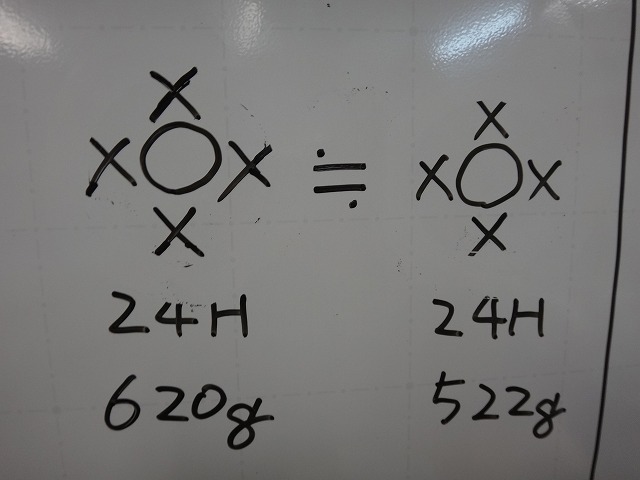
For the disc brake model, the hub and spokes in "sea urchin formation" (without the rim) are considered to weigh roughly the same.
The nipples are identical and the same in number, so for these two wheels there's no need to consider weight differences.
Just recently, a spare parts list was updated and I was able to check the R9200 series wheels, so I looked up spoke lengths.
Numbers in parentheses are estimated individual spoke weights based on spoke specific gravity.
WH-R9270-C36-TL
Left spoke 280.5mm (4.68g)
Right spoke 282mm (4.71g)
WH-R9270-C36-TU
Left spoke 282mm (4.71g)
Right spoke 285mm (4.75g)
So the TL total spoke weight comes to 112.68g, while TU totals 113.52g.
At roughly 1g difference, they're basically the same.
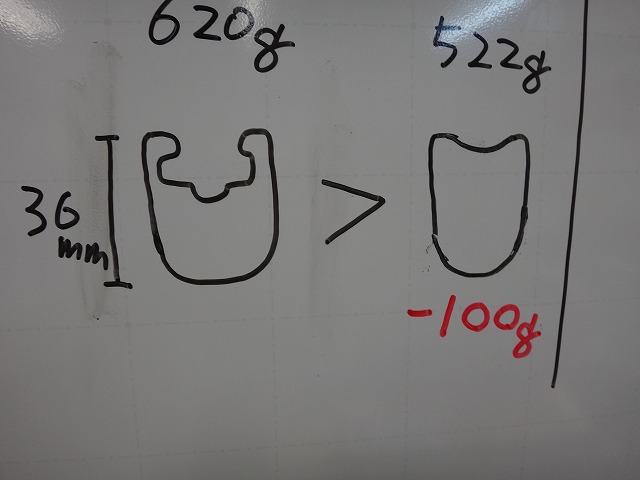
Which means there's roughly a 100g difference in rim weight between the TL and TU versions, both with 36mm rim height.
I'll mark this in red text.
In the diagram the tubular rim appears thinner, but the actual rim width is the same at 28mm external width.
For reference, ENVE's SES3.4 front rim, with dimensions close to Shimano's C36, comes in three specs. All have 38mm rim height and 27.5mm external rim width:
TU (rim brake/with brake zone) at 392g,
TL (rim brake/with brake zone) at 458g,
TL (disc brake/no brake zone) at 387g.
Shimano doesn't offer rim brake TL, and ENVE doesn't offer disc brake TU—that's the difference. But for ENVE, with the same TL rim, the difference between having and not having a brake zone is 71g lighter on the disc brake side, and with the same brake zone but different tire specs, the TU rim is 66g lighter.

If I tried to express Shimano's C36 the same way, I might be fooled into thinking that with the same TU rim, the disc brake version is 80g lighter... but here's the catch: the ENVE weight differences were for the rim alone, whereas these are for the complete front wheel.
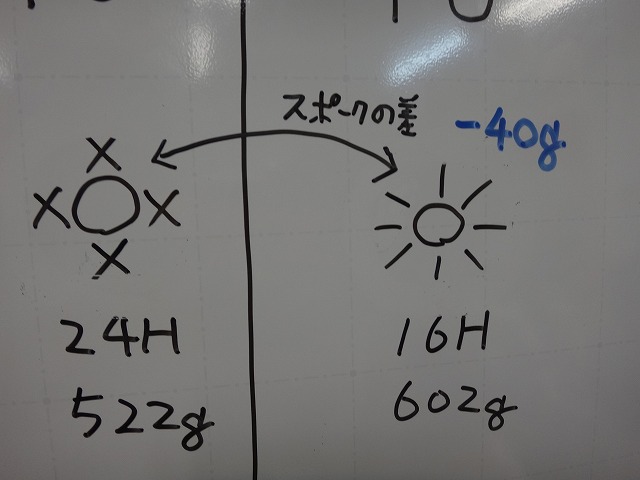
The C36 rim brake TU front wheel has 275mm spokes, with an estimated weight of 4.59g each, and since it's 16H, that's 73.44g total.
As I mentioned, the disc brake TU front wheel has 24H spokes at 113.52g, so the spoke weight difference is about 40g.
I'll mark this in blue text.
So the rim brake TU front wheel has a 40g advantage in spoke weight, yet the complete wheel is 80g heavier. By simple math, that means the TU rim weight difference is 120g.
There's an 8-nipple difference, but that's only about 3g, not a big deal.
The front hubs use 5/32" ball bearings in cup-and-cone design on both, so the disc hub being lighter is pretty much impossible—in fact, the disc hub should be slightly heavier.
If we add that in, the rim weight difference is over 120g.
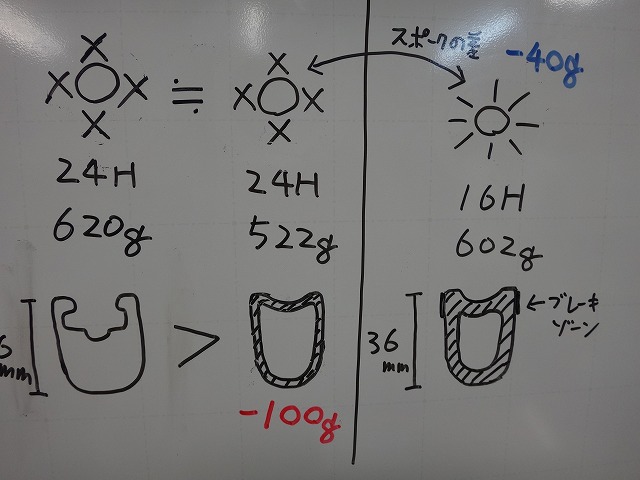
Even if the TU rim brake rim, with its brake zone, was designed with braking in mind compared to the disc brake rim, it's hard to imagine it would be thick enough to account for a 120g weight difference.
For the top diagram, if we're comparing just disc brakes, the blue text is irrelevant. If we're comparing just TU rims, the red text is irrelevant.
If the weights of the two TU wheels, 522g and 602g, were reversed, things would make more sense...
Speaking of something else—the R9200 crankset is considerably heavier than R9100.
Actually, R9100 is also slightly heavier than R9000, but to start:
R9000 is:
55-42T (639g)
54-42T (632g)
53-39T (618g)
52-38T (622g)
52-36T (618g)
50-34T (610g)
Then R9100 is:
55-42T (650g)
54-42T (642g)
53-39T (626g)
52-36T (624g)
50-34T (614g)
R9100 doesn't come in 52-38T.
Also, everything up to this point is for 170mm crank length with BB sold separately.
I assume the same applies to R9200, but below:
54-40T (714g)
52-36T (692g)
50-34T (685g)
The tooth options are narrower, and 54-40T has been added.
Just to be clear, all these weights are without a power meter.
The manufacturer's website describes the FC-R9200 as "optimizing rigidity, strength, weight, and rotational performance"—the kind of phrase used when something isn't necessarily lighter. That made me curious, so I looked it up.
I think you could make a hollow-type glued crankarm lighter with the same rigidity, but they've stopped doing that, probably because of explosion incidents.
If amateur riders in Japan see it happen fairly frequently, I can only imagine what happened to top pros—not that it ever comes out publicly.
As an example of a Dura-Ace crankset with a troubled past: the FC-7410. Even amateurs could notice the flex, and some top pros kept using the previous version. With the FC-R9200, the manufacturing method got closer to the FC-7900, but the 7900 didn't have a reputation for being soft.
When you make a hollow crankarm match the weight of a glued crankarm, rigidity tests or top pro feedback say it feels noodly. So when they made the rigidity the same instead, the weight went up. That's probably what happened here.
Incidentally, the FC-R9200 54-40T is about the same weight as the 105 FC-R7000 50-34T (713.4g).
The CS-R9200 12-speed sprocket apparently comes in only two tooth configs: 11-30T and 11-34T.
The sprocket box has a series of single-digit numbers; for example, 12-speed 11-30T shows 123456791470, which means:
11-12-13-14-15-16-17-19-21-24-27-30T
There's a 11-28T not yet listed on the manufacturer's website or in the spare parts list, but I saw it at a distributor showing 2023 or later as the expected availability.
And this is still 2021. The digit string is 123456789148.
The RD-R9250 basically looks like an MTB rear derailleur with just the chain stabilizer lever removed, but since it doesn't say you can't combine a 54-40T crank with an 11-34T sprocket, you can use 54×34T.
I briefly thought "if the chain length is set for that, won't it sag when you're on 40×11?" But Shimano 12-speed is currently electric-only, so you physically can't chain 40×11 (inner×top), and even if that "potential sag" existed, nobody would know. For now, no problem.
If 105 12-speed mechanical ever comes out, I don't know what'll happen.
For single-tension rear derailleurs and chain tension, see here.
One more thing I noticed: the RD-R9250's supported rear sprocket low gear minimum is 28T.
Wait? The lineup only has 11-30T and 11-34T... so why? (deadpan)
The manufacturer's site says the RD-R9250 has "the widest gear range in Dura-Ace history."
What gear range does that mean? Here are the relevant numbers:
・Total capacity 37T
・Max front chainring tooth difference 16T
・Rear sprocket min teeth 11T
・Rear sprocket max teeth 34T
・Low gear min teeth 28T
・Low gear max teeth 34T
The pulley teeth aren't large like Campagnolo's (which are 12T top and bottom); they're 11T top and bottom.
The M9100 XTR is 13T top and bottom, by comparison.
Making them larger is fine, but even-tooth numbers wear unevenly alternating ways, risking uneven wear, so it's better to avoid... but there we go.
Back when Dura-Ace offered a front triple, the 7700-series 9-speed and 7800-series 10-speed, plus contemporary Altegra and 105 triple-specific rear derailleurs, all used 11T pulleys (except one exception), extending the pulley cage distance to gain capacity.
Those rear derailleurs all had 37T total capacity (29T for a double).
So Dura-Ace's all-time best total capacity was 37T, and the RD-R9250 is the same... or so you'd think. But that earlier "one exception" actually beats it.
That's the RD-7700-GS, which gains capacity differently.
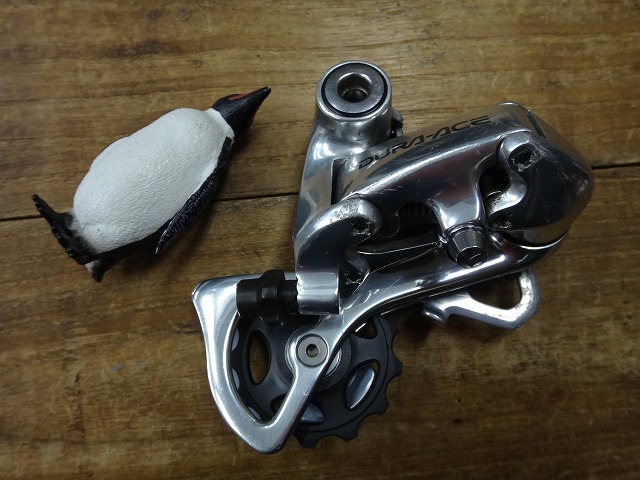
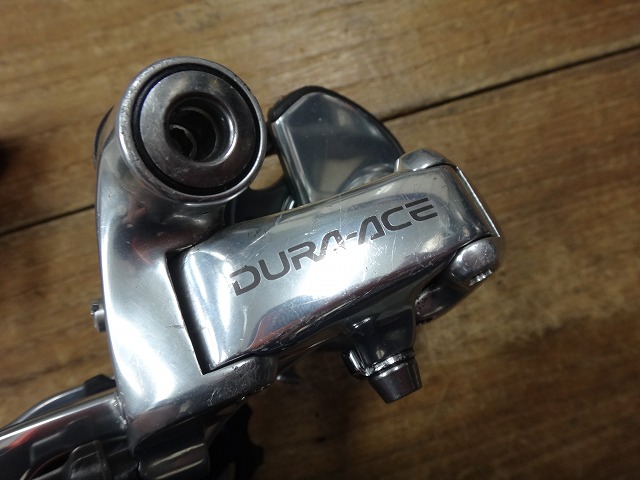
↑ This is the RD-7700-GS.
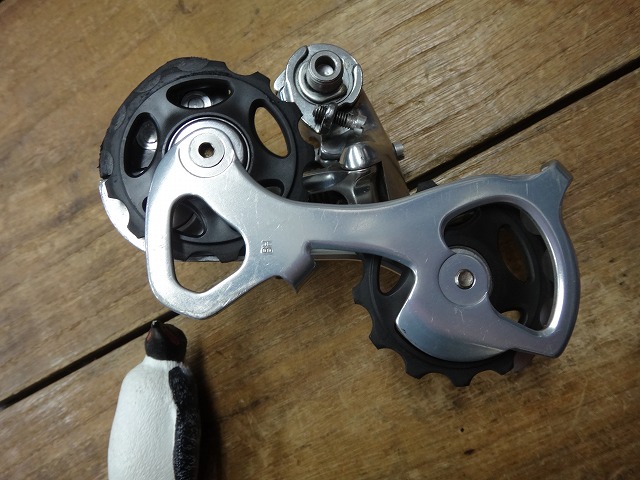
It uses an enormous 13T pulley—huge for its era—and gains capacity by keeping the pulley distance as short as possible.
Writing out the same specs for RD-7700-GS:
・Total capacity 38T ← All-time Dura-Ace record!
・Max front chainring tooth difference 23T
・Rear sprocket min teeth 11T
・Rear sprocket max teeth 27T
・Low gear min teeth no standard, but 21T minimum (with 11-21T and 12-21T)
・Low gear max teeth 27T
The FC-7703 only came in 53-39-30T, and on the CS-7700, only the 12-27T has that 27T max, so the chain is long enough for 53×27T without sagging at 30×12T with those pulleys and cage distance. Contrast that with the later RD-7800-GS, which used 11T top and bottom, resulting in a much longer pulley cage.
In my book, the RD-7700-GS and RD-6800-GS (→here and →here) are masterpieces—"custom-engineered with incredible effort and ideas, yet those specs never carried forward to later models."